



Community hub
Community hub
Recent from talks
Knowledge base stats:
Talk channels stats:
Members stats:
Chemical biology
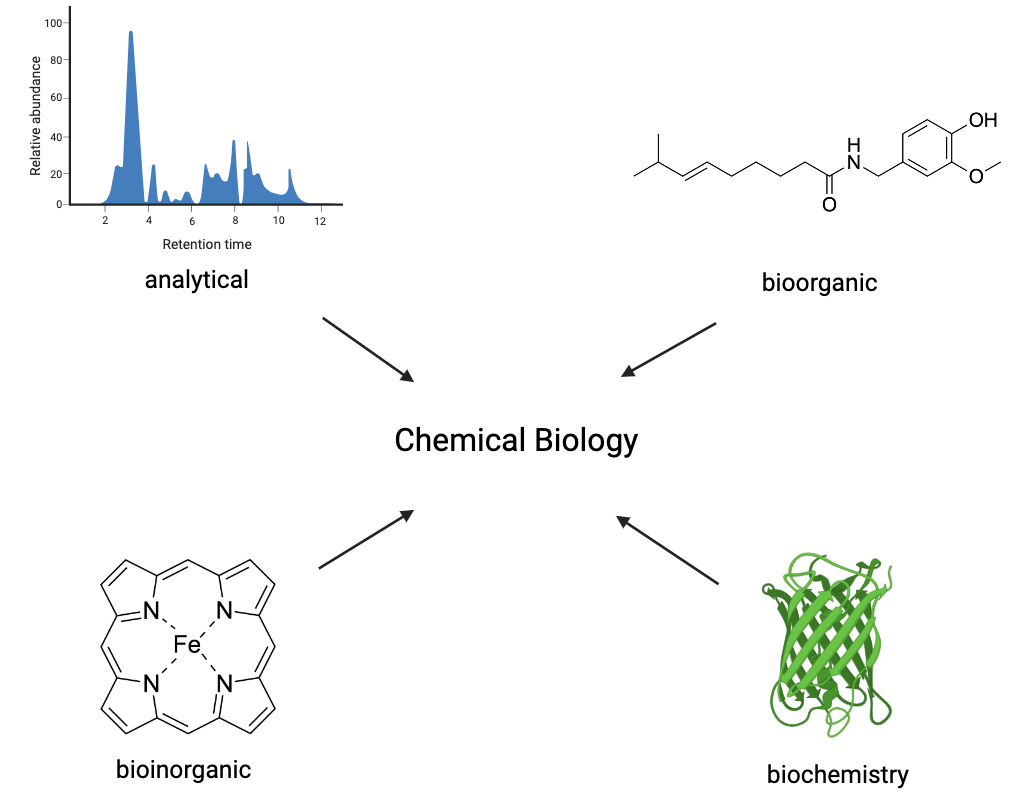
Chemical biology is a scientific discipline between the fields of chemistry and biology. The discipline involves the application of chemical techniques, analysis, and often small molecules produced through synthetic chemistry, to the study and manipulation of biological systems. Although often confused with biochemistry, which studies the chemistry of biomolecules and regulation of biochemical pathways within and between cells, chemical biology remains distinct by focusing on the application of chemical tools to address biological questions.
Although considered a relatively new scientific field, the term "chemical biology" has been in use since the early 20th century, and has roots in scientific discovery from the early 19th century. The term 'chemical biology' can be traced back to an early appearance in a book published by Alonzo E. Taylor in 1907 titled "On Fermentation", and was subsequently used in John B. Leathes' 1930 article titled "The Harveian Oration on The Birth of Chemical Biology". However, it is unclear when the term was first used.
Friedrich Wöhler's 1828 synthesis of urea is an early example of the application of synthetic chemistry to advance biology. It showed that biological compounds could be synthesized with inorganic starting materials and weakened the previous notion of vitalism, or that a 'living' source was required to produce organic compounds. Wöhler's work is often considered to be instrumental in the development of organic chemistry and natural product synthesis, both of which play a large part in modern chemical biology.
Friedrich Miescher's work during the late 19th century investigating the cellular contents of human leukocytes led to the discovery of 'nuclein', which would later be renamed DNA. After isolating the nuclein from the nucleus of leukocytes through protease digestion, Miescher used chemical techniques such as elemental analysis and solubility tests to determine the composition of nuclein. This work would lay the foundations for Watson and Crick's discovery of the double-helix structure of DNA.
The rising interest in chemical biology has led to several journals dedicated to the field. Nature Chemical Biology, created in 2005, and ACS Chemical Biology, created in 2006, are two of the most well-known journals in this field, with impact factors of 14.8 and 4.0 respectively.
Glycobiology is the study of the structure and function of carbohydrates. While DNA, RNA, and proteins are encoded at the genetic level, carbohydrates are not encoded directly from the genome, and thus require different tools for their study. By applying chemical principles to glycobiology, novel methods for analyzing and synthesizing carbohydrates can be developed. For example, cells can be supplied with synthetic variants of natural sugars to probe their function. Carolyn Bertozzi's research group has developed methods for site-specifically reacting molecules at the surface of cells via synthetic sugars.
Combinatorial chemistry involves simultaneously synthesizing a large number of related compounds for high-throughput analysis. Chemical biologists are able to use principles from combinatorial chemistry in synthesizing active drug compounds and maximizing screening efficiency. Similarly, these principles can be used in areas of agriculture and food research, specifically in the syntheses of unnatural products and in generating novel enzyme inhibitors.
Chemical synthesis of proteins is a valuable tool in chemical biology as it allows for the introduction of non-natural amino acids as well as residue-specific incorporation of "posttranslational modifications" such as phosphorylation, glycosylation, acetylation, and even ubiquitination. These properties are valuable for chemical biologists as non-natural amino acids can be used to probe and alter the functionality of proteins, while post-translational modifications are widely known to regulate the structure and activity of proteins. Although strictly biological techniques have been developed to achieve these ends, the chemical synthesis of peptides often has a lower technical and practical barrier to obtaining small amounts of the desired protein.
Hub AI
Chemical biology AI simulator
(@Chemical biology_simulator)
Chemical biology
Chemical biology is a scientific discipline between the fields of chemistry and biology. The discipline involves the application of chemical techniques, analysis, and often small molecules produced through synthetic chemistry, to the study and manipulation of biological systems. Although often confused with biochemistry, which studies the chemistry of biomolecules and regulation of biochemical pathways within and between cells, chemical biology remains distinct by focusing on the application of chemical tools to address biological questions.
Although considered a relatively new scientific field, the term "chemical biology" has been in use since the early 20th century, and has roots in scientific discovery from the early 19th century. The term 'chemical biology' can be traced back to an early appearance in a book published by Alonzo E. Taylor in 1907 titled "On Fermentation", and was subsequently used in John B. Leathes' 1930 article titled "The Harveian Oration on The Birth of Chemical Biology". However, it is unclear when the term was first used.
Friedrich Wöhler's 1828 synthesis of urea is an early example of the application of synthetic chemistry to advance biology. It showed that biological compounds could be synthesized with inorganic starting materials and weakened the previous notion of vitalism, or that a 'living' source was required to produce organic compounds. Wöhler's work is often considered to be instrumental in the development of organic chemistry and natural product synthesis, both of which play a large part in modern chemical biology.
Friedrich Miescher's work during the late 19th century investigating the cellular contents of human leukocytes led to the discovery of 'nuclein', which would later be renamed DNA. After isolating the nuclein from the nucleus of leukocytes through protease digestion, Miescher used chemical techniques such as elemental analysis and solubility tests to determine the composition of nuclein. This work would lay the foundations for Watson and Crick's discovery of the double-helix structure of DNA.
The rising interest in chemical biology has led to several journals dedicated to the field. Nature Chemical Biology, created in 2005, and ACS Chemical Biology, created in 2006, are two of the most well-known journals in this field, with impact factors of 14.8 and 4.0 respectively.
Glycobiology is the study of the structure and function of carbohydrates. While DNA, RNA, and proteins are encoded at the genetic level, carbohydrates are not encoded directly from the genome, and thus require different tools for their study. By applying chemical principles to glycobiology, novel methods for analyzing and synthesizing carbohydrates can be developed. For example, cells can be supplied with synthetic variants of natural sugars to probe their function. Carolyn Bertozzi's research group has developed methods for site-specifically reacting molecules at the surface of cells via synthetic sugars.
Combinatorial chemistry involves simultaneously synthesizing a large number of related compounds for high-throughput analysis. Chemical biologists are able to use principles from combinatorial chemistry in synthesizing active drug compounds and maximizing screening efficiency. Similarly, these principles can be used in areas of agriculture and food research, specifically in the syntheses of unnatural products and in generating novel enzyme inhibitors.
Chemical synthesis of proteins is a valuable tool in chemical biology as it allows for the introduction of non-natural amino acids as well as residue-specific incorporation of "posttranslational modifications" such as phosphorylation, glycosylation, acetylation, and even ubiquitination. These properties are valuable for chemical biologists as non-natural amino acids can be used to probe and alter the functionality of proteins, while post-translational modifications are widely known to regulate the structure and activity of proteins. Although strictly biological techniques have been developed to achieve these ends, the chemical synthesis of peptides often has a lower technical and practical barrier to obtaining small amounts of the desired protein.