

Recent from talks
Chemical force microscopy
Knowledge base stats:
Talk channels stats:
Members stats:
Chemical force microscopy
In materials science, chemical force microscopy (CFM) is a variation of atomic force microscopy (AFM) which has become a versatile tool for characterization of materials surfaces. With AFM, structural morphology is probed using simple tapping or contact modes that utilize van der Waals interactions between tip and sample to maintain a constant probe deflection amplitude (constant force mode) or maintain height while measuring tip deflection (constant height mode). CFM, on the other hand, uses chemical interactions between functionalized probe tip and sample. Choice chemistry is typically gold-coated tip and surface with R−SH thiols attached, R being the functional groups of interest. CFM enables the ability to determine the chemical nature of surfaces, irrespective of their specific morphology, and facilitates studies of basic chemical bonding enthalpy and surface energy. Typically, CFM is limited by thermal vibrations within the cantilever holding the probe. This limits force measurement resolution to ~1 pN, which is still very suitable considering weak COOH/CH3 interactions are ~20 pN per pair. Hydrophobicity is used as the primary example throughout this consideration of CFM, but certainly any type of bonding can be probed with this method.
CFM has been primarily developed by Charles Lieber at Harvard University in 1994. The method was demonstrated using hydrophobicity where polar molecules (e.g. COOH) tend to have the strongest binding to each other, followed by nonpolar (e.g. CH3-CH3) bonding, and a combination being the weakest. Probe tips are functionalized and substrates patterned with these molecules. All combinations of functionalization were tested, both by tip contact and removal as well as spatial mapping of substrates patterned with both moieties and observing the complementarity in image contrast. Both of these methods are discussed below. The AFM instrument used is similar to the one in Figure 1.
This is the simpler mode of CFM operation where a functionalized tip is brought in contact with the surface and is pulled to observe the force at which separation occurs, (see Figure 2). The Johnson-Kendall-Roberts (JKR) theory of adhesion mechanics predicts this value as

(1)
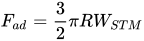
where with being the radius of the tip, and being various surface energies between the tip, sample, and the medium each is in (liquids discussed below). is usually obtained from SEM and and from contact angle measurements on substrates with the given moieties. When the same functional groups are used, and which results in Doing this twice with two different moieties (e.g. COOH and CH3) gives values of and , both of which can be used together in the same experiment to determine . Therefore, can be calculated for any combination of functionalities for comparison to CFM determined values.





For similarly functionalized tip and surface, at tip detachment JKR theory also predicts a contact radius of
(2)
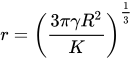
with an “effective” Young's modulus of the tip derived from the actual value and the Poisson ratio . If one knows the effective area of a single functional group, (e.g. from quantum chemistry simulations), the total number of ligands participating in tension can be estimated as As stated earlier, the force resolution of CFM does allow one to probe individual bonds of even the weakest variety, but tip curvature typically prevents this. Using Eq 2, a radius of curvature < 10 nm has been determined as the requirement to conduct tensile testing of individual linear moieties.


Hub AI
Chemical force microscopy AI simulator
(@Chemical force microscopy_simulator)
Chemical force microscopy
In materials science, chemical force microscopy (CFM) is a variation of atomic force microscopy (AFM) which has become a versatile tool for characterization of materials surfaces. With AFM, structural morphology is probed using simple tapping or contact modes that utilize van der Waals interactions between tip and sample to maintain a constant probe deflection amplitude (constant force mode) or maintain height while measuring tip deflection (constant height mode). CFM, on the other hand, uses chemical interactions between functionalized probe tip and sample. Choice chemistry is typically gold-coated tip and surface with R−SH thiols attached, R being the functional groups of interest. CFM enables the ability to determine the chemical nature of surfaces, irrespective of their specific morphology, and facilitates studies of basic chemical bonding enthalpy and surface energy. Typically, CFM is limited by thermal vibrations within the cantilever holding the probe. This limits force measurement resolution to ~1 pN, which is still very suitable considering weak COOH/CH3 interactions are ~20 pN per pair. Hydrophobicity is used as the primary example throughout this consideration of CFM, but certainly any type of bonding can be probed with this method.
CFM has been primarily developed by Charles Lieber at Harvard University in 1994. The method was demonstrated using hydrophobicity where polar molecules (e.g. COOH) tend to have the strongest binding to each other, followed by nonpolar (e.g. CH3-CH3) bonding, and a combination being the weakest. Probe tips are functionalized and substrates patterned with these molecules. All combinations of functionalization were tested, both by tip contact and removal as well as spatial mapping of substrates patterned with both moieties and observing the complementarity in image contrast. Both of these methods are discussed below. The AFM instrument used is similar to the one in Figure 1.
This is the simpler mode of CFM operation where a functionalized tip is brought in contact with the surface and is pulled to observe the force at which separation occurs, (see Figure 2). The Johnson-Kendall-Roberts (JKR) theory of adhesion mechanics predicts this value as
(1)
where with being the radius of the tip, and being various surface energies between the tip, sample, and the medium each is in (liquids discussed below). is usually obtained from SEM and and from contact angle measurements on substrates with the given moieties. When the same functional groups are used, and which results in Doing this twice with two different moieties (e.g. COOH and CH3) gives values of and , both of which can be used together in the same experiment to determine . Therefore, can be calculated for any combination of functionalities for comparison to CFM determined values.
For similarly functionalized tip and surface, at tip detachment JKR theory also predicts a contact radius of
(2)
with an “effective” Young's modulus of the tip derived from the actual value and the Poisson ratio . If one knows the effective area of a single functional group, (e.g. from quantum chemistry simulations), the total number of ligands participating in tension can be estimated as As stated earlier, the force resolution of CFM does allow one to probe individual bonds of even the weakest variety, but tip curvature typically prevents this. Using Eq 2, a radius of curvature < 10 nm has been determined as the requirement to conduct tensile testing of individual linear moieties.
Recent media