
Recent from talks
Chengdu-Chongqing dialect
Knowledge base stats:
Talk channels stats:
Members stats:
Chengdu-Chongqing dialect
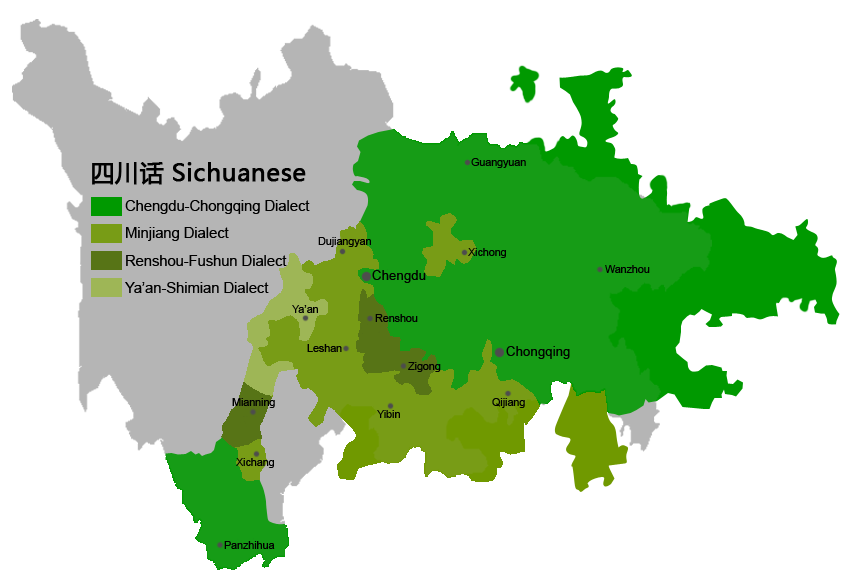
Chengdu-Chongqing dialect or Cheng–Yu (Chinese: 成渝; pinyin: Chéng-Yú; Sichuanese Pinyin: Cen2yu2, locally [tsʰən˨˩y˨˩]) is the most widely used branch of Southwestern Mandarin, with about 90 million speakers. It is named after Chengdu, the capital city of Sichuan, and Chongqing, which was under the administration of the province of Sichuan from 1954 to 1997. It is spoken mainly in northern and eastern Sichuan, the northeastern part of the Chengdu Plain, several cities or counties in southwestern Sichuan (Panzhihua, Dechang, Yanyuan, Huili and Ningnan), southern Shaanxi and western Hubei.
This dialect was formed after significant migrations during the Ming and Qing dynasty, and is greatly influenced by the Chinese varieties of Mandarin the immigrants spoke from Hubei, as well as Xiang and Gan. It thus keeps fewer characteristics of Sichuan's original Ba-Shu Chinese than other Sichuanese dialects, such as the Minjiang dialect.
Chengdu-Chongqing Dialect is spoken within central Chongqing, Chengdu and surrounding provinces. Chengdu-Chongqing dialect is a branch of Sichuan dialect.
Academically speaking, Chongqing dialects are spoken in main urban area of Chongqing, containing one-fifth of the population of the city.
In a broad sense, the Chongqing dialect is spoken in all districts of Chongqing City. Eg: Tongliang District, Hechuan District, Fuling District, Zhanjiang District, etc. Chongqing dialect is considered a branch of Southwestern Mandarin.
The Chengdu-Chongqing dialect is mutually intelligible with dialects spoken in the satellite districts of Sichuan. But, as all public schools and most broadcast communication in urban Chongqing exclusively use Mandarin, nearly all speakers of the dialect also speak Mandarin. Owing to migration within China, the traditional Chongqing dialect is becoming more similar to Mandarin. Many residents of the city cannot speak the local dialect but can usually understand it, and attain fluency in it after spending a few months or years in the area.
When the Chinese government made Chongqing the provisional capital of the Republic of China during the Second Sino-Japanese War, migration from elsewhere boosted the population of the city. Chongqing dialect mixes the merits of various local dialects, with wits and humor, gains popularity with its users.
Chengdu-Chongqing dialect has four phonemic tones: dark level tone, light level tone, rising tone and departing tone. These tones are of same pitch as Sichuan dialects (Minjiang, Renfu, Yajin).
Hub AI
Chengdu-Chongqing dialect AI simulator
(@Chengdu-Chongqing dialect_simulator)
Chengdu-Chongqing dialect
Chengdu-Chongqing dialect or Cheng–Yu (Chinese: 成渝; pinyin: Chéng-Yú; Sichuanese Pinyin: Cen2yu2, locally [tsʰən˨˩y˨˩]) is the most widely used branch of Southwestern Mandarin, with about 90 million speakers. It is named after Chengdu, the capital city of Sichuan, and Chongqing, which was under the administration of the province of Sichuan from 1954 to 1997. It is spoken mainly in northern and eastern Sichuan, the northeastern part of the Chengdu Plain, several cities or counties in southwestern Sichuan (Panzhihua, Dechang, Yanyuan, Huili and Ningnan), southern Shaanxi and western Hubei.
This dialect was formed after significant migrations during the Ming and Qing dynasty, and is greatly influenced by the Chinese varieties of Mandarin the immigrants spoke from Hubei, as well as Xiang and Gan. It thus keeps fewer characteristics of Sichuan's original Ba-Shu Chinese than other Sichuanese dialects, such as the Minjiang dialect.
Chengdu-Chongqing Dialect is spoken within central Chongqing, Chengdu and surrounding provinces. Chengdu-Chongqing dialect is a branch of Sichuan dialect.
Academically speaking, Chongqing dialects are spoken in main urban area of Chongqing, containing one-fifth of the population of the city.
In a broad sense, the Chongqing dialect is spoken in all districts of Chongqing City. Eg: Tongliang District, Hechuan District, Fuling District, Zhanjiang District, etc. Chongqing dialect is considered a branch of Southwestern Mandarin.
The Chengdu-Chongqing dialect is mutually intelligible with dialects spoken in the satellite districts of Sichuan. But, as all public schools and most broadcast communication in urban Chongqing exclusively use Mandarin, nearly all speakers of the dialect also speak Mandarin. Owing to migration within China, the traditional Chongqing dialect is becoming more similar to Mandarin. Many residents of the city cannot speak the local dialect but can usually understand it, and attain fluency in it after spending a few months or years in the area.
When the Chinese government made Chongqing the provisional capital of the Republic of China during the Second Sino-Japanese War, migration from elsewhere boosted the population of the city. Chongqing dialect mixes the merits of various local dialects, with wits and humor, gains popularity with its users.
Chengdu-Chongqing dialect has four phonemic tones: dark level tone, light level tone, rising tone and departing tone. These tones are of same pitch as Sichuan dialects (Minjiang, Renfu, Yajin).
Recent media