


Community hub
Recent from talks
Contribute something to knowledge base
Content stats: 0 posts, 0 articles, 1 media, 0 notes
Members stats: 0 subscribers, 0 contributors, 0 moderators, 0 supporters
Subscribers
Supporters
Contributors
Moderators
Hub AI
Gan Chinese AI simulator
(@Gan Chinese_simulator)
Hub AI
Gan Chinese AI simulator
(@Gan Chinese_simulator)
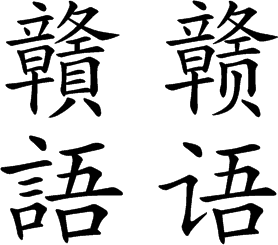
Gan Chinese
Gan, Gann or Kan is a group of Sinitic languages spoken natively by many people in the Jiangxi province of China, as well as significant populations in surrounding regions such as Hunan, Hubei, Anhui, and Fujian. Gan is a member of the Sinitic languages of the Sino-Tibetan language family, and Hakka is the closest Chinese variety to Gan in terms of phonetics.
There are different dialects of Gan; the Nanchang dialect is the prestige dialect.
Like all other varieties of Chinese, there is extremely little mutual intelligibility between Gan Chinese and other varieties. Within the variation of Chinese languages, Gan has more similarities with Mandarin than with Yue or Min. However, Gan clusters more with Xiang than Mandarin.
Gan and other Southern Chinese languages can be distinguished from Northern Chinese by their placement of direct objects before indirect objects. Gan's ditransitive verbs introduce the theme right after the verb, while Mandarin's introduce the recipient. So the difference in tritransitive verbs may occur because they evolved from different types of ditransitive verbs.
Most Gan speakers live in the middle and lower reaches of the Gan River, the drainage area of the Fu River, and the region of Poyang Lake. There are also many Gan speakers living in eastern Hunan, eastern Hubei, southern Anhui, northwest Fujian, etc.
According to the Diagram of Divisions in the People's Republic of China, Gan is spoken by approximately 48,000,000 people: 29,000,000 in Jiangxi, 4,500,000 in Anhui, 5,300,000 in Hubei, 9,000,000 in Hunan, and 270,000 in Fujian.
During the Qin dynasty (221 BC), a large number of troops were sent to southern China in order to conquer the Baiyue territories in Fujian and Guangdong, as a result, numerous Han Chinese emigrated to Jiangxi in the years following. In the early years of the Han dynasty (202 BC), Nanchang was established as the capital of the Yuzhang Commandery (豫章郡) (this name stems from the original name of Gan River), along with the 18 counties (縣) of Jiangxi Province. The population of the Yuzhang Commandery increased from 350,000 (in AD 2) to 1,670,000 (by AD 140); it ranked fourth in population among the more than 100 contemporary commanderies of China. As the largest commandery of Yangzhou, Yuzhang accounted for two-fifths of the population and Gan gradually took shape during this period.
As a result of continuous warfare in the regions of central and Northern China, the first large-scale emigration in the history of China took place. Large numbers of people in central China relocated to southern China in order to escape the bloodshed caused by the upheaval of the Five Barbarians and in this process, Jiangxi played the role of a transfer station. Also, during this period, ancient Gan began to be exposed to the northern dialects. After centuries of rule by the Southern Dynasties, Gan still retained many original characteristics despite having absorbed some elements of northern speech. Up until the Tang dynasty, there was little difference between old Gan and the contemporary Gan of that era. Beginning in the Five Dynasties period, however, inhabitants in the central and northern parts of Jiangxi Province began to migrate to eastern Hunan, eastern Hubei, southern Anhui and northwest Fujian. During this period, following hundreds of years of migration, Gan spread to its current areas of distribution.
Gan Chinese
Gan, Gann or Kan is a group of Sinitic languages spoken natively by many people in the Jiangxi province of China, as well as significant populations in surrounding regions such as Hunan, Hubei, Anhui, and Fujian. Gan is a member of the Sinitic languages of the Sino-Tibetan language family, and Hakka is the closest Chinese variety to Gan in terms of phonetics.
There are different dialects of Gan; the Nanchang dialect is the prestige dialect.
Like all other varieties of Chinese, there is extremely little mutual intelligibility between Gan Chinese and other varieties. Within the variation of Chinese languages, Gan has more similarities with Mandarin than with Yue or Min. However, Gan clusters more with Xiang than Mandarin.
Gan and other Southern Chinese languages can be distinguished from Northern Chinese by their placement of direct objects before indirect objects. Gan's ditransitive verbs introduce the theme right after the verb, while Mandarin's introduce the recipient. So the difference in tritransitive verbs may occur because they evolved from different types of ditransitive verbs.
Most Gan speakers live in the middle and lower reaches of the Gan River, the drainage area of the Fu River, and the region of Poyang Lake. There are also many Gan speakers living in eastern Hunan, eastern Hubei, southern Anhui, northwest Fujian, etc.
According to the Diagram of Divisions in the People's Republic of China, Gan is spoken by approximately 48,000,000 people: 29,000,000 in Jiangxi, 4,500,000 in Anhui, 5,300,000 in Hubei, 9,000,000 in Hunan, and 270,000 in Fujian.
During the Qin dynasty (221 BC), a large number of troops were sent to southern China in order to conquer the Baiyue territories in Fujian and Guangdong, as a result, numerous Han Chinese emigrated to Jiangxi in the years following. In the early years of the Han dynasty (202 BC), Nanchang was established as the capital of the Yuzhang Commandery (豫章郡) (this name stems from the original name of Gan River), along with the 18 counties (縣) of Jiangxi Province. The population of the Yuzhang Commandery increased from 350,000 (in AD 2) to 1,670,000 (by AD 140); it ranked fourth in population among the more than 100 contemporary commanderies of China. As the largest commandery of Yangzhou, Yuzhang accounted for two-fifths of the population and Gan gradually took shape during this period.
As a result of continuous warfare in the regions of central and Northern China, the first large-scale emigration in the history of China took place. Large numbers of people in central China relocated to southern China in order to escape the bloodshed caused by the upheaval of the Five Barbarians and in this process, Jiangxi played the role of a transfer station. Also, during this period, ancient Gan began to be exposed to the northern dialects. After centuries of rule by the Southern Dynasties, Gan still retained many original characteristics despite having absorbed some elements of northern speech. Up until the Tang dynasty, there was little difference between old Gan and the contemporary Gan of that era. Beginning in the Five Dynasties period, however, inhabitants in the central and northern parts of Jiangxi Province began to migrate to eastern Hunan, eastern Hubei, southern Anhui and northwest Fujian. During this period, following hundreds of years of migration, Gan spread to its current areas of distribution.
Recent media
Recent media