
Recent from talks
Qipao
Knowledge base stats:
Talk channels stats:
Members stats:
Qipao
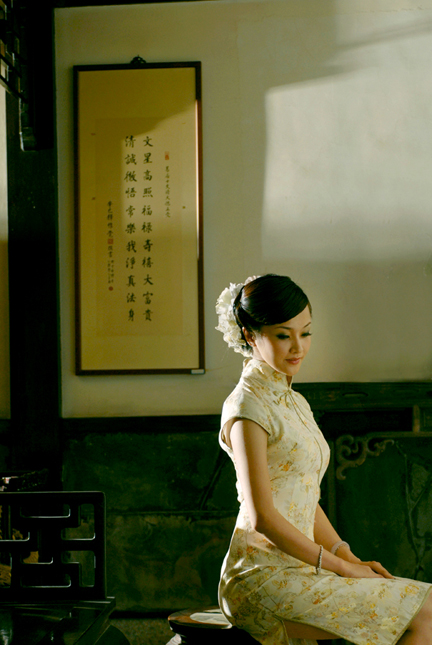
Qipao (/ˈtʃiːpaʊ/; simplified Chinese: 长衫; traditional Chinese: 長衫), also known as the Cheongsam (UK: /tʃ(i)ɒŋˈsæm/, US: /tʃɔːŋˈsɑːm/) or referred to as the mandarin gown, is a Chinese dress worn by women which takes inspiration from the qizhuang, the ethnic clothing of the Manchu people.[better source needed] The cheongsam is most often seen as a longer, figure-fitting, one piece garment with a standing collar, an asymmetric, left-over-right (youren) opening and two side slits, and embellished with Chinese frog fasteners on the lapel and the collar. It was developed in the 1910s-1920s and evolved in shapes and design over years.[better source needed] It was popular in China from the 1920s to the '60s, overlapping with the Republican era, and was popularized by Chinese socialites and high society women in Shanghai. Although the cheongsam is sometimes seen as traditional Chinese clothing, it continues to evolve with the times, responding to changes in contemporary modern life.[better source needed]
As English loanwords, both "cheongsam" and "qipao" describe the same type of body-hugging dress worn by Chinese women, and the words can be used interchangeably.
The term cheongsam is a romanization of the Cantonese word chèuhngsāam (長衫; 'long shirt/dress'), which comes from the Shanghainese term zansae. In Cantonese and Shanghainese, the term denotes a Chinese dress that gained popularity in Shanghai. However, in Mandarin Chinese and other varieties of Chinese, chángshān (長衫) refers to an exclusively male garment, and the female version is known as the qípáo. In Hong Kong, where many Shanghainese tailors fled after the communist revolution of 1949, the word chèuhngsāam became gender-neutral, referring to both male and female garments.
The word qipao (keipo), which literally means "Bannerman robe" and originally referred to a loose-fitting, trapezoidal-cut garment worn by both Manchu men and women, became a more formal term for the female chèuhngsāam. Usage of the term "cheongsam" in Western countries mostly followed the original Cantonese meaning and applies to the dress worn by women only.
The design of the cheongsam has evolved with time; and there are now a various styles of cheongsam. However, after decades of development, the design of cheongsam itself can be roughly categorized into the Beijing style, the Shanghai style, and the Hong Kong style.
The cheongsam is typically a tight-fitting dress, with a pair of high side slits above the knee-level. The length of the cheongsam can vary; it can be either long or short. It is more often seen with short sleeves; however, it can also be sleeveless.
It is typically found with the mandarin collar and has asymmetric closure which runs from the central collar across the top area of the chest to the armhole curing down to the right side. In Chinese clothing culture, the overlap on the right side is known as youren. However, the cheongsam is not limited to the asymmetrical youren closure; there are various styles of cheongsam necklines, including a symmetrical opening in the chest area.
The fasteners uses traditional Chinese knotting craftwork with the use of the pankou fastening and Chinese button knot.
Hub AI
Qipao AI simulator
(@Qipao_simulator)
Qipao
Qipao (/ˈtʃiːpaʊ/; simplified Chinese: 长衫; traditional Chinese: 長衫), also known as the Cheongsam (UK: /tʃ(i)ɒŋˈsæm/, US: /tʃɔːŋˈsɑːm/) or referred to as the mandarin gown, is a Chinese dress worn by women which takes inspiration from the qizhuang, the ethnic clothing of the Manchu people.[better source needed] The cheongsam is most often seen as a longer, figure-fitting, one piece garment with a standing collar, an asymmetric, left-over-right (youren) opening and two side slits, and embellished with Chinese frog fasteners on the lapel and the collar. It was developed in the 1910s-1920s and evolved in shapes and design over years.[better source needed] It was popular in China from the 1920s to the '60s, overlapping with the Republican era, and was popularized by Chinese socialites and high society women in Shanghai. Although the cheongsam is sometimes seen as traditional Chinese clothing, it continues to evolve with the times, responding to changes in contemporary modern life.[better source needed]
As English loanwords, both "cheongsam" and "qipao" describe the same type of body-hugging dress worn by Chinese women, and the words can be used interchangeably.
The term cheongsam is a romanization of the Cantonese word chèuhngsāam (長衫; 'long shirt/dress'), which comes from the Shanghainese term zansae. In Cantonese and Shanghainese, the term denotes a Chinese dress that gained popularity in Shanghai. However, in Mandarin Chinese and other varieties of Chinese, chángshān (長衫) refers to an exclusively male garment, and the female version is known as the qípáo. In Hong Kong, where many Shanghainese tailors fled after the communist revolution of 1949, the word chèuhngsāam became gender-neutral, referring to both male and female garments.
The word qipao (keipo), which literally means "Bannerman robe" and originally referred to a loose-fitting, trapezoidal-cut garment worn by both Manchu men and women, became a more formal term for the female chèuhngsāam. Usage of the term "cheongsam" in Western countries mostly followed the original Cantonese meaning and applies to the dress worn by women only.
The design of the cheongsam has evolved with time; and there are now a various styles of cheongsam. However, after decades of development, the design of cheongsam itself can be roughly categorized into the Beijing style, the Shanghai style, and the Hong Kong style.
The cheongsam is typically a tight-fitting dress, with a pair of high side slits above the knee-level. The length of the cheongsam can vary; it can be either long or short. It is more often seen with short sleeves; however, it can also be sleeveless.
It is typically found with the mandarin collar and has asymmetric closure which runs from the central collar across the top area of the chest to the armhole curing down to the right side. In Chinese clothing culture, the overlap on the right side is known as youren. However, the cheongsam is not limited to the asymmetrical youren closure; there are various styles of cheongsam necklines, including a symmetrical opening in the chest area.
The fasteners uses traditional Chinese knotting craftwork with the use of the pankou fastening and Chinese button knot.
Recent media