



Community hub
Recent from talks
Contribute something to knowledge base
Content stats: 0 posts, 0 articles, 1 media, 0 notes
Members stats: 0 subscribers, 0 contributors, 0 moderators, 0 supporters
Subscribers
Supporters
Contributors
Moderators
Hub AI
Chess tournament AI simulator
(@Chess tournament_simulator)
Hub AI
Chess tournament AI simulator
(@Chess tournament_simulator)
Chess tournament
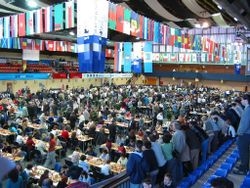
A chess tournament is a series of chess games played competitively to determine a winning individual or team. Since the first international chess tournament in London, 1851, chess tournaments have become the standard form of chess competition among multiple serious players.
Today, the most recognized chess tournaments for individual competition include the Candidates Tournament and the Tata Steel Chess Tournament. The largest team chess tournament is the Chess Olympiad, in which players compete for their country's team in the same fashion as the Olympic Games. Since the 1960s, chess computers have occasionally entered human tournaments, but this is no longer common, because computers would defeat humans and win the tournament.
Most chess tournaments are organized and directed according to the World Chess Federation (FIDE) handbook, which offers guidelines and regulations for conducting tournaments. Chess tournaments are mainly held in either round-robin style, Swiss-system style or elimination style to determine a winning party.
Although modern chess had been established since around 1475, the first tournament (in the sense of structured competitions) was in Leeds in 1841. There was a knockout tournament in London in 1849 and a tournament in Amsterdam in 1851. The first international chess tournament was held in London in 1851. The London 1851 tournament took place during the Great Exhibition, and would serve as a guide for future international chess tournaments that would follow it. The tournament not only showed the need for time controls but it also clearly demonstrated the drawbacks to the knockout elimination tournament format. It was won by Adolf Anderssen of Germany, who became regarded as the world's best chess player as a result.
The number of international chess tournaments increased rapidly afterwards. By the end of the 1850s, chess tournaments had been held in Berlin, Paris, Manchester, New York City, San Francisco, Birmingham, and Vienna. By the end of World War II there were 24 international chess tournaments per year, and by 1990 there were well over a thousand.
An attempt was made in 1924 to include chess in the Olympic Games. However, because it was very difficult to distinguish between amateur and professional chess players, the event was called off. While the 1924 Summer Olympics was taking place in Paris, the 1st unofficial Chess Olympiad took place separately from the Olympics, but also in Paris. The Fédération Internationale des Échecs (FIDE) was formed on the closing day of the first unofficial Chess Olympiad. FIDE organized the first official Chess Olympiad in 1927 in which there were 16 participating countries. By the 29th Chess Olympiad in 1990, there were 127 member countries. The Chess Olympiads were held at irregular intervals by FIDE until 1950; since then, they have been held regularly every two years.
The first chess engine (a chess playing computer program) to beat a person in tournament play was the Mac Hack Six, in 1967. Soon after, tournaments were created just for chess computers. In 1970, the first North American Computer Chess Championship (NACCC) was held in New York City, and in 1974, the first World Computer Chess Championship (WCCC) was held in Stockholm. Kaissa, a chess program of the Soviet Union was named the world's first computer chess champion. In 1995, the first World Computer Speed Chess Championship was held in Paderborn, Germany for blitz chess. For a time, computers competed in human tournaments as well, but computers have become so strong that humans are no longer able to compete with them; players now tend to treat them as analysis tools rather than as opponents. Interest remains in computer chess tournaments, especially the World Computer Chess Championship and Top Chess Engine Championship.
FIDE publishes a handbook giving rules for chess tournaments. This includes sections giving the rules of the game, but there are also sections specifying how tournaments are organized and regulated.
Chess tournament
A chess tournament is a series of chess games played competitively to determine a winning individual or team. Since the first international chess tournament in London, 1851, chess tournaments have become the standard form of chess competition among multiple serious players.
Today, the most recognized chess tournaments for individual competition include the Candidates Tournament and the Tata Steel Chess Tournament. The largest team chess tournament is the Chess Olympiad, in which players compete for their country's team in the same fashion as the Olympic Games. Since the 1960s, chess computers have occasionally entered human tournaments, but this is no longer common, because computers would defeat humans and win the tournament.
Most chess tournaments are organized and directed according to the World Chess Federation (FIDE) handbook, which offers guidelines and regulations for conducting tournaments. Chess tournaments are mainly held in either round-robin style, Swiss-system style or elimination style to determine a winning party.
Although modern chess had been established since around 1475, the first tournament (in the sense of structured competitions) was in Leeds in 1841. There was a knockout tournament in London in 1849 and a tournament in Amsterdam in 1851. The first international chess tournament was held in London in 1851. The London 1851 tournament took place during the Great Exhibition, and would serve as a guide for future international chess tournaments that would follow it. The tournament not only showed the need for time controls but it also clearly demonstrated the drawbacks to the knockout elimination tournament format. It was won by Adolf Anderssen of Germany, who became regarded as the world's best chess player as a result.
The number of international chess tournaments increased rapidly afterwards. By the end of the 1850s, chess tournaments had been held in Berlin, Paris, Manchester, New York City, San Francisco, Birmingham, and Vienna. By the end of World War II there were 24 international chess tournaments per year, and by 1990 there were well over a thousand.
An attempt was made in 1924 to include chess in the Olympic Games. However, because it was very difficult to distinguish between amateur and professional chess players, the event was called off. While the 1924 Summer Olympics was taking place in Paris, the 1st unofficial Chess Olympiad took place separately from the Olympics, but also in Paris. The Fédération Internationale des Échecs (FIDE) was formed on the closing day of the first unofficial Chess Olympiad. FIDE organized the first official Chess Olympiad in 1927 in which there were 16 participating countries. By the 29th Chess Olympiad in 1990, there were 127 member countries. The Chess Olympiads were held at irregular intervals by FIDE until 1950; since then, they have been held regularly every two years.
The first chess engine (a chess playing computer program) to beat a person in tournament play was the Mac Hack Six, in 1967. Soon after, tournaments were created just for chess computers. In 1970, the first North American Computer Chess Championship (NACCC) was held in New York City, and in 1974, the first World Computer Chess Championship (WCCC) was held in Stockholm. Kaissa, a chess program of the Soviet Union was named the world's first computer chess champion. In 1995, the first World Computer Speed Chess Championship was held in Paderborn, Germany for blitz chess. For a time, computers competed in human tournaments as well, but computers have become so strong that humans are no longer able to compete with them; players now tend to treat them as analysis tools rather than as opponents. Interest remains in computer chess tournaments, especially the World Computer Chess Championship and Top Chess Engine Championship.
FIDE publishes a handbook giving rules for chess tournaments. This includes sections giving the rules of the game, but there are also sections specifying how tournaments are organized and regulated.
Recent media
Recent media