Hubbry Logo
Chess tournamentChess tournamentMain
Open search
Chess tournament
Community hub
Chess tournament
logo
8 pages, 0 posts
0 subscribers
Be the first to start a discussion here.
Chess tournament
Chess tournament
from Wikipedia
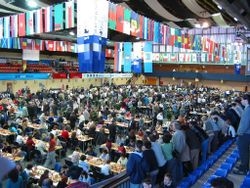
The 35th Chess Olympiad, a chess tournament for teams

A chess tournament is a series of chess games played competitively to determine a winning individual or team. Since the first international chess tournament in London, 1851, chess tournaments have become the standard form of chess competition among multiple serious players.

Today, the most recognized chess tournaments for individual competition include the Candidates Tournament and the Tata Steel Chess Tournament. The largest team chess tournament is the Chess Olympiad, in which players compete for their country's team in the same fashion as the Olympic Games. Since the 1960s, chess computers have occasionally entered human tournaments, but this is no longer common, because computers would defeat humans and win the tournament.

Most chess tournaments are organized and directed according to the World Chess Federation (FIDE) handbook, which offers guidelines and regulations for conducting tournaments. Chess tournaments are mainly held in either round-robin style, Swiss-system style or elimination style to determine a winning party.

A large youth chess tournament in Spain

History

[edit]
Adolf Anderssen

Although modern chess had been established since around 1475, the first tournament (in the sense of structured competitions) was in Leeds in 1841.[1] There was a knockout tournament in London in 1849 and a tournament in Amsterdam in 1851.[2][3] The first international chess tournament was held in London in 1851.[1][4] The London 1851 tournament took place during the Great Exhibition, and would serve as a guide for future international chess tournaments that would follow it. The tournament not only showed the need for time controls but it also clearly demonstrated the drawbacks to the knockout elimination tournament format.[5] It was won by Adolf Anderssen of Germany, who became regarded as the world's best chess player as a result.[6][7]

The number of international chess tournaments increased rapidly afterwards. By the end of the 1850s, chess tournaments had been held in Berlin, Paris, Manchester, New York City, San Francisco, Birmingham, and Vienna.[8][9][10] By the end of World War II there were 24 international chess tournaments per year, and by 1990 there were well over a thousand.[11]

Chess Olympiads

[edit]
Chess Olympiad tournament hall, Torino 2006

An attempt was made in 1924 to include chess in the Olympic Games. However, because it was very difficult to distinguish between amateur and professional chess players, the event was called off.[12] While the 1924 Summer Olympics was taking place in Paris, the 1st unofficial Chess Olympiad took place separately from the Olympics, but also in Paris. The Fédération Internationale des Échecs (FIDE) was formed on the closing day of the first unofficial Chess Olympiad.[13] FIDE organized the first official Chess Olympiad in 1927 in which there were 16 participating countries.[12] By the 29th Chess Olympiad in 1990, there were 127 member countries.[11] The Chess Olympiads were held at irregular intervals by FIDE until 1950; since then, they have been held regularly every two years.[12]

Growth of Chess Olympiads
There were 16 participating nations in the 1st Chess Olympiad, 1927.
By the 37th Chess Olympiad, 2006, there were 133 participating nations.

Computers in chess tournaments

[edit]
A pressure-sensory chess computer with an LCD screen from the 1990s

The first chess engine (a chess playing computer program) to beat a person in tournament play was the Mac Hack Six, in 1967.[14] Soon after, tournaments were created just for chess computers. In 1970, the first North American Computer Chess Championship (NACCC) was held in New York City, and in 1974, the first World Computer Chess Championship (WCCC) was held in Stockholm. Kaissa, a chess program of the Soviet Union was named the world's first computer chess champion.[15][16] In 1995, the first World Computer Speed Chess Championship was held in Paderborn, Germany for blitz chess. For a time, computers competed in human tournaments as well,[17] but computers have become so strong that humans are no longer able to compete with them; players now tend to treat them as analysis tools rather than as opponents.[18] Interest remains in computer chess tournaments, especially the World Computer Chess Championship and Top Chess Engine Championship.

Rules

[edit]

FIDE publishes a handbook giving rules for chess tournaments.[19] This includes sections giving the rules of the game, but there are also sections specifying how tournaments are organized and regulated.

The chess clock

[edit]
A typical analog chess clock. Note the two separate timers.

A chess clock is a clock with two separate time displays of which only one display can be running at a time. The player with the black pieces will initiate their opponent's timer at the start of the game. Thus the player with the white pieces will have their timer running first, and will make the first move. The player or the arbiter may end the game at any time after the player's opponent has overstepped their time limit. If a timed-out clock remains unnoticed, the game will continue as normal. If the game needs to be interrupted, the arbiter shall stop the clock.

Due to most tournaments having increment or delay as well as digital clocks being more precise, digital chess clocks are the preferred choice of equipment in tournaments.

A brown chess clock with blue buttons along the bottom. A digital display shows the time remaining for each side
Digital clock

Irregularities

[edit]

If it is found that the starting position of the pieces was incorrect, the game must be cancelled and restarted. If it is found that an illegal move has been made, the game must return to the position directly before the irregularity. For the first illegal move by a player, the arbiter shall give two minutes extra time to his opponent. If a player makes a second illegal move in the same game, the arbiter shall declare the game lost by the offending player. If a game begins with the piece colors reversed, the game should be stopped and restarted unless an arbiter rules otherwise. If a player displaces any pieces, they should place them in the correct locations on their own time.

The recording of moves

[edit]
A chess score sheet of a 1909 match between José Raúl Capablanca and Louis Eisenberg, in descriptive notation

In games with long time controls, each player is required to record all moves of the game in algebraic chess notation. If, however, a player reaches less than five minutes on their clock, and does not have an increment of thirty seconds or more, they are excused from recording the remaining game moves until the game has been completed. At the conclusion of the game, both players must sign each other's score sheets and turn them to the event organizer if instructed to do so. In fast chess games, players are not required to record moves, as it would take away from important thinking time. The score sheets must be visible to the arbiter at all times.

The drawn game

[edit]

A player must make their own move before offering a draw, and must not stop their own clock and start their opponent's clock before they have made the offer. If a player does not make a move before offering a draw, the opponent can request a move before considering the draw offer (which cannot be retracted). No conditions may be attached to a draw offer. If a player claims a draw according to the rules of chess, the player is allowed to stop both clocks and record the draw claim as long as their opponent agrees to the claim.[20] If the opponent disputes the draw claim, the director may be called to come to a conclusion. If the claim is found to be correct, the game is drawn. Once a player has made a move from a position eligible for a draw, they lose their rights to claim a draw in that position.[21][22]

Quickplay finish

[edit]

The quickplay finish is the phase of the game when all remaining moves must be made in a limited time. If a player has two minutes or less left on their clock, they may ask the arbiter to adjudicate a draw. The arbiter must decide if the player's opponent is making any attempt to win the game by normal means, or if the position can be won in any way. If the arbiter decides against a draw, the player's opponent will be awarded two extra minutes of time. Otherwise, the game is drawn, and the decision of the arbiter is final.

Scoring

[edit]
Symbol Score
1–0 White wins
0–1 Black wins
½–½ drawn game

Players are granted one point (1) for a win, a half point (½) for a draw, and no points (0) for a loss toward their tournament score. A minority of tournaments use alternative scoring systems such as "football scoring" (3 points for a win, 1 point for a draw), but they are treated the same as regular scoring for the purposes of Elo rating. Full-point byes are received when a player is excluded from a round because of an extra player. Thus, in tournaments with an odd number of players, a different player will receive a full-point each round. A full-point bye is equal in points to a normal win. Half-point byes can be requested by a player who will be unavailable for a round. If accepted, the player will receive a half-point, as if they had drawn the game.[23] A player who wins by forfeit or default will also be granted one point.

Player conduct

[edit]

Players are not allowed to take any action that will bring the game into disrepute. For example, deliberate attempts at cheating by sneaking a captured piece back on to the board can be punished by this rule, rather than the rules dealing with illegal moves.[24]

Players can not make any use of any outside information. This includes advice, notes, and analysis of another chess board. During play, a player is forbidden to have a mobile phone or any other electronic means of communication in the playing venue; failure to comply with this may result in a forfeit. Chess score sheets may be used for recording matters relevant to the game. Players should not distract or annoy their competitor in any way. Once a player has finished their game, they are considered a spectator. Refusal of a player to comply with the rules may result in penalty, up to and including forfeiture of the game or even disqualification of the player. If two opponents both refuse to obey the rules, the game may be considered lost by both players. In 1976, smoking was banned in a major tournament for the first time (the National Open, Las Vegas).[25]

The role of the arbiter

[edit]

The arbiter must see that the Laws of Chess are observed and make decisions in the best interest of the competition, but must not interfere with the game otherwise. If a rule is broken, the arbiter may choose from a number of penalties including the following:

  • warning the offending player
  • increasing the remaining time of the opponent
  • reducing the remaining time of the offending player
  • declaring a game to be lost
  • reducing the points scored in a game by the offending player
  • increasing the points scored in a game by the opponent
  • expulsion of the offending player from the event.

The arbiter may also expel offending spectators from the venue. Spectators are also forbidden to use mobile phones at any time in the playing area, and may be expelled for it. Member federations are allowed to ask FIDE authorities to give an official decision about problems relating to the Laws of Chess.

Formats

[edit]

Most chess tournaments are held in either round-robin style, Swiss-system style or single-elimination style.

Round-robin

[edit]

In round-robin tournaments, each participant plays every other participant an equal number of times.[26] Round-robin tournaments involving four participants are known as "quads" or "foursome". Round-robin tournaments are often used for small groups because the element of luck is reduced when every player plays everyone else.[27] Rating categories are sometimes used to separate players of different levels into different round-robin groups. The World Chess Federation, the Australian Chess Federation and the United States Chess Federation all use different categorization scales to distinguish player ability.[28]

Most round robin tournaments use the traditional 1-½-0 scoring system. In recent years, however, a few tournaments, such as Bilbao and London, have experimented with the football 3-1-0 scoring system to encourage players to go for wins.

Swiss system

[edit]

A tournament that has too many participants for a round-robin format is commonly conducted as a Swiss-system tournament.[29] This is the most common format for amateur events, and is also common at professional level. In the Swiss style, players are paired as far as possible with opponents having same or similar scores.[30] Pairing players for Swiss-system tournaments is often quite complicated due to some nontrivial constraints:

  • Players do not face the same opponent more than once.
  • As far as possible, color allocation is equalized, and in the end, the number of White and Black games should differ by no more than one.
  • In some tournaments, pairings between players from the same federation are avoided in the final round to avoid match fixing.
  • In some tournaments, pairings between players from particular countries are avoided for political reasons.

Swiss tournament pairings were traditionally done by hand using cards. Today, tournament organizers usually use software.

Due to the high percentage of draws and the small granularity of the scoring system which is entirely based on final results, it is common for players to have the same score as the tournament finishes. Although it is often not an issue, as the tied players often split prizes equally, in case of necessity (for trophies, qualifications to other tournaments, etc.), there are a few ways to achieve tiebreak. In no particular order:

  • Sonneborn–Berger score
  • Rating performance
  • Number of wins, number of Black wins, etc.
  • Tiebreak games, often involving the players playing a series of games with increasingly faster time controls until one player scores higher points (explained in more details in Elimination section)

Tournament organizers specify the tie-breaking rules (if any) on the entry form.

Elimination

[edit]
A 16-player single-elimination tournament bracket

Single-elimination style or knock-out style are also sometimes used for chess tournaments. In fact, the first international chess tournament was held in single-elimination style.[31] In single-elimination tournaments, the loser of a game is immediately eliminated from winning the first prize.[32][33] In most single-elimination chess tournaments there is a chance for players to compete for positions other than first. Players are normally given seeds based on their rating in order to prevent the highest ranked players from facing each other early in the competition. Double-elimination tournaments work in the same way as single-elimination tournaments except that a player loses eligibility to take first prize after two losses.[34]

Since chess is believed to have a first move advantage for white, to ensure fairness, the players have to face each other in an equal number of white and black games. For example, in the Chess World Cup, players face off each other in two games, except the final with four games. Resolving ties is absolutely crucial in this format, with the modern rule generally following:

1. The players play a number of rapid games (2 or 4) until ties are broken.

2. If the players are tied, they keep playing pairs of blitz games until ties are broken, or until a set number of pairs are played (usually 1 or 2 pairs, although it can be up to 5 pairs).

3. If the players are still tied, a single deciding game (Armageddon) will be used, with Black receiving draw odds (draw count as a win) in exchange for White having time advantage (typically 5 vs 4 minutes).

Scheveningen system

[edit]

The Scheveningen system, first used in Scheveningen, Netherlands in 1923, involves two teams, each member of one team playing against each member of the other team. Typically each team has between 6 and 12 players, and both individual and team prizes may be awarded.[21][35]

Reporting results

[edit]

Results are reported using a crosstable. A crosstable is an arrangement of the results of every game in a tournament in the form of a table. The result of each individual game is recorded in the appropriate cell.

Round-robin tournaments

[edit]

Rows contain the player's name and a number indicating their finishing position; individual games can be looked up using these numbers as co-ordinates. Wins are indicated by 1, draws by ½ and losses by 0. For example, the following cross table shows the result of the Hastings 1895 chess tournament:

Hastings 1895
# Player 1 2 3 4 5 6 7 8 9 10 11 12 13 14 15 16 17 18 19 20 21 22 Total
1  Harry Pillsbury (United States) X 0 0 1 1 1 1 1 0 ½ ½ 1 1 1 1 1 1 ½ 1 1 1 1 16½
2  Mikhail Chigorin (Russian Empire) 1 X 1 1 0 0 1 1 1 1 ½ 0 1 1 1 ½ ½ 1 1 ½ 1 1 16
3  Emanuel Lasker (German Empire) 1 0 X 0 1 1 0 1 1 0 1 1 ½ 1 1 1 ½ 1 1 ½ 1 1 15½
4  Siegbert Tarrasch (German Empire) 0 0 1 X 1 1 ½ 0 ½ 1 1 1 0 1 ½ 1 1 1 0 ½ 1 1 14
5  William Steinitz (United States) 0 1 0 0 X 1 1 ½ ½ 1 1 0 1 ½ 1 0 1 1 0 ½ 1 1 13
6  Emanuel Schiffers (Russian Empire) 0 1 0 0 0 X ½ ½ 0 1 1 1 ½ ½ 1 1 0 ½ 1 ½ 1 1 12
7  Curt von Bardeleben (German Empire) 0 0 1 ½ 0 ½ X ½ ½ 0 0 ½ 1 1 1 ½ ½ 1 1 1 0 1 11½
8  Richard Teichmann (German Empire) 0 0 0 1 ½ ½ ½ X ½ 0 0 ½ 1 1 0 1 ½ 1 ½ 1 1 1 11½
9  Carl Schlechter (Austria) 1 0 0 ½ ½ 1 ½ ½ X ½ ½ 0 1 1 ½ ½ ½ ½ ½ ½ 1 0 11
10  Joseph Henry Blackburne (England) ½ 0 1 0 0 0 1 1 ½ X 0 1 0 1 0 ½ 1 0 1 0 1 1 10½
11  Carl August Walbrodt (German Empire) ½ ½ 0 0 0 0 1 1 ½ 1 X 0 ½ 0 ½ ½ 0 ½ ½ 1 1 1 10
12  David Janowski (France) 0 1 0 0 1 0 ½ ½ 1 0 1 X ½ 0 0 ½ 0 1 ½ 1 0 1
13  James Mason (England) 0 0 ½ 1 0 ½ 0 0 0 1 ½ ½ X 1 0 1 ½ 0 1 1 0 1
14  Amos Burn (England) 0 0 0 0 ½ ½ 0 0 0 0 1 1 0 X 0 ½ 1 1 1 1 1 1
15  Isidor Gunsberg (England) 0 0 0 ½ 0 0 0 1 ½ 1 ½ 1 1 1 X 0 1 ½ 0 1 0 0 9
16  Henry Bird (England) 0 ½ 0 0 1 0 ½ 0 ½ ½ ½ ½ 0 ½ 1 X 1 ½ 0 ½ ½ 1 9
17  Adolf Albin (Romania) 0 ½ ½ 0 0 1 ½ ½ ½ 0 1 1 ½ 0 0 0 X 0 0 1 1 ½
18  Georg Marco (Austria) ½ 0 0 0 0 ½ 0 0 ½ 1 ½ 0 1 0 ½ ½ 1 X 1 1 0 ½
19  William Pollock (Canada) 0 0 0 1 1 0 0 ½ ½ 0 ½ ½ 0 0 1 1 1 0 X 0 0 1 8
20  Jacques Mieses (German Empire) 0 ½ ½ ½ ½ ½ 0 0 ½ 1 0 0 0 0 0 ½ 0 0 1 X 1 1
21  Samuel Tinsley (England) 0 0 0 0 0 0 1 0 0 0 0 1 1 0 1 ½ 0 1 1 0 X 1
22  Beniamino Vergani (Italy) 0 0 0 0 0 0 0 0 1 0 0 0 0 0 1 0 ½ ½ 0 0 0 X 3

From this table, it can be seen that tournament winner Pillsbury lost to Chigorin, Lasker and Schlechter; drew with Blackburne, Walbrodt and Marco; and won his remaining 15 games.

Swiss-system tournaments

[edit]

In Swiss-system tournaments, results are usually displayed on a round by round basis. There are variants to the way Swiss tournaments are displayed, such as listing wins by the letter "W", losses by the letter "L" and draws by the letter "D". Additional symbols may also be used, such as indicating wins by forfeit with "X", losses by forfeit with "F", half point byes (i.e. byes requested by the player) with "H", full point byes (unpaired due to odd number of players) with "B" etc.[36] The following table shows the result of the 1991 Women's Interzonal Tournament in Subotica, Serbia, a qualifying event for the 1993 Women's World Championship.

1991 Women's Interzonal Tournament
Player 1 2 3 4 5 6 7 8 9 10 11 12 13 Points Tie break
1  Nona Gaprindashvili (Soviet Union) +14 =28 +2 +17 +21 -9 =3 =5 =7 +12 =4 +6 =10 9 67.75
2  Peng Zhaoqin (China) =26 +33 -1 +20 +27 =5 =16 +9 +3 =4 =6 +7 =12 9 63.75
3  Nana Ioseliani (Soviet Union) +27 =17 +9 =5 =6 +21 =1 =7 -2 =8 +24 +11 =4 61.25
4  Irina Levitina (USA) -25 =24 -33 +34 +15 +10 =6 +14 +16 =2 =1 +9 =3 59.25
5  Wang Pin (China) =32 +12 +7 =3 =16 =2 +9 =1 +8 =18 =11 -10 =13 8 60.00
6  Qin Kanying (China) +13 =11 +32 =26 =3 -8 =4 +21 =17 +16 =2 -1 +9 8 55.50
7  Ketevan Arakhamia (Soviet Union) =18 =20 -5 +33 +32 +17 +8 =3 =1 -9 +14 -2 +19 8 52.75
8  Svetlana Matveeva (Soviet Union) =28 =14 +15 =9 +10 +6 -7 =16 -5 =3 =12 =18 +29 53.25
9  Alisa Galliamova (Soviet Union) +29 +16 -3 =8 +26 +1 -5 -2 +21 +7 +18 -4 -6 52.25
10  Ketino Kachiani (Soviet Union) =31 =26 +18 =16 -8 -4 -15 +33 +20 +25 =13 +5 =1 49.00
11  Marta Litinskaya-Shul (Soviet Union) +22 =6 -21 =32 +25 -16 =27 +20 =15 +17 =5 -3 +18 48.50
12  Aynur Sofiyeva (Soviet Union) =20 -5 -26 -29 +35 +34 +31 +27 +24 -1 =8 +14 =2 42.00
13  Ildikó Mádl (Hungary) -6 +29 =20 -21 +23 =25 -14 -22 +30 +28 =10 +25 =5 7 44.00
14  Cristina Adela Foișor (Romania) -1 =8 =29 =19 +31 =18 +13 -4 +32 +15 -7 -12 +22 7 43.75
15  Daniela Nuțu-Gajić (Romania) -16 +22 -8 +35 -4 =20 +10 +32 =11 -14 +33 -19 +26 7 39.00
16  Julia Demina (Soviet Union) +15 -9 +25 =10 =5 +11 =2 =8 -4 -6 =22 =29 =24 45.50
17  Margarita Voyska (Bulgaria) +30 =3 +23 -1 =18 -7 =25 =19 =6 -11 =27 +33 =20 41.00
18  Zsuzsa Verőci-Petronic (Hungary) =7 +34 -10 +28 =17 =14 =21 =24 +25 =5 -9 =8 -11 40.25
19  Tünde Csonkics (Hungary) =34 -23 =31 =14 =28 +33 =32 =17 =22 -24 +26 +15 -7 37.75
20  Vesna Bašagić (Yugoslavia) =12 =7 =13 -2 =24 =15 +30 -11 -10 bye =23 +28 =17 36.00
21  Sanja Vuksanović (Yugoslavia) +24 =25 +11 +13 -1 -3 =18 -6 -9 -26 +34 =23 bye 33.25
22  Gordana Marković (Yugoslavia) -11 -15 +30 =31 =29 -32 +28 +13 =19 =23 =16 =27 -14 6 37.25
23  Mirjana Marić (Yugoslavia) =33 +19 -17 -27 -13 =28 +29 =31 =26 =22 =20 =21 =30 6 36.25
24  Irina Chelushkina (Soviet Union) -21 =4 +34 -25 =20 +29 +26 =18 -12 +19 -3 -13 =16 6 36.00
25  Anna-Maria Botsari (Greece) +4 =21 -16 +24 -11 =13 =17 +26 -18 -10 -28 +35 =27 6 36.00
26  Beatriz MacArthur (USA) =2 =10 +12 =6 -9 +27 -24 -25 =23 +21 -19 bye -15 6 35.25
27  Nataša Bojković (Yugoslavia) -3 +30 =28 +23 -2 -26 =11 -12 =31 +34 =17 =22 =25 6 34.25
28  Constanze Jahn (Germany) =8 =1 =27 -18 =19 =23 -22 =35 bye -13 +25 -20 +33 6 29.75
29  Suzana Maksimović (Yugoslavia) -9 -13 =14 +12 =22 -24 -23 bye =34 +35 +30 =16 -8 6 27.50
30  Johanna Paasikangas (Finland) -17 -27 -22 bye =33 +35 -20 +34 -13 +32 -29 +31 =23 6 22.00
31  Sheila Jackson (England) =10 -32 =19 =22 -14 bye -12 =23 =27 -33 +35 -30 +34
32  Claudia Amura (Argentina) =5 +31 -6 =11 -7 +22 =19 -15 -14 -30 bye =35 -34 5 24.25
33  Khương Thị Hồng Nhung (Vietnam)[37] =23 -2 +4 -7 =30 -19 bye -10 +35 +31 -15 -17 -28 5 22.50
34  Niina Koskela (Finland) =19 -18 -24 -4 bye -12 +35 -30 =29 -27 -21 =32 -31
35  Sylvia Chidi (Nigeria) FF* FF* bye -15 -12 -30 -34 =28 -33 -29 -31 -25 +32

Sylvia Chidi of Nigeria didn't enter the tournament until after the first two rounds were played, so her first two games are listed as forfeited.

Relaying moves and broadcasting

[edit]

Relaying moves formerly required another person to copy the moves of the players on a large demonstration board behind the players, and then transmit them via radio or telegram. Advancements in camera technology allowed zooming clearly at the players' board, although relaying moves was still done manually. In the early 2000s, autosensory boards were introduced, allowing moves to be relayed instantaneously, but are not commonly used due to their cost.

In elite tournaments, besides cameras on the players' boards, there are also chess commentators – strong chess players who comment on the game and explain the thought processes and plans of the game. Advances in chess engines also allow for casual viewers to evaluate the position in real time; for this reason tournament broadcasts commonly include a 30-minute delay.

Disabled players

[edit]

FIDE has rules for disabled players, with the aim of facilitating competition on an equal footing with able-bodied players.[38]

Although the Blind Chess Olympiad is the most significant chess event for the blind and visually impaired, players in either group can participate at most standard tournaments including international ones.[39][40] In some cases, specially designed chessboards with raised squares and pegs are used to aid the visually handicapped, while a tournament assistant can be used to help players with other physical handicaps.[41]

Tournament categories

[edit]

FIDE uses tournament results to determine whether a player has qualified for a title, such as Grandmaster. For a number of years, starting in 1970, FIDE classified tournaments in categories according to the average Elo rating of the participants, as part of the calculation of whether a particular tournament result could count towards a particular title. The starting category for master-level tournaments was category I, which applied to a tournament whose participants had an average rating from 2251 to 2275. From 2276 to 2300 it was a category II tournament, and so on with a further category every 25 points. Categories are no longer used in these calculations, but informally, strong tournaments are sometimes described by category. Through 2005, the strongest tournaments had been classified category XXI.[42][43] The Zurich Chess Challenge 2014, held from 29 January to 4 February 2014, was the first ever category XXIII tournament, with an average Elo rating of 2801. The 2014 Sinquefield Cup, held from 27 August to 7 September, was the second category XXIII tournament, with an average Elo rating of 2802.

Cat. Elo range
I 2251–2275
II 2276–2300
III 2301–2325
IV 2326–2350
V 2351–2375
VI 2376–2400
VII 2401–2425
 VIII  2426–2450
Cat. Elo range
IX 2451–2475
X 2476–2500
XI 2501–2525
XII 2526–2550
 XIII  2551–2575
XIV 2576–2600
XV 2601–2625
XVI 2626–2650
Cat. Elo range
XVII 2651–2675
 XVIII  2676–2700
XIX 2701–2725
XX 2726–2750
XXI 2751–2775
XXII 2776–2800
XXIII 2801–2825

Tournament classes

[edit]

To gauge tournaments held before 1970, Jeff Sonas devised an unofficial class system, intended to roughly correspond to categories. This is simply based on the presence or absence of the world's ten highest-ranked players at the time, and does not involve rating numbers.[44]

According to this system, the Vienna 1882 chess tournament would compare in strength to Linares 1993.[44]

Time controls

[edit]

A time control is a mechanism in tournament play that allows each round of the match to finish in a timely fashion so that the tournament can proceed. The three main types of time controls used in chess tournaments are blitz, standard, and compensation.

Blitz

[edit]

In blitz chess (also known as sudden death chess) each player starts with a fixed amount of time for all their moves of the game.[45] The FIDE Handbook designates the following common blitz time controls:[46]

  • Bullet: one or two minutes per side.
  • Blitz: less than 10 minutes per side (often 5 minutes), sometimes with a small time increment every move.
  • Rapid: 10–60 minutes per side (often 25 minutes), sometimes with a small time increment every move.
  • Armageddon: a single game guaranteed to produce a decisive result, because Black has draw odds (that is, for Black, a draw is equivalent to a victory). To compensate, White has more time on the clock.

Blitz time controls increase the odds that a player would "lose on time", meaning forfeiture of the game due to expiration of their clock time. Blitz tournaments are often documented with the notation "G/5" or "G/15", meaning "game in 5" and "game in 15", respectively.[45]

Standard

[edit]

In standard time controls (STCs) a player has a set amount of time to complete a specified number of moves. If the specified number of moves is met, the player's time will rejuvenate. The first standard time controls, introduced in 1861, were 24 moves in two hours, with the average game lasting five hours.[47] In the mid-1980s, a new format, 40 moves in two hours, proved popular because few games lasted over 60 moves.[47]

Compensation

[edit]

There are two main forms that provide compensation for both the time lost in physically making a move and ensuring that a player can avoid having an ever-decreasing amount of time remaining.

  • Simple delay (also known as countdown delay and US delay). When it becomes a player's turn to move, the clock waits for the delay period before starting to subtract from the player's remaining time. For example, if the delay is five seconds, the clock waits five seconds before counting down. The time is not accumulated. If the player moves within the delay period, no time is added or subtracted from his remaining time. There is also Bronstein delay which displays the delay differently but is mathematically equivalent to simple delay.
  • Increment, invented by Bobby Fischer. When it becomes a player's turn to move, the delay is added to the player's remaining time. For example, if the delay is five seconds and the player has ten minutes remaining on his clock, when his clock is activated, he now has ten minutes and five seconds remaining. Time can be accumulated, so if the player moves within the delay period, his remaining time increases. This form of time control is common on internet chess servers.

Prizes

[edit]

The winners of chess tournaments are often rewarded with monetary prizes. Often, the chess tournament draws its prizes from a prize fund, dispensing rewards for all the winners in each section. For example, the 2008 World Open chess tournament had a prize fund of $400,000. The winner of the open section was rewarded $30,000, while the winners of lesser sections were rewarded subsequently smaller amounts.[48] Other chess tournaments, such as the World Chess Championship, also reward the winners with a title, such as "World Chess Champion".[49] Lesser tournaments sometimes replace monetary rewards with book prizes or trophies.[50]

See also

[edit]

References

[edit]
[edit]
Revisions and contributorsEdit on WikipediaRead on Wikipedia
from Grokipedia
A chess tournament is a structured competition in which multiple chess players or teams engage in a series of games against one another, governed by the FIDE Laws of Chess and the organization's General Regulations for Competitions, to establish a winner, ranking, or qualification for higher events based on points accumulated from individual results. These events range from local club matches to prestigious international gatherings, emphasizing fair play, precise time controls, and standardized equipment to ensure equity among participants. The modern tradition of chess tournaments began with the first international event held in in 1851, organized by at the St. George's Chess Club, featuring 16 players from across Europe in a format that culminated in Adolf Anderssen's victory after he defeated top competitors including Staunton himself. This tournament marked a pivotal shift from informal matches to organized competitions, inspiring the growth of the sport and leading to the establishment of the in on July 20, 1924, which adopted the motto Gens una sumus ("We are one people") to unify global chess governance. Under FIDE's oversight, tournaments now adhere to rigorous standards, including anti-cheating protocols, qualified arbiters, and rating systems that track player performance worldwide. Chess tournaments employ diverse formats to suit varying participant numbers and objectives, such as the round-robin system where each player faces every other (common in elite events like the ), the Swiss system for larger fields that pairs players of similar standings without repetition, and team-based competitions like the , held biennially since 1927 and featuring national squads. Notable modern examples include the World Championship cycle, which determines the undisputed world champion through qualifiers and a final match, and rapid or blitz variants that accelerate play while maintaining competitive integrity. These events not only crown champions but also foster international diplomacy and skill development, with FIDE-rated tournaments contributing to the used to rank over 500,000 rated players globally (as of 2025).

History

Origins and Early Tournaments

The origins of organized chess competitions trace back to informal matches in European coffeehouses during the 18th and early 19th centuries, where enthusiasts gathered in venues like London's Simpson's Divan and Paris's to play casual games and wagers. These settings fostered the growth of chess clubs and informal challenges among strong players, gradually evolving into structured events as interest in the game spread across social classes. By the mid-19th century, this casual play transitioned into formal tournaments, driven by the desire to determine supremacy among Europe's top talents and coinciding with broader cultural events like world's fairs. The first modern international chess tournament took place in in 1851, organized by English chess master in association with the at . Featuring 16 players from across Europe in a single-elimination format with best-of-three or best-of-seven matches, the event marked a pivotal shift toward standardized competition; of emerged as the winner after defeating Staunton 4-1 in the semifinals and Marmaduke Wyvill in the final. The tournament's success, with a prize fund of approximately £356, highlighted the feasibility of international gatherings and set the stage for future events by attracting participants from multiple nations and establishing chess as a . Subsequent tournaments built on this foundation, expanding participation and prize structures. The Paris 1867 international tournament, held at the Grand Cercle during the Paris Exposition, involved 13 players in a double round-robin format, drawing competitors from , , , , and beyond, which underscored the growing global appeal of chess. Ignatz von Kolisch won first place with a score of 21/24, earning 5,000 francs—the largest prize to date—along with a Sèvres porcelain vase, while second-place Szymon Winawer received 2,500 francs. Similarly, the Vienna 1882 tournament, funded by patrons including Ignatz Kolisch and Baron Albert von Rothschild with a total purse of 7,500 francs, featured 18 players from 10 countries in a double round-robin; and Szymon Winawer tied for first at 24/34, but Steinitz secured the top prize through a playoff victory. These events reflected increasing international involvement, with prize money incentivizing travel and elevating the professional status of players. A notable example of this evolution is the St. Petersburg 1896 tournament, organized by the St. Petersburg Chess Society, which attracted 18 masters for a preliminary round-robin, with the top five advancing to a double round-robin final. Emanuel Lasker won outright with 7/8 points in the final, ahead of Harry Pillsbury's 6/8 and Wilhelm Steinitz's 4.5/8. In their three encounters during the tournament, Lasker scored 2.5 points against Steinitz, highlighting the rivalry between the reigning world champion and his predecessor. Such high-profile clashes in formal settings further professionalized the game. Paralleling these international developments, national championships emerged, exemplified by the first British Chess Championship in 1904 at Hastings, organized by the British Chess Federation with 30 players in a Swiss-system format; William Ewart Napier claimed the title after a playoff win over Henry Atkins, both scoring 8.5/11. This event laid the groundwork for ongoing domestic competitions. These early tournaments paved the way for modern international fixtures like the Chess Olympiads in the 1920s.

Major International Events

The Chess Olympiads, organized by the since , represent the premier team competition in international chess, fostering national rivalries through biennial events typically featuring teams of four players per nation plus reserves. The inaugural official Olympiad took place in in 1927 with 16 participating countries, establishing a format where teams compete in a round-robin or Swiss system across multiple boards to determine the strongest national squad. Held every two years except during disruptions like , these events have grown to include over 180 teams in recent editions, emphasizing collective strategy and individual brilliance in crowning world team champions. A notable early edition was the 1930 Hamburg Olympiad, the third in the series, where Poland secured after a tense final-round victory over , while the event also hosted the second , highlighting its role in promoting gender-inclusive competition. Subsequent Olympiads, such as those in (1939) and (1952), solidified the tournament's status as a cornerstone of global chess, with dominant performances from teams like the , which won 20 of the first 23 post-war events, underscoring the event's geopolitical undertones during the era. The cycles originated with the first official title match in 1886 between and in the United States, where Steinitz emerged victorious with a score of 12½–7½, establishing the match format as the standard for determining the world champion through a series of games until one player reached a decisive . Prior to 's involvement, championships were arranged by challengers, but in 1948, FIDE formalized a structured triennial cycle following the death of Emanuel Lasker-era champion , incorporating zonal qualifiers, interzonal tournaments, candidates events, and a final title match to ensure systematic selection of contenders. This evolution democratized access to the title, shifting from private negotiations to an organized qualification process that has crowned 18 undisputed champions since Steinitz. Within this FIDE cycle, the , first held in in 1950 as a double round-robin among 10 elite players, serves as the penultimate stage to select the challenger for the world champion, with and Isaac Boleslavsky tying for first before Bronstein's playoff win. Interzonal tournaments, introduced in the as an intermediate step, qualified top performers from regional zonals—such as zonal winners and seeded grandmasters—into the candidates pool; for instance, the 1952 Interzonal advanced players like and , who then competed in subsequent candidates events. These qualification paths, refined over decades until the cycle's restructuring in the 1990s, ensured broad representation while maintaining high competitive standards, with notable interzonals like (1970) producing Robert Fischer's dominant 19/23 score en route to his 1972 title challenge. Regional events complement these global spectacles by nurturing continental talent and rivalries. The , established in 2000 by the European Chess Union, annually gathers top players from over 40 nations in a Swiss-system format to determine the continental champion, with its inaugural event in Saint-Vincent, , won by on tiebreak, and the 2001 edition in won by Emil Sutovsky; subsequent editions like Reykjavik 2022 emphasizing rapid qualification paths to events. Similarly, the Asian Team Chess Championship, first contested in , , in 1974 with seven teams, operates on a four-year cycle for men's squads of four and women's teams of two, using a Swiss system; the claimed the debut title, and the event has since highlighted Asia's rising chess powers, including China's eight open-division victories.

Evolution with Technology

The introduction of computers into chess tournaments began in the mid-20th century, marking a pivotal shift in how the game was analyzed and competed. In 1967, MacHack VI, developed by Richard Greenblatt at MIT, became the first chess program to compete in a human tournament, participating in the Amateur Championship where it achieved a draw and losses but demonstrated rudimentary competitive viability. This milestone paved the way for dedicated computer events; the inaugural North American Computer Chess Championship in 1970, organized by the Association for Computing Machinery in New York, featured six programs competing exclusively against each other, with CHESS 3.0 emerging as the winner after three wins and one draw. These early integrations highlighted computers' potential, evolving into the annual series starting that year, which fostered rapid advancements in algorithmic search and evaluation techniques. Chess engines profoundly influenced human tournament preparation and analysis from the 1980s onward, enabling deeper strategic exploration beyond human intuition. By the 1990s, programs like Deep Thought and subsequent iterations had Elo ratings surpassing 2500, aiding players in studying openings and endgames with unprecedented precision. A landmark event was IBM's in 1997, a six-game exhibition match in where Deep Blue won 3.5–2.5, becoming the first computer to defeat a reigning world champion under tournament conditions; this victory, achieved through massive parallel processing and a 200 million position-per-second evaluation, accelerated the adoption of engines for post-game analysis while prompting to prohibit their use during human play. The match inspired hybrid human-AI formats, such as "" or freestyle events in the early 2000s, where players collaborated with engines, revealing that optimal performance often combined human creativity with computational power—evidenced by team events where human-engine pairs consistently outperformed top grandmasters alone. The proliferation of online platforms after 2000 revolutionized tournament accessibility, transforming chess from elite in-person gatherings into global digital spectacles. Sites like , launched in 2007, and , established in 2010, hosted millions of games annually, enabling real-time matchmaking and engine-assisted training integrated into user interfaces. A defining moment came during the with the 2020 Invitational on , an online rapid tournament featuring eight top grandmasters and a $250,000 prize fund—the largest for an online event at the time—which Carlsen won by defeating in the final, underscoring technology's role in sustaining elite competition amid restrictions. These platforms not only democratized participation but also introduced anti-cheating measures like statistical , ensuring integrity in virtual formats that now rival traditional over-the-board events in viewership and prize money. As of 2025, technological evolution continues with AI-enhanced broadcasting and innovative variants like Freestyle Chess. AI tools now provide real-time commentary and during live streams, as seen in events like the Game Arena AI Chess Exhibition in August 2025, where general-purpose models competed and were analyzed via livestreams with grandmaster input, enhancing audience engagement through instant tactical breakdowns. Concurrently, the Freestyle Chess Grand Slam Tour, a series of five Chess960 tournaments organized by Freestyle Chess Operations, debuted in 2025 with events in , Weissenhaus, and , featuring top players like and competing for over $2 million in total prizes; this variant, which randomizes starting positions to reduce engine dominance in openings, represents a tech-driven to balance human ingenuity against computational superiority. has responded with guidelines on digital tools to maintain fair play across these formats.

Rules and Regulations

Core Gameplay Rules

The core gameplay rules of chess tournaments are governed by the Laws of Chess, which ensure standardized and fair play across international competitions. These rules, outlined in Articles 1 through 5 of the FIDE handbook, define the fundamental structure of the game, from board setup to piece movements and game objectives. Chess is played on an square board divided into alternating light and dark squares, with each player positioned such that a white square is in the right-hand corner nearest to them. The initial position places 16 pieces per side: one and one queen on the central back rank, flanked by two rooks on the corners, two knights next to the rooks, and two bishops adjacent to the knights, while eight pawns occupy the second rank from the player's perspective. White always moves first, and players alternate turns. The primary objective is to the opponent's by placing it under attack where it has no legal escape, while prohibiting any move that places or leaves one's own in check or attempts to capture the opponent's . Piece movements follow precise patterns, with all moves executed in one's own turn using one hand only. The king moves one square in any direction. The queen moves any number of squares diagonally, horizontally, or vertically. The rook moves any number of squares horizontally or vertically. The moves any number of squares diagonally. The moves in an L-shape—two squares in one direction and one perpendicular, or vice versa—allowing it to jump over other pieces. Pawns advance forward one square (or two on their first move from the second rank) without capturing, but capture diagonally one square forward; they cannot move backward. Special pawn rules include , where a pawn can capture an opponent's pawn that has just advanced two squares as if it had moved only one, but only immediately on the next move, and promotion, where a pawn reaching the opponent's back rank is immediately replaced by a queen, rook, bishop, or knight of the same color. , a defensive maneuver, allows the king to move two squares toward a rook on the same rank, with the rook then jumping to the king's other side, provided neither piece has previously moved, no pieces intervene, and the king does not pass through or end on an attacked square. No piece may jump over others except the knight. The enforces decisive play in tournaments: if a player deliberately touches one or more of their own pieces on the board, they must move the first touched piece that has a legal move; if they touch an opponent's piece, they must capture it if possible. Touching pieces of both colors requires capturing the opponent's piece with their own if legal, or otherwise moving or capturing the first possible piece. For castling, touching the king and then the rook obligates the player to castle if legal; otherwise, a different king move is required. Once a piece is released on a square, the move is complete, except in cases of irregularity addressed by the arbiter. To maintain integrity, players are strictly prohibited from receiving outside assistance during a , including consulting notes, sources of information, advice, or analyzing on another board or device. Violations, such as using a or other aids, result in penalties enforced by the arbiter, potentially including a warning, time adjustment, loss, point reduction, or expulsion from the tournament. A ends in victory for one player through , resignation by the opponent, or loss on time if integrated with tournament clocks, where a player's falls before completing their move.

Time Controls and Clocks

In chess tournaments, time controls are enforced using a , a device that alternates between two time displays—one for each player—to ensure games progress at a regulated pace. The consists of either analog or digital mechanisms, with each display featuring a that visually indicates when a player's time has expired. At the start of a game, each player receives a predetermined time allocation, such as 90 minutes for the first 40 moves in classical formats, which is set on their respective display. After making a move, a player must stop their own clock and immediately start the opponent's using the same hand, ensuring the time elapsed during their turn is accurately recorded. Many modern clocks incorporate an increment, also known as Fischer mode after its popularization by , which adds a fixed amount of time—typically 30 seconds— to the player's remaining time after each move to encourage decisive play without excessive time pressure. This feature, patented by in 1988, allows for flexible , where the base time is supplemented cumulatively throughout the game. Digital clocks, which became widespread in tournaments by the , support this increment precisely and often include audible signals for low time warnings. The International Chess Federation (FIDE) outlines standards for clock usage in Article 6 of its Laws of Chess, mandating that the arbiter position the clock before the game and start the white player's display at the official start time. If a player arrives late, they forfeit time until arrival, with a default of zero minutes unless specified otherwise; persistent lateness may result in loss by default. The "flag fall"—when a player's flag drops due to time expiration—is confirmed by the arbiter or a valid claim from the opponent, leading to loss unless the position precludes checkmate, in which case the game is drawn. Both flags falling simultaneously, if the order cannot be determined, results in a draw only if it occurs in the final time period; otherwise, play continues. Irregularities with clocks are addressed through arbiter intervention to maintain fairness. If a clock is defective, it is replaced, and the arbiter estimates and sets the remaining times on the new device based on best judgment, without altering the move count unless necessary. Disputes over time remaining or improper handling—such as forcibly pressing the clock or hovering over the button—are penalized under 's conduct rules, with the arbiter correcting settings if discovered mid-game. Players may pause the clock only for valid reasons, like seeking assistance, and unauthorized pauses incur penalties. The evolution of chess clocks began with rudimentary sand timers in the mid-19th century, used informally to limit overly long games, but these proved unreliable for precise measurement. The first mechanical dual-faced analog clocks were introduced at the 1883 tournament, revolutionizing competitive play by providing accurate alternation between players' times. Digital clocks appeared in 1973, offering greater precision and the capacity for increments, though accelerated in the 1990s with affordable models compliant with standards. This progression from analog to digital has ensured that time controls adapt to faster-paced modern tournaments while preserving the integrity of strategic depth.

Move Recording and Notation

In chess tournaments governed by , players are required to record their own moves and those of their opponent in algebraic notation on official scoresheets, ensuring clarity and legibility throughout the game. This obligation, outlined in Article 8 of the FIDE Laws of Chess, mandates that recording occur move by move, with players permitted to respond to an opponent's move before noting it but required to record their prior move before initiating another. Players must record moves throughout the game in standard competitions. Algebraic notation, the sole system recognized by for international competitions (as detailed in Appendix C), identifies squares on the 8x8 board using files (a-h) and ranks (1-8), with pieces abbreviated as K (), Q (queen), R (rook), B (), N (), and pawns unmarked. For example, "Nf3" denotes a moving to the f3 square, while captures are indicated with "x" (e.g., "Bxe5"), and special moves like use "0-0" for kingside or "0-0-0" for queenside. Draw offers must be noted with the symbol "(=)" on the scoresheet, and all recordings remain visible to the arbiter during play. Arbiters play a key role in verifying scoresheets post-game to resolve potential disputes, checking for accurate results, signatures from both players, and compliance with notation standards before the sheets are submitted to organizers. If discrepancies arise, such as incomplete or erroneous recordings, the arbiter may reconstruct the game using available evidence, including the opponent's scoresheet or board position, to determine outcomes fairly. In online tournaments compliant with Online Chess Regulations, move recording is handled digitally and automatically by the platform, capturing all moves, clock times, and results in real-time for both players' visibility, eliminating manual notation while maintaining a verifiable record. These digital records also facilitate brief relaying of moves for analysis or commentary.

Draws, Irregularities, and Forfeits

In chess tournaments governed by rules, games may end in a draw through several mechanisms outlined in Article 5 of the Laws of Chess. A occurs when both players consent to end the game after each has completed at least one move, provided no unresolved claims under Articles 9.2 or 9.3 (such as repetition or the 50-move rule) are pending; this agreement must be formalized by stopping the clocks and notifying the arbiter to prevent disputes. Additionally, a draw results from under Article 5.2.1, where the player to move has no legal moves but their is not in check, immediately terminating the game. Insufficient material leading to a dead position under Article 5.2.2 also draws the game if neither player can achieve with any sequence of legal moves, regardless of remaining time on the clock. Further draw claims are regulated in Article 9, focusing on repetitive or stagnant play to ensure fair outcomes. The rule (Article 9.2) allows a player to claim a draw if the same position appears for the third time (not necessarily consecutively), with the same player to move and rights and possibilities unchanged; the claimant must write their intended move on the scoresheet and alert the arbiter before making it, using standard algebraic notation to verify the position via scoresheets if needed. The 50-move rule (Article 9.3) similarly permits a draw claim if 50 consecutive moves by each player have passed without a pawn move or capture, again requiring the claimant to record their move and notify the arbiter; these claims are verified against scoresheets or clock records. In quickplay finishes—games without increment where all moves must be completed in finite time—no external occurs, and draws follow these rules strictly without arbiter intervention beyond verification. Irregularities, addressed in Article 7, encompass errors such as illegal moves, incorrect piece placement, or board setup issues, with procedures to restore fairness while imposing graduated penalties. An illegal move is deemed complete once the player presses the clock (Article 7.5.1); the arbiter reinstates the position immediately prior to the error using scoresheets if available, or the last verifiable position otherwise, then adjusts clocks per Article 6.13 to reflect elapsed time. For the first and second illegal moves in a standard game, the opponent receives two minutes of added time each instance (Article 7.5.5), serving as a warning; a third illegal move results in loss of the game for the offender, unless the position precludes by the opponent, in which case it is a draw. Other irregularities, like touching a piece not in turn (Article 7.4), may warrant a warning or time adjustment by the arbiter, but persistent violations escalate to game loss under Article 7.5.5. In rapid or blitz events, even a single illegal move can lead to immediate loss, emphasizing precision under time pressure. Forfeits occur when a player fails to meet basic participation or conduct obligations, leading to automatic loss of the game and potential further sanctions. Late arrival constitutes a forfeit if the player does not appear at the board within the default time specified by tournament regulations—typically 30 to 60 minutes from the round's official start, though zero minutes apply if unspecified (Article 6.6)—after which the opponent claims the win via the arbiter; extensions may be granted for valid reasons at the arbiter's discretion. Unexcused absence, such as failing to resume an adjourned game or missing a round without notification, also results in forfeit (Article 6.7), scoring the game as a loss for the absent player. Improper conduct, including deliberate stalling or unsportsmanlike behavior, triggers penalties under Article 13.4, ranging from warnings and time adjustments (up to two minutes added or subtracted) to declaring the game lost; repeated offenses can lead to expulsion from the event. In quickplay finishes, deadlock situations—such as both players' flags falling nearly simultaneously or disputes over winning chances—are resolved solely by the arbiter without external consultation to maintain tournament flow. Under Article 10.2, a player with less than two minutes remaining may stop the clock and claim a draw if the opponent is not pursuing a win by normal means (e.g., offering a draw in a drawable position) or if checkmate is impossible; the arbiter assesses the position and declares a draw if criteria are met, otherwise restarting the clock. If both flags fall during the final time control and the order cannot be determined, the game is drawn (Guidelines III.3.1.2), ensuring impartiality in time-critical scenarios.

Player Conduct and Arbiter Responsibilities

Players in chess tournaments are expected to adhere to the Ethics & Disciplinary Code, which prohibits , such as using electronic devices or other sources of information during a game, as outlined in Article 11.7(e). Distraction and unsportsmanlike conduct are also forbidden, including abusive behavior, unjustified interference with the event's orderly conduct under Article 11.9(d), and toward officials like or threats per Article 11.9(f). These ethical principles emphasize fair play, integrity, and respect as core values guiding chess conduct, with Article 6.19 stating that "fair play is the basic guiding principle in the sport of chess." Violations can result in severe penalties under the , including fines up to €50,000 as per Article 13.1(c), and bans ranging from one month to 15 years or lifetime expulsion in exceptional cases under Article 13.1(d). Sanctions may also involve warnings, reprimands, exclusion from events, or revocation of titles, enforced by the Ethics & Disciplinary Commission. Etiquette standards require players to maintain respectful behavior, avoiding disruptions to opponents or the playing environment. Dress codes vary by event level but promote professionalism; for major tournaments like the World Rapid and Blitz Championships, smart business attire is mandatory, including suits, dark (such as non-distressed in permitted cases), collared shirts, and closed shoes for men, with equivalent formal options for women. In super-tournaments, stricter formal attire like suits and ties is typically enforced to uphold the event's prestige, with non-compliance leading to exclusion from play until corrected. Arbiters play a central role in upholding these standards, as defined in Article 13 of the FIDE Laws of Chess, where they must ensure strict observance of the laws and act in the competition's best interest by maintaining a good playing environment and supervising progress. Their duties include directing the tournament, such as overseeing pairings and announcements using FIDE-approved systems like Swiss or round-robin formats, and enforcing rules by observing games—particularly during time pressure—and imposing penalties ranging from warnings to expulsion for infractions. In , arbiters intervene to enforce decisions impartially, settling issues like external disturbances by awarding additional time if warranted under Article 13.5, while limiting direct interference to avoid influencing play. The chief arbiter manages overall order, including spectator control and prohibiting unauthorized devices in the venue per Article 13.7. Appeals against arbiter rulings are first directed to the tournament's Appeals Committee, which examines claims after the chief arbiter's decision, with further recourse possible to the Appeals Committee under its procedural rules.

Tournament Formats

Round-Robin Tournaments

In a round-robin chess tournament, every participant competes against each other participant exactly once in a single round-robin or twice in a double round-robin format, ensuring an all-play-all structure that provides comprehensive matchup data. Scheduling follows systematic pairings, often using tables as outlined in the , which organize games into cycles across multiple rounds to avoid conflicts and balance colors (white/black). For instance, with 10 players, the tournament consists of 9 rounds where each player faces 9 opponents, resulting in a total of 45 games, calculated as n(n-1)/2 for n participants. This format offers significant advantages in fairness, as it distributes opponents evenly without reliance on seeding or random draws, leading to clear and merit-based standings derived directly from head-to-head results. However, its primary disadvantage is the intensive time requirement, making it impractical for large fields beyond elite groups of 10-16 players, where the exponential growth in games can extend the event over weeks. In comparison to scalable systems like Swiss pairings, round-robin prioritizes exhaustive precision over efficiency for smaller, high-stakes competitions. Historically, the exemplified round-robin excellence from its inception in 1978 through 2010, initially as a single round-robin before adopting a double format in 1998 to intensify competition among top grandmasters. Similarly, the (formerly Corus) has employed a 14-player single round-robin in its Masters group since the early 2000s, using Berger tables for pairings and establishing itself as a premier annual super-tournament. To resolve ties in round-robin events, the Sonneborn-Berger score serves as a key tiebreak, computed by summing the full scores of opponents defeated plus half the scores of opponents drawn against, rewarding performance against stronger competition as per regulations. This system, originally proposed in 1883 and standardized by , ensures nuanced rankings when points are equal, often applied sequentially with other criteria like direct encounters.

Swiss-System Tournaments

The Swiss system is a format widely used in chess to efficiently determine a winner among large fields of players without requiring every participant to play every other, as in a round-robin setup. It pairs players based on their cumulative scores after each round, ensuring that those with similar performance levels compete against each other, which promotes competitive balance and reduces the likelihood of mismatched games. This method is particularly suited for events with 50 or more entrants, where full round-robin pairings would be impractical due to time and logistical constraints. Pairing in the Swiss system follows strict rules to maintain fairness: players are grouped by their current scores, with top scorers paired against other top scorers, and so on, while avoiding rematches between the same opponents across rounds. The number of rounds is predetermined, typically ranging from 5 to 11 for tournaments with over 100 players, allowing the field to narrow toward a clear leader without excessive games per participant. If the number of players in a round is odd, one player receives a bye, awarded full points but no opponent or color assignment, provided they have not previously received one or scored a win without playing. Color assignments prioritize balance, ensuring no player has more than two more games of one color than the other overall, and no three consecutive games of the same color, with exceptions permitted only in the final round. These principles are enforced to prevent manipulation and ensure transparency in pairings. The -endorsed Dutch system serves as the primary algorithm for generating Swiss pairings, organizing players into score-based brackets and subgroups to minimize imbalances, such as unpaired players (downfloaters) or cross-score matches, while respecting prior opponents and color histories. Accelerated pairings, another FIDE-approved variant, modify early rounds by virtually adjusting scores to compress the leader group faster, ideal for shorter events or to heighten contention among top players. software like Swiss-Manager automates these processes, implementing FIDE algorithms for individual Swiss tournaments and ensuring compliance with rating updates and bye allocations. This format is standard in major open tournaments, such as the Gibraltar International Chess Festival, which employs a 10-round Swiss system for up to 250 players, and the World Open, a longstanding U.S. event using 9-11 rounds to crown a champion from fields exceeding 1,000 entrants. guidelines mandate these pairings for rated events to guarantee impartiality, with organizers required to pre-announce the system and report any deviations to the Qualification Commission. The system also underpins team events like the , where nations are paired similarly across multiple boards. Tiebreakers resolve final standings when players share the same score, with recommending an ordered sequence starting with Buchholz—the sum of opponents' scores—to reward those who faced stronger competition—followed by Sonneborn-Berger, which weights opponents' scores by the result achieved against them (full points for wins, half for draws). Variants like Buchholz Cut 1 (excluding the lowest opponent score) may apply to further refine rankings, and direct encounters or lot drawing serve as last resorts; all must be announced in advance for transparency.

Elimination and Hybrid Formats

In elimination formats, also known as tournaments, players compete in a where the loser of each is immediately eliminated, continuing until a single winner emerges. This structure emphasizes decisive outcomes and high-stakes drama, often used in major events to determine qualifiers for larger championships. The most common variant is single elimination, where a single loss ends a player's participation; for instance, the World Cup employs a single-elimination starting with 206 players across eight rounds, featuring two-game classical matches per round, with ties resolved by rapid, blitz, and games. Double elimination, less prevalent in professional chess but occasionally featured in online or invitational events, requires players to lose twice before full elimination, providing a second chance through a losers' bracket and reducing the impact of upsets. An example is the 2022 American Cup, where top players advanced via a double-elimination format to ensure competitive depth. These formats are particularly suited to large fields, as they efficiently narrow down participants; in a 128-player single-elimination event like past World Cups, seven rounds suffice to crown a champion. Hybrid formats combine elimination elements with other systems for added balance or team dynamics. The Scheveningen system, a team-based hybrid, divides participants into two groups where each player from one team faces every opponent from the other, blending round-robin play within an eliminatory team context and often used in international matches. Similarly, major championships frequently incorporate best-of-match hybrids in knockout stages, such as the Candidates Tournament playoffs, where tied candidates proceed to two-game rapid matches followed by single-game blitz if needed. These formats excel in generating excitement through their do-or-die nature and faster resolution compared to accumulative systems, making them ideal for rapid and blitz events like the Speed Chess Championship, a single-elimination with 16 top players competing in timed segments of 5+1, 3+1, and 1+1 games. FIDE allows such structures for tiebreakers in open tournaments, providing for playoffs for small groups—e.g., four players drawn into two-game elimination matches—ensuring swift deciders without altering core scoring. They are sometimes integrated with Swiss-system qualifiers to seed , enhancing fairness in hybrid events.

Organization and Categories

Tournament Categories and Rating Systems

Chess tournaments are classified into categories primarily by the International Chess Federation () based on the average Elo rating of the participants, which indicates the event's competitive strength and is crucial for title norm eligibility. The category number is derived from the average rating, with each category spanning a 25-point range starting from Category 1 (average rating 2251–2275) and progressing upward; for instance, Category 20 corresponds to an average rating of 2726–2750. This system extends to Category 28 (2976–3000), encompassing elite events, while super-tournaments—featuring top global players—are typically those rated Category 22 or higher, such as historical events like Linares or Wijk aan Zee in their peak years. FIDE ratings, which underpin these categories, are updated using the Elo system formula: a player's new rating R=R+K(SE)R' = R + K (S - E), where RR is the current rating, SS is the actual score (wins + half points for draws), EE is the expected score calculated as E=11+10(RbR)/400E = \frac{1}{1 + 10^{(R_b - R)/400}} for each opponent with rating RbR_b, and KK is the K-factor that varies by player experience and strength to control rating volatility. Specifically, K=40K = 40 for new players until 30 rated games are completed, K=20K = 20 for established players rated below 2400, and K=10K = 10 for those rated 2400 or higher after 30 games; these adjustments occur after each rated tournament based on pre-tournament ratings. Title norms for International Master (IM) and Grandmaster (GM) are awarded based on superior performance in categorized FIDE-rated tournaments meeting strict criteria, including a minimum number of games (at least 9, often more), including at least one-third of the opponents being Grandmasters (minimum of three) for a GM norm or International Masters/Grandmasters for an IM norm, along with opponents from at least three different federations (minimum three from each, excluding the player's federation), and federation diversity. A GM norm requires a performance rating Rp2600R_p \geq 2600, calculated as the rating that yields the player's actual score as the expected score against the opponents using the Elo formula (with minimum average opponent rating Ra2380R_a \geq 2380), along with at least three such norms, a peak rating of 2500, and stability at 2500 over 30 games; similarly, an IM norm demands Rp2450R_p \geq 2450 with Ra2230R_a \geq 2230, plus three norms and a 2400 peak rating. Higher-category tournaments facilitate norms by providing stronger opposition, allowing slightly lower scores to achieve the required performance due to elevated RaR_a. In national contexts, such as (USCF) open tournaments, players are often grouped into class sections by rating bands to ensure balanced competition: Class 1 (1800–1999), Class 2 (1600–1799), Class 3 (1400–1599), Class 4 (1200–1399), and Class 5 (below 1200). These classes promote accessible play for amateurs while mirroring broader rating stratification, with USCF ratings typically 100–200 points higher than equivalents due to differing player pools and calculation nuances.

Qualification and Player Selection

Chess tournaments employ diverse methods for qualification and player selection, balancing merit, ratings, and organizational discretion to ensure competitive integrity. Closed events, such as the , rely exclusively on invitations extended by organizers to elite players, typically those ranked among the top 10 in the world by Elo ratings or recent tournament winners, fostering high-level matchups without open entry. Open tournaments and major qualifiers provide broader access through structured pathways, often tied to national or international performances. Players commonly qualify via national championships or continental events, which feed into larger cycles like the World Cup; for instance, the 2025 World Cup allocates 180 spots from national, continental, and Olympiad events, distributed by continental quotas (e.g., 35 for , 41 for , 21 for the , 3 for ) as updated in September 2024 based on top finishers who achieve at least 50% scores. The Circuit further enables qualification by aggregating points from elite rated tournaments across the year, with the top performers in the 2025 Circuit securing spots in events like the 2026—specifically, one direct spot for the Circuit leader and additional replacements drawn from the top three if primary qualifiers are unavailable. Seeding within tournaments is determined primarily by ratings to promote fair pairings, with higher-rated players positioned as top seeds to avoid early clashes among favorites, as seen in Swiss-system events where initial boards are assigned by descending Elo order. Wildcards and nominations add flexibility, allowing presidents to grant up to four spots for promising talents and organizers two for host preferences, often favoring youth or underrepresented regions in events like the 2025 World Cup. For hybrid or specialized formats, online qualifiers occasionally supplement paths, such as in the FIDE World Corporate Chess Championship 2025, where preliminary rounds occur on platforms like .org before over-the-board finals. Rating norms may serve as prerequisites for title eligibility in rated events, ensuring participants meet performance thresholds against titled opponents.

National, International, and Specialized Events

National chess tournaments serve as key platforms for domestic competition and talent development within individual countries. For instance, the Chess Championship, organized annually by the , features top American players vying for the national title and a substantial prize fund exceeding $400,000, with the event held at the in 2025. This championship functions as a zonal tournament under 's structure, allocating qualification spots to the for the highest finishers. Similar national opens and championships occur worldwide, such as the British Championships or the German Championship, emphasizing local rivalries and pathways from regional qualifiers. International chess tournaments extend competition across borders, often sanctioned by to promote global participation and determine elite qualifiers. The 2025, held in a Swiss-system format with 11 rounds and 172 players from various continents, awarded the top two finishers qualification to the 2026 . These events, including continental championships like the , foster international diplomacy through chess while adhering to FIDE's rating and eligibility standards. National champions or top zonal performers may briefly reference pathways to such internationals, such as advancing from the US Championship to the and beyond. Specialized chess tournaments target specific demographics or formats to enhance inclusivity and diversity in the game. The Women's World Chess Championship, a premier event for female players, culminates in a match between the defending champion and a challenger, as seen in the 2025 edition featuring against in . Since its inception in 1927, it has highlighted women's achievements in chess. The World Junior Chess Championship, restricted to players under 20 years old as of January 1 of the competition year, promotes youth development; the 2025 open section in , was won by . Online series like the Champions Chess Tour 2025, organized by , offer high-stakes virtual competition with a total prize fund of $1,500,000 across multiple events, attracting top grandmasters in rapid formats. Emerging specialized events introduce innovative variants to refresh traditional chess. The Freestyle Chess Grand Slam Tour 2025, focusing on the Chess960 variant to minimize opening preparation, featured multiple legs including Weissenhaus, Germany, and , , with prize funds reaching $200,000 per major event and culminating in finals in . This tour, limited to elite grandmasters, emphasizes middlegame creativity over memorized theory.

Time Controls

Classical Time Controls

Classical time controls in chess tournaments refer to extended durations designed to facilitate deep strategic analysis and comprehensive game exploration, typically allocating 90 to 120 minutes for the first 40 moves, followed by an additional 30 minutes for the remainder of the game, with a 30-second increment per move starting from move one. This structure ensures players have sufficient time to calculate variations without rushing, promoting high-quality play in official FIDE-rated events. In major competitions, such as matches, the control is often adjusted to 100 minutes for 40 moves, 50 minutes for the next 20 moves, and 15 minutes thereafter, still with a 30-second increment, to accommodate the intensity of elite-level contests. The benefits include reduced blunders from time pressure, enabling thorough opening preparation and middlegame planning, which enhances the instructional value of games for study and analysis. In 2025, introduced a pilot for 'fast classical' controls, such as 45 minutes plus a 30-second increment, in certain events to rate under the standard system while reducing overall playing time. Historically, chess lacked formal time limits before the , leading to protracted sessions that could span days and often required adjournments, where games were halted and resumed later with sealed moves to prevent . The introduction of mechanical clocks in the late imposed initial limits, such as two hours for 20 moves in early tournaments, evolving into the 40-move segments by the mid-20th century. Adjournments persisted until the , when digital clocks and increments eliminated the need by extending effective playing time, phasing out the practice in events after the 1996 . A representative example is the , which employed 100 minutes for the first 40 moves, 50 minutes for the next 20 moves, and 15 minutes for the remainder, plus a 30-second increment per move from the first move, in its 14-player round-robin Masters section to foster strategic depth among top grandmasters. This contrasts briefly with rapid controls, which prioritize quicker pacing over exhaustive calculation.

Rapid and Blitz Variants

Rapid chess tournaments feature time controls where each player has more than 10 minutes but less than 60 minutes for the entire game, often incorporating increments to encourage faster play while allowing some depth in decision-making. A common format is per player plus a 10-second increment per move, which balances speed with strategic elements and is widely used in FIDE-rated events. These shorter durations promote entertainment and accessibility, making rapid variants staples in open tournaments and online platforms, where they attract broader participation compared to longer classical games. Blitz chess intensifies the pace further, with FIDE defining it as games where each player has more than 3 minutes but no more than 10 minutes total, typically using a 3-minute base with a 2-second increment. This format emphasizes quick intuition and tactical sharpness, and it has been showcased annually in the since 2006, except for interruptions in 2011 and 2020, drawing top grandmasters for its high-stakes excitement. The event's structure often includes multiple rounds to determine a champion, highlighting the format's role in testing rapid calculation under pressure. An even faster variant, , restricts each player to less than 3 minutes for the game, commonly 1 minute or 2 minutes with no increment, and is predominantly played on online platforms like for its chaotic, adrenaline-fueled nature. In all rapid, blitz, and formats, scoring follows standard chess rules: a time forfeit results in a loss (0 points) for the player whose flag falls first, unless the opponent lacks sufficient material to deliver , in which case the game may be ruled a draw. This strict enforcement underscores the premium on time management in these variants. As of 2025, trends in rapid and blitz tournaments include multi-stage events like the Speed Chess Championship, organized by , which combines segments of 5+1 (rapid-style), 3+1 (blitz), and 1+1 () games in a single-elimination bracket to crown an overall speed champion. This format, running from October 2025 to February 2026, exemplifies the growing integration of varied short controls to enhance viewer engagement in both live and streamed competitions.

Flexible and Compensatory Controls

Flexible and compensatory controls in chess tournaments encompass adjustable time allocation mechanisms that enhance fairness by adapting to player needs, imbalances, or special circumstances, distinct from fixed time limits. These systems, often implemented via digital chess clocks, include increment and delay modes that dynamically replenish time, preventing abrupt time forfeits and promoting strategic depth. Such controls are particularly valuable in longer games where time pressure can disproportionately affect certain players or scenarios. Increment and delay modes represent core flexible controls. The Bronstein delay, developed by Soviet grandmaster David Bronstein in the 1970s, operates by adding a predetermined delay period (e.g., 10 seconds) after each move, where the amount added to the remaining time is the lesser of the delay and the time actually spent on that move; if more time was spent, the full delay is added and the excess is deducted from the main time. In contrast, the Fischer increment, patented by Bobby Fischer in 1988, unconditionally adds a fixed amount of time (typically 30 seconds) to the remaining clock after every move, irrespective of the move's duration, ensuring steady accumulation of thinking time across the game and revolutionizing modern time management. These modes are standardized in FIDE-approved clocks and widely used in international events to balance endurance and precision. Compensatory controls address inherent asymmetries, such as color imbalance or rating disparities in events. In formats, employed as tiebreakers in major tournaments like the , White is allocated more time (e.g., five minutes versus 's four minutes) to reflect the first-move advantage, while draws count as wins, creating strategic tension and equity. For handicaps in competitions, some national championships and club events grant extra time to lower-rated players or boards; for instance, certain regional systems deduct minutes from higher-rated opponents based on Elo differences (e.g., one minute per 100 rating points) to equalize opportunities in matches. guidelines permit unequal controls in mixed-format events, such as hybrid classical-rapid playoffs, allowing organizers to tailor time disparities for balanced outcomes. In accessible tournaments, compensatory measures extend to disabled players under FIDE protocols. Visually impaired participants receive exemptions from notating moves in the final five minutes of games, even with a 30-second increment, and must update scoresheets post-time trouble to avoid penalties. The chief arbiter may award additional thinking time to opponents assisting disabled players, such as those operating clocks or pieces, ensuring procedural fairness without altering core game dynamics. These accommodations, mandatory in FIDE-rated events, facilitate inclusivity while upholding competitive integrity.

Reporting and Broadcasting

Result Calculation and Reporting

In chess tournaments, individual games are scored using a standard system where a win earns 1 point, a draw earns ½ point, and a loss earns 0 points. This applies across formats, with players' total scores aggregated over all rounds to determine standings. In team events like the , scoring combines match points—awarded as 2 for a team win, 1 for a draw, and 0 for a loss—with game points from individual board results using the same 1/½/0 scale. For round-robin tournaments, results are reported via comprehensive standings tables listing each player's total score, often supplemented by crosstables that detail head-to-head outcomes against all opponents. Ties in final standings are resolved using tiebreak systems such as Sonneborn-Berger, which calculates a score based on the results against defeated opponents weighted by those opponents' total points. In Swiss-system events, reporting focuses on progressive score groups, where players are ranked within brackets of similar cumulative points, and tiebreaks may include the sum of progressive scores accumulated round by round. Official reporting includes the publication of full crosstables and tournament bulletins, which document all games, scores, and annotations for archival purposes. Following the event, organizers submit rating reports to , detailing game results, time controls, and participant data to update official ratings. In 2025, digital platforms have enhanced real-time result calculation and reporting, as seen in the Prague International Chess Festival, where tools on sites like provided live standings updates and automated score aggregation during the .

Move Relaying and Live Broadcasting

Move relaying in chess tournaments involves the real-time transmission of game moves from the playing area to broadcasters and spectators, typically facilitated by arbiter-approved methods to ensure accuracy and fairness. In modern setups, electronic DGT (Digital Game Technology) boards are commonly used, where pieces detect moves automatically and relay them in format to a central server for distribution. Alternatively, designated scribes—trained officials—manually record and input moves from scoresheets or direct observation, adhering strictly to guidelines that prohibit unauthorized personnel from accessing the playing venue. A common anti-cheating measure in move relaying is a minimum delay, typically at least 15 minutes for classical games and shorter (e.g., 5 minutes) for rapid formats, as determined by the organizers and arbiters per guidelines. This prevents real-time analysis by external engines or accomplices, and violations can result in penalties for organizers or players. Relaying systems must also comply with notation standards like PGN for seamless integration across platforms. The broadcasting of chess tournaments has evolved significantly from traditional print bulletins, which provided daily summaries of moves and analysis in publications like the American Chess Bulletin starting in the early , to dynamic online streams that offer live coverage. Platforms such as (now integrated with ) and Twitch have revolutionized this by enabling real-time video feeds with grandmaster commentary, drawing millions of viewers to events like the . By 2025, integrations of AI commentary have further enhanced broadcasts, with tools like Chessify AI providing instant move explanations and strategic insights during live events such as the Global Chess League. This shift has had substantial economic impact, attracting sponsorships from digital platforms that fund high-profile series. For instance, Chess.com's partnership with the 2025 Freestyle Chess Grand Slam Tour underscores how broadcasting rights and integrations generate revenue, supporting prize funds exceeding $1 million and expanding global reach.

Special Considerations

Accessibility for Disabled Players

Chess tournaments have increasingly incorporated adaptations to ensure participation by players with disabilities, guided by the International Chess Federation () and affiliated organizations. These measures address various impairments through specialized equipment, venue modifications, and rule adjustments, allowing disabled players to compete in both dedicated events and mainstream tournaments without . FIDE's guidelines emphasize equal treatment, prohibiting refusals to play against disabled opponents in rated events and requiring organizers to provide reasonable accommodations upon request. For players with visual impairments, has established specific protocols since the 1990s, building on earlier efforts by the International Braille Chess Association (IBCA), founded in 1975 and affiliated with in 1980. These include the use of tactile chessboards with raised edges on black squares to distinguish them by touch, enabling players to sense positions without sight. Verbal announcements of moves by an assistant are permitted, who also maintains the score in , longhand, or via recording device, and operates the opponent's clock while adhering to touch-move rules. In games between sighted and visually impaired players, the sighted player may request a second board for verification, and special chess clocks that audibly announce time and moves are admissible. Physical accommodations focus on mobility and motor challenges, mandating wheelchair-accessible venues with wide aisles—at least one-third of the playing area configured for easy —and alternative supervised locations if the primary site is inaccessible. For motor disabilities, such as those affecting hand or function, organizers may grant compensatory time extensions to account for slower movement, adjusted equitably by the arbiter without penalty. These provisions ensure fair competition, as seen in adaptive equipment like large-button clocks for easier pressing. Dedicated events like the IBCA World Individual Chess Championship for the Blind and Visually Impaired, held biennially since 1980, provide competitive platforms tailored to these needs, with the 2025 edition in , , featuring over 50 participants from multiple countries. The International Physically Disabled Chess Association (IPCA), established in 1997 and FIDE-affiliated, organizes similar championships and Olympiads for physical disabilities. Integration into mainstream open tournaments is encouraged, with disabled players competing under FIDE-rated conditions using the above accommodations, as demonstrated by participants in events like the . In 2025, advanced accessibility for hearing-impaired players through enhanced online tools during preparatory events and the 2nd for People with Disabilities, incorporating visual clocks and digital interfaces that display timers and alerts without audio reliance, aligning with the year's Social Chess initiative. This Olympiad, held in , , from October 19-26, featured teams including hearing-impaired athletes and awarded distinctions like the youngest hearing-disabled participant, underscoring ongoing efforts to broaden inclusion.

Inclusivity for Women and Juniors

Chess tournaments have increasingly emphasized inclusivity for women and juniors through dedicated events and initiatives aimed at addressing participation gaps. The Women's Grand Prix series, launched in 2009, provides a structured cycle of elite tournaments exclusively for female players, offering qualification paths to the Women's and substantial prize funds to elevate women's competition. This series has featured top performers like and in its early cycles, fostering a competitive environment that highlights female talent. Complementing this, maintains separate women's rating lists and titles, such as Woman Grandmaster (WGM), which require lower Elo thresholds than open titles (e.g., 2300 for WGM versus 2500 for GM) to encourage female achievement while allowing women to compete in mixed events using the unified rating system. Progress toward greater mixed-gender integration is evident in studies showing that girls starting chess at the same age and initial rating as boys maintain comparable performance and retention rates, supporting 's broader efforts to normalize co-ed participation at all levels. For juniors, the World Youth Chess Championships serve as a cornerstone, annually crowning champions in age categories from under-8 to under-18 for both boys and girls since their formal establishment in the 1980s, building on earlier youth events like the World Junior Championship that began in 1951 for under-20 players. These championships, such as the 2025 edition in , , attracting over 800 young participants from 90 countries, promoting global development through structured competition. Scholastic programs further bolster junior involvement by integrating chess into school curricula worldwide; for instance, organizations like the National Scholastic Chess Foundation in the U.S. offer after-school clubs, camps, and tournaments that teach problem-solving and strategy to K-12 students, reaching thousands annually. Despite these advancements, gender imbalance persists in open tournaments, where women constitute less than 15% of participants—for example, around 10% of -rated players and 7-8% in major youth events—often due to lower overall participation rates stemming from societal and access barriers. To counter this, has implemented equity programs, including the 2025 Challenge for intermediate female players and ongoing in Chess Index (GECI) monitoring, which track and incentivize balanced representation in tournaments. These initiatives prioritize targeted support for women and juniors, such as financial aid for women's closed events in early 2025. The accelerated online youth events post-2020, with platforms like and hosting booming under-12 blitz tournaments that lower barriers to entry through accessible formats. FIDE's Online World Cadets and Youth Rapid Championships, featuring under-12 sections, exemplify this shift, drawing thousands of young players globally and sustaining engagement during travel restrictions.

Prizes, Sponsorship, and Economics

Chess tournaments feature diverse prize structures, often favoring top performers in a winner-takes-most distribution while ensuring minimum payouts for participants to encourage broad entry. In major events like the 2025, held in , , the total prize fund reached $2,000,000, with the winner receiving $120,000, runners-up $85,000 each, and even first-round losers guaranteed $3,500, reflecting a progressive scale that rewards advancement in the knockout format. Other prestigious tournaments, such as the , distribute prizes more evenly among the top finishers, with the 2025 edition offering €150,000 total, split across the top 14 players in the Masters section to promote competitive depth. Sponsorship models have evolved from traditional corporate backing to innovative online and digital partnerships, sustaining tournament viability. Long-standing corporate sponsors like have supported events since 1988, rebranding the former Hoogovens Tournament and providing annual funding that covers prizes, venues, and logistics for the Wijk aan Zee event, enhancing brand visibility among global audiences. In contrast, online platforms such as have emerged as key backers, partnering with series like the 2025 Freestyle Chess Grand Slam Tour to inject $1,000,000 per tournament in prizes, leveraging digital broadcasting for mutual promotion and fan engagement. , as the governing body, facilitates revenue sharing in its organized events, drawing from sponsorships and organizational fees to allocate portions of funds toward prize pools and operational costs, as outlined in its 2024-2025 budget projecting €12.7 million in total income, including €11.15 million from events. The economic impact of chess tournaments extends beyond prizes to include participant fees, travel stipends, and appearance fees, fostering professional viability amid growing scale. Open tournaments often charge entry fees ranging from $50 to $500, which fund operations and prizes, while invitational events provide stipends covering full board, single-room accommodations for , and € in travel reimbursement for players rated 2650+, ensuring top talents can compete without financial burden. Appearance fees for super-grandmasters in high-stakes events can reach tens of thousands of euros, supplementing prize winnings. Overall, prize funds have expanded dramatically, from approximately 100,000100,000-200,000 in prominent 1990s tournaments like Linares to multi-million-dollar pools in 2025 circuits, driven by heightened sponsorship and viewership, though top-tier growth has shown some stagnation post-2020. High-category tournaments, essential for FIDE title norms, intertwine prestige with substantial economic incentives. Norms for titles like Grandmaster require performances in events with an average rating of at least 2380 (Category 4) or higher, which typically feature elevated prize funds—such as the €500,000+ in the 2025 FIDE Grand Swiss—to attract elite fields and justify the organizational investment. These events not only validate title achievements but also amplify economic returns through associated sponsorships and brief broadcasting revenue shares.

References

Add your contribution
Related Hubs
User Avatar
No comments yet.