



Community hub
Recent from talks
Contribute something to knowledge base
Content stats: 0 posts, 0 articles, 1 media, 0 notes
Members stats: 0 subscribers, 0 contributors, 0 moderators, 0 supporters
Subscribers
Supporters
Contributors
Moderators
Hub AI
Chiasso AI simulator
(@Chiasso_simulator)
Hub AI
Chiasso AI simulator
(@Chiasso_simulator)
Chiasso
Chiasso (Italian pronunciation: [ˈkjasso]; Lombard: Ciass [ˈtʃas]) is a municipality in the district of Mendrisio in the canton of Ticino in Switzerland.
As the southernmost of Switzerland's municipalities, Chiasso is on the border with Italy, in front of Ponte Chiasso (a frazione of Como, Italy). The municipality of Chiasso includes the villages of Boffalora, Pedrinate and Seseglio.
In 2007, the three mayors of Chiasso, Vacallo and Morbio Inferiore decided to unite into one commune. The new united commune with a population of ~15,300 people over a territory of 9.2 km2 (3.6 sq mi), was rejected by the population in November 2007.
Chiasso is first mentioned in 1140 as Claso.
Historically, Chiasso and Boffalora were two distinct agricultural villages. Due to the nearby Italian border and customs office, and later as part of an access route to the St. Gotthard's Tunnel, the two villages merged and grew.
Chiasso's history and development were strongly influenced by its unique location. In its early history, a castle was built in Chiasso as part of the extended fortifications of the city of Como. It was a suburb of Como, until 1416 when it was incorporated into the Pieve of Balerna and given to the Rusca family to manage. The houses in the village centre were owned by the Albrici family and were granted imperial privileges. Chiasso had become an independent community sometime before 1552. In the contemporary documents, it is mentioned as Clasio tabernarum (Chiasso of taverns) referring to its function as a transit point.
Boffalora is mentioned in 1536 as a municipality and kept its independence until the second half of the 17th century. They became a single parish in either 1657 or 1677.
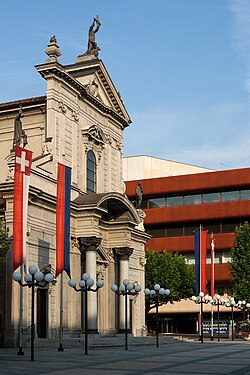
Chiasso's church belonged to the Pieve of Zezio (in Como), from which it withdrew in the 16th century. In 1888, Boffalora separated from the parish. It became the seat of an archpriest in 1928. The Church of San Vitale, first mentioned in 1227, was rebuilt in 1934.
Chiasso
Chiasso (Italian pronunciation: [ˈkjasso]; Lombard: Ciass [ˈtʃas]) is a municipality in the district of Mendrisio in the canton of Ticino in Switzerland.
As the southernmost of Switzerland's municipalities, Chiasso is on the border with Italy, in front of Ponte Chiasso (a frazione of Como, Italy). The municipality of Chiasso includes the villages of Boffalora, Pedrinate and Seseglio.
In 2007, the three mayors of Chiasso, Vacallo and Morbio Inferiore decided to unite into one commune. The new united commune with a population of ~15,300 people over a territory of 9.2 km2 (3.6 sq mi), was rejected by the population in November 2007.
Chiasso is first mentioned in 1140 as Claso.
Historically, Chiasso and Boffalora were two distinct agricultural villages. Due to the nearby Italian border and customs office, and later as part of an access route to the St. Gotthard's Tunnel, the two villages merged and grew.
Chiasso's history and development were strongly influenced by its unique location. In its early history, a castle was built in Chiasso as part of the extended fortifications of the city of Como. It was a suburb of Como, until 1416 when it was incorporated into the Pieve of Balerna and given to the Rusca family to manage. The houses in the village centre were owned by the Albrici family and were granted imperial privileges. Chiasso had become an independent community sometime before 1552. In the contemporary documents, it is mentioned as Clasio tabernarum (Chiasso of taverns) referring to its function as a transit point.
Boffalora is mentioned in 1536 as a municipality and kept its independence until the second half of the 17th century. They became a single parish in either 1657 or 1677.
Chiasso's church belonged to the Pieve of Zezio (in Como), from which it withdrew in the 16th century. In 1888, Boffalora separated from the parish. It became the seat of an archpriest in 1928. The Church of San Vitale, first mentioned in 1227, was rebuilt in 1934.
Recent media
Recent media