

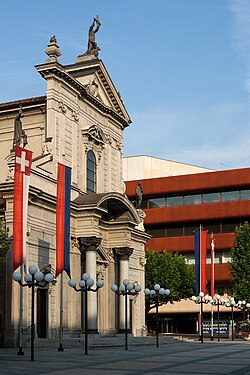

Chiasso
View on WikipediaChiasso (Italian pronunciation: [ˈkjasso]; Lombard: Ciass [ˈtʃas]) is a municipality in the district of Mendrisio in the canton of Ticino in Switzerland.
Key Information


As the southernmost of Switzerland's municipalities, Chiasso is on the border with Italy, in front of Ponte Chiasso (a frazione of Como, Italy). The municipality of Chiasso includes the villages of Boffalora, Pedrinate and Seseglio.
In 2007, the three mayors of Chiasso, Vacallo and Morbio Inferiore decided to unite into one commune. The new united commune with a population of ~15,300 people over a territory of 9.2 km2 (3.6 sq mi), was rejected by the population in November 2007.
History
[edit]Chiasso is first mentioned in 1140 as Claso.[1]
Chiasso (and Boffalora)
[edit]

Historically, Chiasso and Boffalora were two distinct agricultural villages. Due to the nearby Italian border and customs office, and later as part of an access route to the St. Gotthard's Tunnel, the two villages merged and grew.
Chiasso's history and development were strongly influenced by its unique location. In its early history, a castle was built in Chiasso as part of the extended fortifications of the city of Como. It was a suburb of Como, until 1416 when it was incorporated into the Pieve of Balerna and given to the Rusca family to manage. The houses in the village centre were owned by the Albrici family and were granted imperial privileges. Chiasso had become an independent community sometime before 1552. In the contemporary documents, it is mentioned as Clasio tabernarum (Chiasso of taverns) referring to its function as a transit point.
Boffalora is mentioned in 1536 as a municipality and kept its independence until the second half of the 17th century. They became a single parish in either 1657 or 1677.
Chiasso's church belonged to the Pieve of Zezio (in Como), from which it withdrew in the 16th century. In 1888, Boffalora separated from the parish. It became the seat of an archpriest in 1928. The Church of San Vitale, first mentioned in 1227, was rebuilt in 1934.
In the 15th century, Chiasso was known for its horse market. But the market ended after the invasion of the Swiss Confederation and the march through Chiasso in the War of the League of Cambrai in 1510. In the late 16th century, Chiasso had a smaller population than other municipalities of the Mendrisiotto valley. The village survived through its role as a border town (providing warehouses and inns) along with income from agriculture and paper mills. In the 19th century, tobacco and silk factories moved into the town.
The construction of the railway along with income from customs induced an economic and demographic recovery in Chiasso. In 1874 the railway line Lugano-Chiasso opened, followed in 1876 by one running to Como.
In 1910, the Mendrisio electric tramway opened, linking a northern terminus in Riva San Vitale with Capolago, Mendrisio, Balerna and Chiasso. The section of the line in Chiasso closed in 1950 and was replaced by a bus service.[2]
Today, a large part of the town is devoted to Chiasso's international railway station and related customs (though some of the border-control responsibilities have been moved to Como, in Italy). There is also a sizeable customs area for traffic passing by road and motorway (both commercial and non-commercial vehicles).
Chiasso offers also a lot of customs-related services. A considerable source of revenue for the town is Italians crossing the border to buy certain goods more cheaply in Switzerland, particularly cigarettes and petrol. It is also a banking centre for Italian clients wishing to keep money within the Swiss banking system.
Starting in 1950, Chiasso became an important financial centre and the economic centre of the Mendrisio region; hence rapid population growth. Since the 1980s, however, population and jobs, especially in the service sector, have shifted into neighbouring communities.
The pedestrian zone
[edit] |
From 2001 to 2005, a new pedestrian zone was created, stretching from the customs area to the municipal building. An enlargement of this zone was proposed by the local administration and put to a public referendum on 24 September 2006.
Pedrinate
[edit] |
Pedrinate was first mentioned in 1291 as Pedrenate, but Roman ruins near the village church indicate a much longer history. It was mentioned in 1335 as part of the village cooperative of Seseglio. The village church of S. Stefano is first mentioned in 1545 and was part of the Balerna parish until the 17th century.
Pedrinate municipality was aggregated in the Chiasso municipality in 1975, along with Seseglio. It is located above Chiasso, on the Penz hill. Pedrinate is the most southern village in Switzerland.
Around Pedrinate there are some vineyards.
Seseglio
[edit]Seseglio is on the northern boundary of Chiasso municipality.
Geography
[edit]

Chiasso has an area, as of 1997[update], of 5.33 square kilometers (2.06 sq mi). Of this area, 1.63 km2 (0.63 sq mi) or 30.6% is used for agricultural purposes, while 2.65 km2 (1.02 sq mi) or 49.7% is forested. Of the rest of the land, 1.94 km2 (0.75 sq mi) or 36.4% is settled (buildings or roads), 0.02 km2 (4.9 acres) or 0.4% is either rivers or lakes and 0.04 km2 (9.9 acres) or 0.8% is unproductive land.
Of the built-up area, industrial buildings made up 1.7% of the total area while housing and buildings made up 18.4% and transportation infrastructure made up 14.4%. while parks, green belts and sports fields made up 1.7%. Of the forested land, 47.5% of the total land area is heavily forested and 2.3% is covered with orchards or small clusters of trees. Of the agricultural land, 7.9% is used for growing crops, 4.3% is used for orchards or vine crops, and 18.4% is used for alpine pastures. All the water in the municipality is flowing water.[3]
The municipality is in the Mendrisio district, on the Italian border. Since Pedrinate merged into Chiasso in 1976, it has been the most southerly municipality in Switzerland.
Coat of arms
[edit]The blazon of the municipal coat of arms is Argent lion passant holding a letter C gules standing on a carriage entrance azure. The carriage entrance refers to Chiasso location of the ancient road coming from Como and giving access to several places from Chiasso.[4]
Demographics
[edit]Chiasso has a population (as of December 2020[update]) of 7,581.[5] As of 2008[update], 36.4% of the population are resident foreign nationals.[6] In 1997–2007 the population changed at a rate of −2.8%.
Most of the people (as of 2000[update]) speak Italian (91.3%); German is second most common (2.5%) and Albanian is third (1.2%).[7] Of the Swiss national languages (as of 2000[update]), 196 speak German, 71 people speak French, 7,048 people speak Italian, and 4 people speak Romansh. The remainder (401 people) speak another language.[8]
As of 2008[update], the gender distribution of the population was 47.0% male and 53.0% female. The population was made up of 2,226 Swiss men (28.7% of the population), and 1,420 (18.3%) non-Swiss men. There were 2,774 Swiss women (35.7%), and 1,343 (17.3%) non-Swiss women.[9]
In 2008[update] there were 42 live births to Swiss citizens and 26 births to non-Swiss citizens, and in the same time span, there were 63 deaths of Swiss citizens and 27 non-Swiss citizen deaths. Ignoring immigration and emigration, the population of Swiss citizens decreased by 21 while the foreign population decreased by 1. There was 1 Swiss man who immigrated back to Switzerland and 3 Swiss women who emigrated from Switzerland. At the same time, there were 104 non-Swiss men and 94 non-Swiss women who immigrated from another country to Switzerland. The total Swiss population change in 2008 (from all sources, including moves across municipal borders) was a decrease of 47 and the non-Swiss population change was an increase of 108 people. This represents a population growth rate of 0.8%.[6]
The age distribution, as of 2009[update], in Chiasso is; 567 children or 7.3% of the population are between 0 and 9 years old and 586 teenagers or 7.5% are between 10 and 19. Of the adult population, 790 people or 10.2% of the population are 20–29 years old. 1,118 people or 14.4% are between 30 and 39, 1,215 people or 15.7% are between 40 and 49, and 1,008 people or 13.0% are between 50 and 59. The senior population is 996 people or 12.8% of the population are 60–69 years old, 841 people or 10.8% are 70–79, there are 642 people or 8.3% who are over 80.[9]
As of 2000[update], there were 3,774 private households in the municipality and an average of 2. persons per household.[7] In 2000[update] there were 313 single-family homes (or 33.3% of the total) of a total of 940 inhabited buildings. There were 336 multi-family buildings (35.7%), along with 193 multi-purpose buildings that were mostly used for housing (20.5%) and 98 other use buildings (commercial or industrial) that also had some housing (10.4%). Of the single-family homes, 11 were built before 1919, while 38 were built between 1990 and 2000. The greatest number of single-family homes (111) were built between 1919 and 1945.[10]
In 2000[update] there were 4,498 apartments in the municipality. The most common apartment size was 3 rooms of which there were 1,692. There were 316 single-room apartments and 493 apartments with five or more rooms. Of these apartments, a total of 3,763 apartments (83.7% of the total) were permanently occupied, while 181 apartments (4.0%) were seasonally occupied and 554 apartments (12.3%) were empty.[10] The vacancy rate for the municipality, in 2008[update], was 3.5%.[7] As of 2007[update], the construction rate of new housing units was 2.4 new units per 1000 residents.[7]
As of 2003[update] the average price to rent an average apartment in Chiasso was 873.89 Swiss francs (CHF) per month (US$700, £390, €560 approx. exchange rate from 2003). The average rate for a one-room apartment was 491.07 CHF (US$390, £220, €310), a two-room apartment was about 646.96 CHF (US$520, £290, €410), a three-room apartment was about 806.94 CHF (US$650, £360, €520) and a six or more room apartment cost an average of 1544.67 CHF (US$1240, £700, €990). The average apartment price in Chiasso was 78.3% of the national average of 1116 CHF.[11]
The historical population is given in this chart:[1][12]

Notable people
[edit]- Antonio Soldini (1854 in Chiasso – 1933), a Swiss-Italian sculptor
- Serge Brignoni (1903 in Chiasso – 2002), a Swiss avant-garde painter and sculptor
- Marco Grassi (born 1968 in Chiasso), a retired Swiss footballer, played 309 league games and 31 for the Switzerland national team
Sights
[edit]The entire village of Chiasso is designated as part of the Inventory of Swiss Heritage Sites.[13]
Politics
[edit]In the 2007 federal election the most popular party was the FDP which got 29.77% of the vote. The next three most popular parties were the SP (20.42%), the Ticino League (18.12%) and the CVP (16.54%). In the federal election, a total of 2,050 votes were cast, and the voter turnout was 45.6%.[14]
In the 2007[update] Gran Consiglio election, there were a total of 4,447 registered voters in Chiasso, of which 2,623 or 59.0% voted. 41 blank ballots and 14 null ballots were cast, leaving 2,568 valid ballots in the election. The most popular party was the PLRT which received 698 or 27.2% of the vote. The next three most popular parties were; the PS (with 486 or 18.9%), the SSI (with 456 or 17.8%) and the LEGA (with 406 or 15.8%).[15]
In the 2007[update] Consiglio di Stato election, 30 blank ballots and 21 null ballots were cast, leaving 2,572 valid ballots. The most popular party was the PLRT which received 668 or 26.0% of the vote. The next three most popular parties were the PS (with 531 or 20.6%), the LEGA (with 530 or 20.6%) and the SSI (with 417 or 16.2%).[15]
Economy
[edit]As of 2007[update], Chiasso had an unemployment rate of 7.01%. As of 2005[update], there were 42 people employed in the primary economic sector and about 19 businesses involved in this sector. 880 people were employed in the secondary sector and there were 69 businesses in this sector. 5,549 people were employed in the tertiary sector, with 779 businesses in this sector.[7] There were 3,410 residents of the municipality who were employed in some capacity, of which females made up 42.3% of the workforce.
In 2008[update] the total number of full-time equivalent jobs was 6,265. The number of jobs in the primary sector was 15, all of which were in agriculture. The number of jobs in the secondary sector was 931, of which 402 (43.2%) were in manufacturing and 473 (50.8%) were in construction. The number of jobs in the tertiary sector was 5,319. In the tertiary sector; 810 or 15.2% were in wholesale or retail sales or the repair of motor vehicles, 1,550 or 29.1% were in the movement and storage of goods, 208 or 3.9% were in a hotel or restaurant, 84 or 1.6% were in the information industry, 706 or 13.3% were the insurance or financial industry, 684 or 12.9% were technical professionals or scientists, 132 or 2.5% were in education and 365 or 6.9% were in health care.[16]
In 2000[update], there were 6,532 workers who commuted into the municipality and 1,667 workers who commuted away. The municipality is a net importer of workers, with ~3.9 workers entering the municipality for everyone leaving. About 21.4% of the workforce coming into Chiasso are coming from outside Switzerland, while 4.0% of the locals commute out of Switzerland for work.[17] Of the working population, 9.9% used public transportation to get to work, and 47.8% used a private car.[7]
As of 2009[update], there were 4 hotels in Chiasso with a total of 128 rooms and 281 beds.[18]
Companies based in Chiasso include Lastminute.com Group.
Traffic
[edit]
The fortune of Chiasso is mostly linked to its location on the A2; the main route to St. Gotthard's Tunnel, which connects the southern parts of the Alps and Italy with the northern part of Switzerland and Germany.
The A2 Swiss motorway begins at Chiasso. Long traffic queues often occur on the motorway around the border where vehicles are being checked for contraband.
Religion
[edit]
From the 2000 census[update], 6,235 or 80.8% were Roman Catholic, while 230 or 3.0% belonged to the Swiss Reformed Church. There are 754 individuals (or about 9.77% of the population) who belong to another church (not listed on the census), and 501 individuals (or about 6.49% of the population) did not answer the question.[8]
Education
[edit]
The entire Swiss population is generally well educated. In Chiasso about 58.1% of the population (between age 25–64) have completed either non-mandatory upper secondary education or additional higher education (either University or a Fachhochschule).[7]
In Chiasso there were a total of 999 students (as of 2009[update]). The Ticino education system provides up to three years of non-mandatory kindergarten and in Chiasso there were 173 children in kindergarten. The primary school program lasts for five years and includes both a standard school and a special school. In the municipality, 300 students attended the standard primary schools and 20 students attended the special school. In the lower secondary school system, students either attend a two-year middle school followed by a two-year pre-apprenticeship or they attend a four-year program to prepare for higher education. There were 249 students in the two-year middle school and 10 in their pre-apprenticeship, while 78 students were in the four-year advanced program.
The upper secondary school includes several options, but at the end of the upper secondary program, a student will be prepared to enter a trade or to continue on to a university or college. In Ticino, vocational students may either attend school while working on their internship or apprenticeship (which takes three or four years) or may attend school followed by an internship or apprenticeship (which takes one year as a full-time student or one and a half to two years as a part-time student).[19] There were 57 vocational students who were attending school full-time and 98 who attend part-time.
The professional program lasts three years and prepares a student for a job in engineering, nursing, computer science, business, tourism and similar fields. There were 14 students in the professional program.[20]
As of 2000[update], there were 265 students in Chiasso who came from another municipality, while 318 residents attended schools outside the municipality.[17]
Sport
[edit]
References
[edit]- ^ a b Chiasso in German, French and Italian in the online Historical Dictionary of Switzerland.
- ^ "Tramvie Madrisiensi". www.eingestellte-bahnen.ch (in German). Archived from the original on 2012-01-05. Retrieved 2012-09-20.
- ^ Altitudine, superficie, secondo il genere di utilizzazione, rilevazione 1992/1997, e densità della popolazione, nel 2000 (in Italian) accessed 25 October 2010
- ^ Flags of the World.com accessed 31-January-2011
- ^ "Ständige und nichtständige Wohnbevölkerung nach institutionellen Gliederungen, Geburtsort und Staatsangehörigkeit". bfs.admin.ch (in German). Swiss Federal Statistical Office - STAT-TAB. 31 December 2020. Retrieved 21 September 2021.
- ^ a b Swiss Federal Statistical Office - Superweb database - Gemeinde Statistics 1981-2008 Archived June 28, 2010, at the Wayback Machine (in German) accessed 19 June 2010
- ^ a b c d e f g Swiss Federal Statistical Office Archived January 5, 2016, at the Wayback Machine accessed 31-January-2011
- ^ a b Popolazione residente, secondo la lingua principale e la religione, nel 2000 Archived July 7, 2011, at the Wayback Machine (in Italian) accessed 23 November 2010
- ^ a b 01.02.03 Popolazione residente permanente Archived July 7, 2011, at the Wayback Machine (in Italian) accessed 23 November 2010
- ^ a b Federal Statistical Office STAT-TAB - Datenwürfel für Thema 09.2 - Gebäude und Wohnungen Archived January 21, 2015, at the Wayback Machine (in German) accessed 28 January 2011
- ^ Swiss Federal Statistical Office-Rental prices Archived 2010-04-23 at the Wayback Machine 2003 data (in German) accessed 26 May 2010
- ^ Swiss Federal Statistical Office STAT-TAB Bevölkerungsentwicklung nach Region, 1850-2000 Archived September 30, 2014, at the Wayback Machine (in German) accessed 29 January 2011
- ^ "Kantonsliste A-Objekte:Ticino" (PDF). KGS Inventar (in German). Federal Office of Civil Protection. 2009. Archived from the original (PDF) on 6 July 2011. Retrieved 12 July 2010.
- ^ Swiss Federal Statistical Office, Nationalratswahlen 2007: Stärke der Parteien und Wahlbeteiligung, nach Gemeinden/Bezirk/Canton Archived May 14, 2015, at the Wayback Machine (in German) accessed 28 May 2010
- ^ a b Elezioni cantonali: Gran Consiglio, Consiglio di Stato Archived July 7, 2011, at the Wayback Machine (in Italian) accessed 23 November 2010
- ^ Swiss Federal Statistical Office STAT-TAB Betriebszählung: Arbeitsstätten nach Gemeinde und NOGA 2008 (Abschnitte), Sektoren 1-3 Archived December 25, 2014, at the Wayback Machine (in German) accessed 28 January 2011
- ^ a b Swiss Federal Statistical Office - Statweb (in German) accessed 24 June 2010
- ^ Settori alberghiero e paralberghiero Archived July 7, 2011, at the Wayback Machine (in Italian) accessed 23 November 2010
- ^ EDK/CDIP/IDES (2010). KANTONALE SCHULSTRUKTUREN IN DER SCHWEIZ UND IM FÜRSTENTUM LIECHTENSTEIN / STRUCTURES SCOLAIRES CANTONALES EN SUISSE ET DANS LA PRINCIPAUTÉ DU LIECHTENSTEIN (PDF) (Report). Retrieved 24 June 2010.
- ^ Allievi e studenti, secondo il genere di scuola, anno scolastico 2009/2010 Archived July 7, 2011, at the Wayback Machine (in Italian) accessed 23 November 2010
External links
[edit]
- (in Italian) Official municipality website
- Chiasso in German, French and Italian in the online Historical Dictionary of Switzerland.
 | ||
| International | |
|---|---|
| National | |
| Geographic | |
| Other | |

Chiasso
View on GrokipediaHistory
Origins and Medieval Period
The site of Chiasso, situated at the Italo-Swiss border along ancient north-south trade routes from the Po Valley toward Alpine passes like the Gotthard, likely facilitated early human transit and settlement due to its position near Lake Lugano's outlet. While the broader Ticino region exhibits evidence of Bronze Age and Roman-era activity—including roads and artifacts indicative of connectivity between Como and Bellinzona—specific pre-12th-century documentation for Chiasso remains elusive, with any prior habitation inferred from its logistical role rather than direct finds. The toponym "Chiasso," first appearing as "Claso" or "Clasio Tabernarium" in 1146, derives from the Latin tabernae (inns or rest stops), underscoring its emergence as a cluster of traveler accommodations amid growing medieval commerce.[4] In its initial recorded phase, Chiasso belonged to the territorial holdings of the Bishopric of Como, managed by the local Albrici family, who oversaw feudal interests in the Mendrisiotto district. By the 13th century, ecclesiastical ties strengthened, as evidenced by the 1237 mention of the Church of San Vitale, which served as a waypoint for pilgrims and merchants. Integration into the Pieve di Balerna—a medieval ecclesiastical and administrative subdivision—formalized its rural parish status, embedding it within the Lombardic-influenced socio-economic fabric of southern Ticino.[4] The late medieval era saw Chiasso's consolidation under noble patronage, with assignment to the Rusca family in 1416, who held sway over regional lands amid shifting Milanese hegemony. This period highlighted its commercial vitality: as a border nexus, it hosted a prominent 15th-century equestrian fair, drawing equines, goods, and traders en route to northern markets, thereby fostering localized economic dependencies on tolls and provisioning. Political turbulence escalated with the Swiss Confederation's expansion southward; in 1510, during clashes between confederate forces and Sforza Milanese troops, Chiasso fell under Swiss control, ending its direct Italian overlordship and aligning it with emerging Helvetic alliances.[4]Early Modern Development and Swiss Integration
In the 15th century, Chiasso emerged as a notable transit point on the route between Milan and the Alpine passes, renowned for its annual horse fair that attracted traders from northern Italy and beyond.[5] This market, centered in a village then comprising modest dimensions, contributed to local prosperity through commerce and related services, though it operated under the feudal oversight of the Rusca family following the area's integration into the Pieve di Balerna in 1416.[5][6] The Swiss Confederation's military expeditions during the Italian Wars marked a pivotal shift, with troops marching through Chiasso in 1510 en route to support papal forces against Venetian and Milanese interests, leading to the village's annexation into Swiss-controlled territory amid conflicts with the Sforza dynasty.[5] This event, part of broader Confederate expansion southward, curtailed the horse fair's viability due to disrupted trade routes and heightened border tensions, transitioning Chiasso into a peripheral outpost under joint Swiss administration.[5] By 1521, the Confederacy had consolidated control over the region from the Gotthard Pass to Chiasso, incorporating it into the bailiwicks (Vogteien) of the Mendrisiotto, governed collectively by cantons including Uri, Schwyz, and Lucerne.[7] Under Swiss overlordship, Chiasso's economy pivoted toward subsistence agriculture, small-scale milling (including fulling and paper production), and border-related activities such as taverns and hospices serving travelers and troops.[5] The village, designated a commune around 1552 and known locally as "Clasio tabernarum" for its inns, experienced gradual population growth—from 160 inhabitants in 1591 to 315 in 1685 and 455 by 1769—reflecting stability rather than expansion in a rural, frontier context.[5] Administrative ties to the Swiss core remained loose, with local governance handled by podestà appointed from the ruling cantons, while ecclesiastical separation from the Zezio parish occurred in the 16th century, fostering modest institutional autonomy.[5] This period of integration embedded Chiasso within the Old Swiss Confederacy's transalpine domains, prioritizing defensive and customs functions over commercial revival, until the Napoleonic upheavals of 1798–1803 restructured the region into the Canton of Ticino.[5] Economic modesty persisted, with no significant industrialization or demographic surges until the subsequent railway era.[5]19th-Century Growth and Industrialization
The 19th century marked the onset of notable economic expansion in Chiasso, driven primarily by the emergence of small-scale manufacturing sectors focused on silk processing and tobacco production. These industries capitalized on the town's proximity to Italy and access to regional agricultural inputs, such as mulberry leaves for silkworms and locally grown tobacco leaves, which had been cultivated in Ticino since the late 18th century. Factories for weaving silk and curing tobacco began operations in the early to mid-1800s, providing employment and stimulating local trade across the border, though output remained modest compared to larger Swiss industrial centers.[4][8] Population growth reflected this nascent industrialization, with Chiasso's residents numbering just 579 in 1801 after centuries of slow increase, but accelerating in the first half of the century due to job opportunities in the new manufactories and related border commerce. By mid-century, the influx of workers from surrounding areas contributed to demographic pressures, prompting initial infrastructure improvements like expanded housing and roads to handle cross-border traffic. However, the town's economy still relied heavily on agriculture and transit duties rather than heavy mechanization, limiting it to proto-industrial status until later developments.[9][10] A pivotal catalyst arrived with the completion of the Gotthard railway line in 1882, which connected northern Switzerland to Italy via the newly pierced Gotthard Tunnel and established Chiasso as the primary southern terminus and customs hub. This infrastructure transformed the municipality into a vital transit node for passengers, freight, and mail, dramatically increasing cross-border flows and generating revenue from tariffs and services. The railway station's expansion facilitated not only trade in goods like textiles and foodstuffs but also spurred ancillary industries, such as warehousing and mechanical workshops, laying the groundwork for Chiasso's role in Switzerland's north-south axis.[4][11]20th-Century Expansion and Financial Boom
In the early 20th century, Chiasso's infrastructure expanded to support cross-border trade, with the introduction of the Mendrisio electric tramway connecting the town to surrounding areas, enhancing accessibility until its replacement by bus services in 1950.[12] This development underscored Chiasso's role as a gateway between Switzerland and Italy, fostering initial economic ties through customs and commerce at the Brogeda border crossing. From 1950 onward, Chiasso emerged as a key financial center in the Mendrisio region, driven by Switzerland's banking secrecy laws attracting substantial Italian capital fleeing post-war instability and high taxes in Italy.[13] Local branches of major Swiss banks, such as Credit Suisse, channeled billions in undeclared funds from Italy, with the town's border proximity enabling discreet transfers via cash smuggling or numbered accounts.[14] This influx positioned Chiasso as a hub for private banking and asset management, contributing to Ticino's broader shift toward finance as an economic pillar. The second half of the 20th century saw accelerated growth in Chiasso's services sector, particularly finance and logistics, transforming it into the region's economic core and Ticino's second-largest employment center after Lugano. This expansion was fueled by Italy's economic miracle, which increased demand for Swiss financial services among wealthy individuals and firms seeking stability and anonymity, leading to rapid urbanization and infrastructure investments in commercial districts.[13] However, the scale of these flows drew scrutiny, exemplified by the 1977 Chiasso scandal, where Credit Suisse's local branch handled approximately $1.2 billion in illicit Italian deposits, prompting tighter regulations but highlighting the town's prior boom in cross-border finance.[14][15]Recent Annexations and Urban Developments
In the absence of recent municipal annexations or mergers—despite periodic discussions, such as renewed interest in fusions noted in 2015—Chiasso has prioritized infrastructure enhancements tied to its role as a key border and rail hub.[16] The "ACE Chiasso" project, executed from 2017 to 2021 at a cost of CHF 21.6 million, renovated the SBB Chiasso station across a 7,000 m² freight yard with five tracks, incorporating elevated sidewalks, new passenger shelters, a customs building, and improved access ramps to accommodate increased passenger and freight traffic from the Gotthard Base Tunnel, Monte Ceneri base tunnel, and Mendrisio-Varese rail link.[17] These upgrades reduced travel time to Milan Centrale to 46 minutes while adapting to larger rolling stock.[17] A new intermodal logistics terminal opened in 2022 at the Chiasso marshalling yard, funded by approximately €10 million from the Swiss Federal Office of Transport, to enable efficient road-to-rail transfers within Switzerland's regional network and bolster cross-border freight resilience.[18] Complementing this, SBB Cargo completed an expanded workshop in Chiasso in 2023, investing over CHF 12 million to support maintenance demands from heightened Alpine transit volumes.[19] Urban renewal efforts include the enhancement of the Soldini district, featuring upgraded public roads, dedicated slow-traffic zones, and revitalized open spaces to improve pedestrian connectivity and livability.[20] Residential developments continue to address housing needs near the border, with ongoing renewal of areas emphasizing sustainable growth amid Ticino's broader territorial planning.[21] These projects reflect Chiasso's adaptation to economic pressures from EU-Swiss trade dynamics and regional agglomeration trends, without territorial expansion.[22]Geography
Location and Topography
Chiasso is a municipality in the Distretto di Mendrisio of Canton Ticino, Switzerland, marking the country's southernmost point and directly bordering the Italian region of Lombardy. It serves as a crucial border crossing, facilitating major rail and road links, including the endpoint of the Gotthard route. The town's central coordinates are 45.84°N, 9.02°E.[1][23][24] The municipality covers 5.33 km² at an elevation of about 230 m in the urban core, with topography featuring flat plains transitioning to gentle hills in the Mendrisiotto area, at the Alps' southern foothills. Average elevation across the area reaches 362 m, supporting urban, agricultural, and forested land uses amid varied relief.[25][26][26]Climate and Environmental Features
Chiasso exhibits a temperate climate with Mediterranean influences, featuring mild winters and warm, humid summers typical of southern Switzerland's Ticino region. Annual precipitation averages 1,571 mm, with significant rainfall throughout the year contributing to lush vegetation in surrounding areas. Temperatures vary seasonally from average lows of around -2°C in winter months like January to highs reaching 28°C in summer, particularly July, where daily averages approach 24°C.[27] [28] The region's low elevation of approximately 230 meters above sea level and proximity to the Italian border amplify warmer conditions compared to northern Switzerland, with the Alps shielding it from harsher continental weather patterns.[29] Environmentally, Chiasso lies in the flat Mendrisiotto plain, part of the broader Po Valley extension, supporting agriculture such as vineyards that benefit from the sunny, warm microclimate with extended daylight hours.[30] Air quality remains generally good, with low PM2.5 levels monitored in the area, though cross-border traffic at the customs station introduces occasional localized pollution from vehicles.[31] The surrounding topography includes gentle hills rising to the Prealps, fostering a mix of urban development and green spaces, but the municipality's border location heightens vulnerability to transboundary environmental factors like Italian industrial emissions.[32]Heraldry
Coat of Arms and Symbolism
The coat of arms of Chiasso consists of a silver (argent) field bearing an azure carriage entrance (portone), surmounted by a red (gules) lion passant holding a red letter "C".[33] This blazon was officially adopted in 1953 as part of a comprehensive heraldic study conducted for all municipalities in the Canton of Ticino to mark the 150th anniversary of the canton's accession to the Swiss Confederation in 1803.[34] The design reworks elements from the historical arms of the Albrici family, patricians from nearby Como who acquired properties in Chiasso as early as 1375, linking the municipal emblem to medieval landownership patterns in the region.[34] The central carriage entrance symbolizes Chiasso's longstanding role as a gateway town on ancient transit routes, emphasizing its strategic position at the Swiss-Italian border and historical significance for trade and passage since Roman times.[33] In heraldry, the lion passant evokes vigilance and defensive strength, positioned as a guardian over the portal, while the prominent "C" directly initials the municipality's name, reinforcing local identity.[33] Earlier iterations of the arms reflected evolving civic priorities; a 19th-century version incorporated a liberty tree atop a fasces bundle with a Phrygian cap, evoking revolutionary ideals, whereas the 1903 revision added Mercury's winged caduceus—tilted to the right as a commerce emblem—alongside a torch-bearing fasces and a radiant Swiss federal cross, underscoring the town's burgeoning trade functions amid industrialization.[34] The 1953 standardization prioritized historical continuity over these transient motifs, favoring a simplified, enduring representation tied to territorial heritage.[34]Demographics
Population Trends and Statistics
As of 31 December 2023, Chiasso's permanent resident population stood at 7,738, reflecting a slight increase from the previous year driven by net positive migration despite a natural decrease from births and deaths.[35] By 31 December 2024, this figure rose marginally to 7,784, continuing a modest recovery after years of stagnation or decline.[36] The municipality has seen population pressures from its border location, with a notable decline in the late 2010s: in 2019, the total fell due to deaths outpacing births (birth rate approximately 6.7‰ versus death rate of 17.4‰), though foreign inflows partially mitigated losses.[37] [38] Recent data indicate a turnaround, with rising births contributing to growth after prolonged contraction, alongside sustained immigration supporting the resident base.[39] Key statistics highlight an aging profile, with an average resident age of 48.3 years and a high proportion of foreigners at 43.9% of the total population, reflecting cross-border economic ties with Italy.[40] Population density remains elevated at around 1,414 inhabitants per square kilometer, consistent with urban border dynamics in the Mendrisio district.[41]Ethnic and Linguistic Composition
Chiasso's linguistic composition is overwhelmingly Italian-dominant, consistent with its position in the Italian-speaking canton of Ticino. Approximately 91.3% of residents speak Italian as their mother tongue, reflecting both native Swiss-Italian heritage and the influence of cross-border ties with Italy. Minorities include German speakers at around 2.5% and Albanian at 1.2%, often associated with smaller immigrant communities. Ethnically, the population comprises Swiss nationals, predominantly of Italian linguistic and cultural background, alongside a substantial foreign-resident segment. Foreign nationals constitute 43.9% of the approximately 7,564 inhabitants, with many originating from Italy due to the municipality's adjacency to the border.[42] This demographic reflects historical migration patterns tied to trade, commuting, and economic opportunities across the Swiss-Italian frontier, though detailed breakdowns by specific nationalities beyond Europeans remain limited in municipal reporting.[43] The high proportion of foreign-born individuals (around 55%, based on country-of-birth data) underscores Chiasso's role as a cosmopolitan border hub, yet the shared Italo-Swiss cultural continuum minimizes stark ethnic divides.[2]Religious Affiliations
Chiasso's religious affiliations are characterized by a strong Roman Catholic majority, influenced by its position in the predominantly Catholic canton of Ticino and historical ties to northern Italy. Swiss Cities Statistics indicate that 66.5% of residents affiliate with the Roman Catholic Church, a figure elevated compared to the national urban average of 31.5% and attributable in part to post-World War II immigration from Catholic-majority countries such as Italy, Spain, and Portugal.[44] Protestant affiliations remain minimal, with the Swiss Reformed Church representing a small segment of the population, historically around 3% as per early 2000s data patterns in similar Ticino municipalities.[45] The town's border location fosters a diverse expatriate and commuter population, contributing to the presence of Orthodox Christian communities, particularly from Eastern Europe, and a growing Muslim minority linked to recent labor migration, though specific percentages for these groups in Chiasso are not granularly reported in federal aggregates.[46] Non-religious affiliations have risen nationally, surpassing Catholics at 34% in 2022, but Chiasso's Catholic adherence suggests slower secularization locally, sustained by cultural and familial traditions.[47] The primary place of worship, the Church of San Vitale, serves the Catholic parish under the Diocese of Lugano, underscoring the centrality of Catholicism in community life.Government and Politics
Municipal Administration
The municipal administration of Chiasso operates under the standard framework for municipalities in the Canton of Ticino, featuring an executive body (Municipio) and a legislative body (Consiglio Comunale), supplemented by an Assembly of Citizens for certain deliberations. The Municipio consists of five members, elected by proportional representation from party lists, and is presided over by the mayor (sindaco), who serves as primus inter pares with enhanced ceremonial and representational responsibilities but no veto power over decisions.[48] The executive handles day-to-day governance, policy implementation, and departmental assignments such as finance, social services, and urban planning, with the mayor coordinating meetings and external relations.[48] The Consiglio Comunale, comprising 45 members, functions as the legislative authority, approving budgets, ordinances, and major initiatives while overseeing the executive through commissions and inquiries.[49] Members are also elected via proportional representation from lists, ensuring multipartisan representation reflective of voter preferences.[50] Elections for both bodies occur every four years on a uniform cantonal date, with the most recent held on April 14, 2024, yielding a turnout of approximately 50% among eligible voters.[51] [52] In the 2024 elections, Bruno Arrigoni of the PLR-Liberali was re-elected mayor with 1,492 personal votes, the highest tally, securing his leadership role for the 2024-2028 term.[53] The full Municipio includes Arrigoni alongside Luca Bacciarini (PLR, 1,110 votes), Stefano Tonini (Lega), and two others elected from competitive lists, maintaining a balance among centrist and right-leaning parties.[53] [54] The council composition reflects PLR dominance with multiple seats, followed by distributions to the Lega, Il Centro (former PPD), and minor lists like PS and Verdi, as determined by the Hare quota method applied to 161,068 total votes cast.[49] [50] Administrative operations are supported by a cancelleria (secretariat) handling records, elections, and citizen services, led by a secretary reporting to the executive.[55]Electoral Outcomes and Party Representation
In the municipal elections held on April 14, 2024, Chiasso's 45-seat Consiglio Comunale was elected using a proportional representation system, with seats allocated based on list vote totals via the Hagenbach-Bischoff method. The FDP.The Liberals (PLR I Liberali Radicali) secured the largest share, winning 16 seats with 56,683 list votes (35.2% of the valid vote).[49] The Lega dei Ticinesi-UDC-Indipendenti coalition followed with 10 seats from 34,848 votes (21.6%), while the Unità di Sinistra-I Verdi-Indipendenti list obtained 9 seats with 33,547 votes (20.8%).[49] The Centro e i Verdi Liberali alliance also gained 9 seats from 30,604 votes (19.0%), and the minor list HelvEthica Ticino took the remaining seat with 5,386 votes (3.3%).[49] Of 4,123 registered voters, 2,290 participated (55.5% turnout), yielding 2,213 valid ballots and total list votes of 161,068.[49] The five-member executive body, the Municipio, is indirectly elected from council lists, with terms aligning to council cycles. In 2024, the PLR retained two seats, including re-elected mayor Bruno Arrigoni (1,491 personal votes) and Luca Bacciarini; the remaining seats went to representatives from the Lega-UDC-Indipendenti (one), Unità di Sinistra-I Verdi-Indipendenti (one), and Centro e i Verdi Liberali (Davide Lurati, elected by a narrow two-vote margin over competitor Amedeo Mapelli).[56][57] This configuration reflects a centrist-leaning balance, with the PLR as the dominant force despite a 3.5% vote decline from prior cycles, amid gains for centrist and minor lists.[56][54]| Party/List | Seats | Vote % |
|---|---|---|
| PLR I Liberali Radicali | 16 | 35.2 |
| Lega dei Ticinesi - UDC - Indipendenti | 10 | 21.6 |
| Unità di Sinistra - I Verdi - Indipendenti | 9 | 20.8 |
| il Centro e i Verdi Liberali | 9 | 19.0 |
| HelvEthica Ticino | 1 | 3.3 |