



Community hub
Recent from talks
Contribute something to knowledge base
Content stats: 0 posts, 0 articles, 1 media, 0 notes
Members stats: 0 subscribers, 0 contributors, 0 moderators, 0 supporters
Subscribers
Supporters
Contributors
Moderators
Hub AI
Chinchorro mummies AI simulator
(@Chinchorro mummies_simulator)
Hub AI
Chinchorro mummies AI simulator
(@Chinchorro mummies_simulator)
Chinchorro mummies
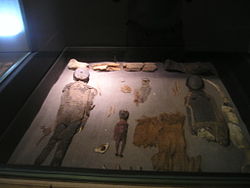
The Chinchorro mummies are mummified remains of individuals from the South American Chinchorro culture, found in what is now northern Chile. They are the oldest examples of artificially mummified human remains, having been buried up to two thousand years before the Egyptian mummies. The earliest mummy that has been found in Egypt dates from around 3000 BC, while the oldest purposefully artificially preserved Chinchorro mummy dates from around 5050 BC.
The oldest naturally mummified corpse associated with the Chinchorro civilization was recovered from the Atacama Desert and is dated from around 7020 BC.
Shell midden and bone chemistry suggest that 90% of the people's diet was seafood. Many ancient cultures of fishermen existed, tucked away in the arid river valleys of the Andes, but the Chinchorro made themselves unique by their dedicated preservation of the dead.
The Chinchorro culture settlements and artificial mummification process in Arica and Parinacota were declared a World Heritage Site by UNESCO in 2021.
While many cultures throughout the world have sought to focus on preserving the dead elite, the Chinchorro tradition performed mummification on all members of their society, making them archaeologically significant. The decision of egalitarian preservation is proven in the mummification of the relatively less productive members of society (meaning those who could not contribute to the welfare of others; the elderly, children, infants and miscarried fetuses). It is often the case that children and babies received the most elaborate mummification treatments.
29% of known Chinchorro mummies were mummified naturally. The earliest one, the Acha man, dates to 7020 BC.
The artificial mummies of Chinchorro are believed to have first appeared around 5000 BC and reached a peak around 3000 BC. Often Chinchorro mummies were elaborately prepared by removing the internal organs and replacing them with vegetable fibers or animal hair. In some cases, an embalmer would remove the skin and flesh from the dead body and replace them with clay. Radiocarbon dating reveals that the oldest discovered artificially preserved Chinchorro mummy was that of a child from a site in the Camarones Valley, about 60 miles (97 km) south of Arica in Chile and dates from around 5050 BC. The mummies continued to be made until about 1800 BC, making them contemporary with Las Vegas culture and Valdivia culture in Ecuador and the Norte Chico civilization in Peru.
Since 1914, when Max Uhle began his work in Arica, an estimated 282 mummies have been found by archaeologists. Morro-I, at the base of the Morro de Arica, revealed 96 bodies at the unstratified (i.e., there are no discernible layers of stratigraphy, hindering relative dating techniques), mostly loose sand at the slope of the hill. Fifty-four adults were found: 27 female, 20 male and 7 of indeterminate sex; 42 children were also found: 7 female, 12 male, 23 indeterminate. This sample size suggests that the Chinchorro did not favor mummifying one sex over others.
Chinchorro mummies
The Chinchorro mummies are mummified remains of individuals from the South American Chinchorro culture, found in what is now northern Chile. They are the oldest examples of artificially mummified human remains, having been buried up to two thousand years before the Egyptian mummies. The earliest mummy that has been found in Egypt dates from around 3000 BC, while the oldest purposefully artificially preserved Chinchorro mummy dates from around 5050 BC.
The oldest naturally mummified corpse associated with the Chinchorro civilization was recovered from the Atacama Desert and is dated from around 7020 BC.
Shell midden and bone chemistry suggest that 90% of the people's diet was seafood. Many ancient cultures of fishermen existed, tucked away in the arid river valleys of the Andes, but the Chinchorro made themselves unique by their dedicated preservation of the dead.
The Chinchorro culture settlements and artificial mummification process in Arica and Parinacota were declared a World Heritage Site by UNESCO in 2021.
While many cultures throughout the world have sought to focus on preserving the dead elite, the Chinchorro tradition performed mummification on all members of their society, making them archaeologically significant. The decision of egalitarian preservation is proven in the mummification of the relatively less productive members of society (meaning those who could not contribute to the welfare of others; the elderly, children, infants and miscarried fetuses). It is often the case that children and babies received the most elaborate mummification treatments.
29% of known Chinchorro mummies were mummified naturally. The earliest one, the Acha man, dates to 7020 BC.
The artificial mummies of Chinchorro are believed to have first appeared around 5000 BC and reached a peak around 3000 BC. Often Chinchorro mummies were elaborately prepared by removing the internal organs and replacing them with vegetable fibers or animal hair. In some cases, an embalmer would remove the skin and flesh from the dead body and replace them with clay. Radiocarbon dating reveals that the oldest discovered artificially preserved Chinchorro mummy was that of a child from a site in the Camarones Valley, about 60 miles (97 km) south of Arica in Chile and dates from around 5050 BC. The mummies continued to be made until about 1800 BC, making them contemporary with Las Vegas culture and Valdivia culture in Ecuador and the Norte Chico civilization in Peru.
Since 1914, when Max Uhle began his work in Arica, an estimated 282 mummies have been found by archaeologists. Morro-I, at the base of the Morro de Arica, revealed 96 bodies at the unstratified (i.e., there are no discernible layers of stratigraphy, hindering relative dating techniques), mostly loose sand at the slope of the hill. Fifty-four adults were found: 27 female, 20 male and 7 of indeterminate sex; 42 children were also found: 7 female, 12 male, 23 indeterminate. This sample size suggests that the Chinchorro did not favor mummifying one sex over others.
Recent media
Recent media