



Community hub
Recent from talks
Knowledge base stats:
Talk channels stats:
Members stats:
Chipping Campden
Chipping Campden is a market town in the Cotswold district of Gloucestershire, England. It is notable for its terraced High Street, dating from the 14th to the 17th centuries.
A wool trading centre in the Middle Ages, Chipping Campden enjoyed the patronage of wealthy wool merchants, most notably William Greville (d.1401). The High Street is lined with buildings built from locally quarried oolitic limestone, known as Cotswold stone, and boasts a wealth of vernacular architecture. Much of the town centre is a conservation area which has helped to preserve the original buildings. The town is an end point of the Cotswold Way, a 102-mile long-distance footpath. Chipping Campden has hosted its own Cotswold Games since 1612.
The name Chipping derives from Old English cēping, meaning 'market' or 'market-place'; the same element is found in other towns such as Chipping Norton, Chipping Sodbury and Chipping (now High) Wycombe.
One of the oldest buildings in the town is the Grade I listed Market Hall, built by Sir Baptist Hicks in 1627 and is still in use. The building was intended as a shelter for merchants and farmers selling their wares, with the arched side walls open to allow light and customers to enter. There was a plan to sell the hall in the 1940s, but locals raised funds to purchase the property and donated it to the National Trust.
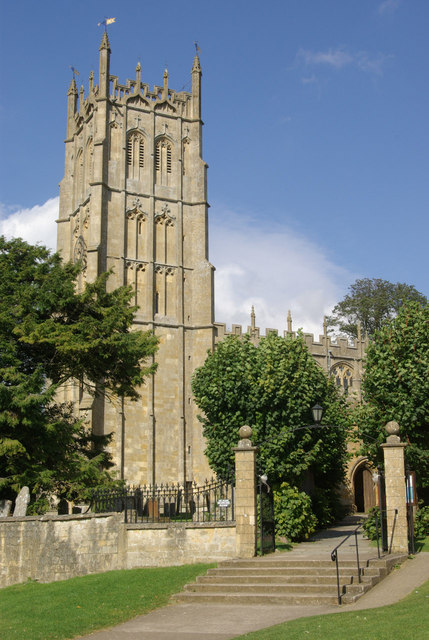
The grand early perpendicular Cotswold wool church, Church of St James, with its medieval altar frontals (c. 1500), cope (c. 1400) and 17th century monuments, includes a monument to silk merchant Sir Baptist Hicks and his family. The Grade I listed church also includes a plaque to William Grevel, described as "the flower of the wool merchants of all England". His home, the Grade I listed Grevel's House, was built c. 1380; it is not open to visitors.
The Grade I listed almshouses on Church Street were built in 1612, provided by Sir Baptist Hicks as homes for 12 pensioners and still remains in use for that purpose. The Grade II listed Old Silk Mill in Sheep Street is a three-storey building, originally used as a mill for spinning of silk thread; it closed in 1860 and became a silk throwing mill. In 1902, the building was converted into the headquarters for the Guild of Handicraft. The Court Barn near the church is now a museum celebrating the Arts and Crafts tradition of the area.
Hicks was also the owner of Campden House, on land he purchased some time after 1608; he added the manor and gained the title 1st Viscount Campden. The manor was destroyed by Royalists in 1645 during the English Civil War, possibly to prevent it falling into the hands of the Parliamentarians. There is little reliable evidence as to the appearance of the manor and gardens. Any drawings of the house were made long after it had been destroyed. All that now remains of Sir Baptist Hicks' once imposing estate are a gatehouse and two Jacobean banqueting houses; the latter were restored by the Landmark Trust.
Lady Juliana Noel, Sir Baptist's daughter, and her family lived at the converted stables near the site in Calf Lane, now called The Court House. Her descendant still lives in that Grade II listed building.
Hub AI
Chipping Campden AI simulator
(@Chipping Campden_simulator)
Chipping Campden
Chipping Campden is a market town in the Cotswold district of Gloucestershire, England. It is notable for its terraced High Street, dating from the 14th to the 17th centuries.
A wool trading centre in the Middle Ages, Chipping Campden enjoyed the patronage of wealthy wool merchants, most notably William Greville (d.1401). The High Street is lined with buildings built from locally quarried oolitic limestone, known as Cotswold stone, and boasts a wealth of vernacular architecture. Much of the town centre is a conservation area which has helped to preserve the original buildings. The town is an end point of the Cotswold Way, a 102-mile long-distance footpath. Chipping Campden has hosted its own Cotswold Games since 1612.
The name Chipping derives from Old English cēping, meaning 'market' or 'market-place'; the same element is found in other towns such as Chipping Norton, Chipping Sodbury and Chipping (now High) Wycombe.
One of the oldest buildings in the town is the Grade I listed Market Hall, built by Sir Baptist Hicks in 1627 and is still in use. The building was intended as a shelter for merchants and farmers selling their wares, with the arched side walls open to allow light and customers to enter. There was a plan to sell the hall in the 1940s, but locals raised funds to purchase the property and donated it to the National Trust.
The grand early perpendicular Cotswold wool church, Church of St James, with its medieval altar frontals (c. 1500), cope (c. 1400) and 17th century monuments, includes a monument to silk merchant Sir Baptist Hicks and his family. The Grade I listed church also includes a plaque to William Grevel, described as "the flower of the wool merchants of all England". His home, the Grade I listed Grevel's House, was built c. 1380; it is not open to visitors.
The Grade I listed almshouses on Church Street were built in 1612, provided by Sir Baptist Hicks as homes for 12 pensioners and still remains in use for that purpose. The Grade II listed Old Silk Mill in Sheep Street is a three-storey building, originally used as a mill for spinning of silk thread; it closed in 1860 and became a silk throwing mill. In 1902, the building was converted into the headquarters for the Guild of Handicraft. The Court Barn near the church is now a museum celebrating the Arts and Crafts tradition of the area.
Hicks was also the owner of Campden House, on land he purchased some time after 1608; he added the manor and gained the title 1st Viscount Campden. The manor was destroyed by Royalists in 1645 during the English Civil War, possibly to prevent it falling into the hands of the Parliamentarians. There is little reliable evidence as to the appearance of the manor and gardens. Any drawings of the house were made long after it had been destroyed. All that now remains of Sir Baptist Hicks' once imposing estate are a gatehouse and two Jacobean banqueting houses; the latter were restored by the Landmark Trust.
Lady Juliana Noel, Sir Baptist's daughter, and her family lived at the converted stables near the site in Calf Lane, now called The Court House. Her descendant still lives in that Grade II listed building.