Hubbry Logo
Chitose LineChitose LineMain
Open search
Chitose Line
Community hub
Chitose Line
logo
8 pages, 0 posts
0 subscribers
Be the first to start a discussion here.
Chitose Line
Chitose Line
from Wikipedia
Chitose Line
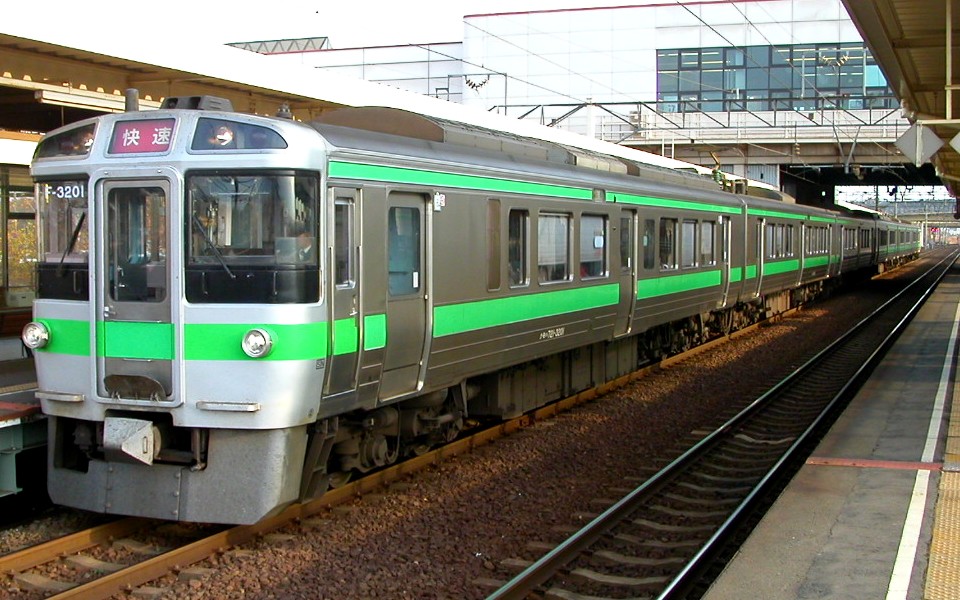
A 721 series EMU on an Airport rapid service at Minami-Chitose Station
Overview
Native name千歳線
OwnerThe logo of Hokkaido Railway Company (JR Hokkaido). JR Hokkaido
LocaleHokkaido
Termini
Stations15
Service
TypeAirport rail link
Commuter rail
History
Opened21 August 1926; 99 years ago (1926-08-21)
Technical
Line length56.6 km (35.2 mi)
Number of tracksDouble (except Airport branch which is single)
Track gauge1,067 mm (3 ft 6 in)
ElectrificationAC 20 kV 50 Hz with overhead catenary
Route map

The Chitose Line (千歳線, Chitose-sen) is a railway line in Hokkaido operated by Hokkaido Railway Company (JR Hokkaido), connecting Numanohata, Tomakomai and Shiroishi Station in Shiroishi-ku, Sapporo, linking the Muroran Main Line and Hakodate Main Line. There also is a branch line to New Chitose Airport.

Service outline

[edit]

The line forms part of the trunk route between Sapporo and Southern Hokkaido. As such, Hokuto limited express trains run between Sapporo and Hakodate once every 1 to 2 hours, as well as the Suzuran limited express between Sapporo and Muroran.[1]

The section between Sapporo and Minami-Chitose is also a part of the trunk route between Sapporo and eastern Hokkaido. The Ōzora and Tokachi limited express services to Obihiro and Kushiro run through.[1]

The rapid trains Special Rapid Airport and Rapid Airport previously ran approximately once every 12 minutes, functioning as the airport rail link between New Chitose Airport Station and Sapporo or Otaru. Since the Chitose Line goes through the most urbanized area in Hokkaido, there are roughly 3 to 4 local train services per hour.

On 16 March 2024, a new rapid service named "Semi-Rapid Airport" plying between Sapporo and New Chitose Airport Station was introduced, operating only during the daytime at two trains per hour. This train stops at Sapporo, Shin-Sapporo and all stations between Kita-Hiroshima and New Chitose Airport. Since then, no local services operate between Kita-Hiroshima and Chitose during the daytime, and the daytime service frequency of other rapid trains was adjusted to one per hour for Special Rapid Airport trains and three per hour for Rapid Airport trains. Local services are operated at two trains per hour between Sapporo and Kita-Hiroshima and one train per hour between Chitose and Tomakomai during the daytime.[2]

Former services

[edit]

There were sleeper trains between Honshu and Hokkaido, such as the Hokutosei, Cassiopeia, Twilight Express, and Hamanasu.

Station list

[edit]

Source:[3]

SRA: Special Rapid Airport
RA: Rapid Airport
SmRA: Semi-Rapid Airport
L: Local
All rapid trains stop at stations signed "+", some at "◌", and all skip stations marked "-".[4] Local trains stop at most stations but some skip stations signed "◌".
No. Station name Japanese Distance (km) SRA RA SmRA L Transfers Location (all in Hokkaido)
Tomakomai to Numanohata: officially Muroran Main Line
H18 Tomakomai 苫小牧 -8.8 + Tomakomai
Chitose Line (Main Line)
H17 Numanohata 沼ノ端 0.0 + Muroran Main Line (for Oiwake) Tomakomai
H16 Uenae 植苗 6.4
H14 Minami-Chitose 南千歳 18.4 + + + +
Chitose
H13 Chitose 千歳 21.4 - + + +
H12 Osatsu 長都 24.9 - - + +
H11 Sapporo Beer Teien サッポロビール庭園 27.1 - - + Eniwa
H10 Eniwa 恵庭 29.4 - + + +
H09 Megumino 恵み野 31.9 - - + +
H08 Shimamatsu 島松 34.1 - - + +
H07 Kitahiroshima 北広島 40.6 - + + + Kitahiroshima
H06 Kami-Nopporo 上野幌 48.6 - - - + Atsubetsu-ku, Sapporo
H05 Shin-Sapporo 新札幌 51.5 + + + + The logo of the Tozai Line of the Sapporo Municipal Subway. Tōzai Line (T19)
H04 Heiwa 平和 54.4 - - - + Shiroishi-ku, Sapporo
Shiroishi to Sapporo: officially Hakodate Main Line
H03 Shiroishi 白石 56.6 - - + Hakodate Main Line (for Asahikawa) Shiroishi-ku, Sapporo
H02 Naebo 苗穂 60.2 - - - + Chūō-ku, Sapporo
 01  Sapporo 札幌 62.4 + + + +
Kita-ku, Sapporo

Airport Branch Line

[edit]
No. Station name Japanese Distance (km) SRA RA SmRA L Transfers Location (all in Hokkaido)
H14 Minami-Chitose 南千歳 0.0 + + + +
  •   Chitose Line (Main Line)
  • Sekishō Line
Chitose
AP15 New Chitose Airport 新千歳空港 2.6 + + + +

Closed station

[edit]
  • H15 Bibi: Closed since 4 March 2017, now a signal base.

Rolling stock

[edit]

History

[edit]

The entire line opened on 21 August 1926.

Duplication

[edit]

The Chitose-Eniwa section was double-tracked in September 1965, and extended to Kitahiroshima in September 1966.

The Chitose-Uenae section was double-tracked in 1968, and extended to Numanohata in 1969.

The Shiraishi-Kitahiroshima section was double-tracked in 1973, completing the work to double-track the line.

Electrification

[edit]

Chitose Station and its approaches were elevated in 1980, and the line was electrified in association with the opening of the nearby Chitose airport.

The Minami-chitose—Chitose Airport branch opened as an electrified line in 1992.

See also

[edit]

References

[edit]
[edit]
Revisions and contributorsEdit on WikipediaRead on Wikipedia
from Grokipedia
The Chitose Line (千歳線, Chitose-sen) is a railway line in , , operated by (JR Hokkaido), connecting Shiroishi Station in to Numanohata Station in and providing vital access to via a short branch from Minami-Chitose Station. This 57-kilometer route serves as a key transportation artery in southern , linking the island's largest city with the important industrial hub of and the region's primary international gateway at , which handles millions of passengers annually. The line features 17 stations, including major stops like , Shin-Sapporo, Chitose, and Minami-Chitose, and supports a mix of local, rapid, and services, with the Rapid Airport trains offering a direct 37-minute journey from to central . It forms part of the broader network, enabling through services to destinations such as , Muroran, and via connections with the Muroran Main Line, and plays a crucial role in regional commuting, , and airport transfers.

Route and Services

Route Description

The Chitose Line is a railway line operated by JR Hokkaido, spanning approximately 56.6 km along its main route from Shiroishi Station in eastern to Numanohata Station near . Services on the line typically commence at , proceeding southeast through key intermediate stations including Naganuma and Chitose before reaching . This path serves suburban districts near and transitions into more rural landscapes in central , facilitating regional connectivity across the Ishikari Plain. A short branch line, measuring 2.6 km, diverges from Minami-Chitose Station to New Chitose Airport Station, providing direct rail access to Hokkaido's primary international airport for passengers and cargo. The overall network length, including this branch, totals 59.2 km. At its endpoints, the Chitose Line interconnects with the Hakodate Main Line: to the south at Numanohata and Tomakomai Stations, enabling through services toward Hakodate, and to the north at Sapporo Station, where it also links with the Sassho Line for northern Hokkaido routes. The line employs the 1,067 mm narrow gauge standard for JR Hokkaido's conventional rail network and features double tracking throughout the main line for efficient operations.

Current Services

The Chitose Line facilitates key rapid services for airport connectivity and regional travel, primarily operated by JR Hokkaido. The Rapid Airport service links directly to Station in 37 minutes, with the Special Rapid Airport variant completing the journey in 33 minutes and the Semi-Rapid Airport in 43 minutes. These trains stop at select intermediate stations, including Minami-Chitose, and some extend northward to Otaru Station. Frequencies are high during peak hours, with six Rapid Airport operations per hour from 9:00 a.m. to 4:00 p.m., totaling 163 daily services overall. Limited express services, such as the Hokuto, utilize sections of the Chitose Line en route from Sapporo to Hakodate, stopping at major stations like Minami-Chitose and Tomakomai to serve passengers connecting to the airport or southern Hokkaido destinations. This service runs approximately 11 times daily from Sapporo, providing all-reserved seating and integration with broader Hokkaido rail networks. Local and semi-rapid services operate along the main line from Sapporo to Tomakomai, offering frequent but less intensive options compared to airport-focused trains. Timetable data indicates around 70 rapid services and 15 section rapid services daily on the airport branch alone, with local trains numbering about six per day, emphasizing commuter and regional access. Freight operations on the Chitose Line support local industries, including prominent in the Chitose area, with JR Freight trains observed at junction points like Minami-Chitose. As of 2025, the line's services remain unaffected by the , whose extension from Shin-Hakodate-Hokuto to —originally targeted for 2030—has been delayed to 2039, though future through-services to are under consideration. Ticketing for Chitose Line services is streamlined with compatibility for the Kitaca IC card across the route from to , allowing seamless tap-and-go payments. The base fare for the Rapid Airport to is 1,230 yen, with an additional 840 yen for reserved seating in designated cars.

Stations and Infrastructure

Station List

The Chitose Line proper comprises 14 active stations spanning 59.2 kilometers from Shiroishi Station in to Numanohata Station in , facilitating commuter, regional, and freight services across 's central and southern regions. These stations are primarily served by local and rapid trains, with key interchanges at Minami-Chitose enabling connections to broader JR Hokkaido networks, including the . Distances are measured from Shiroishi Station along the Chitose Line alignment. Operational services often extend westward via the to (7.2 km west of Shiroishi) and eastward via the Muroran Main Line from Numanohata to (4.8 km east). The following table lists the stations in order from Shiroishi to Numanohata, including brief opening dates, connecting lines, and notable facilities.
Station NameDistance from Shiroishi (km)Opening DateLines ServedKey Facilities
Shiroishi01903, Chitose LineLocal commuter stop with shelters and automated ticket machines.
Heiwa2.11986Chitose LineResidential access point with platform canopies and parking.
Shin-Sapporo5.21973Chitose LineInterchange with Tozai Line, staffed ticket office, elevators.
Kami-Nopporo8.91926Chitose LineSuburban stop with basic amenities and bus connections.
Kitahiroshima171926Chitose LineSports facilities access (planned Ballpark nearby), parking lot.
Shimamatsu22.81926Chitose LineRural platform with shelters.
Megino25.31988Chitose LineUnstaffed local stop serving agricultural areas.
Eniwa27.81926Chitose LineIndustrial access, waiting room, bus links.
Sapporo Beer Teien29.81987Chitose LineAdjacent to Sapporo Garden, tourist-oriented with seasonal events.
Osaru31.81958Chitose LineFlag stop for local passengers, minimal facilities.
Chitose35.81926Chitose LineMid-sized station with ticket sales, nearby aquarium and outlet mall.
Minami-Chitose38.81980Chitose Line, Sekisho LineMajor junction with 4 platforms, staffed, connections to airport branch and eastern .
Uenae47.81926Chitose LineRural unstaffed stop with basic platforms.
Numanohata59.21926Chitose Line, Muroran Main LineJunction with freight facilities, local access.
Station classifications on the Chitose Line as of 2025 include a mix of fully staffed facilities at urban and junction points like Shin-Sapporo, Chitose, and Minami-Chitose, while smaller rural stations such as Osaru, Megino, and Uenae operate as unstaffed or flag stops requiring passengers to request stops in advance for local trains. features are standardized across the network, with elevators, ramps, and installed at all platforms of major stations (Shin-Sapporo, Eniwa, Chitose, Minami-Chitose) to support users and those with mobility impairments, in compliance with Japan's barrier-free legislation. Smaller stations feature sloped ramps where feasible, though some require assistance for full access. The Airport Branch Line, a 2.6-kilometer from Minami-Chitose, serves direct airport connectivity and includes two stations optimized for traveler convenience.
Station NameDistance from Shiroishi (km)Opening DateLines ServedKey Facilities
Minami-Chitose38.81980Chitose Line, Airport Branch, Sekisho LineJunction platform for branch services, storage, staffed counters.
Shin-Chitose-Airport41.41992Airport BranchIntegrated into terminal (B1F), counters, IC card , direct / access to arrivals/departures.
Unique station features enhance the line's utility: Numanohata Station includes dedicated industrial sidings connected to the nearby port for freight operations, supporting Hokkaido's logistics sector. While Jozankei hot springs are not directly served, connections at (via ) provide bus links to this popular area approximately 50 kilometers southwest, offering thermal bathing options for passengers.

Closed Stations

The Chitose Line has undergone several rationalizations, leading to the closure of stations primarily due to route rerouting for improved efficiency and declining ridership from rural depopulation. In 1973, a major line reconfiguration between Kitahiroshima and abandoned the original route, closing multiple stations along the old alignment to facilitate double-tracking and urban development integration. This shift eliminated underutilized facilities in sparsely populated areas, reflecting broader efforts to modernize 's rail network amid shifting demographics. Key closures from this era include:
Station NameLocation (Approximate km post from Shiroishi)Closure DateReason
Higashi-Sapporo Station (東札幌駅)2.1 km (east of Shiroishi, old alignment)September 9, 1973 (passenger service); full closure November 1, 1986Route rerouting to new alignment; retained briefly as freight station for local industry before decommissioning due to low demand.
Tsukisappu Station (月寒駅)~0.6 km (near Shiroishi, old alignment)September 9, 1973 (passenger service); full closure October 1, 1976Line reconfiguration; temporary freight use for nearby brewery until operations shifted, exacerbated by urban expansion reducing local rail dependency.
Oyachigai Station (大谷地駅)~3.6 km (old alignment)September 9, 1973Direct result of new line opening, with daily ridership around 200 passengers deemed insufficient for retention amid route optimization.
Old Uenopporo Station (旧上野幌駅)~7 km (old alignment near Shin-Sapporo)September 9, 1973Obsolete following new routing; site repurposed for recreational paths, highlighting transition from rural to suburban land use.
These 1973 closures significantly impacted local communities in southern wards, where residents lost direct rail access, forcing reliance on buses or longer walks to surviving stations like Kitahiroshima, contributing to further depopulation in Ishikari-adjacent rural pockets. In the late 20th and early 21st centuries, further rationalizations targeted isolated stations with negligible usage. The most recent closure was Bibi Station (美々駅) at approximately 32.5 km from Shiroishi (between Megino and Eniwa? Wait, adjust: actually between Shimamatsu and Megino, ~24 km from Shiroishi), operational since 1926 but shuttered on March 4, 2017, due to averaging fewer than one passenger daily in prior years, driven by proximity to without supporting infrastructure or population. This made it the first IC card-enabled station in to close, underscoring JR Hokkaido's cost-cutting amid chronic deficits. The site was downgraded to Bibi Signal Field, with no passenger facilities remaining, and local access in the remote Chitose area now depends on infrequent buses, amplifying isolation for sparse residents amid ongoing rural decline. No reactivation proposals exist as of 2025, as ridership recovery remains unfeasible without major economic shifts.

Rolling Stock and Operations

Rolling Stock

The rolling stock on the Chitose Line primarily consists of electric multiple units (EMUs) for passenger services, reflecting the line's full electrification with 20 kV AC overhead catenary. These EMUs are assigned to suburban and rapid operations in the Sapporo area, including local and Airport rapid services. Freight operations utilize diesel locomotives operated by JR Freight, with maintenance for passenger stock handled at JR Hokkaido facilities in the Sapporo area, such as the Higashi-Sapporo depot, and shunting duties at Tomakomai. For local services, the 737 series two-car EMUs are the primary units, introduced in 2023 as JR Hokkaido's first driver-only operated commuter trains. These aluminium-bodied sets feature 160 kW motors on the power car, a top speed of 120 km/h, and universal access toilets for improved , accommodating approximately 269 (93 seated and 176 standing) with a mix of longitudinal and transverse seating. The series enhances efficiency on short-haul suburban runs by reducing crew requirements while maintaining compatibility with the line's infrastructure. Rapid services, including the frequent Rapid Airport connecting Sapporo to , employ 721, 731, and 733 series EMUs. The 721 series, in three-car formations, offers a top speed of 120 km/h with thyristor-phase control for smooth acceleration and capacities exceeding 200 passengers per set, featuring air-conditioned saloons and priority seating for accessibility. Complementing these are the stainless steel-bodied 733 series sets, also three cars long, with similar 120 km/h capabilities and enhanced corrosion resistance suited to 's harsh winters; they include wheelchair spaces and low-floor entry modifications in newer batches. The 731 series provides additional flexibility for peak-hour operations, sharing comparable specifications including 230 kW per motor output and elements like priority areas for elderly and disabled passengers. As of 2024, JR Hokkaido announced plans to replace some 721 series with additional 733 series on Chitose Line Airport services. These EMUs ensure reliable, high-frequency service on the double-tracked line. Freight traffic on the Chitose Line is handled by JR Freight's DF200 class diesel-electric locomotives, six-axle heavy-haul units with approximately 2,500 kW power output and a top speed of 110 km/h, designed specifically for Hokkaido's snowy conditions and used for container and general cargo trains between Tomakomai port and inland destinations. Local shunting and haulage at yards like Tomakomai rely on DE10 class diesel-hydraulic locomotives, Bo-Bo wheel arrangement models producing 330 kW, which perform switching duties and short freights with dimensions of 10.5 m length and capacities for coupled wagons up to 1,000 tonnes. These diesel units operate independently of the electrified passenger tracks, supporting the line's role in regional logistics.

Operational Features

The Chitose Line employs across its double-tracked sections to maintain safe intervals between trains and prevent collisions. JR Hokkaido has integrated (ATC) and (ATS) systems on the line since the 2010s, providing continuous speed supervision and automatic braking in response to signals or obstacles, thereby enhancing operational reliability and reducing human error. Full double-tracking of the line was completed in 1980, enabling bidirectional operations without conflicts and supporting higher frequencies; this upgrade allows for a capacity of up to 30 trains per hour during on key segments. The is electrified with 20 kV AC overhead from to , implemented in 1980 to coincide with the opening of the branch, while any unelectrified spurs rely on diesel propulsion for local services. Safety on the Chitose Line includes measures addressing incidents, particularly in rural stretches where visibility and traffic patterns pose risks; the Japan Transport Safety Board has documented several such accidents, prompting reinforced barriers and warning systems. General Japanese railway accident rates, including level crossings, stand at approximately 0.6 incidents per million train-kilometers as of 2023. Operations are coordinated from JR Hokkaido's control center in , where dispatchers oversee signaling, routing, and crew assignments to ensure seamless management of the line's traffic. This setup is compatible with electric multiple units designed for the line's parameters.

History

Construction and Early Development

The construction of the Chitose Line formed part of the Japanese government's ambitious railway expansion in during the late , aimed at accelerating the island's and economic integration into the empire. Following the , the government established the Hokkaido Development Commission (Kaitakushi) in 1869 to oversee systematic development, recognizing Hokkaido's strategic importance for national defense and prosperity. To facilitate this, the Hokkaido Railway Construction Law was enacted in 1896, exempting the island from mainland regulations and enabling targeted projects to transport settlers, timber, , and agricultural essential for populating and exploiting the frontier. These railways, including precursors to the Chitose Line, were built using imported Western technology, primarily British designs, to connect remote areas and support Japan's imperial expansion northward. Development of the line progressed during the early , culminating in the full route's completion from to on August 21, 1926, under the private and initially designated as the Sapporo Line. This extension enhanced connectivity between and southern , integrating the route into the broader Muroran Main Line network and solidifying its role in colonial logistics. The early phase featured a single-track, non-electrified alignment operated with on 1,067 mm narrow gauge, reflecting the standard engineering practices of the era that prioritized cost-effective construction amid challenging terrain and harsh weather. The line's development was driven by the need to bolster Hokkaido's agricultural and industrial base, transporting pioneers and commodities southward to ports like for export, thereby accelerating Japanese settlement and displacing indigenous Ainu communities. Following nationalization of the in 1943, the line was operated by (JNR). It was renamed the Chitose Line on March 15, 1981, coinciding with the formation of during the of .

Expansion and Upgrades

The of in 1987 marked a turning point for the Chitose Line, enabling to prioritize investments in key infrastructure to boost capacity and service reliability amid growing passenger demand from Sapporo's expansion and air travel growth. This shift from state ownership to a regional operator allowed for targeted funding, resulting in improved financial performance and the initiation of major upgrades that reduced operational costs and enhanced connectivity. The line was electrified in 1980 using 20 kV AC overhead catenary, replacing diesel operations and enabling the deployment of electric multiple units. The section from to Teine, shared with the , was elevated and quadrupled in 1988, with the 721 series introduced that year to support faster services and handle increased traffic. The Airport Branch, constructed to link the line with Chitose Airport, opened in 1980 with the establishment of Chitose Airport Station (now Minami-Chitose), providing initial rail access to the facility. Following the opening of 's new terminal in 1988, the branch was extended approximately 2.5 km southward, culminating in the underground New Chitose Airport Station on July 1, 1992, which integrated directly beneath the terminal for seamless passenger transfers and rapid transit capabilities. Duplication of the line progressed in phases from the to address rising commuter and freight volumes, with the Shiraishi–Kitahiroshima segment completed in 1973 to finalize double-tracking toward . These enhancements, combined with post-privatization funding, elevated the line's role as a vital corridor for Hokkaido's economic activity.

References

Add your contribution
Related Hubs
User Avatar
No comments yet.