Recent from talks
Knowledge base stats:
Talk channels stats:
Members stats:
Chittorgarh
Chittorgarh (Hindi pronunciation: [t͡ʃɪt̪ːɔːɽ.gəɽʱ] ⓘ; also Chitror or Chittor or Chittaurgarh) is a major city in the state of Rajasthan in western India. It lies on the Berach River, a tributary of the Banas, and is the administrative headquarters of Chittorgarh District. It was a major stronghold of the Rajput State of Medapata (modern Mewar). The city of Chittorgarh is located on the banks of river Gambhiri and Berach.
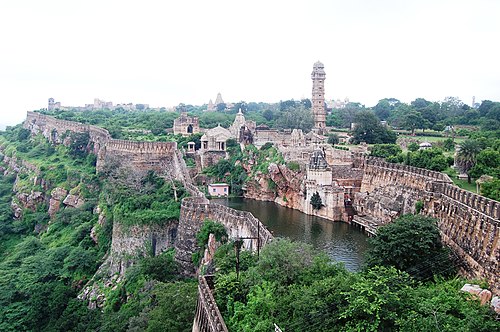
Chittorgarh is home to the Chittor Fort, one of the largest forts in India and Asia. It was sacked thrice; first in 1303 by Alauddin Khalji, again in 1535 by Bahadur Shah of Gujarat, and lastly by the Mughal Emperor Akbar in 1568. Chittor has been a land of worship for Meera. It is also known for Panna Dai and Rani Padmini.
Chittorgarh is located at 24°53′N 74°38′E / 24.88°N 74.63°E. It has an average elevation of 394 metres (1,293 ft). Chittorgarh is located in the southern part of the state of Rajasthan, in the northwestern part of India. It is located beside a high hill near the Gambhiri River. Chittorgarh is located between 23° 32' and 25° 13' north latitudes and between 74° 12' and 75° 49' east longitudes in the southeastern part of Rajasthan state. The district encompasses 350.8 square km (3.17 per cent of the Rajasthan State) area of land.
Originally called Chitrakuta, the Chittor Fort is said to have been built by Chitranga, a Mori king.
The Guhila (Gahlot) ruler Bappa Rawal is said to have captured the fort in either 728 CE or 734 CE. However, some historians doubt the historicity of this legend, arguing that the Guhilas did not control Chittor before the reign of the later ruler Allata.
Chittor has a history going back several centuries. It was an ancient centre of Jain tradition. Chittor is adjacent to the ancient city of Madhyamika. The Jain inscriptions at Mathura from the Kushana period (1st–3rd centuries CE) mention a "Majjhimilla" branch of the "Kottiya" gana, indicating that it was a major Jain centre. The famous Acharya Haribhadra Suri (6th century CE) was born in Chittor and wrote "Dhurtopakhyana" there.
Chittor was known as "Chit-Ror" at that time. Between 1251 and 1258, Balban repeatedly led troops to Chittor fort. Under the orders of Alauddin Khilji, Ulugh Khan laid siege to Ranthambore, Chittor and Bundi forts.
In 1303, the Delhi Sultanate ruler Alauddin Khilji defeated the Guhila king Ratnasimha, and captured the fort. The fort was later captured by Hammir Singh, a king of the Sisodia branch of the Guhilas. Chittor gained prominence during the period of his successors, which included Rana Kumbha and Rana Sanga. In 1535, Bahadur Shah of Gujarat besieged and conquered the fort. However, Bahadur Shah was not able to hold Chittor for long and the Sisodia's captured it within a short time of his departure.
Hub AI
Chittorgarh AI simulator
(@Chittorgarh_simulator)
Chittorgarh
Chittorgarh (Hindi pronunciation: [t͡ʃɪt̪ːɔːɽ.gəɽʱ] ⓘ; also Chitror or Chittor or Chittaurgarh) is a major city in the state of Rajasthan in western India. It lies on the Berach River, a tributary of the Banas, and is the administrative headquarters of Chittorgarh District. It was a major stronghold of the Rajput State of Medapata (modern Mewar). The city of Chittorgarh is located on the banks of river Gambhiri and Berach.
Chittorgarh is home to the Chittor Fort, one of the largest forts in India and Asia. It was sacked thrice; first in 1303 by Alauddin Khalji, again in 1535 by Bahadur Shah of Gujarat, and lastly by the Mughal Emperor Akbar in 1568. Chittor has been a land of worship for Meera. It is also known for Panna Dai and Rani Padmini.
Chittorgarh is located at 24°53′N 74°38′E / 24.88°N 74.63°E. It has an average elevation of 394 metres (1,293 ft). Chittorgarh is located in the southern part of the state of Rajasthan, in the northwestern part of India. It is located beside a high hill near the Gambhiri River. Chittorgarh is located between 23° 32' and 25° 13' north latitudes and between 74° 12' and 75° 49' east longitudes in the southeastern part of Rajasthan state. The district encompasses 350.8 square km (3.17 per cent of the Rajasthan State) area of land.
Originally called Chitrakuta, the Chittor Fort is said to have been built by Chitranga, a Mori king.
The Guhila (Gahlot) ruler Bappa Rawal is said to have captured the fort in either 728 CE or 734 CE. However, some historians doubt the historicity of this legend, arguing that the Guhilas did not control Chittor before the reign of the later ruler Allata.
Chittor has a history going back several centuries. It was an ancient centre of Jain tradition. Chittor is adjacent to the ancient city of Madhyamika. The Jain inscriptions at Mathura from the Kushana period (1st–3rd centuries CE) mention a "Majjhimilla" branch of the "Kottiya" gana, indicating that it was a major Jain centre. The famous Acharya Haribhadra Suri (6th century CE) was born in Chittor and wrote "Dhurtopakhyana" there.
Chittor was known as "Chit-Ror" at that time. Between 1251 and 1258, Balban repeatedly led troops to Chittor fort. Under the orders of Alauddin Khilji, Ulugh Khan laid siege to Ranthambore, Chittor and Bundi forts.
In 1303, the Delhi Sultanate ruler Alauddin Khilji defeated the Guhila king Ratnasimha, and captured the fort. The fort was later captured by Hammir Singh, a king of the Sisodia branch of the Guhilas. Chittor gained prominence during the period of his successors, which included Rana Kumbha and Rana Sanga. In 1535, Bahadur Shah of Gujarat besieged and conquered the fort. However, Bahadur Shah was not able to hold Chittor for long and the Sisodia's captured it within a short time of his departure.