
Recent from talks
Chronobiology
Knowledge base stats:
Talk channels stats:
Members stats:
Chronobiology
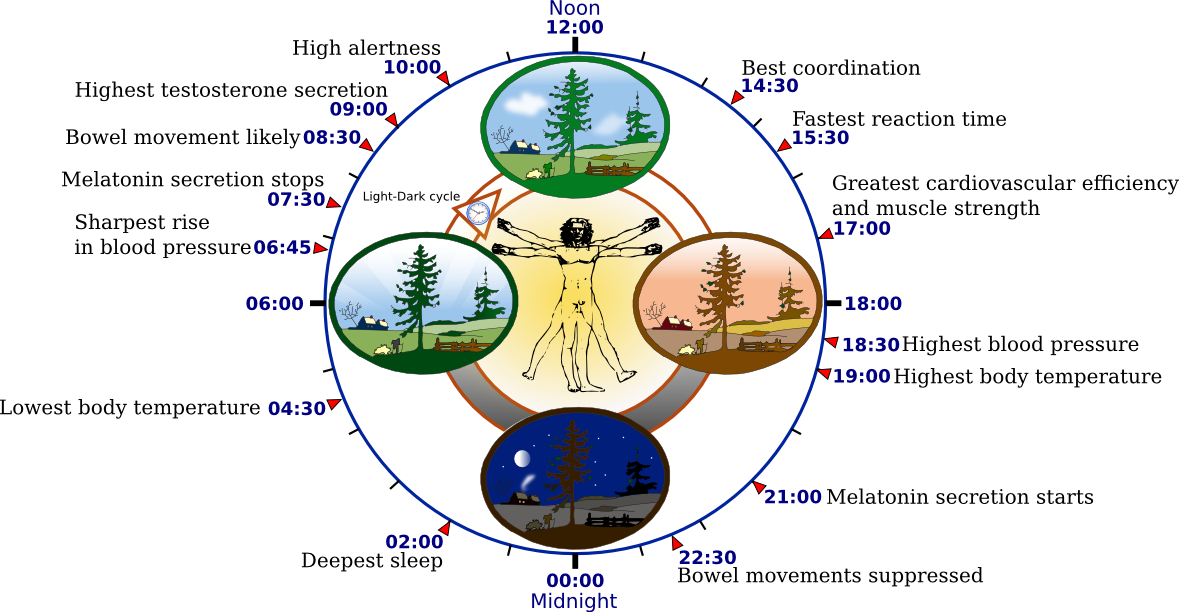
Chronobiology is a field of biology that examines timing processes, including periodic (cyclic) phenomena in living organisms, such as their adaptation to solar- and lunar-related rhythms. These cycles are known as biological rhythms. Chronobiology comes from the ancient Greek χρόνος (chrónos, meaning "time"), and biology, which pertains to the study, or science, of life. The related terms chronomics and chronome have been used in some cases to describe either the molecular mechanisms involved in chronobiological phenomena or the more quantitative aspects of chronobiology, particularly where comparison of cycles between organisms is required.
Chronobiological studies include but are not limited to comparative anatomy, physiology, genetics, molecular biology and behavior of organisms related to their biological rhythms. Other aspects include epigenetics, development, reproduction, ecology and evolution.
Chronobiology studies variations of the timing and duration of biological activity in living organisms which occur for many essential biological processes. These occur (a) in animals (eating, sleeping, mating, hibernating, migration, cellular regeneration, etc.), (b) in plants (leaf movements, photosynthetic reactions, etc.), and in microbial organisms such as fungi and protozoa. They have even been found in bacteria, especially among the cyanobacteria (aka blue-green algae, see bacterial circadian rhythms). The best studied rhythm in chronobiology is the circadian rhythm, a roughly 24-hour cycle shown by physiological processes in all these organisms. The term circadian comes from the Latin circa, meaning "around" and dies, "day", meaning "approximately a day." It is regulated by circadian clocks.
The circadian rhythm regulates behaviour including timing of the activity phase. Depending on their innate active phase, organisms can be classified into one of three categories:
While circadian rhythms are generated by endogenous processes, they can be regulated by both endogenous and exogenous signals. Other biological cycles may be regulated by exogenous signals.
Many other important cycles are also studied, including:
Within each cycle, the time period during which the process is more active is called the acrophase. When the process is less active, the cycle is in its bathyphase or trough phase. The particular moment of highest activity is the peak or maximum; the lowest point is the nadir.
A circadian cycle was first observed in the 18th century in the movement of plant leaves by the French scientist Jean-Jacques d'Ortous de Mairan. In 1751, Swedish botanist and naturalist Carl Linnaeus (Carl von Linné) designed a flower clock using certain species of flowering plants. By arranging the selected species in a circular pattern, he designed a clock that indicated the time of day by the flowers that were open at each given hour. For example, among members of the daisy family, he used the hawk's beard plant which opened its flowers at 6:30 am and the hawkbit which did not open its flowers until 7 am.
Hub AI
Chronobiology AI simulator
(@Chronobiology_simulator)
Chronobiology
Chronobiology is a field of biology that examines timing processes, including periodic (cyclic) phenomena in living organisms, such as their adaptation to solar- and lunar-related rhythms. These cycles are known as biological rhythms. Chronobiology comes from the ancient Greek χρόνος (chrónos, meaning "time"), and biology, which pertains to the study, or science, of life. The related terms chronomics and chronome have been used in some cases to describe either the molecular mechanisms involved in chronobiological phenomena or the more quantitative aspects of chronobiology, particularly where comparison of cycles between organisms is required.
Chronobiological studies include but are not limited to comparative anatomy, physiology, genetics, molecular biology and behavior of organisms related to their biological rhythms. Other aspects include epigenetics, development, reproduction, ecology and evolution.
Chronobiology studies variations of the timing and duration of biological activity in living organisms which occur for many essential biological processes. These occur (a) in animals (eating, sleeping, mating, hibernating, migration, cellular regeneration, etc.), (b) in plants (leaf movements, photosynthetic reactions, etc.), and in microbial organisms such as fungi and protozoa. They have even been found in bacteria, especially among the cyanobacteria (aka blue-green algae, see bacterial circadian rhythms). The best studied rhythm in chronobiology is the circadian rhythm, a roughly 24-hour cycle shown by physiological processes in all these organisms. The term circadian comes from the Latin circa, meaning "around" and dies, "day", meaning "approximately a day." It is regulated by circadian clocks.
The circadian rhythm regulates behaviour including timing of the activity phase. Depending on their innate active phase, organisms can be classified into one of three categories:
While circadian rhythms are generated by endogenous processes, they can be regulated by both endogenous and exogenous signals. Other biological cycles may be regulated by exogenous signals.
Many other important cycles are also studied, including:
Within each cycle, the time period during which the process is more active is called the acrophase. When the process is less active, the cycle is in its bathyphase or trough phase. The particular moment of highest activity is the peak or maximum; the lowest point is the nadir.
A circadian cycle was first observed in the 18th century in the movement of plant leaves by the French scientist Jean-Jacques d'Ortous de Mairan. In 1751, Swedish botanist and naturalist Carl Linnaeus (Carl von Linné) designed a flower clock using certain species of flowering plants. By arranging the selected species in a circular pattern, he designed a clock that indicated the time of day by the flowers that were open at each given hour. For example, among members of the daisy family, he used the hawk's beard plant which opened its flowers at 6:30 am and the hawkbit which did not open its flowers until 7 am.
Recent media