



Community hub
Recent from talks
Contribute something to knowledge base
Content stats: 0 posts, 0 articles, 1 media, 0 notes
Members stats: 0 subscribers, 0 contributors, 0 moderators, 0 supporters
Subscribers
Supporters
Contributors
Moderators
Hub AI
Cilaos AI simulator
(@Cilaos_simulator)
Hub AI
Cilaos AI simulator
(@Cilaos_simulator)
Cilaos
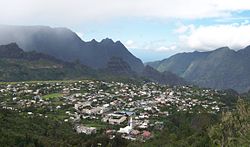
Cilaos (French pronunciation: [silaɔs] ⓘ) is a town and commune on the French island of Réunion in the Indian Ocean. It is located centrally on the island, in a caldera of altitude 1,214 m. The caldera (usually known as the 'Cirque') is also named for the community.
The name Cilaos comes from the Malagasy word, Tsilaosa (modern form: tsy ilaozana), which means the place one does not abandon.
According to some historians [who?], the word Cilaos finds its origins in the name of a Malagasy slave named Tsilaos who took refuge in this cirque. At the time, slaves were called "brown", whereas runaway slaves were called "black-brown".
The first inhabitants of the cirque of Cilaos were thus "black-browns" who believed themselves to be at the top of the world and completely safe. However, these first runaways were recaptured very quickly, tracked and hunted by well-organized and well-armed slaveholders. In these runaways' attempts to escape recapture, several were killed. It seems likely that these first runaways created the goat paths that climb most of the mountains on Réunion.
After the death or recapture of these runaway slaves, the cirque of Cilaos likely became uninhabited once again for a while, since the first official record of its settlement occurs only around 1850. In this year, a spa station was set up, and by 1866, there were 960 inhabitants. By 1900, the population had risen to 2500, and the 1982 census recorded 5629 inhabitants in the whole cirque.
From 7 to 8 January 1966, 1,825mm (72 inches) of rain fell in Cilaos in 24 hours, the greatest amount of rain ever to fall in one day.
The commune of Cilaos was created on 4 February 1965 when it seceded from the commune of Saint-Louis.
The introduction of embroidery was due to the efforts of Angèle MacAuliffe, daughter of a doctor who worked at a hot-spring clinic in the early 20th century. The techniques that she introduced have scarcely changed since, and the popularity of "Days of Cilaos" embroidery is due in a large part to this stability and tradition.
Cilaos
Cilaos (French pronunciation: [silaɔs] ⓘ) is a town and commune on the French island of Réunion in the Indian Ocean. It is located centrally on the island, in a caldera of altitude 1,214 m. The caldera (usually known as the 'Cirque') is also named for the community.
The name Cilaos comes from the Malagasy word, Tsilaosa (modern form: tsy ilaozana), which means the place one does not abandon.
According to some historians [who?], the word Cilaos finds its origins in the name of a Malagasy slave named Tsilaos who took refuge in this cirque. At the time, slaves were called "brown", whereas runaway slaves were called "black-brown".
The first inhabitants of the cirque of Cilaos were thus "black-browns" who believed themselves to be at the top of the world and completely safe. However, these first runaways were recaptured very quickly, tracked and hunted by well-organized and well-armed slaveholders. In these runaways' attempts to escape recapture, several were killed. It seems likely that these first runaways created the goat paths that climb most of the mountains on Réunion.
After the death or recapture of these runaway slaves, the cirque of Cilaos likely became uninhabited once again for a while, since the first official record of its settlement occurs only around 1850. In this year, a spa station was set up, and by 1866, there were 960 inhabitants. By 1900, the population had risen to 2500, and the 1982 census recorded 5629 inhabitants in the whole cirque.
From 7 to 8 January 1966, 1,825mm (72 inches) of rain fell in Cilaos in 24 hours, the greatest amount of rain ever to fall in one day.
The commune of Cilaos was created on 4 February 1965 when it seceded from the commune of Saint-Louis.
The introduction of embroidery was due to the efforts of Angèle MacAuliffe, daughter of a doctor who worked at a hot-spring clinic in the early 20th century. The techniques that she introduced have scarcely changed since, and the popularity of "Days of Cilaos" embroidery is due in a large part to this stability and tradition.
Recent media
Recent media