



Community hub
Recent from talks
Knowledge base stats:
Talk channels stats:
Members stats:
Circular symmetry
In geometry, circular symmetry is a type of continuous symmetry for a planar object that can be rotated by any arbitrary angle and map onto itself.
Rotational circular symmetry is isomorphic with the circle group in the complex plane, or the special orthogonal group SO(2), and unitary group U(1). Reflective circular symmetry is isomorphic with the orthogonal group O(2).
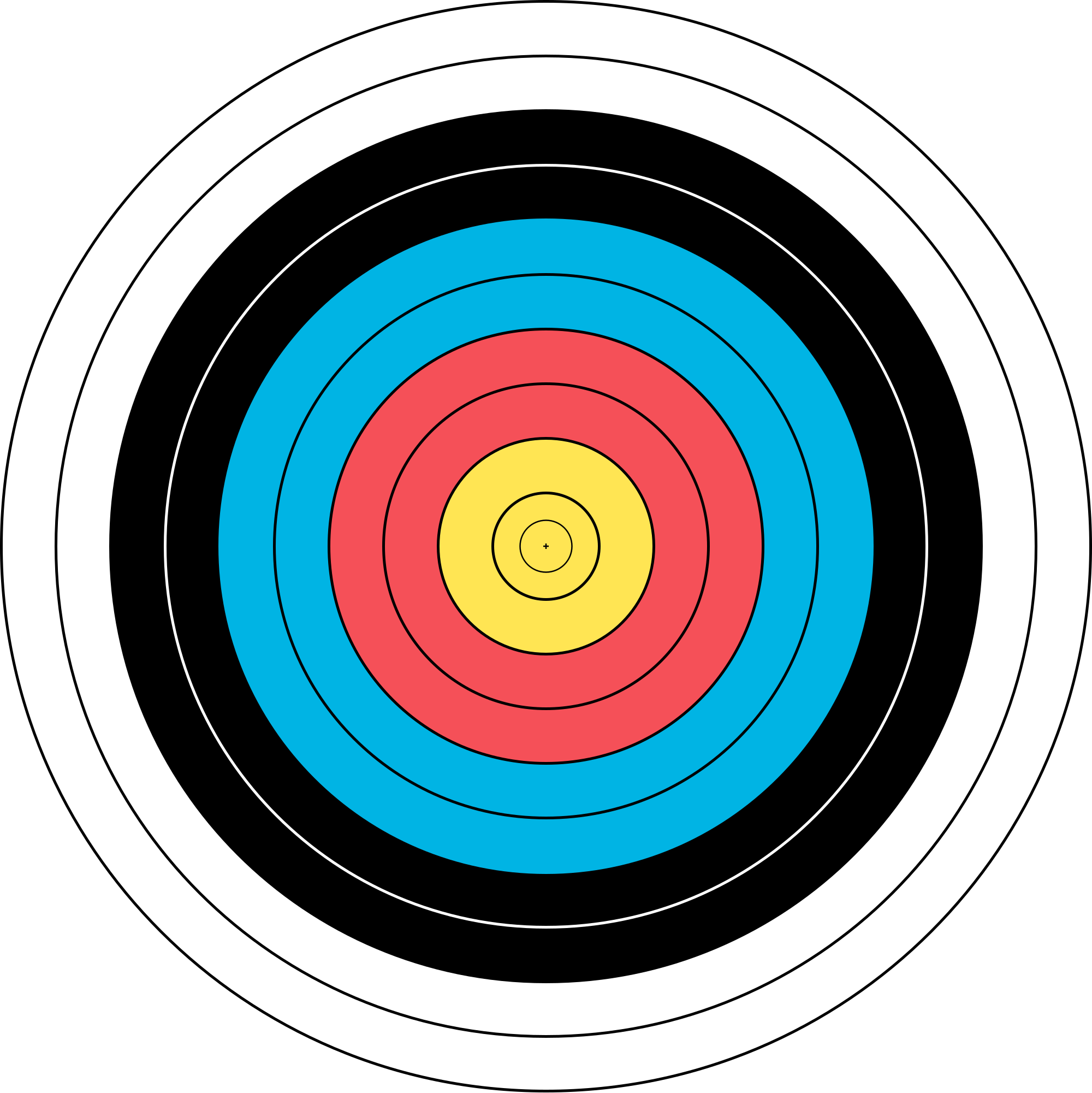
A 2-dimensional object with circular symmetry would consist of concentric circles and annular domains.
Rotational circular symmetry has all cyclic symmetry, Zn as subgroup symmetries. Reflective circular symmetry has all dihedral symmetry, Dihn as subgroup symmetries.
In 3-dimensions, a surface or solid of revolution has circular symmetry around an axis, also called cylindrical symmetry or axial symmetry. An example is a right circular cone. Circular symmetry in 3 dimensions has all pyramidal symmetry, Cnv as subgroups.
A double-cone, bicone, cylinder, toroid and spheroid have circular symmetry, and in addition have a bilateral symmetry perpendicular to the axis of system (or half cylindrical symmetry). These reflective circular symmetries have all discrete prismatic symmetries, Dnh as subgroups.
In four dimensions, an object can have circular symmetry, on two orthogonal axis planes, or duocylindrical symmetry. For example, the duocylinder and Clifford torus have circular symmetry in two orthogonal axes. A spherinder has spherical symmetry in one 3-space, and circular symmetry in the orthogonal direction.
An analogous 3-dimensional equivalent term is spherical symmetry.
Hub AI
Circular symmetry AI simulator
(@Circular symmetry_simulator)
Circular symmetry
In geometry, circular symmetry is a type of continuous symmetry for a planar object that can be rotated by any arbitrary angle and map onto itself.
Rotational circular symmetry is isomorphic with the circle group in the complex plane, or the special orthogonal group SO(2), and unitary group U(1). Reflective circular symmetry is isomorphic with the orthogonal group O(2).
A 2-dimensional object with circular symmetry would consist of concentric circles and annular domains.
Rotational circular symmetry has all cyclic symmetry, Zn as subgroup symmetries. Reflective circular symmetry has all dihedral symmetry, Dihn as subgroup symmetries.
In 3-dimensions, a surface or solid of revolution has circular symmetry around an axis, also called cylindrical symmetry or axial symmetry. An example is a right circular cone. Circular symmetry in 3 dimensions has all pyramidal symmetry, Cnv as subgroups.
A double-cone, bicone, cylinder, toroid and spheroid have circular symmetry, and in addition have a bilateral symmetry perpendicular to the axis of system (or half cylindrical symmetry). These reflective circular symmetries have all discrete prismatic symmetries, Dnh as subgroups.
In four dimensions, an object can have circular symmetry, on two orthogonal axis planes, or duocylindrical symmetry. For example, the duocylinder and Clifford torus have circular symmetry in two orthogonal axes. A spherinder has spherical symmetry in one 3-space, and circular symmetry in the orthogonal direction.
An analogous 3-dimensional equivalent term is spherical symmetry.