
Recent from talks
Solid of revolution
Knowledge base stats:
Talk channels stats:
Members stats:
Solid of revolution
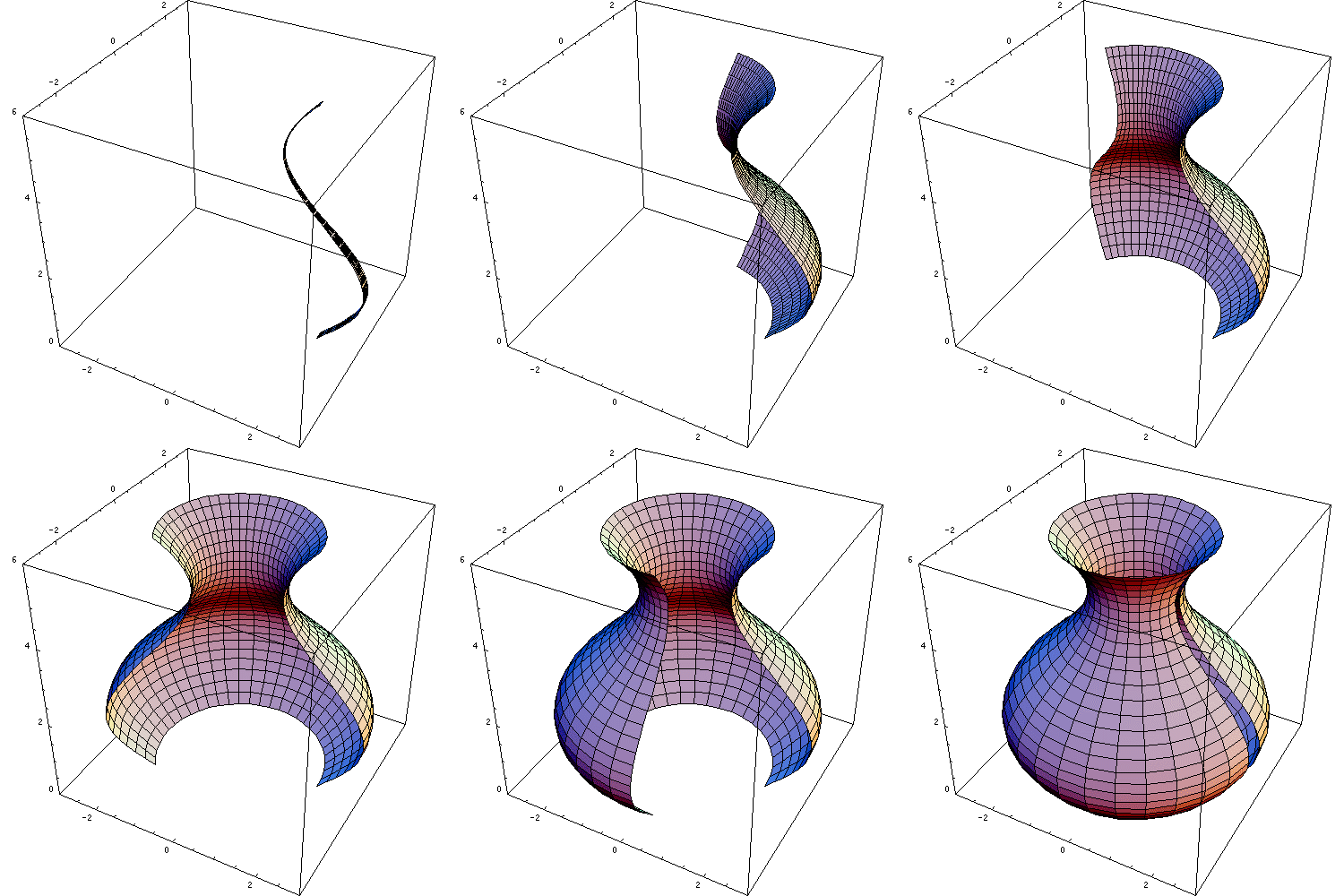
In geometry, a solid of revolution is a solid figure obtained by rotating a plane figure around some straight line (the axis of revolution), which may not intersect the generatrix (except at its boundary). The surface created by this revolution and which bounds the solid is the surface of revolution.
Assuming that the curve does not cross the axis, the solid's volume is equal to the length of the circle described by the figure's centroid multiplied by the figure's area (Pappus's second centroid theorem).
A representative disc is a three-dimensional volume element of a solid of revolution. The element is created by rotating a line segment (of length w) around some axis (located r units away), so that a cylindrical volume of πr2w units is enclosed.
Two common methods for finding the volume of a solid of revolution are the disc method and the shell method of integration. To apply these methods, it is easiest to draw the graph in question; identify the area that is to be revolved about the axis of revolution; determine the volume of either a disc-shaped slice of the solid, with thickness δx, or a cylindrical shell of width δx; and then find the limiting sum of these volumes as δx approaches 0, a value which may be found by evaluating a suitable integral. A more rigorous justification can be given by attempting to evaluate a triple integral in cylindrical coordinates with two different orders of integration.
The disc method is used when the slice that was drawn is perpendicular to the axis of revolution; i.e. when integrating parallel to the axis of revolution.
The volume of the solid formed by rotating the area between the curves of f(y) and g(y) and the lines y = a and y = b about the y-axis is given by If g(y) = 0 (e.g. revolving an area between the curve and the y-axis), this reduces to:
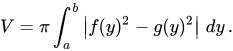
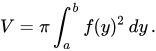
The method can be visualized by considering a thin horizontal rectangle at y between f(y) on top and g(y) on the bottom, and revolving it about the y-axis; it forms a ring (or disc in the case that g(y) = 0), with outer radius f(y) and inner radius g(y). The area of a ring is π(R2 − r2), where R is the outer radius (in this case f(y)), and r is the inner radius (in this case g(y)). The volume of each infinitesimal disc is therefore πf(y)2 dy. The limit of the Riemann sum of the volumes of the discs between a and b becomes integral (1).
Assuming the applicability of Fubini's theorem and the multivariate change of variables formula, the disk method may be derived in a straightforward manner by (denoting the solid as D):

Hub AI
Solid of revolution AI simulator
(@Solid of revolution_simulator)
Solid of revolution
In geometry, a solid of revolution is a solid figure obtained by rotating a plane figure around some straight line (the axis of revolution), which may not intersect the generatrix (except at its boundary). The surface created by this revolution and which bounds the solid is the surface of revolution.
Assuming that the curve does not cross the axis, the solid's volume is equal to the length of the circle described by the figure's centroid multiplied by the figure's area (Pappus's second centroid theorem).
A representative disc is a three-dimensional volume element of a solid of revolution. The element is created by rotating a line segment (of length w) around some axis (located r units away), so that a cylindrical volume of πr2w units is enclosed.
Two common methods for finding the volume of a solid of revolution are the disc method and the shell method of integration. To apply these methods, it is easiest to draw the graph in question; identify the area that is to be revolved about the axis of revolution; determine the volume of either a disc-shaped slice of the solid, with thickness δx, or a cylindrical shell of width δx; and then find the limiting sum of these volumes as δx approaches 0, a value which may be found by evaluating a suitable integral. A more rigorous justification can be given by attempting to evaluate a triple integral in cylindrical coordinates with two different orders of integration.
The disc method is used when the slice that was drawn is perpendicular to the axis of revolution; i.e. when integrating parallel to the axis of revolution.
The volume of the solid formed by rotating the area between the curves of f(y) and g(y) and the lines y = a and y = b about the y-axis is given by If g(y) = 0 (e.g. revolving an area between the curve and the y-axis), this reduces to:
The method can be visualized by considering a thin horizontal rectangle at y between f(y) on top and g(y) on the bottom, and revolving it about the y-axis; it forms a ring (or disc in the case that g(y) = 0), with outer radius f(y) and inner radius g(y). The area of a ring is π(R2 − r2), where R is the outer radius (in this case f(y)), and r is the inner radius (in this case g(y)). The volume of each infinitesimal disc is therefore πf(y)2 dy. The limit of the Riemann sum of the volumes of the discs between a and b becomes integral (1).
Assuming the applicability of Fubini's theorem and the multivariate change of variables formula, the disk method may be derived in a straightforward manner by (denoting the solid as D):
Recent media