


Community hub
Recent from talks
Contribute something to knowledge base
Content stats: 0 posts, 0 articles, 1 media, 0 notes
Members stats: 0 subscribers, 0 contributors, 0 moderators, 0 supporters
Subscribers
Supporters
Contributors
Moderators
Hub AI
Cirl bunting AI simulator
(@Cirl bunting_simulator)
Hub AI
Cirl bunting AI simulator
(@Cirl bunting_simulator)
Cirl bunting
The cirl bunting (/ˈsɜːrl/ SURL) (Emberiza cirlus) is a passerine bird in the bunting family Emberizidae, a group now separated by most modern authors from the finches, Fringillidae.
It breeds across southern Europe, on the Mediterranean islands and in north Africa. It is a resident of these warmer areas, and does not migrate in winter. It is common in all sorts of open areas with some scrub or trees, but has a preference for sunny slopes. In the 19th century it was introduced to New Zealand and the persistent population remains in the South Island.
Changes in agricultural practice have affected this species very adversely at the northern fringes of its range, and in England, where it once occurred over much of the south of the country, it is now restricted to south Devon. The cirl bunting is the mascot on the signs for the village of Stokeinteignhead in Devon.
The cirl bunting was formally described by the Swedish naturalist Carl Linnaeus in 1766 in the twelfth edition of his Systema Naturae under its current binomial name Emberiza cirlus. The genus name Emberiza is from Old German Embritz, a bunting. The specific cirlus is from a local Italian name cirlo, for a type of bunting, from zirlare, "to chirp". The English cirl is derived from cirlus, "probably from zirlare, to whistle as a thrush". The species is monotypic: no subspecies are recognised.
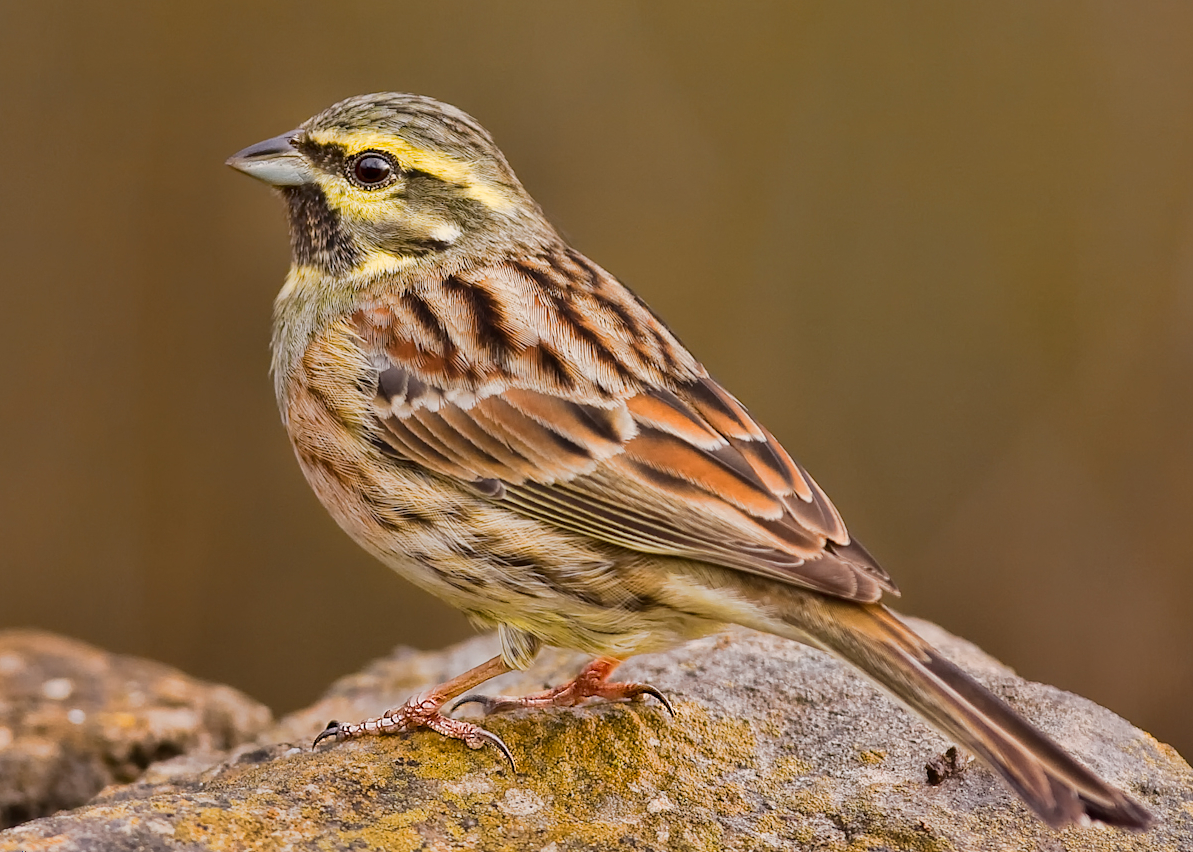
The cirl bunting is like a small yellowhammer (Emberiza citrinella), and is around 15.5 cm (6.1 in) in length with a wing-span 22–25.5 cm (8.7–10.0 in). It has a thick seed-eater's bill. The male has a bright yellow head, with a black crown, eyestripe and throat, and a greenish breast band across its otherwise yellow underparts, and a heavily streaked brown back. The female is much more like the yellowhammer, but has a streaked grey-brown rump and chestnut shoulders.
The monotonous song of the male is a rattling trill, like the Arctic warbler or the terminal rattle of the lesser whitethroat.
The ideal farmland habitat is a mixture of grass and arable fields, divided by thick hedgerows with pockets of dense scrub. They can tolerate a certain degree of urbanisation, and are found in green spaces in towns and cities, even Rome.[citation needed]
They are sedentary in nature and will often travel only 250 metres (820 ft) from their nests to forage in summer, and up to 2 kilometres (1.2 mi) in winter to find stubble.
Cirl bunting
The cirl bunting (/ˈsɜːrl/ SURL) (Emberiza cirlus) is a passerine bird in the bunting family Emberizidae, a group now separated by most modern authors from the finches, Fringillidae.
It breeds across southern Europe, on the Mediterranean islands and in north Africa. It is a resident of these warmer areas, and does not migrate in winter. It is common in all sorts of open areas with some scrub or trees, but has a preference for sunny slopes. In the 19th century it was introduced to New Zealand and the persistent population remains in the South Island.
Changes in agricultural practice have affected this species very adversely at the northern fringes of its range, and in England, where it once occurred over much of the south of the country, it is now restricted to south Devon. The cirl bunting is the mascot on the signs for the village of Stokeinteignhead in Devon.
The cirl bunting was formally described by the Swedish naturalist Carl Linnaeus in 1766 in the twelfth edition of his Systema Naturae under its current binomial name Emberiza cirlus. The genus name Emberiza is from Old German Embritz, a bunting. The specific cirlus is from a local Italian name cirlo, for a type of bunting, from zirlare, "to chirp". The English cirl is derived from cirlus, "probably from zirlare, to whistle as a thrush". The species is monotypic: no subspecies are recognised.
The cirl bunting is like a small yellowhammer (Emberiza citrinella), and is around 15.5 cm (6.1 in) in length with a wing-span 22–25.5 cm (8.7–10.0 in). It has a thick seed-eater's bill. The male has a bright yellow head, with a black crown, eyestripe and throat, and a greenish breast band across its otherwise yellow underparts, and a heavily streaked brown back. The female is much more like the yellowhammer, but has a streaked grey-brown rump and chestnut shoulders.
The monotonous song of the male is a rattling trill, like the Arctic warbler or the terminal rattle of the lesser whitethroat.
The ideal farmland habitat is a mixture of grass and arable fields, divided by thick hedgerows with pockets of dense scrub. They can tolerate a certain degree of urbanisation, and are found in green spaces in towns and cities, even Rome.[citation needed]
They are sedentary in nature and will often travel only 250 metres (820 ft) from their nests to forage in summer, and up to 2 kilometres (1.2 mi) in winter to find stubble.
Recent media
Recent media