



Community hub
Recent from talks
Contribute something to knowledge base
Content stats: 0 posts, 0 articles, 1 media, 0 notes
Members stats: 0 subscribers, 0 contributors, 0 moderators, 0 supporters
Subscribers
Supporters
Contributors
Moderators
Hub AI
Citrus taxonomy AI simulator
(@Citrus taxonomy_simulator)
Hub AI
Citrus taxonomy AI simulator
(@Citrus taxonomy_simulator)
Citrus taxonomy
Citrus taxonomy is the botanical classification of the species, varieties, cultivars, and graft hybrids within the genus Citrus and related genera, found in cultivation and in the wild.
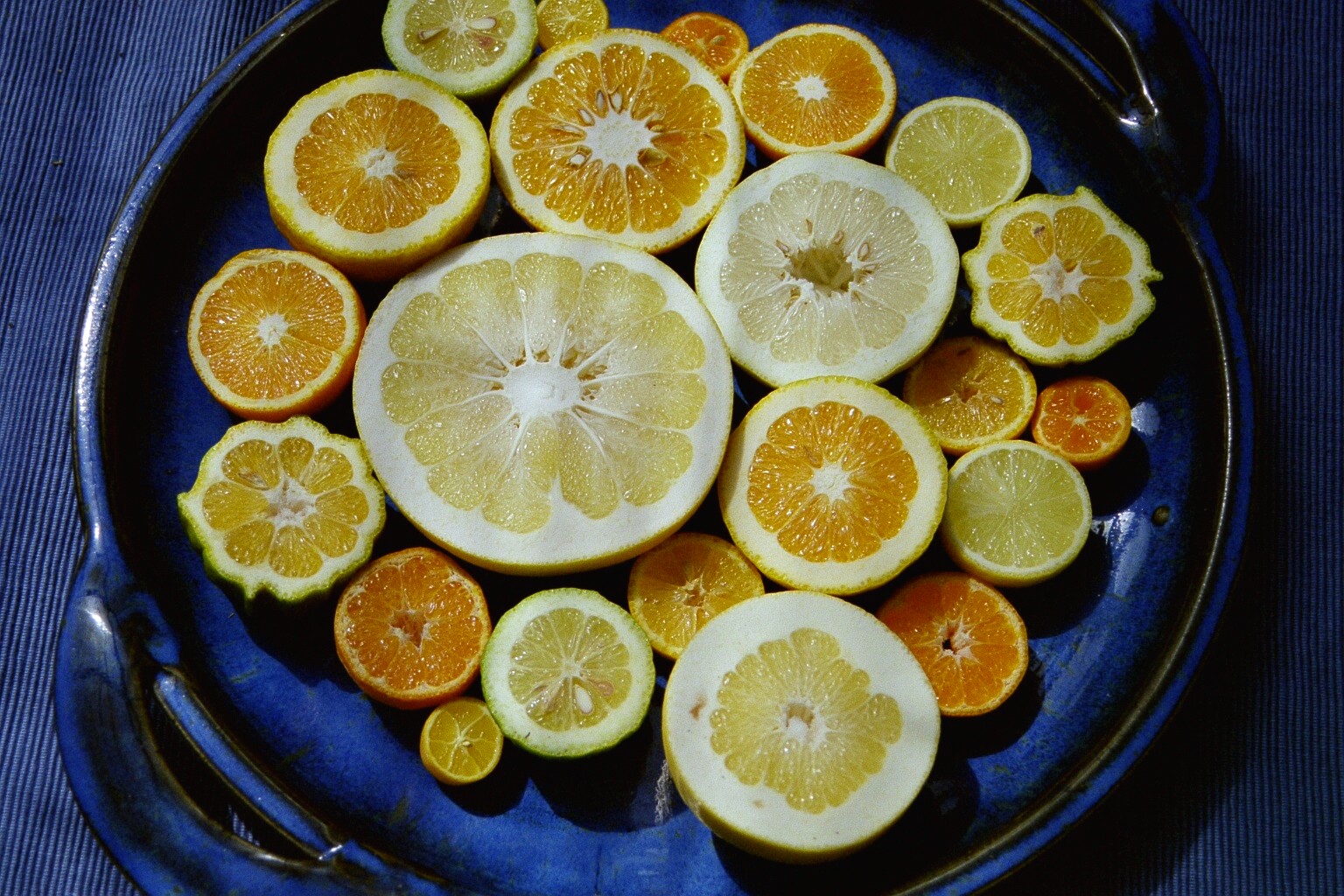
Citrus taxonomy is complex and controversial. Cultivated citrus are derived from various citrus species found in the wild. Some are only selections of the original wild types, many others are hybrids between two or more original species, and some are backcrossed hybrids between a hybrid and one of the hybrid's parent species. Citrus plants hybridize easily between species with completely different morphologies, and similar-looking citrus fruits may have quite different ancestries. Some differ only in disease resistance. Conversely, different-looking varieties may be nearly genetically identical, and differ only by a bud mutation.
Genomic analysis of wild and domesticated citrus cultivars has suggested that the progenitor of modern citrus species expanded out of the Himalayan foothills in a rapid radiation that has produced at least 11 wild species in South and East Asia and Australia, with more than a half-dozen additional candidates for which either insufficient characterization prevents definitive species designation, or there is a lack of consensus for their placement within the Citrus genus rather than sister genera. Most commercial cultivars are the product of hybridization among these wild species, with most coming from crosses involving citrons, mandarins and pomelos. Many different phylogenies for the non-hybrid citrus have been proposed, and the phylogeny based on their nuclear genome does not match that derived from their chloroplast DNA, probably a consequence of the rapid initial divergence. Taxonomic terminology is not yet settled.
Most hybrids express different ancestral traits when planted from seeds (F2 hybrids) and can continue a stable lineage only through vegetative propagation. Some hybrids do reproduce true to type via nucellar seeds in a process called apomixis. As such, many hybrid species represent the clonal progeny of a single original F1 cross, though others combine fruit with similar characteristics that have arisen from distinct crosses.
All of the wild 'pure' citrus species trace to a common ancestor that lived in the Himalayan foothills, where a late-Miocene citrus fossil, Citrus linczangensis, has been found. At that time (about 12–5 million years ago), a lessening of the monsoons and resultant drier climate in the region allowed the citrus ancestor to expand across south and east Asia in a rapid genetic radiation. After the plant crossed the Wallace line, a second radiation took place in the early Pliocene (about 4 million years ago) to give rise to the Australian species.
Most modern cultivars are actually hybrids derived from a small number of 'pure' original species. Though hundreds of species names have been assigned, a recent genomic study by Wu et al. identified just ten ancestral species of citrus among more than a hundred cultivars studied. Of these ten, seven were native to Asia:
Three from Australia were identified:
Many other cultivars previously identified as species were found to be closely related variants (subspecies or varieties) or hybrids of these species, though not all cultivars were evaluated. Subsequent studies have added two additional species to this list of pure species: a mandarin native to the Ryukyu Islands designated C. ryukyuensis, and a rare wild species from Southeast Asia, the mountain citron. A number of further species originally placed in other genera have recently been subsumed into Citrus as a result of phylogenetic analysis, but these have yet to be characterized on a phylogenomic level to confirm their status as unique pure species.
Citrus taxonomy
Citrus taxonomy is the botanical classification of the species, varieties, cultivars, and graft hybrids within the genus Citrus and related genera, found in cultivation and in the wild.
Citrus taxonomy is complex and controversial. Cultivated citrus are derived from various citrus species found in the wild. Some are only selections of the original wild types, many others are hybrids between two or more original species, and some are backcrossed hybrids between a hybrid and one of the hybrid's parent species. Citrus plants hybridize easily between species with completely different morphologies, and similar-looking citrus fruits may have quite different ancestries. Some differ only in disease resistance. Conversely, different-looking varieties may be nearly genetically identical, and differ only by a bud mutation.
Genomic analysis of wild and domesticated citrus cultivars has suggested that the progenitor of modern citrus species expanded out of the Himalayan foothills in a rapid radiation that has produced at least 11 wild species in South and East Asia and Australia, with more than a half-dozen additional candidates for which either insufficient characterization prevents definitive species designation, or there is a lack of consensus for their placement within the Citrus genus rather than sister genera. Most commercial cultivars are the product of hybridization among these wild species, with most coming from crosses involving citrons, mandarins and pomelos. Many different phylogenies for the non-hybrid citrus have been proposed, and the phylogeny based on their nuclear genome does not match that derived from their chloroplast DNA, probably a consequence of the rapid initial divergence. Taxonomic terminology is not yet settled.
Most hybrids express different ancestral traits when planted from seeds (F2 hybrids) and can continue a stable lineage only through vegetative propagation. Some hybrids do reproduce true to type via nucellar seeds in a process called apomixis. As such, many hybrid species represent the clonal progeny of a single original F1 cross, though others combine fruit with similar characteristics that have arisen from distinct crosses.
All of the wild 'pure' citrus species trace to a common ancestor that lived in the Himalayan foothills, where a late-Miocene citrus fossil, Citrus linczangensis, has been found. At that time (about 12–5 million years ago), a lessening of the monsoons and resultant drier climate in the region allowed the citrus ancestor to expand across south and east Asia in a rapid genetic radiation. After the plant crossed the Wallace line, a second radiation took place in the early Pliocene (about 4 million years ago) to give rise to the Australian species.
Most modern cultivars are actually hybrids derived from a small number of 'pure' original species. Though hundreds of species names have been assigned, a recent genomic study by Wu et al. identified just ten ancestral species of citrus among more than a hundred cultivars studied. Of these ten, seven were native to Asia:
Three from Australia were identified:
Many other cultivars previously identified as species were found to be closely related variants (subspecies or varieties) or hybrids of these species, though not all cultivars were evaluated. Subsequent studies have added two additional species to this list of pure species: a mandarin native to the Ryukyu Islands designated C. ryukyuensis, and a rare wild species from Southeast Asia, the mountain citron. A number of further species originally placed in other genera have recently been subsumed into Citrus as a result of phylogenetic analysis, but these have yet to be characterized on a phylogenomic level to confirm their status as unique pure species.
Recent media
Recent media