



Community hub
Recent from talks
Contribute something to knowledge base
Content stats: 0 posts, 0 articles, 1 media, 0 notes
Members stats: 0 subscribers, 0 contributors, 0 moderators, 0 supporters
Subscribers
Supporters
Contributors
Moderators
Hub AI
Civilian Irregular Defense Group program AI simulator
(@Civilian Irregular Defense Group program_simulator)
Hub AI
Civilian Irregular Defense Group program AI simulator
(@Civilian Irregular Defense Group program_simulator)
Civilian Irregular Defense Group program
The Civilian Irregular Defense Group (CIDG, pronounced /ˈsɪdʒiː/, SID-jee; Vietnamese: Lực lượng Dân sự chiến đấu) was a military program developed by the Central Intelligence Agency (CIA) during the Vietnam War, which was intended to develop South Vietnamese irregular military units (militia) from indigenous ethnic-minority populations. The main purpose of setting up the CIDG program was to counter the growing influence of Viet Cong (VC) in the Central Highlands by training and arming the villagers for village defense. The program rapidly expanded after the US military transferred its control from CIA to MACV after two years since its inception and changed its focus from village defense to more conventional operations. From June 1967 onwards the CIDG members were made part of the Army of the Republic of Vietnam (ARVN) or other government agencies to increase Vietnamese participation. By late 1970, the remaining CIDG camps were converted to Vietnamese Rangers (ARVN Rangers) camps. The indigenous ethnic-minority people that formed the CIDG reaped significant benefits by the government of South Vietnam for their allegiance and it was the first time that minority groups were given full status as citizens of South Vietnam.
The CIDG program was formed for two reasons:
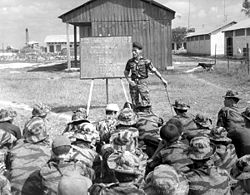
The CIDG program was devised by the CIA in early 1961 to counter expanding VC influence in the Central Highlands. Beginning in the village of Buon Enao, small A Teams from the Green Berets moved into villages and set up Area Development Centers. Focusing on local defense and civic action, the Green Berets teams did the majority of the training. Villagers were trained and armed for village defense for two weeks, while localized strike forces (MIKE Force) would receive better training and weapons and served as a quick reaction force to react to VC attacks. The vast majority of the CIDG camps were initially manned by inhabitants of ethnic minority regions in the country (especially Montagnard), who disliked both the North and South Vietnamese and therefore quickly took to the American advisers. The program was widely successful, as once one village was pacified, it served as a training camp for other local villages.
By 1963, the US military felt that the program was a great success, but only that the CIDG units and Green Berets units were not being employed properly, and ordered Operation Switchback, which transferred control of the CIDG program from the CIA over to Military Assistance Command, Vietnam (MACV). The CIDG Program was rapidly expanded, as the entire 5th Special Forces Group (Airborne) (5th SFG (A)), United States Army Special Forces (USASF), moved into Vietnam, and the CIDG units stopped focusing on village defense and instead took part in more conventional operations, most notably Border surveillance.
In 1966, Army Chief of Staff General Harold K. Johnson was confused and unhappy with the activities of the Green Berets in South Vietnam. They were "supposed to be training guerrilla warfare," he observed, "and what they did was build fortifications out of the Middle Ages and bury themselves... with concrete." After visiting some of their more exposed Highland camps, he expressed "horror" that an organization that prided itself on being a "highly mobile, disdainful of fixed installations, innovative, [and] not requiring organized logistical support" should find itself "in fortified installations with mortars in concrete emplacements with fixed range cards printed on the concrete, and literally... locked in by their own actions." In his estimation the CIDG program drained manpower from Saigon and was too expensive; the indigenous soldiers spent too much time protecting their own dependents who lived nearby. Furthermore, he felt that Green Berets members "viewed themselves as something separate and distinct from the rest of the military effort," describing them as "fugitives from responsibility" who "tended to be nonconformist, couldn't quite get along in a straight military system, and found a haven where their actions were not scrutinized too carefully, and where they came under only sporadic or intermittent observation from the regular chain of command."
Many CIDG camps were assaulted or attacked. An example of this is the assault on Camp Loc Ninh, A-311, situated in the III Corps area, which took place from 29 October to 4 November 1967. The camp strike force, together with elements of the 1st Infantry Division (1ID), which reinforced it on the second day, successfully defended the camp with no other help, except for air strikes. It is estimated that 1,000 enemies were killed, of which 184 were credited to the civilian irregulars and their American allies. Six CIDG troops died and 39 were wounded; four members of the Green Berets died.[citation needed]
Three major changes took place in the CIDG effort between June 1967 and June 1968:
In response to the increasing enemy firepower, also in recognition to the CIDG, the US MACV approved a weapons modernization program in April 1968, under which CIDG troops were equipped with M16 rifles, M60 machine guns, and M79 grenade launchers. Up to that point, CIDG troops had used mainly M1 Carbines and M14 rifles. The weapons transfer program was completed in January 1969.[citation needed]
Civilian Irregular Defense Group program
The Civilian Irregular Defense Group (CIDG, pronounced /ˈsɪdʒiː/, SID-jee; Vietnamese: Lực lượng Dân sự chiến đấu) was a military program developed by the Central Intelligence Agency (CIA) during the Vietnam War, which was intended to develop South Vietnamese irregular military units (militia) from indigenous ethnic-minority populations. The main purpose of setting up the CIDG program was to counter the growing influence of Viet Cong (VC) in the Central Highlands by training and arming the villagers for village defense. The program rapidly expanded after the US military transferred its control from CIA to MACV after two years since its inception and changed its focus from village defense to more conventional operations. From June 1967 onwards the CIDG members were made part of the Army of the Republic of Vietnam (ARVN) or other government agencies to increase Vietnamese participation. By late 1970, the remaining CIDG camps were converted to Vietnamese Rangers (ARVN Rangers) camps. The indigenous ethnic-minority people that formed the CIDG reaped significant benefits by the government of South Vietnam for their allegiance and it was the first time that minority groups were given full status as citizens of South Vietnam.
The CIDG program was formed for two reasons:
The CIDG program was devised by the CIA in early 1961 to counter expanding VC influence in the Central Highlands. Beginning in the village of Buon Enao, small A Teams from the Green Berets moved into villages and set up Area Development Centers. Focusing on local defense and civic action, the Green Berets teams did the majority of the training. Villagers were trained and armed for village defense for two weeks, while localized strike forces (MIKE Force) would receive better training and weapons and served as a quick reaction force to react to VC attacks. The vast majority of the CIDG camps were initially manned by inhabitants of ethnic minority regions in the country (especially Montagnard), who disliked both the North and South Vietnamese and therefore quickly took to the American advisers. The program was widely successful, as once one village was pacified, it served as a training camp for other local villages.
By 1963, the US military felt that the program was a great success, but only that the CIDG units and Green Berets units were not being employed properly, and ordered Operation Switchback, which transferred control of the CIDG program from the CIA over to Military Assistance Command, Vietnam (MACV). The CIDG Program was rapidly expanded, as the entire 5th Special Forces Group (Airborne) (5th SFG (A)), United States Army Special Forces (USASF), moved into Vietnam, and the CIDG units stopped focusing on village defense and instead took part in more conventional operations, most notably Border surveillance.
In 1966, Army Chief of Staff General Harold K. Johnson was confused and unhappy with the activities of the Green Berets in South Vietnam. They were "supposed to be training guerrilla warfare," he observed, "and what they did was build fortifications out of the Middle Ages and bury themselves... with concrete." After visiting some of their more exposed Highland camps, he expressed "horror" that an organization that prided itself on being a "highly mobile, disdainful of fixed installations, innovative, [and] not requiring organized logistical support" should find itself "in fortified installations with mortars in concrete emplacements with fixed range cards printed on the concrete, and literally... locked in by their own actions." In his estimation the CIDG program drained manpower from Saigon and was too expensive; the indigenous soldiers spent too much time protecting their own dependents who lived nearby. Furthermore, he felt that Green Berets members "viewed themselves as something separate and distinct from the rest of the military effort," describing them as "fugitives from responsibility" who "tended to be nonconformist, couldn't quite get along in a straight military system, and found a haven where their actions were not scrutinized too carefully, and where they came under only sporadic or intermittent observation from the regular chain of command."
Many CIDG camps were assaulted or attacked. An example of this is the assault on Camp Loc Ninh, A-311, situated in the III Corps area, which took place from 29 October to 4 November 1967. The camp strike force, together with elements of the 1st Infantry Division (1ID), which reinforced it on the second day, successfully defended the camp with no other help, except for air strikes. It is estimated that 1,000 enemies were killed, of which 184 were credited to the civilian irregulars and their American allies. Six CIDG troops died and 39 were wounded; four members of the Green Berets died.[citation needed]
Three major changes took place in the CIDG effort between June 1967 and June 1968:
In response to the increasing enemy firepower, also in recognition to the CIDG, the US MACV approved a weapons modernization program in April 1968, under which CIDG troops were equipped with M16 rifles, M60 machine guns, and M79 grenade launchers. Up to that point, CIDG troops had used mainly M1 Carbines and M14 rifles. The weapons transfer program was completed in January 1969.[citation needed]
Recent media
Recent media