Hubbry Logo
search
logo
2191728

M60 machine gun

logo
Community Hub0 Subscribers
Write something...
Be the first to start a discussion here.
See all
M60 machine gun

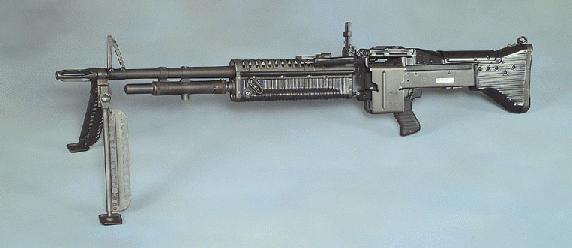
The M60, officially the Machine Gun, Caliber 7.62 mm, M60, is a family of American general-purpose machine guns firing 7.62×51mm NATO cartridges from a disintegrating belt of M13 links. There are several types of ammunition approved for use in the M60, including ball, tracer, and armor-piercing rounds.

It was adopted in 1960 and issued to units later that year. It has served with every branch of the U.S. military and still serves with the armed forces of other nations. Its manufacture and continued upgrade for military and commercial purchase continues into the 21st century, although it has been replaced or supplemented in most roles by other designs, most notably the M240 machine gun in U.S. service.

The M60 is a belt-fed machine gun that fires the 7.62×51mm NATO cartridge (similar to .308 Winchester), which is commonly used in larger rifles, such as the M14. The gun's weight and the amount of ammunition it can consume when firing make it difficult for a single soldier to carry and operate, so it is generally used as a crew-served weapon, operated by a team of two or three individuals. The team consists of the gunner, the assistant gunner (AG), and the ammunition bearer. The gunner carries the weapon and between 200 and 1,000 rounds of ammunition depending on strength and stamina. The assistant carries a spare barrel and extra ammunition and reloads and spots targets for the gunner. The ammunition bearer carries additional ammunition and the tripod with associated traversing and elevation mechanism (if issued) and fetches more ammunition as needed during firing.[citation needed]

The M60 can be accurately fired at short ranges from the shoulder thanks to its design. This was an initial requirement for the design and a hold-over in concept from the M1918 Browning Automatic Rifle. It may also be fired from the integral bipod, M122 tripod, and some other mounts.

M60 ammunition comes in a cloth bandolier containing a cardboard box of 100 pre-linked rounds. The M60 uses the M13 ammunition link, a change from the older M1 link system with which it was not compatible. The cloth bandolier is reinforced to allow it to be hung from the current version of the feed tray. Historically, units in Vietnam used B3A cans from C-rations packs locked into the ammunition box attachment system to roll the ammunition belts over for a straighter and smoother feed to the loading port to enhance reliability of feed. The later models changed the ammunition box attachment point and made this adaptation unnecessary.

The M60 has been adopted by various military agencies around the world. It also has been updated and modernized throughout the years to meet modern military requirements.[citation needed]

The M60 machine gun began development in the late 1940s as a program for a new, lighter 7.62 mm machine gun. It was partly derived from German guns of World War II (most notably the FG 42 and the MG 42), but it contained American innovations as well. The final evaluation version was designated the T161E3. It was intended to replace the M1918 Browning Automatic Rifle and M1919A6 Browning machine gun in the squad automatic weapon role, and in the medium machine gun role. One of the weapons tested against it during its procurement process was the FN MAG.

The U.S. Army adopted the T161E3 as the M60 in 1957. The decision to adopt the M60 instead of foreign designs, like modified versions of the proven German MG 42 or the still-unproven FN MAG, was largely due to Congressional requirements that preference be given to the designs of U.S. arms manufacturers primarily to avoid licensing fees, but also to support U.S. firms.

See all
User Avatar
No comments yet.