



Community hub
Recent from talks
Contribute something to knowledge base
Content stats: 0 posts, 0 articles, 1 media, 0 notes
Members stats: 0 subscribers, 0 contributors, 0 moderators, 0 supporters
Subscribers
Supporters
Contributors
Moderators
Hub AI
Clandeboye AI simulator
(@Clandeboye_simulator)
Hub AI
Clandeboye AI simulator
(@Clandeboye_simulator)
Clandeboye
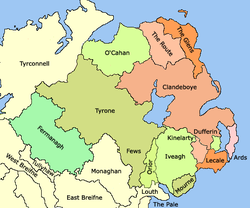
Clandeboye or Clannaboy (Irish Clann Aodha Buí, "family of Hugh the Blond") was a kingdom of Gaelic Ireland, comprising what is now south County Antrim, north County Down, and the barony of Loughinsholin. The entity was relatively late in appearance and is associated partly with the Gaelic resurgence of the High Middle Ages. The O'Neill Clandeboy (Ó Néill Clann Aodha Buidhe) who reigned in the territory descended from Hugh Boy O'Neill, a king of Tyrone. His descendants took advantage of the demise of the Earldom of Ulster during the latter 14th century and seized vast portions of territory. Clandeboye's main seats of power were Shane's Castle and Castle Reagh.
The kingdom came to an end at the dawn of the 17th century after Conn O'Neill, the last head of the Clandeboye O'Neills of Upper Clandeboye, was strong-armed into signing away two-thirds of his land to Scottish and English colonial administrators such as Hugh Montgomery and James Hamilton who proceeded to privately settle their land with settlers from Great Britain just prior to the larger Plantation of Ulster. Conn died in poverty 1618. James Hamilton became the first Viscount Claneboye in 1622.
The spelling of the name has varied over the years, and had been written variously as Clandeboye, Claneboye, Clandyboy, Clannaboy, and Clanaboy. Clandeboye has also been adopted as the name of an electoral ward of North Down Borough Council. It has survived as a geographical location in modern times as an area of Bangor, County Down, Northern Ireland.
The emergence of the Kingdom of Clandeboye is closely associated with the history of its neighbour the Kingdom of Tyrone and the Gaelic resurgence of the 14th century. The O'Neill dynasty that ruled Tyrone had established themselves as a serious power in Ireland by the 13th century, providing Brian Chatha an Dúna O'Neill who was a late claimant to the High Kingship of Ireland before falling at the Battle of Down in 1260.
The O'Neills were, locally, engaged in rivalries with the Norman Earldom of Ulster among other regional foes. In the 12th century, following the Norman invasion of Ireland, the Normans had taken from the native Gaelic Kingdom of Ulster some lands and established their Earldom in the north-eastern corner of Ireland. Subsequently, they were engaged in conflicts and mutual raidings with their direct neighbors the Northern Uí Néill.
By the 14th century, the Earldom of Ulster was under the Ulster branch of the de Burgh dynasty (other branches of this kinship group held territories elsewhere in Ireland, but became heavily Gaelicised). The Bruce campaign in Ireland, with the defenders of the Anglo-aligned Lordship of Ireland being led by Richard Óg de Burgh, 2nd Earl of Ulster, suffered significantly during the conflict. Eventually the Norman title to the Earldom of Ulster passed to the Mortimer family. Niall Mór O'Neill, King of Tyrone (1364–1397) created a vacuum in the area by driving out some of the Anglo-Norman settlers. The Kingship of Tyrone had in recent times been contested by two sets of cousins, one of which was the Clandeboye O'Neills (descended from Hugh Boy O'Neill), who had provided three Kings of Tyrone in the 13th century, before losing out to the line descended from Aodh Reamhair O'Neill (son of Domhnall O'Neill), whom all subsequent Tyrone kings would descend from.
By 1347, Muirchertach Ceannfada O'Neill was the first King of Clandeboye not to be also King of Tyrone, controlling the parts of the old Earldom of Ulster taken over by the O'Neills. Most of their territory was east of the River Bann, in what would today be called south County Antrim and north County Down. The part of Clandeboye territory which was west of the River Bann was Loughinsholin, in what is today County Londonderry, including part of the Sperrin Mountains. This O'Neill line, which had lost out on the Kingship of Tyrone, although technically at first uirrithe (under-kings) of their Tyrone cousins, soon established their own autonomy. Geopolitically, they looked to offset the power of their Tyrone neighbors, by forming alliances with other powers in the area; the MacDonnells of Antrim (a clan of fairly recent Highland Scots descent descended from John of Islay, Lord of the Isles), the powerful O'Donnells of Tyrconnell and, when it suited, the Kingdom of England's Lordship of Ireland based in Dublin. Clandeboye's lands were suited to cattle grazing and so their rulers were able to attain a significant level of wealth through this.
Towards the end of the 14th century and into the early 15th century, the Clandeboye shifted away from their rapprochement with their O'Neill of Tyrone cousins and as with the case of their neighbours to the south, the Magennis clan of Iveagh, entered into an alliance with the powerful O'Donnells of Tyrconnell under Turlough an Fhíona O'Donnell (1380—1422). An ascendant maritime kingdom based in the north-west of Ireland, able to put into the field a strong army with a Gallowglass basis, Tyrconnell mounted a serious challenge to Tyrone's domination of the north of Ireland: Clandeboye and Iveagh saw this as an opportunity to assert more independence for themselves. As part of this complex patchwork of alliances, which spread throughout all of Ireland, there was a wider implication for geopolitics in the British Isles and indeed European politics, in the context of the Hundred Years' War; one faction made alliances with the Plantagenet Kingdom of England, the other with the Stewart Kingdom of Scotland (and thus, by implication of their Auld Alliance; the Kingdom of France). Thus, when Richard II of England visited Ireland and gained the "submission" of a number of Gaelic Irish and Gaelicised chiefs in 1395, there were a few notable absences: the O'Donnells of Tyrconnell (friends of Stewart Scotland) and their Irish allies such as the O'Neills of Clandeboye, Burke of Mayo and O'Connor Ruadh of Roscommon, who never submitted.
Clandeboye
Clandeboye or Clannaboy (Irish Clann Aodha Buí, "family of Hugh the Blond") was a kingdom of Gaelic Ireland, comprising what is now south County Antrim, north County Down, and the barony of Loughinsholin. The entity was relatively late in appearance and is associated partly with the Gaelic resurgence of the High Middle Ages. The O'Neill Clandeboy (Ó Néill Clann Aodha Buidhe) who reigned in the territory descended from Hugh Boy O'Neill, a king of Tyrone. His descendants took advantage of the demise of the Earldom of Ulster during the latter 14th century and seized vast portions of territory. Clandeboye's main seats of power were Shane's Castle and Castle Reagh.
The kingdom came to an end at the dawn of the 17th century after Conn O'Neill, the last head of the Clandeboye O'Neills of Upper Clandeboye, was strong-armed into signing away two-thirds of his land to Scottish and English colonial administrators such as Hugh Montgomery and James Hamilton who proceeded to privately settle their land with settlers from Great Britain just prior to the larger Plantation of Ulster. Conn died in poverty 1618. James Hamilton became the first Viscount Claneboye in 1622.
The spelling of the name has varied over the years, and had been written variously as Clandeboye, Claneboye, Clandyboy, Clannaboy, and Clanaboy. Clandeboye has also been adopted as the name of an electoral ward of North Down Borough Council. It has survived as a geographical location in modern times as an area of Bangor, County Down, Northern Ireland.
The emergence of the Kingdom of Clandeboye is closely associated with the history of its neighbour the Kingdom of Tyrone and the Gaelic resurgence of the 14th century. The O'Neill dynasty that ruled Tyrone had established themselves as a serious power in Ireland by the 13th century, providing Brian Chatha an Dúna O'Neill who was a late claimant to the High Kingship of Ireland before falling at the Battle of Down in 1260.
The O'Neills were, locally, engaged in rivalries with the Norman Earldom of Ulster among other regional foes. In the 12th century, following the Norman invasion of Ireland, the Normans had taken from the native Gaelic Kingdom of Ulster some lands and established their Earldom in the north-eastern corner of Ireland. Subsequently, they were engaged in conflicts and mutual raidings with their direct neighbors the Northern Uí Néill.
By the 14th century, the Earldom of Ulster was under the Ulster branch of the de Burgh dynasty (other branches of this kinship group held territories elsewhere in Ireland, but became heavily Gaelicised). The Bruce campaign in Ireland, with the defenders of the Anglo-aligned Lordship of Ireland being led by Richard Óg de Burgh, 2nd Earl of Ulster, suffered significantly during the conflict. Eventually the Norman title to the Earldom of Ulster passed to the Mortimer family. Niall Mór O'Neill, King of Tyrone (1364–1397) created a vacuum in the area by driving out some of the Anglo-Norman settlers. The Kingship of Tyrone had in recent times been contested by two sets of cousins, one of which was the Clandeboye O'Neills (descended from Hugh Boy O'Neill), who had provided three Kings of Tyrone in the 13th century, before losing out to the line descended from Aodh Reamhair O'Neill (son of Domhnall O'Neill), whom all subsequent Tyrone kings would descend from.
By 1347, Muirchertach Ceannfada O'Neill was the first King of Clandeboye not to be also King of Tyrone, controlling the parts of the old Earldom of Ulster taken over by the O'Neills. Most of their territory was east of the River Bann, in what would today be called south County Antrim and north County Down. The part of Clandeboye territory which was west of the River Bann was Loughinsholin, in what is today County Londonderry, including part of the Sperrin Mountains. This O'Neill line, which had lost out on the Kingship of Tyrone, although technically at first uirrithe (under-kings) of their Tyrone cousins, soon established their own autonomy. Geopolitically, they looked to offset the power of their Tyrone neighbors, by forming alliances with other powers in the area; the MacDonnells of Antrim (a clan of fairly recent Highland Scots descent descended from John of Islay, Lord of the Isles), the powerful O'Donnells of Tyrconnell and, when it suited, the Kingdom of England's Lordship of Ireland based in Dublin. Clandeboye's lands were suited to cattle grazing and so their rulers were able to attain a significant level of wealth through this.
Towards the end of the 14th century and into the early 15th century, the Clandeboye shifted away from their rapprochement with their O'Neill of Tyrone cousins and as with the case of their neighbours to the south, the Magennis clan of Iveagh, entered into an alliance with the powerful O'Donnells of Tyrconnell under Turlough an Fhíona O'Donnell (1380—1422). An ascendant maritime kingdom based in the north-west of Ireland, able to put into the field a strong army with a Gallowglass basis, Tyrconnell mounted a serious challenge to Tyrone's domination of the north of Ireland: Clandeboye and Iveagh saw this as an opportunity to assert more independence for themselves. As part of this complex patchwork of alliances, which spread throughout all of Ireland, there was a wider implication for geopolitics in the British Isles and indeed European politics, in the context of the Hundred Years' War; one faction made alliances with the Plantagenet Kingdom of England, the other with the Stewart Kingdom of Scotland (and thus, by implication of their Auld Alliance; the Kingdom of France). Thus, when Richard II of England visited Ireland and gained the "submission" of a number of Gaelic Irish and Gaelicised chiefs in 1395, there were a few notable absences: the O'Donnells of Tyrconnell (friends of Stewart Scotland) and their Irish allies such as the O'Neills of Clandeboye, Burke of Mayo and O'Connor Ruadh of Roscommon, who never submitted.
Recent media
Recent media