Hubbry Logo
Toronto, OhioToronto, OhioMain
Open search
Toronto, Ohio
Community hub
Toronto, Ohio
logo
8 pages, 0 posts
0 subscribers
Be the first to start a discussion here.
Toronto, Ohio
Toronto, Ohio
from Wikipedia

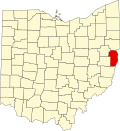
Toronto a city in Jefferson County, Ohio, United States, on the Ohio River. The population was 5,303 at the 2020 census, making it the second-most populous city in Jefferson County.[4] It is part of the Weirton–Steubenville metropolitan area.

Key Information

History

[edit]
1899 bird's-eye view of Toronto

The area was first settled in the 19th century, when it was known as Newburg's Landing. When the railway was built, however, the area's name was changed to Sloanes Station.[5] In 1881, after a vote, the town was incorporated under its present name inspired by Toronto, Canada, which civic leader Thomas M. Daniels felt was a place worth emulating. Along with its Canadian counterpart, it is one of only two incorporated cities in the world named Toronto.[6]

In the 20th century, the town became a center of heavy industry with a number of large factories in and around the town. In the 1980s and 1990s the city, along with the rest of the region, declined sharply as manufacturing jobs left. Titanium Metals Corporation, the world's largest supplier of titanium metals, is the major employer in the city.[7]

Geography

[edit]

Toronto is located at 40°27′44″N 80°36′16″W / 40.46222°N 80.60444°W / 40.46222; -80.60444 (40.462266, -80.604443),[8] and is about 45 minutes from Pittsburgh. According to the United States Census Bureau, the city has a total area of 2.14 square miles (5.54 km2), of which 1.86 square miles (4.82 km2) is land and 0.28 square miles (0.73 km2) is water.[9] It is about 6 miles (9.7 km) north of Steubenville, Ohio, and included in the Weirton–Steubenville metropolitan area.

Demographics

[edit]
Historical population
CensusPop.Note
18902,536
19003,52639.0%
19104,27121.1%
19204,6849.7%
19307,04450.4%
19407,4265.4%
19507,253−2.3%
19607,7807.3%
19707,705−1.0%
19806,934−10.0%
19906,127−11.6%
20005,676−7.4%
20105,091−10.3%
20205,3034.2%
Sources:[3][10][11][12][13]

2010 census

[edit]

As of the census[14] of 2010, there were 5,091 people, 2,278 households, and 1,395 families living in the city. The population density was 2,737.1 inhabitants per square mile (1,056.8/km2). There were 2,516 housing units at an average density of 1,352.7 per square mile (522.3/km2). The racial makeup of the city was 97.1% White, 1.1% African American, 0.2% Native American, 0.2% Asian, 0.1% from other races, and 1.3% from two or more races. Hispanic or Latino of any race were 0.8% of the population.

There were 2,278 households, of which 26.2% had children under the age of 18 living with them, 42.5% were married couples living together, 14.0% had a female householder with no husband present, 4.7% had a male householder with no wife present, and 38.8% were non-families. 34.0% of all households were made up of individuals, and 15.8% had someone living alone who was 65 years of age or older. The average household size was 2.23 and the average family size was 2.84.

The median age in the city was 44 years. 20.7% of residents were under the age of 18; 7.5% were between the ages of 18 and 24; 23.1% were from 25 to 44; 30.5% were from 45 to 64; and 18.1% were 65 years of age or older. The gender makeup of the city was 46.9% male and 53.1% female.

2000 census

[edit]

As of the census[3] of 2000, there were 5,676 people, 2,452 households, and 1,593 families living in the city. The population density was 3,014.6 inhabitants per square mile (1,163.9/km2). There were 2,627 housing units at an average density of 1,395.2 per square mile (538.7/km2). The racial makeup of the city was 97.60% White, 1.00% African American, 0.19% Native American, 0.21% Asian, 0.07% from other races, and 0.92% from two or more races. Hispanic or Latino of any race were 0.48% of the population.

There were 2,452 households, out of which 28.5% had children under the age of 18 living with them, 49.3% were married couples living together, 12.5% had a female householder with no husband present, and 35.0% were non-families. 31.3% of all households were made up of individuals, and 15.7% had someone living alone who was 65 years of age or older. The average household size was 2.31 and the average family size was 2.90.

In the city the age distribution of the population shows 22.8% under the age of 18, 8.0% from 18 to 24, 26.4% from 25 to 44, 24.9% from 45 to 64, and 17.9% who were 65 years of age or older. The median age was 41 years. For every 100 females, there were 85.0 males. For every 100 females age 18 and over, there were 80.9 males.

The median income for a household in the city was $30,905, and the median income for a family was $38,585. Males had a median income of $37,042 versus $19,405 for females. The per capita income for the city was $15,761. About 11.1% of families and 13.4% of the population were below the poverty line, including 22.2% of those under age 18 and 7.4% of those age 65 or over.

Education

[edit]

Public education in the city is provided by the Toronto City School District, which includes one elementary school and Toronto Junior/Senior High School. Toronto has a public library, a branch of the Public Library of Steubenville and Jefferson County.[15]

Notable people

[edit]

See also

[edit]

References

[edit]
[edit]
Revisions and contributorsEdit on WikipediaRead on Wikipedia
from Grokipedia
Toronto is a located in eastern , , on the west bank of the near the border with . It is part of the Weirton–Steubenville, WV–OH Metropolitan Statistical Area and serves primarily as a residential community for workers in nearby industrial and commercial centers. As of the , the population was 5,303, making Toronto the second-most populous in Jefferson County after the county seat of Steubenville. The area was first settled in the early and laid out in as Newburg's Landing by John DePuy on land originally owned by Michael Myers Sr., attracting settlers due to its scenic position above flood levels along the . In 1856, the arrival of the and Railroad, initially naming the stop Sloane's Station, boosted development and trade. The community was incorporated as a village in 1881 and renamed by popular vote, a suggestion from local pioneer manufacturer Thomas M. Daniels; it achieved in 1931. Early included a municipal building in 1887, water works in 1891, and the establishment of a in 1889, reflecting steady growth from about 500 residents in 1880 to over 5,000 by the mid-20th century. Historically a hub for due to its river access, Toronto facilitated the transport and production of coal, , , , terra cotta, and in the 19th and 20th centuries, with factories drawing immigrant labor and spurring increases. In recent years, the economy has shifted toward service sectors, with the largest industries in 2023 being and social assistance (employing 431 people), retail trade (357 people), and accommodation and food services (279 people); the was $47,202. The maintains a council-manager form of government and features community assets like the Toronto Pool and efforts to revitalize areas such as Walton Acres Park. Notable for its "Gem City" nickname—evoking the area's natural beauty and vibrant community—Toronto preserves its industrial legacy through local historical markers and events along the .

History

Settlement and Founding

The settlement of what is now Toronto, Ohio, began in the early along the west bank of the in the southeast corner of Knox Township, Jefferson County. The area was initially chosen for its elevated position above the river's flood plains, providing a safer location for early inhabitants compared to lower-lying riverbanks. Michael Myers Sr., a Revolutionary War veteran and Indian scout who had received fractional section 25 of township 4, range 1 as a land grant in 1787, owned the tract where development occurred. In 1818, John DePuy formally laid out the settlement, surveying lots measuring 60 by 120 feet, with streets 50 feet wide and numbered parallel to the river, including provisions for a central public square. This plat established the foundational grid that shaped the community's early physical layout. Originally named Newburg Landing—reflecting its role as a river docking point—the settlement experienced slow but steady growth as a stop for regional farmers. By the , it served as a key landing for shipments of agricultural products such as , corn, and whiskey destined for markets in New Orleans via the trade routes, supporting commerce in Knox and Island Creek Townships. Early permanent structures included Joseph Kline's , which facilitated local trade, and a grist mill operated by the Myers family along Croxton's Run (also known as Crouton's Run), essential for processing grain from surrounding farms. Additional foundational buildings comprised the first hotel built by Michael Myers Jr. and a shop run by James Toland, catering to travelers and river traffic. These developments underscored the community's reliance on river-based agriculture and basic mercantile activities through the mid-19th century. The settlement's name evolved over time, with the area later known as Sloane's Station following the arrival of the Cleveland and Pittsburgh Railroad in 1856, which enhanced connectivity beyond river transport. In 1881, residents voted to rename it Toronto, drawing inspiration from the Canadian city of Toronto, Ontario, as suggested by local civic leader and manufacturer Thomas M. Daniels; this choice aligned with a broader pattern of Ohio River towns adopting names from prominent Canadian locales to evoke prosperity and familiarity. By 1880, the population had reached approximately 500, setting the stage for further expansion in the late 19th century.

Industrial Growth and Incorporation

Toronto's industrial expansion in the late was catalyzed by its strategic position along the , which provided essential access for shipping , , and manufactured goods to markets downstream toward New Orleans and beyond. The river facilitated the transport of local resources, including from nearby mines like the LaGrange mines under Alexander Gilchrist (producing approximately 200 tons per day), supporting the town's emergence as a hub for resource extraction and processing. Complementing this was the existing rail infrastructure, such as the Cleveland & Pittsburgh Railroad, which connected Toronto to broader networks and spurred further commercial advantages. Key industries flourished during the 1890s and early 1900s, including production, iron processing, , and manufacturing. Nearby examples of early included the Jefferson Iron Works in Brilliant, while operations like the Great Western Fire Clay Works (established 1879, employing 87 workers and shipping 1,600 rail cars annually of sewer pipes, terra cotta, and fire bricks) and Forest City Works (started 1874, employing 75 workers and shipping 1,200–1,500 rail cars annually) were central to Toronto. The Toronto Pottery Company, founded in 1889 with six large kilns under secretary George C. Pugh, and firms like Excelsior Sewer Pipe and Terra Cotta Works (by Patrick Connor) highlighted the town's manufacturing prowess, with additional contributions from nearby glass works such as La Belle in Bridgeport and Northwood in Martin's . This industrial activity contributed to Toronto earning the nickname "The Gem City" in the early 1900s. Infrastructure developments around 1905, including the extension of rail lines connecting Toronto to nearby Steubenville and East Liverpool, further boosted industrial connectivity and . The 1920s marked an economic peak, with Toronto's population rising from 4,684 in 1920 to 7,044 by 1930—a 50.4% increase—driven by sustained output and river trade. This boom culminated in the village's incorporation as a on January 1, 1931, amid the onset of the , which led to reduced factory operations and employment challenges in local iron, clay, and pottery sectors during the early 1930s.

Geography

Physical Setting

Toronto is situated in eastern Jefferson County, Ohio, along the west bank of the Ohio River, approximately 6 miles northeast of Steubenville. As part of the Weirton–Steubenville , it lies within the broader Upper Ohio Valley region, which spans portions of , , and . The city's position places it near the Ohio-West Virginia-Pennsylvania , facilitating regional connectivity via the river and nearby highways. According to the , Toronto encompasses a total area of 2.14 square miles, including 1.88 square miles of land and 0.26 square miles of water, much of the latter associated with the adjacent . The topography consists of elevated ground rising above the river's floodplains, featuring rolling hills characteristic of the Appalachian foothills in eastern . This terrain, with average elevations around 910 feet, reflects the broader geological influences of the . The Ohio River forms a defining environmental feature, serving as a major waterway for historical and modern transportation while supporting recreational opportunities such as and . Local riverfront areas enhance accessibility, with sites like Newburg Landing offering public access for waterfront activities and Toronto Waterfront Park providing green spaces for picnics and trails along the riverbank.

Climate

Toronto, Ohio, features a (Köppen Dfa) with four distinct seasons, including hot, humid summers and cold, snowy winters. This classification results in significant temperature variations throughout the year, with average highs reaching 83°F and lows dropping to 22°F annually. The region's location along the contributes to elevated , particularly during warmer months, moderating some temperature extremes while enhancing moisture in the air. Annual precipitation totals approximately 40 inches, distributed relatively evenly across the year, supporting lush vegetation in spring and summer. Snowfall averages 28 inches per year, primarily occurring from late November through March, with February typically seeing the heaviest accumulations of about 8 inches. These patterns reflect the continental influences that bring cold air masses in winter, leading to frequent snow events. In summer months from to August, daytime highs often climb into the 80s°F, with July averaging 83°F and nighttime lows around 64°F; peaks during this period, creating muggy conditions and occasional thunderstorms. Winters from to bring average highs in the mid-30s°F and lows in the 20s°F, exemplified by January's typical range of 36°F high and 23°F low, accompanied by cloudy skies and regular snowfall. The USDA Plant Hardiness Zones for span 6b (-5°F to 0°F minimum) and 7a (0°F to 5°F minimum), guiding choices in local agriculture, landscaping, and frost-sensitive crops by indicating the area's winter cold tolerance.

Demographics

As of the , Toronto, Ohio, had a of 5,303 residents. This marked a slight increase from the 2010 count of 5,091, representing a growth of approximately 4.2% over the decade, or an average annual rate of about 0.41%. However, compared to the 2000 figure of 5,676, the has experienced a long-term decline of roughly 6.5% through 2020, attributed in part to shifts in the local industrial economy, including reduced employment in sectors like production. The 2024 estimate is 5,187 residents, reflecting a decline of approximately 2.2% since , or an average annual decrease of about 0.55%. This trajectory aligns with broader patterns in small communities facing economic transitions, though Toronto's proximity to the has helped stabilize some demographic flows. Demographic indicators from the 2023 (based on 2018-2022 data) reveal a age of 43.8 years, suggesting an aging structure. The community is overwhelmingly native-born, with 100% of residents identified as U.S. citizens and only 0.66% foreign-born, underscoring limited immigration influence. Average household size stands at 2.2 persons, consistent with patterns in similar mid-sized cities.

Socioeconomic Characteristics

Toronto, Ohio, exhibits a predominantly population, reflecting its historical settlement patterns in the region. According to the 2018-2022 (ACS) 5-year estimates, the racial composition consists of 94% residents, 2% Black or African American, 2.4% identifying as two or more races, and 0.5% Asian. Hispanic or Latino residents of any race make up approximately 1.2% of the . This demographic profile underscores a low level of ethnic diversity, with limited representation from other racial groups such as American Indian and Alaska Native (0.2%) or Native Hawaiian and Other Pacific Islander (less than 0.1%). Economic indicators reveal a working-class community with moderate income levels compared to state averages. The median household income in Toronto was $47,202 in 2022, while the per capita income stood at $36,357, both figures below the Ohio statewide medians of $66,990 and $38,798, respectively. The poverty rate affects 14.6% of the population for whom it is determined, with those below the poverty line comprising 51.9% females and 48.1% males, indicating a slight gender disparity in economic vulnerability. This rate contributes to challenges in family structures, as households below the poverty threshold often face constraints in housing stability and access to resources. Linguistic and nativity data highlight the homogeneity of Toronto's residents. Only 0.9% of the population aged 5 and older speaks a language other than English at home, pointing to minimal linguistic diversity. Immigration remains low, with just 0.7% of residents foreign-born, the majority of whom are naturalized U.S. citizens. Housing reflects these socioeconomic patterns, with a median property value of $102,800 for owner-occupied units (2018-2022 ACS), which is notably lower than the national median of $281,900 and influences affordability for lower-income families.

Government and Economy

Local Government

Toronto, Ohio, operates under a statutory mayor-council form of government as a non-charter , in accordance with Chapter 705 of the Ohio Revised Code, which outlines the structure for such local governments in the state. The serves as the chief executive, elected directly by voters, and is responsible for administering city operations and appointing department heads with council approval. Current John Parker oversees key departments, including the Police Department led by Chief Charlie Daniels, Fire Department under Chief Ryan Boyd, Water Department managed by Superintendent Garry Daugherty, Sewage Department directed by Superintendent Joe Adamovich, Utilities for bill payments and services, and the Toronto War Memorial Pool as part of the Recreation Department. The city council, the legislative body, comprises seven elected members: President Frank McEwen, at-large representatives Mike Burkey, Larry Glenn, and Ronald Holmes, First Ward representative Clark Crago, Second Ward representative Steve Sninchak, Third Ward representative Troy Stewart, and Fourth Ward representative Greg Herrick. Council members serve four-year terms, with elections staggered to ensure continuity, and the body enacts ordinances, approves budgets, and sets policy during bi-monthly meetings on the second and fourth Mondays at 7:00 p.m. in the Council Chambers at 416 Clark Street. Supporting the council are the Law Director Craig Allen, Clerk Linda Kay Burkey, City Auditor Kayla Whitlatch, and City Treasurer Jim Orsini. In August 2025, the council approved the establishment of a Designated Outdoor Refreshment Area (DORA) encompassing North Fourth Street from Clark to Main Street and portions of Market Street, allowing patrons of participating liquor-permitted businesses to carry alcoholic beverages in designated cups to foster economic vitality in the downtown area. The city's financial operations for governmental activities in 2023, as detailed in the independent , showed total revenues of $5,568,945, primarily from municipal income taxes at 2.0% ($4,317,197), property taxes ($211,646), operating and capital ($669,907), and charges for services ($199,680), which funded expenses of $4,593,049 and resulted in a net position increase to $4,041,224. These funds support , public safety, transportation, and functions. Public services include of liquor licenses by the Police Department and Safety Director William Scalley, ensuring compliance especially within the DORA boundaries. Additionally, the city manages community projects such as the Walton Acres development, a multi-phase initiative improving lines, infrastructure, and roadways in the East Fernwood Drive neighborhood, funded by state and low-interest loans totaling over $217,000 drawn as of year-end 2023.

Economy and Industries

Toronto's economy is primarily driven by , with a significant focus on metals processing, including production at the Titanium Metals Corporation (TIMET) facility, which serves as the city's largest employer and contributes to the persistence of its industrial heritage originally rooted in steel production. The Ohio River's location supports river-related and , facilitating and transportation activities, while small-scale retail and service sectors provide additional employment opportunities in the local business district. Key employers also include utilities and smaller factories, reflecting a diversified but modest industrial base influenced by the region's trends. In 2023, the median household income in Toronto was estimated at $47,202, below the national median of $80,610, largely attributable to shifts in employment and economic restructuring. The poverty rate stood at 14.64%, impacting socioeconomic conditions and linked to ongoing transitions in the local job market from traditional roles. Employment in the city grew by 3.22% from 2022 to 2023, reaching about 2,440 jobs, though broader Jefferson County trends indicate slower growth at 1.39% over the same period. Jefferson County's unemployment rate averaged 5.0% in 2023, above the national average of 3.6%, with recent figures rising to 6.3% in August 2025 compared to the U.S. rate of 4.3%. These rates highlight challenges in the job market amid national economic pressures. To bolster local and , Toronto established a Designated Outdoor Refreshment Area (DORA) in 2025, allowing expanded outdoor alcohol service in designated downtown zones to stimulate small businesses and visitor activity.

Education

Public School System

The Toronto City School District serves students from pre-kindergarten through grade 12 in Toronto, Ohio, encompassing a total enrollment of 824 students across three schools. The district operates Toronto Elementary School for grades K-5 with 358 students, Karaffa Elementary School for pre-kindergarten with approximately 86 students, and Toronto Junior/Senior High School for grades 6-12 with 383 students. The district maintains a student-teacher ratio of 16:1, supported by 52.5 full-time equivalent classroom teachers. In 2023 state proficiency testing, overall rates showed 53% of students proficient in and 65% in reading, with elementary-level reading proficiency reaching 72%. These figures position the district in the top 50% of 's 916 school districts based on combined math and reading performance. Established with roots tracing to 1884 and the first high school graduating class in 1889, the district emphasizes community involvement through events such as annual assemblies at the high school, which honor local veterans with breakfasts and programs. In recent recognition, the Toronto City School District was named one of Ohio's "10 Most Admired School Districts" by The Education Magazine for its legacy of learning and commitment to fostering positive educational environments.

Educational Attainment

In Toronto, Ohio, approximately 92% of adults aged 25 and older have attained a or equivalent, slightly above the state average of 91.6%. This level of basic educational completion supports the community's workforce participation, particularly in local industries. Additionally, 63% of middle school students demonstrate proficiency in reading, reflecting foundational literacy skills among younger residents. Higher education attainment remains limited, with about 22.8% of adults holding a or higher, compared to Ohio's statewide rate of 31%. Local options for postsecondary are scarce, requiring residents to commute to institutions in nearby Steubenville or , which may contribute to the lower attainment figures. The presence of veterans, comprising 8.5% of the , influences initiatives, including targeted support for skill development and readjustment programs. Despite a gradual , educational attainment rates have remained stable over recent years, with the school district's enrollment of around 800 students playing a key role in preparing youth for regional job opportunities in and related fields. Challenges persist, as a 14.6% rate limits access to advanced and for some residents, compounded by low residential mobility of 2.6% that reduces exposure to external educational resources.

Notable People

Sports Figures

Clarke Hinkle, born April 10, 1909, in Toronto, Ohio, was a standout fullback and linebacker for the in the from 1932 to 1941. During his career, he earned four selections, led the in rushing yards in 1937 and 1938, and contributed to two championships in 1936 and 1939, showcasing his versatility as both an offensive powerhouse and defensive stalwart. Nicknamed the "Bucknell Flash" from his All-American college days at , Hinkle was inducted into the in 1964 for his pioneering role in the fullback position. He died on November 9, 1988, in . Bob Vogel, who attended high school in Toronto, Ohio, after earlier schooling in nearby Brilliant and Massillon, emerged as a dominant offensive tackle for the from 1962 to 1972. Selected in the first round of the 1962 NFL Draft out of , where he was a two-time All-Big Ten honoree, Vogel anchored the Colts' line during their appearance in 1969 and earned nods in 1967 and 1968. His contributions helped solidify Baltimore's reputation for physical, run-heavy offenses in the late 1960s. John Comer, born June 10, 1900, in , Ohio, played as a fullback for the in the during the 1926 season, appearing in one game amid the league's early professional era. A product of Toronto High School, Comer's brief stint highlighted the transition from sandlot to organized pro football in the 1920s, when teams like the Bulldogs featured legends such as . He passed away on June 29, 1950, in . Bill Peterson, born May 14, 1923, in Toronto, Ohio, became a influential college football coach, most notably leading from 1960 to 1970, where he compiled a 62-26-11 record and guided the Seminoles to their first bowl victory in the 1967 . After playing end at and coaching at various high schools and colleges, Peterson's innovative passing schemes in the 1960s elevated Florida State's program from obscurity to national contender status, fostering a legacy of offensive creativity. He died on August 5, 1993, in . Gordie Hinkle, born April 3, 1905, in Toronto, Ohio, and the brother of Clarke Hinkle, pursued a career in as a , primarily in the from 1926 to 1947, with brief major league appearances for the St. Louis Cardinals in 1934 and the Phillies in 1936. Known for his defensive skills behind the plate, he batted .259 across 1,424 games and later served as a coach and manager in the minors until his death on March 19, 1972, in Houston, Texas.

Entertainers and Others

Toronto, Ohio, has produced a few notable figures in and , reflecting the town's modest size and its position within the region, where economic shifts in the steel industry prompted many residents to seek opportunities elsewhere. With a current population of approximately 5,200, the community has limited widespread notability, but individuals like exemplify the determination of local talent to achieve success on national stages. Robert Urich, born on December 19, 1946, in Toronto, grew up in a working-class family of Carpatho-Rusyn and Slovak descent in the small mill town along the Ohio River. After attending Florida State University for his undergraduate studies and Michigan State University for graduate work, Urich transitioned from a brief stint in sales to acting, landing his first major television role as Dan Tanna in the crime drama Vega$ (1978–1981). He gained further acclaim for portraying the titular detective in Spenser: For Hire (1985–1988), a role that showcased his charismatic everyman appeal, and appeared in prominent miniseries such as Lonesome Dove (1989) and Amerika (1987). Urich's career spanned over 100 credits, including films like The Ice Pirates (1984) and guest spots on shows like Magnum, P.I., before his death from synovial sarcoma on April 16, 2002, at age 55 in Cabot, Arkansas. His early life in Toronto, marked by the town's industrial heritage, influenced his portrayals of resilient, blue-collar characters. In politics and military service, Gary A. Myers stands out as a representative of Toronto's contributions to public leadership. Born on August 16, 1937, in Toronto, Myers attended local schools before earning a B.S. from the in 1960 and an M.B.A. from the in 1964. He served in the United States Air Force Reserve from 1961 to 1968 while working in mechanical and industrial engineering at steel mills, later becoming a consultant in technical services and project management. Elected as a Republican to the U.S. for Pennsylvania's 45th district, Myers served from 1975 to 1979, focusing on and industrial issues pertinent to communities like his hometown; he did not seek reelection in 1978 and later became president of the American Gas Association from 1981 to 1987. Myers passed away on October 31, 2020, in . His career highlights the migration patterns from Ohio's steel towns to nearby states for professional advancement. Beyond these prominent individuals, Toronto residents have made quieter impacts in military and community roles, often driven by the town's economic transitions in the late , which saw and outward migration as jobs diminished. The broader legacy underscores a community pride that extends to its sports heritage as well. Such patterns mirror the experiences of many small towns, where personal achievements abroad bolster local identity.

References

Add your contribution
Related Hubs
User Avatar
No comments yet.