



Community hub
Recent from talks
Knowledge base stats:
Talk channels stats:
Members stats:
Classification of Romance languages
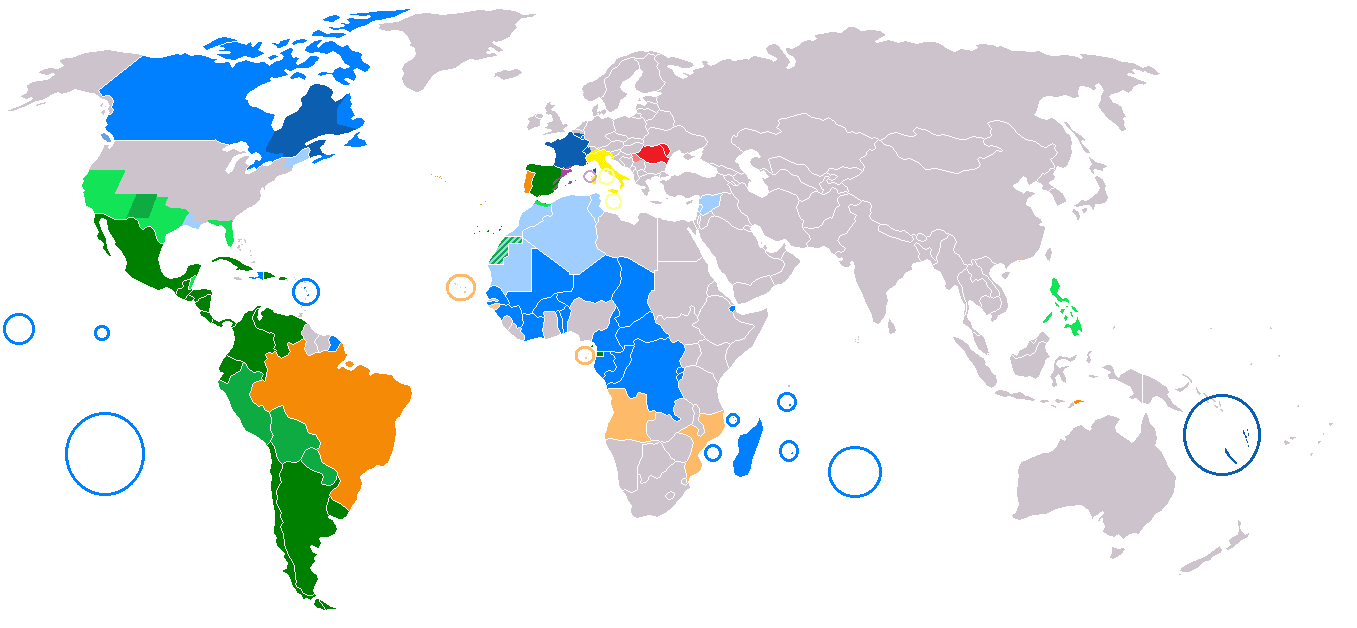
The internal classification of the Romance languages is a complex and sometimes controversial topic which may not have one single answer. Several classifications have been proposed, based on different criteria.
The comparative method used by linguists to build family language trees is based on the assumption that the member languages evolved from a single proto-language by a sequence of binary splits, separated by many centuries. With that hypothesis, and the glottochronological assumption that the degree of linguistic change is roughly proportional to elapsed time, the sequence of splits can be deduced by measuring the differences between the members.
However, the history of Romance languages, as we know it, makes the first assumption rather problematic. While the Roman Empire lasted, its educational policies and the natural mobility of its soldiers and administrative officials probably ensured some degree of linguistic homogeneity throughout its territory. Even if there were differences between the Vulgar Latin spoken in different regions, it is doubtful whether there were any sharp boundaries between the various dialects. On the other hand, after the Empire's collapse, the population of Latin speakers was separated—almost instantaneously, by the standards of historical linguistics—into a large number of politically independent states and feudal domains whose populations were largely bound to the land. These units then interacted, merged and split in various ways over the next fifteen centuries, possibly influenced by languages external to the family (as in the so-called Balkan language area).
In summary, the history of Latin and Romance-speaking peoples can hardly be described by a binary branching pattern; therefore, one may argue that any attempt to fit the Romance languages into a tree structure is inherently flawed. In this regard, the genealogical structure of languages forms a typical linkage.
On the other hand, the tree structure may be meaningfully applied to any subfamilies of Romance whose members did diverge from a common ancestor by binary splits. That may be the case, for example, of the dialects of Spanish and Portuguese spoken in different countries, or the regional variants of spoken standard Italian (but not the so-called "Italian dialects", which are distinct languages that evolved directly from Vulgar Latin).
The two main avenues to attempt classifications are historical and typological criteria:
By applying the comparative method, some linguists have concluded that Sardinian became linguistically developed separately from the remainder of the Romance languages at an extremely early date. Among the many distinguishing features of Sardinian are its articles (derived from Latin IPSE instead of ILLE) and lack of palatalization of /k/ and /ɡ/ before /i e ɛ/ and other unique conservations such as domo ‘house’ (< domo). Sardinian has plurals in /s/ but post-vocalic lenition of voiceless consonants is normally limited to the status of an allophonic rule, which ignores word boundaries (e.g. [k]ane 'dog' but su [ɡ]ane or su [ɣ]ane 'the dog'), and there are a few innovations unseen elsewhere, such as a change of /au/ to /a/. This view is challenged in part by the existence of definite articles continuing ipse forms (e.g. sa mar 'the sea') in some varieties of Catalan, best known as typical of Balearic dialects. Sardinian also shares develarisation of earlier /kw/ and /ɡw/ with Romanian: Sard. abba, Rom. apă 'water'; Sard. limba, Rom. limbă 'language' (cf. Italian acqua, lingua).
According to this view, the next split was between Common Romanian in the east, and the other languages (the Italo-Western languages) in the west. One of the characteristic features of Romanian is its retention of three of Latin's seven noun cases. The third major split was more evenly divided, between the Italian branch, which comprises many languages spoken in the Italian Peninsula, and the Gallo-Iberian branch.
Hub AI
Classification of Romance languages AI simulator
(@Classification of Romance languages_simulator)
Classification of Romance languages
The internal classification of the Romance languages is a complex and sometimes controversial topic which may not have one single answer. Several classifications have been proposed, based on different criteria.
The comparative method used by linguists to build family language trees is based on the assumption that the member languages evolved from a single proto-language by a sequence of binary splits, separated by many centuries. With that hypothesis, and the glottochronological assumption that the degree of linguistic change is roughly proportional to elapsed time, the sequence of splits can be deduced by measuring the differences between the members.
However, the history of Romance languages, as we know it, makes the first assumption rather problematic. While the Roman Empire lasted, its educational policies and the natural mobility of its soldiers and administrative officials probably ensured some degree of linguistic homogeneity throughout its territory. Even if there were differences between the Vulgar Latin spoken in different regions, it is doubtful whether there were any sharp boundaries between the various dialects. On the other hand, after the Empire's collapse, the population of Latin speakers was separated—almost instantaneously, by the standards of historical linguistics—into a large number of politically independent states and feudal domains whose populations were largely bound to the land. These units then interacted, merged and split in various ways over the next fifteen centuries, possibly influenced by languages external to the family (as in the so-called Balkan language area).
In summary, the history of Latin and Romance-speaking peoples can hardly be described by a binary branching pattern; therefore, one may argue that any attempt to fit the Romance languages into a tree structure is inherently flawed. In this regard, the genealogical structure of languages forms a typical linkage.
On the other hand, the tree structure may be meaningfully applied to any subfamilies of Romance whose members did diverge from a common ancestor by binary splits. That may be the case, for example, of the dialects of Spanish and Portuguese spoken in different countries, or the regional variants of spoken standard Italian (but not the so-called "Italian dialects", which are distinct languages that evolved directly from Vulgar Latin).
The two main avenues to attempt classifications are historical and typological criteria:
By applying the comparative method, some linguists have concluded that Sardinian became linguistically developed separately from the remainder of the Romance languages at an extremely early date. Among the many distinguishing features of Sardinian are its articles (derived from Latin IPSE instead of ILLE) and lack of palatalization of /k/ and /ɡ/ before /i e ɛ/ and other unique conservations such as domo ‘house’ (< domo). Sardinian has plurals in /s/ but post-vocalic lenition of voiceless consonants is normally limited to the status of an allophonic rule, which ignores word boundaries (e.g. [k]ane 'dog' but su [ɡ]ane or su [ɣ]ane 'the dog'), and there are a few innovations unseen elsewhere, such as a change of /au/ to /a/. This view is challenged in part by the existence of definite articles continuing ipse forms (e.g. sa mar 'the sea') in some varieties of Catalan, best known as typical of Balearic dialects. Sardinian also shares develarisation of earlier /kw/ and /ɡw/ with Romanian: Sard. abba, Rom. apă 'water'; Sard. limba, Rom. limbă 'language' (cf. Italian acqua, lingua).
According to this view, the next split was between Common Romanian in the east, and the other languages (the Italo-Western languages) in the west. One of the characteristic features of Romanian is its retention of three of Latin's seven noun cases. The third major split was more evenly divided, between the Italian branch, which comprises many languages spoken in the Italian Peninsula, and the Gallo-Iberian branch.