



Community hub
Recent from talks
Contribute something to knowledge base
Content stats: 0 posts, 0 articles, 1 media, 0 notes
Members stats: 0 subscribers, 0 contributors, 0 moderators, 0 supporters
Subscribers
Supporters
Contributors
Moderators
Hub AI
Languages of Italy AI simulator
(@Languages of Italy_simulator)
Hub AI
Languages of Italy AI simulator
(@Languages of Italy_simulator)
Languages of Italy
The languages of Italy constitute one of the richest and most varied linguistic heritages within the European panorama. In fact, only about 45.9% of the Italian population speak Italian at home.
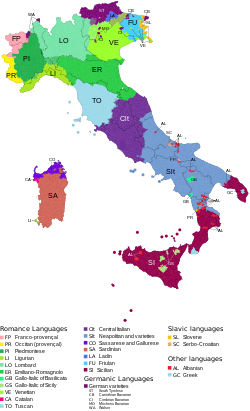
Italian serves as the country's national language, in its standard and regional forms, as well as numerous local and regional languages, most of which, like Italian, belong to the broader Romance group. The majority of languages often labelled as regional are distributed in a continuum across the regions' administrative boundaries, with speakers from one locale within a single region being typically aware of the features distinguishing their own variety from others spoken nearby.
At the time of the political unification of most of Italy under the Kingdom of Sardinia in 1861, according to Tullio De Mauro, Italian speakers made up 2.5% of the population.The language later spread widely among the general population through compulsory education, urbanization, internal migration, bureaucracy, military service, and mass media (both print and audiovisual media) starting from the 1950s.
The official and most widely spoken language across the country is Italian, which started off based on the medieval Tuscan of Florence. In parallel, many Italians also communicate in one of the local languages, most of which, like Tuscan, are indigenous evolutions of Vulgar Latin. Some local languages do not stem from Latin, however, but belong to other Indo-European branches, such as Cimbrian (Germanic), Arbëresh (Albanian), Slavomolisano (Slavic) and Griko (Greek). Other non-indigenous languages are spoken by a substantial percentage of the population due to immigration.
After Italian, the second most spoken language in Italy is another Italian-Romance variant of the same family as Italian: Neapolitan language, spoken by about 11 million people in certain central-southern regions of the country.
Of the indigenous languages, twelve are officially recognized as spoken by linguistic minorities: Albanian, Catalan, German, Greek, Slovene, Croatian, French, Franco-Provençal, Friulian, Ladin, Occitan and Sardinian; Sardinian is regarded as one of the largest of such groups, with approximately one million speakers, even though the Sardophone community is overall declining. However, full bilingualism (bilinguismo perfetto) is legally granted only to the three national minorities whose mother tongue is German, Slovene or French, and enacted in the regions of Trentino-Alto Adige, Friuli-Venezia Giulia and the Aosta Valley, respectively.
Numerous languages were spoken in ancient Italy. These included Etruscan and the Italic branch of the Indo-European languages, consisting of Latino-Faliscan and Osco-Umbrian languages. Furthermore, Celtic languages were spoken in Cisalpine Gaul and ancient Greek was spoken in Magna Graecia. Latin emerged out of the Latino-Faliscan group and replaced the other languages spoken in Italy following the Romanization of the whole peninsula; it is the ancestor of all the Romance languages, the only living subgroup of the Italic languages.
Almost all of the Romance languages spoken in Italy are native to the area in which they are spoken. Apart from Standard Italian, these languages are often referred to as dialetti "dialects", both colloquially and in scholarly usage; however, the term may coexist with other labels like "minority languages" or "vernaculars" for some of them. The label "dialect" may be understood erroneously to imply that the native languages spoken in Italy are "dialects" of Standard Italian in the prevailing English-language sense of "varieties or variations of a language". This is not the case in Italy, as the country's long-standing linguistic diversity does not actually stem from Standard Italian. Most of Italy's variety of Romance languages predate Italian and evolved locally from Vulgar Latin, independently of what would become the standard national language, long before the fairly recent spread of Standard Italian throughout Italy. In fact, Standard Italian itself can be thought of as either a continuation of, or a language heavily based on, the Florentine dialect of Tuscan. Thus, the Romance languages of Italy that are commonly referred to as "dialects" are described as such in a sociolinguistic sense: they are languages that are socially subordinate to Standard Italian, which is the politically and culturally dominant language.
Languages of Italy
The languages of Italy constitute one of the richest and most varied linguistic heritages within the European panorama. In fact, only about 45.9% of the Italian population speak Italian at home.
Italian serves as the country's national language, in its standard and regional forms, as well as numerous local and regional languages, most of which, like Italian, belong to the broader Romance group. The majority of languages often labelled as regional are distributed in a continuum across the regions' administrative boundaries, with speakers from one locale within a single region being typically aware of the features distinguishing their own variety from others spoken nearby.
At the time of the political unification of most of Italy under the Kingdom of Sardinia in 1861, according to Tullio De Mauro, Italian speakers made up 2.5% of the population.The language later spread widely among the general population through compulsory education, urbanization, internal migration, bureaucracy, military service, and mass media (both print and audiovisual media) starting from the 1950s.
The official and most widely spoken language across the country is Italian, which started off based on the medieval Tuscan of Florence. In parallel, many Italians also communicate in one of the local languages, most of which, like Tuscan, are indigenous evolutions of Vulgar Latin. Some local languages do not stem from Latin, however, but belong to other Indo-European branches, such as Cimbrian (Germanic), Arbëresh (Albanian), Slavomolisano (Slavic) and Griko (Greek). Other non-indigenous languages are spoken by a substantial percentage of the population due to immigration.
After Italian, the second most spoken language in Italy is another Italian-Romance variant of the same family as Italian: Neapolitan language, spoken by about 11 million people in certain central-southern regions of the country.
Of the indigenous languages, twelve are officially recognized as spoken by linguistic minorities: Albanian, Catalan, German, Greek, Slovene, Croatian, French, Franco-Provençal, Friulian, Ladin, Occitan and Sardinian; Sardinian is regarded as one of the largest of such groups, with approximately one million speakers, even though the Sardophone community is overall declining. However, full bilingualism (bilinguismo perfetto) is legally granted only to the three national minorities whose mother tongue is German, Slovene or French, and enacted in the regions of Trentino-Alto Adige, Friuli-Venezia Giulia and the Aosta Valley, respectively.
Numerous languages were spoken in ancient Italy. These included Etruscan and the Italic branch of the Indo-European languages, consisting of Latino-Faliscan and Osco-Umbrian languages. Furthermore, Celtic languages were spoken in Cisalpine Gaul and ancient Greek was spoken in Magna Graecia. Latin emerged out of the Latino-Faliscan group and replaced the other languages spoken in Italy following the Romanization of the whole peninsula; it is the ancestor of all the Romance languages, the only living subgroup of the Italic languages.
Almost all of the Romance languages spoken in Italy are native to the area in which they are spoken. Apart from Standard Italian, these languages are often referred to as dialetti "dialects", both colloquially and in scholarly usage; however, the term may coexist with other labels like "minority languages" or "vernaculars" for some of them. The label "dialect" may be understood erroneously to imply that the native languages spoken in Italy are "dialects" of Standard Italian in the prevailing English-language sense of "varieties or variations of a language". This is not the case in Italy, as the country's long-standing linguistic diversity does not actually stem from Standard Italian. Most of Italy's variety of Romance languages predate Italian and evolved locally from Vulgar Latin, independently of what would become the standard national language, long before the fairly recent spread of Standard Italian throughout Italy. In fact, Standard Italian itself can be thought of as either a continuation of, or a language heavily based on, the Florentine dialect of Tuscan. Thus, the Romance languages of Italy that are commonly referred to as "dialects" are described as such in a sociolinguistic sense: they are languages that are socially subordinate to Standard Italian, which is the politically and culturally dominant language.
Recent media
Recent media