


Community hub
Clause IV
View on WikipediaClause IV is part of the Labour Party Rule Book which sets out the aims and values of the British Labour Party. The original clause, adopted in 1918, called for common ownership of industry, and proved controversial in later years; Hugh Gaitskell attempted to remove the clause following Labour's loss in the 1959 general election.
In 1995, under the leadership of Tony Blair, a new Clause IV was adopted. This was seen as a significant moment in Blair's redefinition of the party as New Labour, but has in the years since survived beyond the New Labour branding.
Text
[edit]
The original version of Clause IV was drafted by Sidney and Beatrice Webb in November 1917,[1] and adopted by the party in 1918.[2] It read, in part 4:
To secure for the workers by hand or by brain the full fruits of their industry and the most equitable distribution thereof that may be possible upon the basis of the common ownership of the means of production, distribution and exchange, and the best obtainable system of popular administration and control of each industry or service.[3]
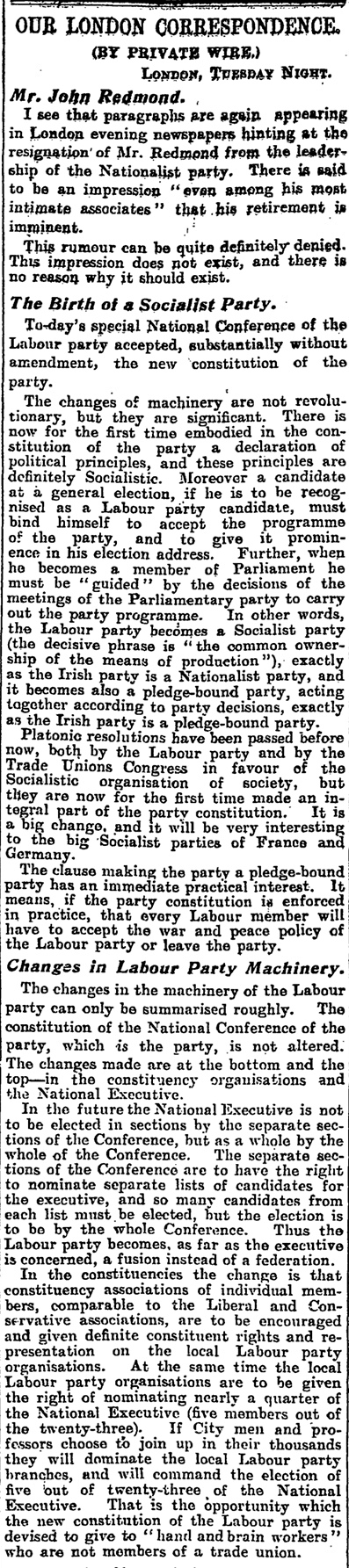
This section was widely seen as the Labour Party's commitment to socialism, even though the word "socialism" is not explicitly mentioned.[3] The Manchester Guardian heralded it as showing "the Birth of a Socialist Party", stating that:
The changes of machinery are not revolutionary, but they are significant. There is now for the first time embodied in the constitution of the party a declaration of political principles, and these principles are definitely Socialistic. ... In other words, the Labour party becomes a Socialist party (the decisive phrase is "the common ownership of the means of production") ... Platonic resolutions have been passed before now, both by the Labour party and by the Trade Unions Congress in favour of the Socialistic organisation of society, but they are now for the first time made an integral part of the party constitution.[2]
In 1918, nationalisation was seen by many voters as akin to modernisation – the nationalisation of the railways was a widely supported policy, for instance, as it would reduce the plethora of uncoordinated and competing companies. This text is usually assumed to involve nationalisation of the whole economy, but close reading of the text shows that there are many other possible interpretations. Common ownership, though later given a technical definition in the Industrial Common Ownership Act 1976, could mean municipal ownership, worker cooperatives or consumer cooperatives.[4]
In December 1944, the Labour Party adopted a policy of "public ownership"[5] and won a clear endorsement for its policies – the destruction of the "evil giants" of want, ignorance, squalour, disease and idleness (identified by William Beveridge in the Beveridge Report)[6]– in the post-war election victory of 1945 which brought Clement Attlee to power. However, the party had no clear plan as to how public ownership would shape their reforms, and much debate ensued.
The nationalization was led by Herbert Morrison, who had had the experience of uniting London's buses and underground train system into a centralized system in the 1930s. He started with the Bank of England in April 1946, whereby stockholders received compensation and the governor and deputy governor were both re-appointed. Further industries swiftly followed: civil aviation in 1946, and railways and telecommunications in 1947, along with the creation of the National Coal Board, which was responsible for supplying 90% of the UK's energy needs. 1946 also saw the establishment of the National Health Service, which came into force in July 1948; railways, canals, road haulage and electricity were all also nationalised in 1948. By 1951, the iron, steel and gas industries had also been brought into public ownership.[7]
Hugh Gaitskell's fight
[edit]After losing the 1959 general election, Labour Party leader Hugh Gaitskell came to believe that public opposition to nationalisation had led to the party's poor performance and proposed to amend Clause IV.[8] The left wing of the party fought back and managed to defeat any change: symbolically, it was then agreed to include Clause IV, part 4, on Labour Party membership cards.[1][9]
The economic crisis of the 1970s, and the defeats suffered by the trade union movement, as well as the decline in influence of the Communist Party of Great Britain, led to a strengthening of the position of Labour Party members who were opposed to Marxism.[1]
Tony Blair's alteration
[edit]
Tony Blair had in 1993, before becoming Leader of the Labour Party, written a pamphlet for the Fabian Society which criticised the wording of Clause IV for not clearly stating the means and ends of the party.[10] Blair put forward a case for re-defining socialism in terms of a set of values which were constant, while the policies needed to achieve them would have to account for a changing society. At the conclusion of the 1994 conference, after becoming Leader, Blair proposed that the Labour Party needed a new statement of aims and values and stated that he would draw one up and present it to the party. This astonished many people, as the last time such a move had been taken in the late 1950s, it had been a failure.[3] The new version was adopted at a Special Conference at Easter 1995 following a debate, and reads, in part:
The Labour Party is a democratic socialist party. It believes that by the strength of our common endeavour we achieve more than we achieve alone, so as to create for each of us the means to realise our true potential and for all of us a community in which power, wealth and opportunity are in the hands of the many, not the few, where the rights we enjoy reflect the duties we owe, and where we live together, freely, in a spirit of solidarity, tolerance and respect.[3]
This version of Clause IV currently appears[update] on the back of individual Labour Party membership cards today.
Presentationally, the abandonment of the socialist principles of the original Clause IV represented a break with Labour's past and, specifically, a break with its 1983 Manifesto (dubbed "the longest suicide note in history", by Gerald Kaufman, one of the party's MPs),[11] in which greater state ownership was proposed.[12]
Jeremy Corbyn's leadership
[edit]The leader of the Labour Party from 2015 to 2020[update], Jeremy Corbyn, was a consistent supporter of renationalising public utilities, such as British Rail and energy companies, to bring them back into public ownership.[13][14]
Corbyn ignited controversy within his party in an interview with The Independent on Sunday:
"I think we should talk about what the objectives of the party are, whether that's restoring the Clause Four as it was originally written or it's a different one, but I think we shouldn't shy away from public participation, public investment in industry and public control of the railways. I'm interested in the idea that we have a more inclusive, clearer set of objectives. I would want us to have a set of objectives which does include public ownership of some necessary things such as rail."[13]
Although this has been seen by some as an endorsement for the reinstatement of the original Clause IV, Corbyn denied this and said that more discussion within the party was needed.[15][16]
Other uses
[edit]Clause Four was also the name of a campaigning group within the Labour Party's student wing (now Labour Students), which succeeded in ending its control by the Militant group in 1975. However, the attempt of the Clause Four group to oppose Militant in the Labour Party Young Socialists (LPYS) was a failure, and LPYS was eventually dissolved.[17]
Clause Four moment
[edit]The changing of Clause IV was seen by political commentators as the defining moment at which Old Labour became New Labour.[18] The phrase "Clause Four moment" has subsequently become a metaphor for any need or perceived need for a fundamental recasting of a political party's principles or attitudes.
See also
[edit]References
[edit]- ^ a b c Gani, Aisha (9 August 2015). "Clause IV: a brief history". The Guardian. Retrieved 27 September 2015.
- ^ a b "The Birth of a Socialist Party". Manchester Guardian. London. 27 February 1918. Retrieved 27 September 2015.
- ^ a b c d Adams, Ian (1998). Ideology and Politics in Britain Today (illustrated, reprint ed.). Manchester University Press. pp. 144–145. ISBN 9780719050565. Retrieved 21 March 2015.
- ^ "Industrial Common Ownership Bill (Hansard, 12 March 1976)". api.parliament.uk. Retrieved 2020-11-22.
- ^ "1945 Labour Party Election Manifesto". 1945. Archived from the original on 2013-03-15. Retrieved 2007-08-21.
There are basic industries ripe and over-ripe for public ownership and management in the direct service of the nation.
- ^ Timmins, Nicholas (2001). The Five Giants: A Biography of the Welfare State (2nd ed.). HarperCollins. p. 23. ISBN 978-0007102648.
- ^ Chester, Daniel (January 1975). The Nationalisation of British industry 1945–1950. Her Majesty's Stationery Office. p. 38. ISBN 9780116301895.
- ^ Jones, Tudor (2005). Remaking the Labour Party: From Gaitskell to Blair. Routledge. p. viii. ISBN 978-1-134-80132-9.
- ^ Hill, Alison (1 April 2015). "Axing Clause IV: Making Labour safe for capitalism". The Socialist. Retrieved 27 September 2015.
- ^ Donadio, Paolo. "Old Clause IV vs. New Clause IV: linguistic / political analysis". federica.unina.it. Retrieved 27 September 2015.
- ^ Mann, Nyta (17 August 2003). "Foot's message of hope to left". BBC News.
- ^ Travis, Alan (11 May 2017). "1983 v 2017: how Labour's manifestos compare". The Guardian.
- ^ a b Merrick, Jane (9 August 2015). "Jeremy Corbyn to 'bring back Clause IV': Contender pledges to bury New Labour with commitment to public ownership of industry". The Independent on Sunday. London. Retrieved 9 August 2015.
- ^ Dathan, Matt; Stone, Jon (23 July 2015). "The 9 charts that show the 'left-wing' policies of Jeremy Corbyn the public actually agrees with". The Independent. London. Retrieved 27 July 2015.
- ^ Perraudin, Frances (9 August 2015). "Jeremy Corbyn denies he would bring back Labour's nationalising clause IV". The Guardian. Retrieved 27 September 2015.
- ^ "Jeremy Corbyn backs greater public ownership for Labour". BBC News. 11 August 2015. Retrieved 27 September 2015.
- ^ Wintour, Patrick (2014-07-16). "From the archive, 16 July 1991: Labour picks fight with Militant Tendency". The Guardian. ISSN 0261-3077. Retrieved 2024-06-24.
- ^ Rentoul, John (1995-03-14). "'Defining moment' as Blair wins backing for Clause IV". The Independent. Retrieved 2013-11-30.
Further reading
[edit]- Bale, Tim. "‘The death of the past’: Symbolic politics and the changing of clause IV." British Elections and Parties Yearbook 6.1 (1996): 158-177.
- Coates, Ken. Common Ownership: Clause IV and the Labour Party (Spokesman Press, 1995) online
- Jobson, Richard. "‘Waving the Banners of a Bygone Age’, Nostalgia and Labour's Clause IV Controversy, 1959–60." Contemporary British History 27.2 (2013): 123-144. https://doi.org/10.1080/13619462.2012.753179
- Jones, Tudor. "‘Taking genesis out of the Bible’: Hugh Gaitskell, clause IV and labour's socialist myth." Contemporary British History 11.2 (1997): 1-23. online
- Jones, Tudor. "Labour’s Constitution and Public Ownership: From ‘Old’ Clause Four to 'New’ Clause Four." in The Labour Party: A Centenary History (Palgrave Macmillan UK, 2000). 292-321.
- Kenny, Michael, and Martin J. Smith. "Discourses of modernization: Gaitskell, Blair and the reform of Clause IV." British Elections & Parties Review 7.1 (1997): 110-126. https://doi.org/10.1080/13689889608412978
- Riddell, Peter. "The end of clause IV, 1994–95." Contemporary British History 11.2 (1997): 24-49. https://doi.org/10.1080/13619469708581435
- Robinson, Emily. "Recapturing Labour’s Traditions? History, nostalgia and the re-writing of Clause IV." British Journal of Politics and International Relations 9 (2007): 582-598 online
External links
[edit]| Political career |
|  |
|---|---|---|
| Shadow Cabinet elections | ||
| Party leadership elections | ||
| General elections | ||
| Family | ||
| Related topics | ||
| Key figures | |
|---|---|
| Political ethos | |
| General elections | |
| Leadership elections | |
| Government | |
| Publications | |
| Funders | |
| Related |
|

Clause IV
View on GrokipediaOrigins and Historical Context
Adoption in 1918
In February 1918, the Labour Party adopted a new constitution at its annual conference in Nottingham, marking its formal independence from the Liberal Party and establishment as a distinct socialist entity amid post-World War I disillusionment with liberal capitalism. Clause IV, drafted by Sidney Webb in November 1917, was incorporated as a core commitment to public ownership, reflecting the party's aspiration to replace private enterprise with collective control over production. The conference, held from 25 to 27 February, endorsed the constitution unanimously, with Webb's formulation emphasizing "common ownership of the means of production, distribution, and exchange" to secure equitable distribution of industry's fruits for workers.[7][8][9] Webb, a Fabian Society leader and co-founder of the London School of Economics, drew on gradualist socialist principles to craft Clause IV, aiming to provide a programmatic basis for Labour's challenge to the established order without immediate revolutionary upheaval. The clause's adoption aligned with broader wartime radicalization, including influences from guild socialism and trade union demands, positioning Labour to appeal to industrial workers seeking systemic change. Contemporary reporting in the Manchester Guardian on 27 February hailed the move as signaling "the birth of a socialist party," highlighting its explicit ideological shift toward nationalization and workers' control.[1][9][10] The 1918 constitution, including Clause IV, strengthened internal party structures by enhancing trade union and constituency influence, while the clause itself served as a symbolic and aspirational mandate rather than a rigid policy blueprint at the time of adoption. Though not immediately tested in government, it encapsulated the party's foundational socialist ethos, influencing subsequent debates on economic ownership despite varying interpretations among moderates and radicals.[11][1]Fabian Society Influence
The Fabian Society, established in 1884 to promote evolutionary socialism through intellectual and institutional permeation, played a pivotal role in shaping Clause IV's commitment to public ownership. Sidney Webb, a founding Fabian and economist, drafted the clause's original text in November 1917, articulating the goal of "common ownership of the means of production, distribution and exchange" as a means to secure workers' full fruits of labor. This draft formed the core of Part IV in the Labour Party's new constitution, adopted at the party's conference in Nottingham on 25 June 1918, amid post-World War I demands for social reconstruction.[10][12] Webb's formulation reflected the Fabians' gradualist approach, emphasizing democratic planning over abrupt expropriation, and drew from their earlier tracts like the 1889 Fabian Essays in Socialism. The society's affiliation with Labour since the party's 1900 inception facilitated this influence, with Fabians providing key policy documents that underpinned the 1918 programme Labour and the New Social Order. This programme, incorporating Clause IV, outlined nationalization of key industries such as land, railways, and banks, aligning with Fabian advocacy for state-directed economic efficiency to mitigate capitalist inequalities.[13][12] Despite the Fabians' non-revolutionary stance, Clause IV's adoption marked a doctrinal shift for Labour, embedding socialist principles that prioritized collective control to enable "the best obtainable system of popular administration and control of each industry or service." Critics later noted the clause's vagueness on implementation timelines, a deliberate Fabian tactic to allow flexibility in permeation strategy, though it committed the party to transformative aims without specifying mechanisms like compensation or sequencing. Empirical assessments of early Fabian-influenced policies, such as limited post-1918 nationalizations, showed mixed outcomes, with productivity gains in some sectors but bureaucratic inefficiencies emerging by the 1920s.[11]Original Text and Core Principles
Exact Wording and Provisions
The original Clause IV, specifically Part 4, of the Labour Party's constitution, drafted by Sidney Webb in 1917 and adopted at the party's conference on 26 February 1918, read as follows:To secure for the producers by hand or by brain, the full fruits of their industry and the most equitable distribution thereof that may be possible upon the basis of the common ownership of the means of production, distribution and exchange, and the best obtainable system of popular administration and control of each industry or service.[14]This wording encapsulated the party's commitment to socialism through collective ownership, targeting the elimination of private control over economic resources deemed essential to production.[14] The phrase "producers by hand or by brain" explicitly included both manual workers and intellectual laborers, broadening the scope beyond traditional trade union bases to encompass a wider proletarian class.[1] The provision's core elements mandated pursuit of "common ownership of the means of production, distribution and exchange," which in practice signified nationalization or public control of industries such as coal, railways, and banking, as later evidenced in the 1945-1951 government's actions.[1] "Full fruits of their industry" implied remuneration commensurate with output without capitalist profit extraction, while "most equitable distribution" presupposed redistribution via state mechanisms to mitigate inequalities inherent in market systems.[14] Finally, "popular administration and control" advocated democratic oversight, potentially through elected boards or worker committees, though implementation often centralized authority in government ministries rather than diffuse popular participation.[11] This aspirational language, while not legally binding, served as an ideological cornerstone, symbolizing rejection of capitalism in favor of planned economic coordination.[1]
Interpretation as Socialist Mandate
Clause IV of the Labour Party's constitution, adopted on February 25, 1918, was interpreted by many within the party as a foundational mandate for socialism, explicitly committing members to pursue "common ownership of the means of production, distribution and exchange."[3] This phrasing, drafted by Fabian Society intellectual Sidney Webb, was seen as endorsing the replacement of private capitalist enterprise with collective forms of ownership, such as state nationalization or worker cooperatives, to ensure equitable distribution of economic fruits to workers.[1][9] For the party's socialist wing, the clause functioned as an ideological cornerstone, obligating Labour to prioritize the socialization of industry over mere reforms within capitalism.[11] It was viewed not as aspirational rhetoric but as a directive for concrete policies aimed at eradicating class exploitation through public control of key sectors, reflecting post-World War I radicalism and the influence of Marxist and guild socialist ideas prevalent in 1918.[15] Proponents, including early leaders like Ramsay MacDonald initially, argued it encapsulated the party's unique mission to transition society toward socialism, distinguishing it from liberal incrementalism.[1] This interpretation gained traction amid interwar economic instability, where Clause IV justified advocacy for widespread nationalizations as the pathway to socialist equity.[16] However, even as it symbolized unyielding socialist commitment, critics within the party later contended that rigid adherence hindered electoral appeal, though the mandate's socialist essence remained undisputed among traditionalists until revisionist challenges in the mid-20th century.[17] The clause's emphasis on "the best obtainable system of popular administration and control" further reinforced perceptions of it as prescribing democratic planning over market mechanisms.[18]Early Implementation and Economic Realities
Attlee Government's Nationalizations (1945-1951)
The Attlee government, following its landslide victory in the July 1945 general election, pursued an extensive program of nationalizations to realize Clause IV's mandate for "common ownership of the means of production, distribution and exchange." These measures targeted industries deemed essential to the economy, aiming to eliminate private monopolies, improve efficiency through centralized planning, and align with post-war reconstruction needs, though implementation relied on state-appointed boards rather than democratic worker control as some socialists advocated.[19][20] Nationalizations commenced with the Bank of England Act 1946, which transferred ownership of the central bank to the state effective 1 March 1946, granting the Treasury full control over its operations and policy without altering its day-to-day functions significantly.[21] This was followed by the Coal Industry Nationalisation Act 1946, vesting ownership of the coal mines in the National Coal Board on 1 January 1947, absorbing over 1,600 private collieries and employing around 700,000 workers to address chronic underinvestment and strikes in the sector.[20] The Civil Aviation Act 1946 established state corporations for scheduled air services, while the Cable and Wireless Act 1946 nationalized the submarine cable and wireless communications company.[22] Subsequent acts expanded public ownership to transport and utilities. The Transport Act 1947 nationalized the "Big Four" railway companies into British Railways and long-distance road haulage under the British Transport Commission, integrating approximately 1.5 million vehicles and 20,000 miles of track to rationalize fragmented services.[20] The Electricity Act 1947 consolidated over 600 private and municipal suppliers into the British Electricity Authority, with 14 area boards for distribution, effective from 1 April 1948.[20] The Gas Act 1948 similarly unified around 1,100 gas undertakings under the Gas Council and 12 area boards, vesting control on 1 May 1949.[23] The program culminated in the Iron and Steel Act 1949, which nationalized major producers including Tata-owned companies, with government acquiring 80% of shares by February 1951, covering about 90% of the industry's capacity and involving 14 firms.[24] Overall, these measures brought roughly one-fifth of the British economy under public ownership, compensating private owners at market values totaling over £2.5 billion, though critics from both left and right questioned the administrative structures' ability to achieve Clause IV's transformative goals without deeper structural reforms.[20][23]Post-War Performance and Critiques
The nationalized industries implemented pursuant to Clause IV's mandate for public ownership demonstrated initial post-war output gains in some sectors, but these were overshadowed by long-term inefficiencies, low productivity growth, and rising costs that required substantial government subsidies. In coal mining, nationalized in 1947 under the National Coal Board, production increased from 193.1 million tonnes in 1946 to a peak of 228.5 million tonnes in 1952 amid reconstruction efforts, yet total output declined by 44% over the subsequent four decades as the industry failed to adapt to shifting energy demands like oil and nuclear power. Productivity in coal grew anemically at 0.9% annually from 1948 to 1958 before contracting at -0.7% per year from 1968 to 1978, reflecting diseconomies of scale, overmanning, and inadequate modernization despite monopoly status.[25][26] In steel, nationalized via the Iron and Steel Act 1949 (effective 1951), productivity lagged international competitors due to rigid structures and insufficient capital investment, with the sector's output and efficiency hampered by political interference prioritizing employment over commercial viability; denationalization in 1953 was partial and reversed in 1967 amid ongoing underperformance. British Railways, nationalized in 1948, faced chronic losses from the 1950s onward, with service standards declining amid heavy reliance on subsidies—exacerbated by the 1955 Modernisation Plan's £1.2 billion investment (equivalent to about £30 billion today) that failed to stem modal shifts to road transport or reverse productivity stagnation. Electricity and gas nationalizations (1947–1949) fared somewhat better organizationally, achieving technical integration, but still suffered from cost escalations and bureaucratic inertia that inflated consumer prices without commensurate efficiency gains.[27][26][28] Critiques from economists and industry analysts centered on structural flaws inherent to state monopoly: absence of profit incentives fostered "X-inefficiency" through overstaffing, weak management accountability, and politicized pricing that subordinated commercial decisions to social or electoral goals, such as maintaining uneconomic pits or routes. By 1971, nationalized industries absorbed 18.7% of UK gross investment, 7.2% of employment, and 10.2% of GDP, yet delivered subpar returns, contributing to Britain's postwar productivity failure—total factor productivity growth averaged just 1.7% annually from 1950 to 1973, trailing West Germany's 3.5%—as inadequate equipment investment and input misallocation compounded union-driven rigidities. These outcomes fueled arguments that nationalization, rather than resolving prewar ailments like fragmented ownership, entrenched higher costs and reduced adaptability, with compensating benefits in strategic planning deemed insufficient by empirical assessments.[29][30][31][32]Initial Revision Efforts
Hugh Gaitskell's 1959-1960 Campaign
Following the Labour Party's defeat in the October 8, 1959, general election, where the party lost six seats despite gaining votes, leader Hugh Gaitskell attributed part of the loss to voter apprehension over potential further nationalizations implied by Clause IV's commitment to "common ownership of the means of production, distribution and exchange".[33] He argued that retaining the clause projected an image of outdated socialism, alienating middle-class and moderate voters in a post-war economy favoring mixed enterprise over wholesale public ownership.[4] At the 1959 Labour Party Conference in Blackpool from October 5 to 8, Gaitskell launched his revision campaign in his leader's address, denouncing Clause IV as "a piece of old luggage" and calling for its replacement with language affirming democratic socialism through flexible means, including public control where necessary but without mandatory nationalization of major industries.[34] He famously likened strict adherence to the clause to "waving the banners of a bygone age," emphasizing the need to modernize the party's image to regain electoral viability amid rising affluence and Conservative successes.[35] The proposal immediately divided the party, with right-wing revisionists supporting Gaitskell and left-wing Bevanites, led by Aneurin Bevan, defending the clause as a core socialist principle essential to distinguishing Labour from Conservatives.[4] The campaign extended into 1960, with Gaitskell and allies like Douglas Jay pushing for constitutional changes through the National Executive Committee (NEC), which drafted revisions emphasizing planning and public ownership selectively rather than comprehensively.[11] Trade union leaders, holding significant voting power at conference, split: some like the Transport and General Workers' Union backed revision for pragmatism, while others resisted to preserve ideological purity.[15] Internal debates highlighted tensions between electoral realism and doctrinal fidelity, with critics accusing Gaitskell of diluting socialism to mimic Conservative policies. At the 1960 Labour Conference in Scarborough from October 3 to 7, delegates rejected the formal revision by a majority, voting on a composite resolution that reaffirmed "adherence to paragraph 4 of Clause IV" as printed on membership cards, effectively upholding the original wording.[15] Gaitskell accepted the defeat but secured a de facto compromise: the party adopted a new policy statement, Signposts for the Sixties, which eschewed pledges for additional nationalizations beyond prior Attlee-era ones, allowing leadership discretion in pursuing mixed-economy approaches without constitutional mandate for mass public ownership.[11] This outcome preserved Clause IV's text while signaling a pragmatic shift, though it exacerbated Gaitskell's rift with the left and contributed to his leadership challenges, including a brief 1960 contest he won decisively.[11]Reasons for Failure
Gaitskell's campaign to revise Clause IV faced staunch opposition from trade unions and the Labour Party's left wing, who regarded the clause as an indelible emblem of socialist principles adopted in 1918.[36] These groups argued that altering the commitment to "common ownership of the means of production" would signal an abandonment of core ideology, despite the clause's aspirational rather than mandatory nature in practice.[11] Even traditionalist right-wing trade union leaders, wielding substantial block votes at party conferences, resisted the changes, broadening the base of dissent beyond ideological extremists.[37] The proposed amendments sought to condition further nationalizations on public support and economic viability, reflecting Gaitskell's assessment that voter backlash against extensive state ownership contributed to Labour's October 8, 1959, general election defeat, where the party secured 43.8% of the vote but lost 17 seats.[4] Opponents countered that such pragmatism diluted the party's transformative vision, invoking nostalgia for the clause's historical role in distinguishing Labour from liberal capitalism.[38] This symbolic entrenchment outweighed electoral arguments, as Clause IV had become a litmus test of loyalty amid internal divisions exacerbated by recent policy clashes, including the 1960 Blackpool conference's initial vote for unilateral nuclear disarmament.[39] By July 13, 1960, anticipating defeat in internal party votes, Gaitskell withdrew the revision proposal to avert a damaging schism, prioritizing party unity over immediate reform.[36] A compromise emerged at the October 1960 Labour Party conference, endorsing a new statement of aims that affirmed flexible pursuit of public ownership while leaving Clause IV unaltered, thus preserving its rhetorical force without enforcing literal implementation.[39] This outcome underscored the trade unions' decisive influence, representing over 80% of conference voting power, and the rank-and-file's aversion to perceived capitulation to conservative electoral pressures.[11]Shift to Revisionism
Electoral Defeats and Pragmatism (1979-1992)
Following the 1979 general election, in which Labour secured 36.9% of the vote but lost power to Margaret Thatcher's Conservatives amid the Winter of Discontent—marked by widespread strikes and economic stagnation—the party faced immediate pressure to reassess its rigid adherence to Clause IV's nationalization mandates.[40] The defeat, Labour's first in four elections since 1945, underscored voter rejection of further public ownership expansions, as Thatcher's platform emphasized privatization and market reforms that contrasted sharply with Labour's socialist commitments.[40] Under Michael Foot's leadership from 1980 to 1983, Labour veered further left, culminating in the 1983 election manifesto that pledged extensive nationalizations aligned with Clause IV, alongside unilateral nuclear disarmament and EEC withdrawal.[40] This resulted in a catastrophic defeat, with Labour garnering only 27.6% of the vote and the Conservatives achieving a 144-seat majority; the document was derided as "the longest suicide note in history" for its perceived unelectability, directly tying Clause IV's ideals to public fears of economic disruption.[40] Foot's tenure highlighted how dogmatic socialism alienated moderate voters, prompting calls for pragmatic moderation to restore competitiveness.[3] Neil Kinnock's election as leader in 1983 initiated a phase of internal reform, including the expulsion of the hard-left Militant Tendency and the 1987-1990 Policy Review, which moderated stances on defense and the economy by embracing NATO membership and selective market mechanisms while retaining Clause IV's public ownership rhetoric.[40] Despite these shifts, Labour lost the 1987 election (30.8% vote share, 102-seat Tory majority) and the 1992 election (34.4% vote, unexpected Conservative win under John Major), with Clause IV symbolizing an outdated commitment to mass nationalization that clashed with post-Thatcher public preference for private enterprise successes.[40] Kinnock's efforts fostered party discipline and electability groundwork but revealed Clause IV as a persistent barrier, as surveys indicated voter skepticism toward renationalization promises amid privatization's apparent efficiencies.[3] These successive defeats—four under Clause IV's unamended influence—drove pragmatic recognition that ideological purity sacrificed electoral viability, setting the stage for deeper revisionism by emphasizing adaptable policies over doctrinal socialism.[41] Kinnock's post-1992 resignation reflected this consensus, with party figures acknowledging that Clause IV's legacy hindered broad appeal in an era of neoliberal ascendancy.[40]Internal Party Dynamics
The period following Labour's 1979 general election defeat was marked by intense factional strife, with the party's left wing, galvanized by Tony Benn, pushing for a return to uncompromising socialist principles enshrined in Clause IV, including widespread nationalization and unilateral nuclear disarmament.[42] This shift culminated in Michael Foot's election as leader in November 1980, defeating moderate Denis Healey, and Benn's narrow loss in the 1981 deputy leadership contest to Healey by just 0.37% of the vote, which nonetheless exposed deep divisions and prompted the formation of the Social Democratic Party by disaffected right-wingers.[43] The 1983 election manifesto, dubbed "the longest suicide note in history" by Labour MP Gerald Kaufman, reflected this leftward lurch with commitments to Clause IV-style public ownership and withdrawal from the European Economic Community, contributing to a landslide defeat with only 27.6% of the vote.[44] Neil Kinnock's ascension to leadership in October 1983 initiated a pragmatic counteroffensive against hard-left elements, particularly the Trotskyist Militant Tendency, which had infiltrated local branches and controlled Liverpool City Council, leading to illegal budget deficits and confrontations over rate-capping in 1984-1985.[43] Kinnock's infamous 1985 party conference speech in Bournemouth condemned Militant's "grotesque chaos" in Liverpool as alien to Labour's traditions, marking the start of systematic expulsions; by 1986, the party had launched an inquiry and begun removing up to 200 Militant members from rolls, reducing their influence from controlling key bodies to marginalization.[45] These measures, alongside a 1989 policy review that diluted commitments to mass nationalization, faced resistance from Bennite factions but gradually restored moderate control, evidenced by Labour's improved 1992 vote share of 34.4% under John Smith, though still short of victory.[46] This internal reconfiguration prioritized electability over ideological purity, with Kinnock's reforms— including rule changes for leadership elections and candidate selection—weakening trade union bloc votes and left-wing vetoes, setting precedents for Tony Blair's later constitutional overhaul.[44] Despite persistent left critiques of "betrayal" from figures like Benn, who advocated reverting to Clause IV orthodoxy, the dynamics underscored a causal shift: electoral pragmatism compelled revisionists to confront entryism and dogma, as unchecked radicalism had repeatedly alienated voters amid Thatcher's economic narrative.[42]Tony Blair's 1995 Revision
Political Context and Strategy
Following Labour's fourth consecutive general election defeat in April 1992, the party faced pressure to modernize its image to regain voter trust after over a decade of Conservative dominance under Margaret Thatcher and John Major.[47] The death of leader John Smith in May 1994 provided an opportunity for change, with Tony Blair elected party leader on 21 July 1994, committed to reforming outdated elements of the party's constitution.[47] Clause IV, Part 4—adopted in 1918 and committing the party to "common ownership of the means of production, distribution and exchange"—had become a symbol of rigid socialism, deterring middle-class and business voters who associated it with threats of widespread nationalization.[1][3] Blair's strategy centered on electoral pragmatism, positioning Labour as a credible alternative government by abandoning dogmatic commitments that alienated swing voters in a post-Thatcher economy favoring private enterprise and deregulation.[5] In his first Labour conference speech on 4 October 1994, Blair explicitly pledged to revise Clause IV, framing it as essential to demonstrate the party's evolution beyond 19th-century Marxism toward a flexible socialism compatible with market mechanisms.[47] This move was part of the broader "New Labour" rebranding, which sought to centralize control within the leadership, marginalize the hard-left, and appeal to aspirational voters by emphasizing opportunity, responsibility, and economic stability over redistribution through state ownership.[15] By targeting Clause IV as a non-core relic—despite its historical significance—Blair aimed to neutralize Conservative attacks portraying Labour as economically reckless, a tactic that had proven effective in prior elections.[48] The revision process was designed for success through party mechanisms, including a special conference in April 1995 where the new text passed overwhelmingly with 90% support from delegates and a ballot of individual members yielding 71% approval on 29 April 1995.[5] Strategically, Blair avoided framing the change as ideological capitulation, instead presenting it as updating the party's aims to reflect democratic socialism's focus on ending poverty and injustice via democratic means rather than prescriptive nationalization.[3] This approach mitigated internal resistance from traditionalists while signaling to the electorate that Labour had learned from past defeats, prioritizing power over purity to enable policy implementation in areas like welfare reform and public service investment.[49] The tactic echoed but succeeded where earlier efforts, such as Hugh Gaitskell's post-1959 defeat campaign, had failed due to insufficient grassroots buy-in.[48]Process and New Text
Tony Blair, elected Labour Party leader on 21 July 1994, committed to revising Clause IV during his first conference speech at the Blackpool gathering from 3 to 6 October 1994, arguing for a modern statement of aims that reflected contemporary realities rather than outdated pledges.[50][51] A special party conference convened on 29 April 1995 in London to debate and vote on the proposed amendment, following months of internal consultation and drafting led by Blair's team.[47][5] The revision process involved bypassing traditional one-member-one-vote mechanisms by securing block votes from affiliated trade unions, which held significant influence under the party's electoral college system, ensuring the leadership's draft prevailed despite opposition from left-wing activists.[17] The conference approved the new text with overwhelming support, estimated at around 90% of delegates, effectively ending the constitutional commitment to public ownership of industry and replacing it with aspirational goals emphasizing individual opportunity and social justice.[52][53] The new Clause IV, titled "Aims and values," states:This formulation explicitly abandoned mandatory nationalization, shifting focus to pragmatic, value-based objectives compatible with a mixed economy.[3]
- The Labour Party is a democratic socialist Party. It believes that by the strength of our common endeavour we achieve more than we achieve alone so as to enable all individuals to reach their full potential, both personally and socially. It seeks to elect to public office those who will act in the interests of the whole community and not just a privileged few.
- The Labour Party strives at all times to promote democracy, individual worth, and social justice in a context of a market economy. It seeks to balance and reconcile the fundamental conflicts between private and public interests. It works for a society where all citizens have the opportunity to achieve their potential regardless of their birth, background or circumstance.
- The rights of individuals to liberty, security, justice and fair treatment must be respected. The Labour Party is committed to the defence and extension of these rights at home and abroad.
- The Labour Party believes that poverty, exploitation, and social injustice are abominations. It aims to eradicate these evils from our society. It seeks to ensure that the rights of the weak against the strong are protected.
- The Labour Party is committed to the promotion of equality of opportunity for all, and the elimination of discrimination on grounds of race, colour, religion, sex, disability or sexual orientation.
- The Labour Party seeks to promote peace throughout the world and the defence of democracy and civil liberties at home and abroad.
- The Labour Party is committed to a strong and independent United Kingdom within a changing European Union.
- The Labour Party is committed to a just society, which rejects the use of scarce resources for the benefit of a privileged few. It seeks to ensure that the economy serves the needs of the people, and not the other way round.[54]