


Community hub
Recent from talks
Contribute something to knowledge base
Content stats: 0 posts, 0 articles, 1 media, 0 notes
Members stats: 0 subscribers, 0 contributors, 0 moderators, 0 supporters
Subscribers
Supporters
Contributors
Moderators
Hub AI
Claymore mine AI simulator
(@Claymore mine_simulator)
Hub AI
Claymore mine AI simulator
(@Claymore mine_simulator)
Claymore mine
The Claymore mine is a directional anti-personnel mine developed for the United States Armed Forces, invented by Norman MacLeod. Unlike a conventional land mine, the Claymore may be command-detonated (fired by remote-control), and is directional, shooting a wide pattern of metal balls into a kill zone. The Claymore can also be activated by a booby-trap tripwire firing system for use in area denial operations.
The Claymore fires steel balls out to about 300 ft (100 m) within a 60° arc in front of the device. It is used primarily in ambushes and as an anti-infiltration device against enemy infantry. It is also used against unarmored vehicles.
Many countries have developed and used mines like the Claymore. Examples include models MON-50, MON-90, MON-100, and MON-200 introduced by the Soviet Union and used by its successor Russia, as well as MRUD (Serbia), MAPED F1 (France), and Mini MS-803 (South Africa).
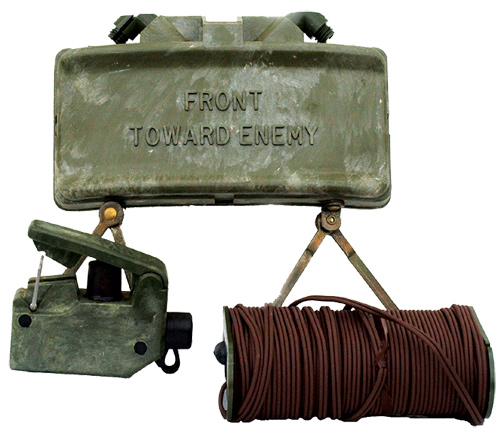
The M18A1 Claymore mine has a horizontally convex gray-green plastic case (inert training versions are light blue or green with a light blue band). The shape was developed through experimentation to deliver the optimum distribution of fragments at 160 ft (50 m) range. The case has the words "FRONT TOWARD ENEMY" embossed on the front of the mine. A simple open sight on the top surface allows for aiming the mine. Two pairs of scissor legs attached to the bottom support the mine and allow it to be aimed vertically. On both sides of the sight are fuse wells set at 45°.
Internally the mine contains a layer of C-4 explosive behind a matrix of about seven hundred 1⁄8-inch-diameter (3 mm) steel balls set into an epoxy resin.
When the M18A1 is detonated, the explosion drives the matrix forward, out of the mine at a velocity of 3,900 ft/s (1,200 m/s), at the same time breaking it into individual fragments. The steel balls are projected in a 60° fan-shaped pattern 7 feet (2 m) high and 160 ft (50 m) wide at a range of 160 ft (50 m). The force of the explosion deforms the relatively soft steel balls into a shape similar to a .22 rimfire projectile. These fragments are moderately effective up to a range of 330 ft (100 m), with a hit probability of around 10% on a prone man-sized 1.3-square-foot (0.12 m2) target. The fragments can travel up to 800 ft (250 m). The optimum effective range is 160 ft (50 m), at which the optimal balance is achieved between lethality and area coverage, with a hit probability of 30% on a man-sized target.
The weapon and all its accessories are carried in an M7 bandolier ("Claymore bag"). The mine is detonated as the enemy personnel approaches the killing zone. Controlled detonation may be accomplished by use of either an electrical or non-electrical firing system. When mines are employed in the controlled role, they are treated as individual weapons and are reported in the unit fire plan. They are not reported as mines; however, the emplacing unit must ensure that the mines are removed, detonated, or turned over to a relieving unit. The 100-foot (30 m) M4 electric firing wire on a green plastic spool is provided in each bandolier. The M57 firing device (colloquially referred to as the "clacker") is included with each mine. An M40 circuit test set is packed in each case of six mines. When the mines are daisy-chained together, one firing device can detonate several mines.
The mine can be detonated by any mechanism that activates the blasting cap. There are field-expedient methods of detonating the mine by tripwire, or by a timer, but these are rarely used.
Claymore mine
The Claymore mine is a directional anti-personnel mine developed for the United States Armed Forces, invented by Norman MacLeod. Unlike a conventional land mine, the Claymore may be command-detonated (fired by remote-control), and is directional, shooting a wide pattern of metal balls into a kill zone. The Claymore can also be activated by a booby-trap tripwire firing system for use in area denial operations.
The Claymore fires steel balls out to about 300 ft (100 m) within a 60° arc in front of the device. It is used primarily in ambushes and as an anti-infiltration device against enemy infantry. It is also used against unarmored vehicles.
Many countries have developed and used mines like the Claymore. Examples include models MON-50, MON-90, MON-100, and MON-200 introduced by the Soviet Union and used by its successor Russia, as well as MRUD (Serbia), MAPED F1 (France), and Mini MS-803 (South Africa).
The M18A1 Claymore mine has a horizontally convex gray-green plastic case (inert training versions are light blue or green with a light blue band). The shape was developed through experimentation to deliver the optimum distribution of fragments at 160 ft (50 m) range. The case has the words "FRONT TOWARD ENEMY" embossed on the front of the mine. A simple open sight on the top surface allows for aiming the mine. Two pairs of scissor legs attached to the bottom support the mine and allow it to be aimed vertically. On both sides of the sight are fuse wells set at 45°.
Internally the mine contains a layer of C-4 explosive behind a matrix of about seven hundred 1⁄8-inch-diameter (3 mm) steel balls set into an epoxy resin.
When the M18A1 is detonated, the explosion drives the matrix forward, out of the mine at a velocity of 3,900 ft/s (1,200 m/s), at the same time breaking it into individual fragments. The steel balls are projected in a 60° fan-shaped pattern 7 feet (2 m) high and 160 ft (50 m) wide at a range of 160 ft (50 m). The force of the explosion deforms the relatively soft steel balls into a shape similar to a .22 rimfire projectile. These fragments are moderately effective up to a range of 330 ft (100 m), with a hit probability of around 10% on a prone man-sized 1.3-square-foot (0.12 m2) target. The fragments can travel up to 800 ft (250 m). The optimum effective range is 160 ft (50 m), at which the optimal balance is achieved between lethality and area coverage, with a hit probability of 30% on a man-sized target.
The weapon and all its accessories are carried in an M7 bandolier ("Claymore bag"). The mine is detonated as the enemy personnel approaches the killing zone. Controlled detonation may be accomplished by use of either an electrical or non-electrical firing system. When mines are employed in the controlled role, they are treated as individual weapons and are reported in the unit fire plan. They are not reported as mines; however, the emplacing unit must ensure that the mines are removed, detonated, or turned over to a relieving unit. The 100-foot (30 m) M4 electric firing wire on a green plastic spool is provided in each bandolier. The M57 firing device (colloquially referred to as the "clacker") is included with each mine. An M40 circuit test set is packed in each case of six mines. When the mines are daisy-chained together, one firing device can detonate several mines.
The mine can be detonated by any mechanism that activates the blasting cap. There are field-expedient methods of detonating the mine by tripwire, or by a timer, but these are rarely used.
Recent media
Recent media