Hubbry Logo
MRUDMRUDMain
Open search
MRUD
Community hub
MRUD
logo
8 pages, 0 posts
0 subscribers
Be the first to start a discussion here.
MRUD
MRUD
from Wikipedia
Yugoslav MRUD anti-personnel mine (back, side view)

Key Information

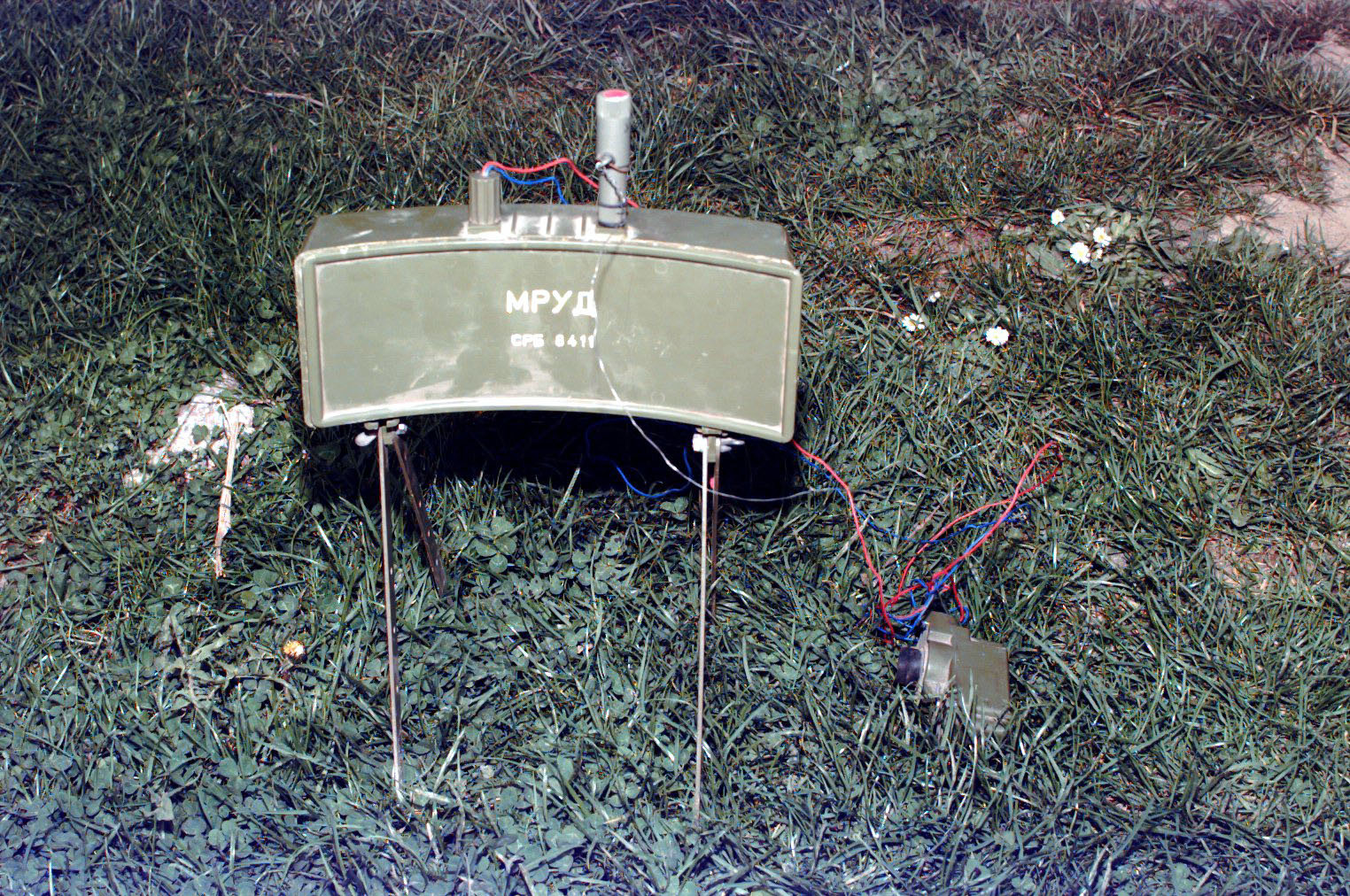
Yugoslav MRUD anti-personnel mine (front, accessories fitted)
Yugoslav MRUD anti-personnel mine (line drawing)
Yugoslav MRUD anti-personnel mine fielded

The MRUD (Serbian: мина распрскавајућа усмереног дејства, romanizedMina Rasprskavajuća Usmerenog Dejstva, lit.'Directed fragmentation mine') is a Yugoslav plastic bodied, convex rectangular directional type anti-personnel mine designed to wound or kill by fragmentation.

Design

[edit]

The MRUD is broadly similar to the M18A1 Claymore mine. The casing is a light green color with two detonator wells and three crude sight lines on the top and an embossed grid pattern on the front of some early mines. Two detachable metal legs fit in slots on the bottom to secure the mine when it is ground mounted.

The body of the MRUD is waterproof and the mine can be used in temperatures from −30˚ to +50˚ C. The mine body contains 900 grams of TNT-based explosive and 650 5.5-millimeter steel balls. When fired the fragmentation has a lethal arc of 60 degrees and a lethal range of 40–50 meters. The MRUD kit comes packed with a manual inductor, circuit test device and an EK-40-69 electric detonator. The mine can be command detonated from up to 30 meters away using a manual inductor or another electrical power source. The fuse cavities also accept any Serbian booby trap fuse with an M10 × 1 mm including the UMP-1 and UMP-2 pull and the UMNOP-1 multi-function fuse.

The MRUD comes packed in a grey/green colored canvas shoulder bag which also contains the firing cable a circuit tester and a manual inductor. Ten of these sets come packed in a natural wooden crate.

These mines have been encountered mounted high in trees as well as the more conventional ground mounting. The MRUD can be located visually as well as with metal detectors. Depending on the actuation method the MRUD will have a limited resistance to blast overpressure from explosive breaching methods like the Giant Viper and MICLIC.

Specifications

[edit]
  • Mine action: Claymore-type directional fragmentation
  • Material: Plastic casing
  • Shape: Claymore
  • Color: Light green, olive
  • Weight: 1500g
  • Fuse #1: Command detonated (electrical)
  • Fuse #2:
    • UMP-1 Mechanical Pull
    • UMNP-1 Mechanical Pull/Pressure
    • Detonation Cord (det cord) attached to PMA-1/2

Demining hazards

[edit]

The MRUD is usually command actuated by electric detonator, but it can also be set up for tripwire actuation. In Bosnia and Croatia it was combined with a PMA-2 blast type anti-personnel mine by inserting one end of a length of detonating cord in the detonator cavity of the MRUD and taping the other end of the detonating cord to the bottom of the PMA-2. When the blast mine actuated, the MRUD was actuated as well.

If an insulated wire is encountered, care must be taken to establish control of both ends of the wire before attempting to neutralize the mine. The mine should be approached from a 90˚ angle (never from the front) in order to remain outside of its blast arc. When tracking the route of a tripwire, keep in mind that additional anti-personnel blast mines may have been buried along its length. It is all too easy to concentrate on following the tripwire, forgetting what may lie concealed underneath it.

References

[edit]
Revisions and contributorsEdit on WikipediaRead on Wikipedia
from Grokipedia
The MRUD (Mina Rasprskavajuća Usmerenog Dejstva) is a directional fragmentation originating from the former , characterized by its plastic body and convex rectangular shape designed to project lethal fragments forward in a 60-degree arc up to 50 meters. It contains 900 grams of , such as PETN or , embedded with 650 pre-formed 5.5 mm bearings to maximize wounding or killing effect against exposed . The device measures 231 mm in length and 89 mm in height, with folding scissor legs enabling ground emplacement or attachment to stakes and trees for elevated positioning, enhancing its utility in and defensive roles. Primarily initiated by electrical command for controlled use, it supports optional fuzing that allows victim-operated , though this configuration raises concerns under international restrictions on anti-personnel mines. Deployed in conflicts across the and more recently in , the MRUD has proven effective for channeling enemy movements and inflicting casualties in linear formations, but its persistence as continues to pose risks to civilians long after hostilities cease. Compared to analogous Western designs like the M18A1 , it incorporates a higher yield while maintaining a lightweight, low-metal construction for concealment and reduced detectability.

History and Development

Origins in Yugoslav Defense Industry

The MRUD (Mina Rasprskavajućeg Dejstva, or fragmentation action mine) emerged from the Socialist Federal Republic of Yugoslavia's (SFRY) emphasis on military self-sufficiency following the 1948 Tito-Stalin split, which prompted the development of an independent defense industry decoupled from Soviet supplies. This sector, centered on producing , artillery, and munitions for the (JNA), included specialized facilities for anti-personnel landmines to support the doctrine of Total National Defense (Opšta Narodna Odbrana), envisioning against potential invaders. The MRUD, a directional fragmentation type akin in function to Western designs, was engineered for ambush and perimeter protection, utilizing a body to reduce detectability and incorporating command-detonation mechanisms. Primary production of anti-personnel mines like the MRUD occurred in factories within the , a key industrial hub for Yugoslav ordnance due to its resource access and engineering expertise. Facilities such as those in Vogošća (home to the Pretis works) and specialized in explosive devices, churning out millions of mines to stockpile JNA reserves and enable exports under non-aligned policies. These plants integrated reverse-engineered elements from global designs—evident in the MRUD's convex rectangular form packed with pre-fragmented steel balls—while adapting them to local materials and tactical needs, such as lightweight portability for deployment. Yugoslav industry records indicate the MRUD entered service during the era, reflecting broader advancements in non-metallic casings to evade mine detectors, a response to evolving threats in scenarios. Production emphasized reliability in rugged terrains, with the mine's 650 embedded 5.5 mm steel fragments optimized for lethal radii up to 50 meters, prioritizing wounding over instant kills to strain enemy logistics—a pragmatic choice rooted in resource constraints rather than humanitarian concerns. While exact initial deployment dates remain undocumented in open sources, the design's simplicity facilitated scaled output, positioning it as a staple in JNA inventories by the .

Production Timeline and Variants

The was produced in the , where the primary facility for manufacturing antipersonnel landmines was situated in the Socialist Republic of Bosnia and Herzegovina. Following the breakup of Yugoslavia in the early 1990s, production of the MRUD persisted in successor states, including and . Detailed production timelines, including start and end dates or annual output figures, remain undocumented in publicly accessible sources. No distinct model variants of the MRUD exist; however, the design accommodates flexible fuzing options for varied tactical applications. Configurations include electrical command initiation via detonators for remote detonation or fuzes with detonators for or tension activation. Early iterations feature an embossed grid pattern on the front surface, distinguishing them from later smooth-faced versions. A single detonator well enables interconnection of multiple mines using for synchronized detonation.

Design and Technical Specifications

Physical Construction and Components

The features a plastic-bodied, convex rectangular casing optimized for directional fragmentation effects. The body measures 230 mm in length, 100 mm in height, and 80 mm in width, with a typically light green coloration. Internally, the mine contains 900 grams of as the main charge, molded into a convex shape on the forward face. This explosive matrix embeds 650 pre-formed 5.5-millimeter steel balls, which are propelled forward upon detonation to create a lethal fragmentation pattern. The exterior includes two detonator wells for fuzing, crude sightlines on the top surface for alignment, and, in some early production models, an embossed grid pattern on the front face. Folding scissor-leg supports enable ground-level emplacement, while the mine can also be affixed to stakes, trees, or other objects for elevated positioning.

Explosive Charge and Fragmentation Mechanism

The MRUD incorporates a main charge of 900 grams of , typically based on high explosives such as PETN or , which provides the necessary for fragment propulsion without requiring a heavy metal casing. This composition allows for a compact, lightweight design using injection-molded for the body, optimizing the forward-directed blast while containing rearward effects through the mine's structural geometry. Fragmentation is achieved via 650 steel ball bearings, each 5.5 mm in diameter, embedded directly into the convex forward surface of the explosive matrix, serving as pre-formed projectiles rather than relying on case fragmentation. Detonation initiates a high-velocity that expels these balls in a conical , with the inherent curvature of the mine's face—approximately 231 mm long and 89 mm high—widening the dispersion to a 60-degree horizontal arc for enhanced coverage against linear targets like personnel formations. The resulting lethal radius extends to 50 meters, where fragment velocities and densities are sufficient to cause penetrating wounds or fatalities, though effectiveness diminishes with distance due to ballistic spread and energy loss. This mechanism parallels directional mines like the M18 but employs simpler, molded-in fragments for reliability in field conditions, prioritizing volume of fire over precision patterning. The absence of a rigid liner or reflector in documented designs relies instead on the explosive's uniform to ensure consistent forward projection, minimizing rates in command-detonated scenarios.

Fuzing Systems and Arming Procedures

The MRUD directional fragmentation mine utilizes two fuze wells located on its rear face, enabling multiple initiation methods including electrical command , tripwire actuation, or . Primary fuzing relies on command-initiated systems, such as electrical detonators or radio command receivers, which allow remote triggering via wired connections or wireless signals from a transmitter. fuzes can be installed in one or both wells, connected to taut wires stretched across likely paths, with a secondary well often reserved for anti-handling detonators to counter tampering. These fuzes transmit the initiation signal to an internal booster charge, propelling approximately 650 steel ball bearings forward in a 60-degree arc upon . Arming procedures commence after securing the mine in position, typically using two detachable metal legs inserted into bottom slots for ground emplacement or alternative staking to trees or posts for elevated setups. Fuzes are inserted into the wells, followed by the removal of mechanical pins that prevent premature arming during and storage; this step activates the and arming mechanism, enabling operational readiness. For radio command variants, the receiver unit's antenna is deployed, and the system incorporates a delay to ensure full arming only after pin removal and environmental settling, minimizing accidental discharge. configurations require stretching and tensioning wires to specified sensitivities, often calibrated to 1-5 kg pull forces depending on the model, though exact thresholds vary by Yugoslav-era production standards. Once armed, the mine's waterproof plastic body protects internal components from environmental degradation, supporting prolonged field deployment.

Operational Principles and Deployment

Tactical Employment Methods

The MRUD mine is primarily employed for defensive protection of positions and in operations against advances. It is emplaced by attaching folding scissor-leg supports to elevate and orient the device toward anticipated enemy paths, or by securing it to trees, posts, or other fixed structures at heights of approximately 0.5 to 1 meter for optimal fragmentation dispersal. netting or natural foliage is applied to conceal the mine and its supports, minimizing visibility while ensuring the convex face projects fragments in a 60-degree horizontal arc up to 50 meters. Command initiation via an electrical connected by up to 30 meters of wire to a firing clacker allows operators to detonate the mine remotely, synchronizing with troop movements or observed threats for maximum effect in ambushes or perimeter defense. Alternatively, fuzes can be attached to the two fuse wells in the mine body, enabling victim-operated deployment where a low (typically 5-10 cm above ground) triggers the device upon enemy contact, suitable for denying access to choke points or trails. In both configurations, the mine's plastic body and directional design reduce backblast risks to friendly forces positioned behind it, facilitating integration into layered defensive layouts with multiple devices staggered for overlapping kill zones. Tactical patterns often involve clustering MRUDs in "mini-fields" of 3-5 units to cover 100-200 meter fronts, combined with cover or obstacles to channel attackers into the fragmentation cones. Electrical testing prior to arming verifies circuit integrity, preventing premature failures, while the mine's lightweight 3.8 kg construction enables rapid setup by small teams in under 10 minutes under cover of darkness or poor visibility. This employment prioritizes area denial over persistent threat, as the single-use nature and requirement for manual initiation limit its role in unattended minefields compared to pressure-fused alternatives.

Range and Lethality Characteristics

The MRUD mine functions as a directional anti-personnel fragmentation device, expelling pre-formed fragments forward in a controlled pattern upon initiation. Its lethal range extends up to 50 meters within a 60-degree arc directly ahead of the device, with the convex face of the charge directing fragments outward in a fan-like dispersion to maximize coverage in the target sector. This configuration prioritizes wounding or killing exposed personnel in open or semi-open terrain, where fragment velocity and density remain sufficient for penetration at the outer limits. Lethality derives from 650 embedded steel ball bearings, each 5.5 mm in diameter, propelled by detonation of 900 grams of , generating high-velocity fragments capable of inflicting severe trauma through laceration, penetration, and shock effects. and ordnance disposal assessments indicate that within the primary —closer to 20-30 meters—the probability of fatal or debilitating injury exceeds 50% for unarmored targets, diminishing progressively beyond 40 meters due to fragment spread and energy loss, though environmental factors like wind or obstacles can alter dispersion patterns. The mine's plastic construction and low metallic content further enhance its tactical lethality by complicating detection while maintaining reliable fragment projection without structural failure under field conditions.

Military Applications and Effectiveness

Use in Yugoslav Wars and Regional Conflicts

The MRUD directional fragmentation mine was deployed by the (JNA) and successor Serb forces during the (1991–1995) and the (1992–1995) to secure military positions, urban facilities, and defensive perimeters against advancing Croatian and Bosniak forces. Its design facilitated rapid setup with folding legs for ground emplacement or attachment to trees and obstacles, enabling use in ambushes and to deny access to key terrain or installations. In Bosnia-Herzegovina, JNA engineers systematically incorporated MRUDs into layered minefields, prioritizing them over other types for their lethal fragmentation effect, which could kill exposed personnel within a 50-meter and cause injuries extending to 100 meters. These deployments contributed to widespread contamination around and other contested areas, posing immediate hazards to advancing troops and later to international peacekeepers; for instance, U.S. forces preparing for IFOR deployment in December 1995 identified MRUDs—loaded with hundreds of ball-bearing fragments—as among the primary subsurface threats in forward operating zones. By April 1996, during Operation Joint Endeavor, MRUDs were cleared from sites like the Grbavica suburb of , highlighting their residual tactical placement in urban combat environments. Similar applications occurred in , where MRUDs supplemented bounding and pressure-activated mines to fortify JNA garrisons in cities such as and , often laid haphazardly amid rapid retreats to impede pursuits. The mine's low-metal plastic construction and command-detonation options allowed discreet integration into mixed defenses, though undocumented layouts exacerbated postwar clearance challenges across both theaters. While less documented in the (1998–1999), Yugoslav forces likely employed stockpiled MRUDs for static defense against incursions, consistent with prior patterns in regional engagements. Overall, the MRUD's effectiveness in these conflicts stemmed from its simplicity and directed blast, but irregular employment without records prolonged humanitarian risks in the Western Balkans.

Comparative Advantages Over Similar Mines

The MRUD exhibits advantages in environmental durability over comparable directional anti-personnel mines, featuring a waterproof body that resists degradation in humid or submerged conditions. Its operational temperature range of -30°C to +50°C supports deployment in diverse climates where temperature extremes might impair less resilient designs. The mine's low metallic content, achieved through predominant construction with pre-molded fragments, reduces detectability by conventional metal detectors relative to alternatives with greater components. Equipped with 900 grams of propelling 650 balls of 5.5 mm diameter across a 60-degree lethal arc to 50 meters, the MRUD provides enhanced fragmentation density and projection energy compared to systems employing smaller charges or fragment sizes. Folding scissor-leg supports allow for straightforward ground-level or elevated stake mounting, enabling quicker emplacement in irregular terrain without additional fixtures. Compatibility with command-detonation via radio systems or tripwires further extends tactical flexibility beyond purely manual initiation methods.

Demining Challenges

Detection and Identification Difficulties

The MRUD mine's predominantly construction, incorporating minimal metallic components beyond the fragmentation balls encased within the explosive charge, renders it largely undetectable by standard electromagnetic metal detectors commonly used in operations. This low-metal-content design, typical of Yugoslav-era munitions intended to evade detection, necessitates reliance on alternative methods such as or visual/prodding techniques, which are slower and more labor-intensive, increasing risks to deminers in contaminated areas. Identification challenges arise from the mine's compact, convex rectangular shape—measuring approximately 230 mm wide, 110 mm high, and 70 mm deep—and its light casing, which can blend with surrounding or degrade over time due to environmental exposure, obscuring features like detonator wells, sightlines, or embossed grid patterns. In regions affected by the , such as and , where MRUDs were emplaced manually, with folding legs for surface mounting, or integrated into defensive layouts, their potential for or burial exacerbates misidentification with debris, , or similar plastic-cased devices, leading to higher false-negative rates in surveys. teams report that the mine's directional fragmentation profile, while distinctive upon close inspection, often requires manual probing or explosive disruption for confirmation, as non-invasive imaging struggles with soil variability and fragmentation embedding.

Neutralization Techniques and Associated Risks

Neutralization of the MRUD mine, a directional fragmentation anti-personnel device akin to the , typically employs either manual defuzing or remote explosive disruption to mitigate risks during operations. Manual neutralization begins with to identify fuze wells, which accommodate tripwire initiators like the UPM-40 or electrical command fuzes such as the EK-40-69, often connected via insulated wires up to 30 meters in length. Operators must trace and secure both ends of any detected wires before proceeding, as failure to do so can trigger linked devices or multiple mines in a chain. The is then unscrewed from the well using specialized tools, followed by safe removal of the mine body containing 900 grams of TNT-equivalent explosive and 650 pre-formed 5.5-millimeter steel balls. This process demands protective gear and adherence to standardized procedures outlined in humanitarian protocols, though the mine's plastic construction and minimal metal components complicate prior detection, increasing handling hazards. Remote techniques prioritize safety by placing donor charges—typically 200-500 grams of —adjacent to or atop the mine, detonated via command wire or radio from a standoff exceeding the fragmentation . This method destroys the and fill without direct contact, suitable for suspected booby-trapped variants common in Yugoslav-era deployments where MRUDs were often integrated with anti-handling devices. Mechanical aids, such as hook-and-line systems, may assist in prodding or dragging the mine to isolate it before charge placement, but these are less effective against surface-laid, stake-optional configurations. Associated risks are amplified by the MRUD's design, which propels fragments in a 60-degree forward arc with a lethal radius of approximately 50 meters upon detonation, posing severe injury or fatality threats to within that . Accidental initiation during wire handling can occur if tension-sensitive fuzes activate on release, a documented hazard in tripwire-dependent setups prevalent in Balkan conflict remnants. Booby-trapping, including secondary charges or interconnected arrays, heightens the danger, as partial disruption of one mine may cascade to others, as evidenced in demining incidents involving similar directional fragmentation devices. Environmental factors, such as overgrown vegetation concealing wires or unstable soil shifting the mine's orientation, further elevate operational hazards, contributing to non-zero accident rates in legacy minefields despite procedural safeguards. from donor charges can also trigger adjacent , necessitating thorough site surveys prior to intervention.

Compliance with International Treaties

The MRUD mine, when operated in its standard command-detonated configuration via electric initiator, does not qualify as a prohibited under the 1997 Ottawa Convention, as the treaty defines such devices as those exploded by the presence, proximity, or contact of a person, excluding manually triggered systems requiring an operator's intervention. This distinction aligns with interpretations treating directional fragmentation mines like the MRUD—analogous to the —as directed weapons rather than autonomous victim-activated ordnance. The mine's adaptability to victim-initiated modes, such as fuzing, would however contravene the Convention's prohibitions for states parties, as these setups enable automatic detonation upon target interaction. acceded to the Convention on September 18, 2003, with it entering into force on March 1, 2004, thereby committing to cease production, stockpiling, and transfer of qualifying anti-personnel mines post-accession. Historical deployments during the from 1991 to 1999 occurred prior to the treaty's negotiation and adoption in 1997. Under Amended Protocol II to the 1980 (CCW)—to which the Federal Republic of (Serbia's predecessor) adhered in 2002—the MRUD's plastic body and limited metallic elements (primarily in fuzes and fragmentation spheres) result in minimal detectability by standard electromagnetic methods, potentially conflicting with Article 6's ban on non-detectable anti-personnel mines intended to impede post-conflict removal. This feature, while enhancing tactical concealment during employment, exacerbates humanitarian clearance challenges without compensatory mechanisms. Serbia's ongoing mine action obligations under both regimes include reporting and destruction of retained stockpiles, though legacy MRUD remnants persist in contaminated areas from pre-treaty conflicts.

Strategic Utility Versus Humanitarian Concerns

The MRUD directional fragmentation mine derives strategic utility from its capacity to provide low-cost, manpower-efficient area denial and capabilities, particularly in defensive operations against advances. Employing a body with 900 grams of explosive charge and 650 pre-formed 5.5 mm steel spheres, it projects lethal fragments over a forward arc of approximately 50 meters, enabling precise engagement of threats while minimizing exposure of friendly forces. During the , doctrine emphasized such mines for deterrence and channelization of enemy movements, with at least 7,241 MRUD units documented in Bosnian minefields alone, contributing to tactical successes in holding terrain against numerically superior or mechanized assaults. Military analyses highlight the mine's versatility—deployable on folding legs, stakes, or trees—and simplicity, requiring minimal training for emplacement via command or tripwires, which enhances its effectiveness in or resource-constrained environments. Unlike omnidirectional mines, the MRUD's focused blast pattern allows for controlled lethality, potentially reducing unintended when actively managed, and its waterproof construction ensures reliability in varied terrains from -30°C to +50°C. from conflict zones underscores these advantages, as Yugoslav anti-personnel mines, including the MRUD, proved "simple, versatile, cheap, and deadly effective" in inflicting casualties and disrupting advances. Counterbalancing these benefits are profound humanitarian concerns, stemming primarily from the mine's dual-fuze adaptability, which often shifts it from directed command use to indiscriminate victim activation after abandonment. In post-Yugoslav states, MRUD remnants have perpetuated contamination, with civilian mine incidents persisting decades later; for instance, reported monthly civilian injuries as of 1998, hindering refugee returns, agriculture, and infrastructure rebuilding in affected regions. Over 130,000 mines cleared in by 2021 still yielded fatalities, including among migrants traversing Balkan routes, illustrating the causal chain from wartime utility to enduring socioeconomic disruption. The debate pivots on causal trade-offs: tactical efficacy yields immediate defensive gains, yet the absence of self-neutralization—rendering the MRUD persistent and hard to detect due to its low-metal plastic components—imposes asymmetric long-term costs, with operations in the consuming billions in aid and manpower without full resolution. While rationales prioritize short-term survivability in high-threat scenarios, empirical data from affected areas reveal disproportionate tolls, including hundreds of post-conflict casualties across former , fueling arguments that such systems undermine strategic victory by encumbering postwar stabilization. International bodies classify non-command-adapted variants as anti-personnel mines under bans, reflecting prioritization of verifiable humanitarian imperatives over retained options.

References

Add your contribution
Related Hubs
User Avatar
No comments yet.