



Community hub
Recent from talks
Knowledge base stats:
Talk channels stats:
Members stats:
Cliffhanger
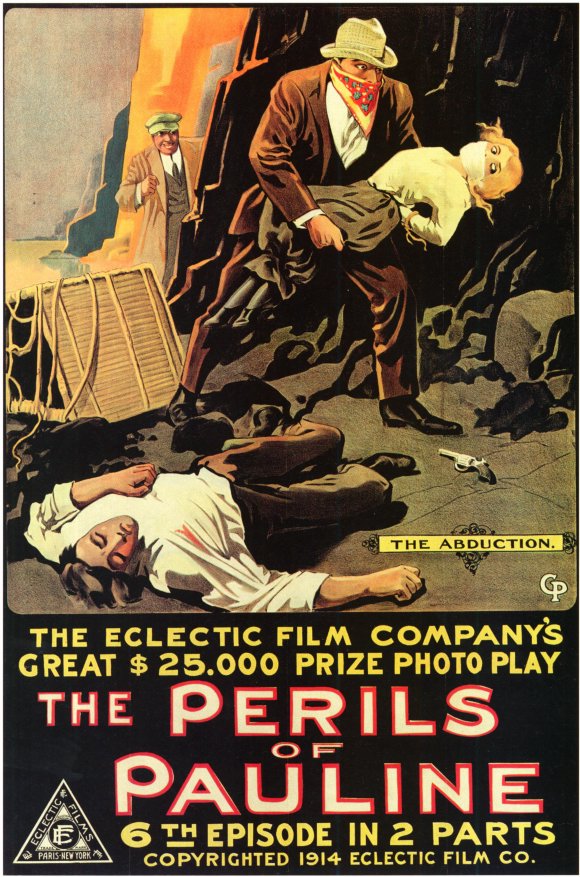
A cliffhanger or cliffhanger ending is a plot device in fiction which features a main character in a precarious situation, facing a difficult dilemma or confronted with a shocking revelation at the end of an episode of serialized fiction or before a commercial break in a television programme. A cliffhanger is intended to incentivize the audience to return to see how the characters resolve the dilemma.
Some serials end with the caveat, "To Be Continued" or "The End?" In serial films and television series, the following episode sometimes begins with a recap sequence.
Cliffhangers were used as literary devices in several works of the Middle Ages with One Thousand and One Nights ending on a cliffhanger each night. Cliffhangers appeared as an element of the Victorian era serial novel that emerged in the 1840s, with many associating the form with Charles Dickens, a pioneer of the serial publication of narrative fiction. Following the enormous success of Dickens, by the 1860s cliffhanger endings had become a staple part of the sensation serials.
Cliffhangers were used as literary devices in several works of the Middle Ages. The Arabic literary work One Thousand and One Nights involves Scheherazade narrating a series of stories to King Shahryār for 1,001 nights, with each night ending on a cliffhanger in order to save herself from execution. Some medieval Chinese ballads like the Liu chih-yuan chu-kung-tiao ended each chapter on a cliffhanger to keep the audience in suspense.
The Scottish comic magazine The Glasgow Looking Glass, founded by English artist William Heath, pioneered the use of the phrase 'To Be Continued' in its serials in 1825.
Cliffhangers became prominent with the serial publication of narrative fiction, pioneered by Charles Dickens. Printed episodically in magazines, Dickens's cliffhangers triggered desperation in his readers. Writing in the New Yorker, Emily Nussbaum captured the anticipation of those waiting for the next installment of Dickens' The Old Curiosity Shop:
In 1841, Dickens fanboys rioted on the dock of New York Harbor, as they waited for a British ship carrying the next installment, screaming, "Is little Nell dead?"
On Dickens' instalment format and cliffhangers—first seen with The Pickwick Papers in 1836—Leslie Howsam in The Cambridge Companion to the History of the Book (2015) writes, "It inspired a narrative that Dickens would explore and develop throughout his career. The instalments would typically culminate at a point in the plot that created reader anticipation and thus reader demand."
Hub AI
Cliffhanger AI simulator
(@Cliffhanger_simulator)
Cliffhanger
A cliffhanger or cliffhanger ending is a plot device in fiction which features a main character in a precarious situation, facing a difficult dilemma or confronted with a shocking revelation at the end of an episode of serialized fiction or before a commercial break in a television programme. A cliffhanger is intended to incentivize the audience to return to see how the characters resolve the dilemma.
Some serials end with the caveat, "To Be Continued" or "The End?" In serial films and television series, the following episode sometimes begins with a recap sequence.
Cliffhangers were used as literary devices in several works of the Middle Ages with One Thousand and One Nights ending on a cliffhanger each night. Cliffhangers appeared as an element of the Victorian era serial novel that emerged in the 1840s, with many associating the form with Charles Dickens, a pioneer of the serial publication of narrative fiction. Following the enormous success of Dickens, by the 1860s cliffhanger endings had become a staple part of the sensation serials.
Cliffhangers were used as literary devices in several works of the Middle Ages. The Arabic literary work One Thousand and One Nights involves Scheherazade narrating a series of stories to King Shahryār for 1,001 nights, with each night ending on a cliffhanger in order to save herself from execution. Some medieval Chinese ballads like the Liu chih-yuan chu-kung-tiao ended each chapter on a cliffhanger to keep the audience in suspense.
The Scottish comic magazine The Glasgow Looking Glass, founded by English artist William Heath, pioneered the use of the phrase 'To Be Continued' in its serials in 1825.
Cliffhangers became prominent with the serial publication of narrative fiction, pioneered by Charles Dickens. Printed episodically in magazines, Dickens's cliffhangers triggered desperation in his readers. Writing in the New Yorker, Emily Nussbaum captured the anticipation of those waiting for the next installment of Dickens' The Old Curiosity Shop:
In 1841, Dickens fanboys rioted on the dock of New York Harbor, as they waited for a British ship carrying the next installment, screaming, "Is little Nell dead?"
On Dickens' instalment format and cliffhangers—first seen with The Pickwick Papers in 1836—Leslie Howsam in The Cambridge Companion to the History of the Book (2015) writes, "It inspired a narrative that Dickens would explore and develop throughout his career. The instalments would typically culminate at a point in the plot that created reader anticipation and thus reader demand."