



Community hub
Recent from talks
Contribute something to knowledge base
Content stats: 0 posts, 0 articles, 1 media, 0 notes
Members stats: 0 subscribers, 0 contributors, 0 moderators, 0 supporters
Subscribers
Supporters
Contributors
Moderators
Hub AI
Geography of Portugal AI simulator
(@Geography of Portugal_simulator)
Hub AI
Geography of Portugal AI simulator
(@Geography of Portugal_simulator)
Geography of Portugal
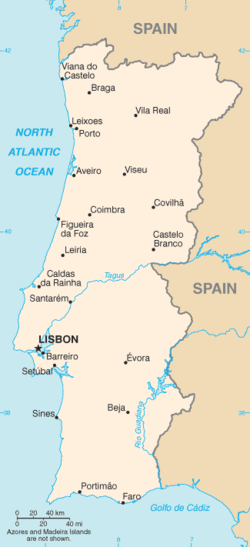
Portugal is a coastal nation in western Europe, located at the western end of the Iberian Peninsula, bordering Spain (on its northern and eastern frontiers: a total of 1,215 kilometres (755 mi)). The Portuguese territory also includes a series of archipelagos in the Atlantic Ocean (the Azores and Madeira), which are strategic islands along the North Atlantic. The extreme south is not too far from the Strait of Gibraltar, leading to the Mediterranean Sea. In total, the country occupies an area of 92,090 square kilometres (35,560 sq mi) of which 91,470 square kilometres (35,320 sq mi) is land and 620 square kilometres (240 sq mi) water.
Despite these definitions, the Portugal-Spain border remains an unresolved territorial dispute between the two countries. Portugal does not recognise the border between Caia and Ribeira de Cuncos River deltas, since the beginning of the 1801 occupation of Olivenza by Spain. This territory, though under de facto Spanish occupation, remains a de jure part of Portugal, consequently no border is henceforth recognised in this area.
Portugal is located on the western coast of the Iberian Peninsula and plateau, that divides the inland Mediterranean Sea from the Atlantic Ocean. It is located on the Atlantic coast of this plateau and crossed by several rivers which have their origin in Spain. Most of these rivers flow from east to west disgorging in the Atlantic; from north to south, the primary rivers are the Minho, Douro, Mondego, Tagus and the Guadiana.
The Portuguese continental shelf has an area of 28,000 square kilometres (11,000 sq mi), although its width is variable from 150 kilometres (93 mi) in the north to 25 kilometres (16 mi) in the south. Its strong relief is marked by deep submarine canyons and the continuation of the main rivers. The Estremadura Spur separates the Iberian Abyssal and Tagus Abyssal Plains, while the continental slope is flanked by sea-mounts and abuts against the prominent Gorringe Bank in the south. Currently, the Portuguese government claims jurisdiction to a sea depth of 200 metres (660 ft), or to the depth of exploitation.
The Portuguese coast is extensive; in addition to approximately 943 kilometres (586 mi) along the coast of continental Portugal, the archipelagos of the Azores (667 km) and Madeira (250 km) are primarily surrounded by rough cliff coastlines. Most of these landscapes alternate between rough cliffs and fine sand beaches; the region of the Algarve is recognized for its sandy beaches popular with tourists, while at the same time its coastline around Cape St. Vincent is well known for steep and forbidding cliffs. An interesting feature of the Portuguese coast is the Ria Formosa with some sandy islands and a mild and pleasant climate characterized by warm, but not very hot, summers and generally mild winters.
In contrast, the Ria de Aveiro coast (near Aveiro, referred to as "The Portuguese Venice") is formed by a delta approximately 45 kilometres (28 mi) long with a maximum width of 11 kilometres (6.8 mi), rich in fish and seabirds. Four main channels flow through several islands and islets at the mouth of the Vouga, Antuã, Boco, and Fontão Rivers. Since the 16th century, this formation of narrow headlands formed a lagoon, which allowed the formation and production of salt. It was also recognized by the Romans, whose forces exported its salt—then a precious resource—to Rome.
The Azores are sprinkled with both black-sand and boulder-lined beaches; only as a rare exception are there white-sand beaches (such as on the island of Santa Maria in Almagreira). The island of Porto Santo has one of the few extensive dune beaches in Portugal, located in the archipelago of Madeira.
Tidal gauges along the Portuguese coast have identified a 1–1.5 millimetres (0.039–0.059 in) rise in sea levels, causing large estuaries and inland deltas in some major rivers to overflow.
Geography of Portugal
Portugal is a coastal nation in western Europe, located at the western end of the Iberian Peninsula, bordering Spain (on its northern and eastern frontiers: a total of 1,215 kilometres (755 mi)). The Portuguese territory also includes a series of archipelagos in the Atlantic Ocean (the Azores and Madeira), which are strategic islands along the North Atlantic. The extreme south is not too far from the Strait of Gibraltar, leading to the Mediterranean Sea. In total, the country occupies an area of 92,090 square kilometres (35,560 sq mi) of which 91,470 square kilometres (35,320 sq mi) is land and 620 square kilometres (240 sq mi) water.
Despite these definitions, the Portugal-Spain border remains an unresolved territorial dispute between the two countries. Portugal does not recognise the border between Caia and Ribeira de Cuncos River deltas, since the beginning of the 1801 occupation of Olivenza by Spain. This territory, though under de facto Spanish occupation, remains a de jure part of Portugal, consequently no border is henceforth recognised in this area.
Portugal is located on the western coast of the Iberian Peninsula and plateau, that divides the inland Mediterranean Sea from the Atlantic Ocean. It is located on the Atlantic coast of this plateau and crossed by several rivers which have their origin in Spain. Most of these rivers flow from east to west disgorging in the Atlantic; from north to south, the primary rivers are the Minho, Douro, Mondego, Tagus and the Guadiana.
The Portuguese continental shelf has an area of 28,000 square kilometres (11,000 sq mi), although its width is variable from 150 kilometres (93 mi) in the north to 25 kilometres (16 mi) in the south. Its strong relief is marked by deep submarine canyons and the continuation of the main rivers. The Estremadura Spur separates the Iberian Abyssal and Tagus Abyssal Plains, while the continental slope is flanked by sea-mounts and abuts against the prominent Gorringe Bank in the south. Currently, the Portuguese government claims jurisdiction to a sea depth of 200 metres (660 ft), or to the depth of exploitation.
The Portuguese coast is extensive; in addition to approximately 943 kilometres (586 mi) along the coast of continental Portugal, the archipelagos of the Azores (667 km) and Madeira (250 km) are primarily surrounded by rough cliff coastlines. Most of these landscapes alternate between rough cliffs and fine sand beaches; the region of the Algarve is recognized for its sandy beaches popular with tourists, while at the same time its coastline around Cape St. Vincent is well known for steep and forbidding cliffs. An interesting feature of the Portuguese coast is the Ria Formosa with some sandy islands and a mild and pleasant climate characterized by warm, but not very hot, summers and generally mild winters.
In contrast, the Ria de Aveiro coast (near Aveiro, referred to as "The Portuguese Venice") is formed by a delta approximately 45 kilometres (28 mi) long with a maximum width of 11 kilometres (6.8 mi), rich in fish and seabirds. Four main channels flow through several islands and islets at the mouth of the Vouga, Antuã, Boco, and Fontão Rivers. Since the 16th century, this formation of narrow headlands formed a lagoon, which allowed the formation and production of salt. It was also recognized by the Romans, whose forces exported its salt—then a precious resource—to Rome.
The Azores are sprinkled with both black-sand and boulder-lined beaches; only as a rare exception are there white-sand beaches (such as on the island of Santa Maria in Almagreira). The island of Porto Santo has one of the few extensive dune beaches in Portugal, located in the archipelago of Madeira.
Tidal gauges along the Portuguese coast have identified a 1–1.5 millimetres (0.039–0.059 in) rise in sea levels, causing large estuaries and inland deltas in some major rivers to overflow.
Recent media
Recent media