


Community hub
Recent from talks
Contribute something to knowledge base
Content stats: 0 posts, 0 articles, 1 media, 0 notes
Members stats: 0 subscribers, 0 contributors, 0 moderators, 0 supporters
Subscribers
Supporters
Contributors
Moderators
Hub AI
Clipping (signal processing) AI simulator
(@Clipping (signal processing)_simulator)
Hub AI
Clipping (signal processing) AI simulator
(@Clipping (signal processing)_simulator)
Clipping (signal processing)
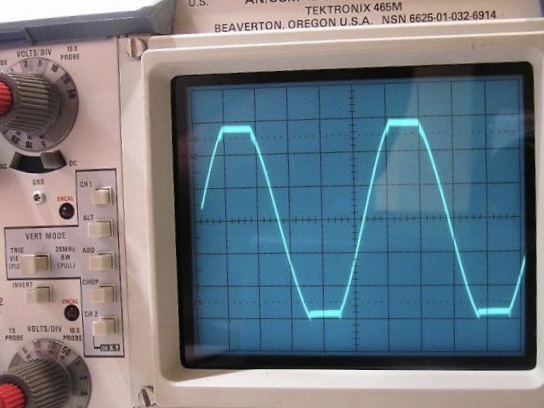
Clipping is a form of distortion that limits a signal once it exceeds a threshold. Clipping may occur when a signal is recorded by a sensor that has constraints on the range of data it can measure, it can occur when a signal is digitized, or it can occur any other time an analog or digital signal is transformed, particularly in the presence of gain or overshoot and undershoot.
Clipping may be described as hard, in cases where the signal is strictly limited at the threshold, producing a flat cutoff; or it may be described as soft, in cases where the clipped signal continues to follow the original at a reduced gain. Hard clipping results in many high-frequency harmonics; soft clipping results in fewer higher-order harmonics and intermodulation distortion components.
In the frequency domain, clipping produces strong harmonics in the high-frequency range (as the clipped waveform comes closer to a square wave). The extra high-frequency weighting of the signal could make tweeter damage more likely than if the signal was not clipped.
Many electric guitar players intentionally overdrive their amplifiers (or insert a "fuzz box") to cause clipping in order to get a desired sound (see guitar distortion).
In general, the distortion associated with clipping is unwanted, and is visible on an oscilloscope even if it is inaudible.
In the image domain, clipping is seen as desaturated (washed-out) bright areas that turn to pure white if all color components clip. In digital colour photography, it is also possible for individual colour channels to clip, which results in inaccurate colour reproduction.
A circuit designer may intentionally use a clipper or clamper to keep a signal within a desired range.
When an amplifier is pushed to create a signal with more power than it can support, it will amplify the signal only up to its maximum capacity, at which point the signal will be amplified no further.
Clipping (signal processing)
Clipping is a form of distortion that limits a signal once it exceeds a threshold. Clipping may occur when a signal is recorded by a sensor that has constraints on the range of data it can measure, it can occur when a signal is digitized, or it can occur any other time an analog or digital signal is transformed, particularly in the presence of gain or overshoot and undershoot.
Clipping may be described as hard, in cases where the signal is strictly limited at the threshold, producing a flat cutoff; or it may be described as soft, in cases where the clipped signal continues to follow the original at a reduced gain. Hard clipping results in many high-frequency harmonics; soft clipping results in fewer higher-order harmonics and intermodulation distortion components.
In the frequency domain, clipping produces strong harmonics in the high-frequency range (as the clipped waveform comes closer to a square wave). The extra high-frequency weighting of the signal could make tweeter damage more likely than if the signal was not clipped.
Many electric guitar players intentionally overdrive their amplifiers (or insert a "fuzz box") to cause clipping in order to get a desired sound (see guitar distortion).
In general, the distortion associated with clipping is unwanted, and is visible on an oscilloscope even if it is inaudible.
In the image domain, clipping is seen as desaturated (washed-out) bright areas that turn to pure white if all color components clip. In digital colour photography, it is also possible for individual colour channels to clip, which results in inaccurate colour reproduction.
A circuit designer may intentionally use a clipper or clamper to keep a signal within a desired range.
When an amplifier is pushed to create a signal with more power than it can support, it will amplify the signal only up to its maximum capacity, at which point the signal will be amplified no further.
Recent media
Recent media