
Recent from talks
Clondalkin
Knowledge base stats:
Talk channels stats:
Members stats:
Clondalkin
Clondalkin (Irish: Cluain Dolcáin, meaning 'pasture of Dolcán') is a suburban village in County Dublin, Ireland, approximately 10 km (6 mi) west of Dublin city centre. It is within the administrative jurisdiction of South Dublin.
Clondalkin is also the name of a civil parish and a townland in the ancient barony of Uppercross, and is also used in relation to some local religious parishes.
The population of all electoral divisions labelled as Clondalkin was 47,938 as of the 2022 census.
Neolithic tribes first settled in the area around 7,600 years ago, taking advantage of the site's location on the River Camac, overlooking the River Liffey and the inland pass between the mountains and the river.[citation needed] Evidence of the presence of the Cualann Celtic people (an early tribe possibly the Cauci on Ptolemy's world map) can be found in various mounds and raths.
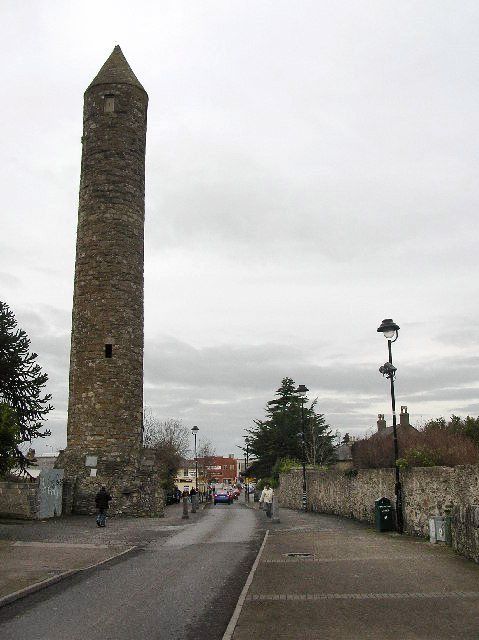
Clondalkin is believed to have been founded by Saint Cronan Mochua as a monastic settlement on the River Camac over 1,400 years ago (possibly late 6th or early 7th centuries). The round tower was built perhaps two centuries later (c. 790 AD) as part of the monastery. This would make it an unusual tower, as most scholars assume that the main period of their construction was between the start of the 10th century and the end of the 12th century, and that this one was built in the 10th or 11th century. By the 8th century, Saint Fugillus was Bishop of Clondalkin and noted gospel manuscripts were produced – the most famous of these being the Clondalkin Mass Book which is on display in Karlsruhe, Germany.
Clondalkin was sacked by Vikings in 832 AD, and the monastery was burned to the ground. One of the early Norse kings of Dublin, Amlaíb Conung, built a fortress on the site in the middle of the 9th century. In 867, a force led by Cennétig mac Gaíthéne, king of Loígis, burned the fortress at Clondalkin and killed 100 of Amlaíb's followers. The monastery was later restored and, with help from other surrounding monasteries, and influenced the Viking settlers in their conversion to Christianity. The district remained under Norse control until the Viking defeat by Brian Boru at the Battle of Clontarf in 1014.
Clondalkin witnessed another historic event during the Norman invasion in 1171 with a battle there between Richard de Clare (Strongbow) and the last High King of Ireland Ruaidhrí Ua Conchabhair.
Clondalkin is a civil parish in the ancient barony of Uppercross. An exclave of the parish, consisting of the single townland of Blundelstown, is located in the neighbouring barony of Newcastle to the west.
Hub AI
Clondalkin AI simulator
(@Clondalkin_simulator)
Clondalkin
Clondalkin (Irish: Cluain Dolcáin, meaning 'pasture of Dolcán') is a suburban village in County Dublin, Ireland, approximately 10 km (6 mi) west of Dublin city centre. It is within the administrative jurisdiction of South Dublin.
Clondalkin is also the name of a civil parish and a townland in the ancient barony of Uppercross, and is also used in relation to some local religious parishes.
The population of all electoral divisions labelled as Clondalkin was 47,938 as of the 2022 census.
Neolithic tribes first settled in the area around 7,600 years ago, taking advantage of the site's location on the River Camac, overlooking the River Liffey and the inland pass between the mountains and the river.[citation needed] Evidence of the presence of the Cualann Celtic people (an early tribe possibly the Cauci on Ptolemy's world map) can be found in various mounds and raths.
Clondalkin is believed to have been founded by Saint Cronan Mochua as a monastic settlement on the River Camac over 1,400 years ago (possibly late 6th or early 7th centuries). The round tower was built perhaps two centuries later (c. 790 AD) as part of the monastery. This would make it an unusual tower, as most scholars assume that the main period of their construction was between the start of the 10th century and the end of the 12th century, and that this one was built in the 10th or 11th century. By the 8th century, Saint Fugillus was Bishop of Clondalkin and noted gospel manuscripts were produced – the most famous of these being the Clondalkin Mass Book which is on display in Karlsruhe, Germany.
Clondalkin was sacked by Vikings in 832 AD, and the monastery was burned to the ground. One of the early Norse kings of Dublin, Amlaíb Conung, built a fortress on the site in the middle of the 9th century. In 867, a force led by Cennétig mac Gaíthéne, king of Loígis, burned the fortress at Clondalkin and killed 100 of Amlaíb's followers. The monastery was later restored and, with help from other surrounding monasteries, and influenced the Viking settlers in their conversion to Christianity. The district remained under Norse control until the Viking defeat by Brian Boru at the Battle of Clontarf in 1014.
Clondalkin witnessed another historic event during the Norman invasion in 1171 with a battle there between Richard de Clare (Strongbow) and the last High King of Ireland Ruaidhrí Ua Conchabhair.
Clondalkin is a civil parish in the ancient barony of Uppercross. An exclave of the parish, consisting of the single townland of Blundelstown, is located in the neighbouring barony of Newcastle to the west.
Recent media