
Recent from talks
Close-in weapon system
Knowledge base stats:
Talk channels stats:
Members stats:
Close-in weapon system
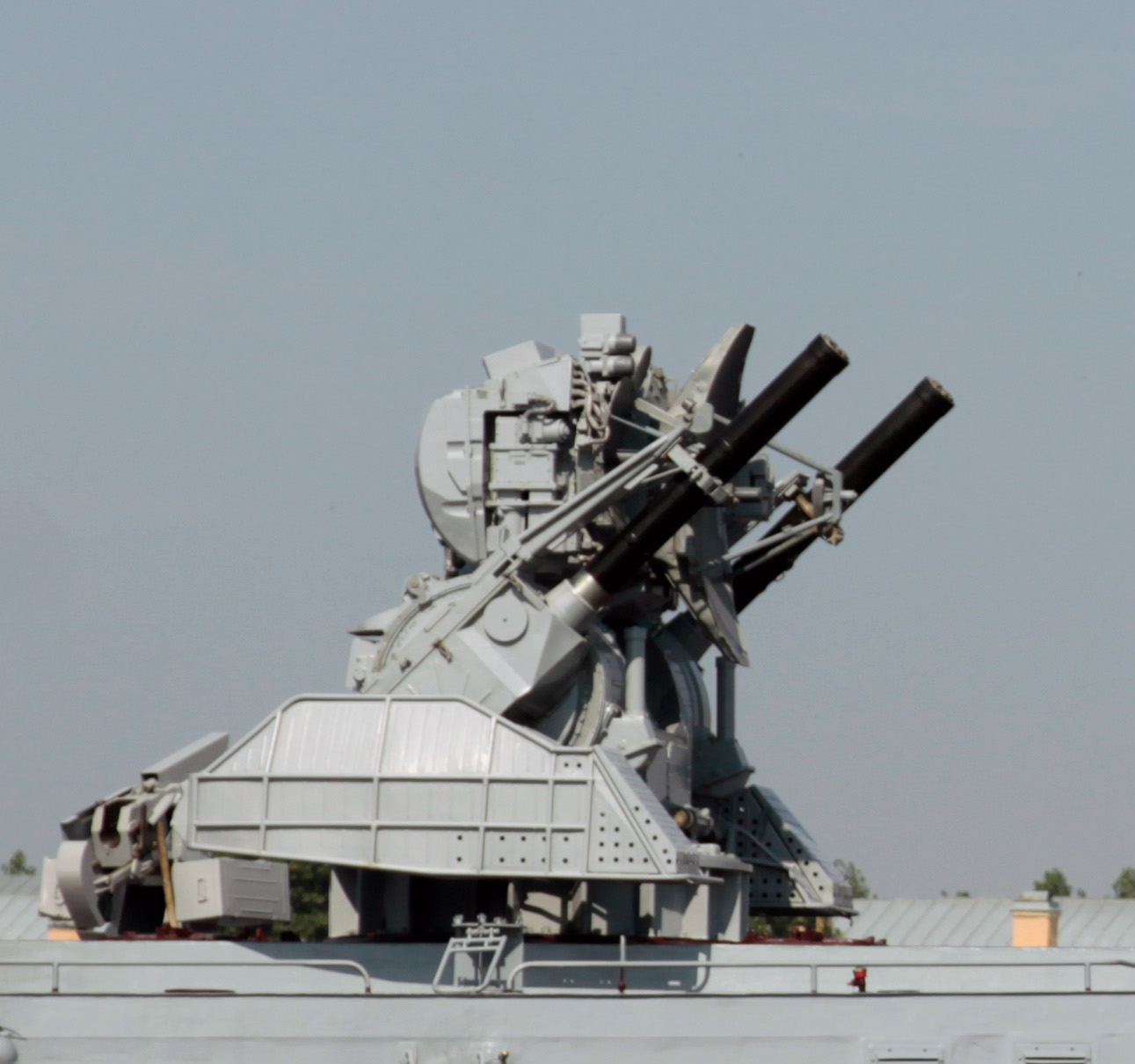
A close-in weapon system (CIWS /ˈsiːwɪz/ SEE-wiz) is a point-defense weapon system for detecting and destroying short-range incoming missiles and enemy aircraft which have penetrated the outer defenses, typically mounted on a naval ship. Nearly all classes of larger modern warships along with many other warships are equipped with some kind of CIWS device.
There are mainly three types of CIWS systems: gun-based CIWS, missile-based CIWS, and hybrid gun- and missile-based CIWS. A gun-based CIWS usually consists of a combination of radars, computers, and rapid-firing multiple-barrel rotary cannons placed on a rotating turret. Missile-based CIWSs use either infra-red, passive radar/ESM, or semi-active radar terminal guidance to guide missiles to the targeted enemy aircraft or other threats. In some cases, CIWS are used on land to protect military bases. In this case, the CIWS can also protect the base from shell and rocket fire.
A gun-based CIWS usually consists of a combination of radars, computers and rotary or revolver cannon placed on a rotating, automatically aimed gun mount. Examples of gun-based CIWS products in operation are:
CIWS systems are short range: the maximum effective range of gun systems is about 5,000 metres (16,000 ft); systems with lighter projectiles have even shorter range. The expected real-world kill-distance of an incoming anti-ship missile is about 500 m (1,600 ft) or less, still close enough to cause damage to the ship's sensor or communication arrays, or to wound or kill exposed personnel. Thus some CIWS like Russian Kashtan and Pantsir systems are augmented by installing the close range surface-to-air missiles on the same mounting for increased tactical flexibility.
They have a limited kill probability compared to other anti-air guns. Even if the missile is hit and damaged, this may not be enough to destroy it entirely or to alter its course. Even in the case of a direct hit, the missile or fragments from it may still impact the intended target, particularly if the final interception distance is short. This is especially true if the gun fires kinetic-energy-only projectiles.
A missile-based CIWS comprises a combination of radars and computers connected to either a rotating, automatically aimed launcher mount or vertical launching system. Examples of missile-based CIWS in operational service are:
Examples of gun-missile-based CIWS in operational service are:
CIWS are also used on land in the form of Pantsir and C-RAM. On a smaller scale, active protection systems are used in some tanks (to destroy rocket propelled grenades (RPGs), and several are in development. The Drozd system was deployed on Soviet Naval Infantry tanks in the early 1980s, but later replaced by explosive reactive armour. Other systems that are available or under development are the Russian Arena, Israeli Trophy, American Quick Kill and South African-Swedish LEDS-150.
Hub AI
Close-in weapon system AI simulator
(@Close-in weapon system_simulator)
Close-in weapon system
A close-in weapon system (CIWS /ˈsiːwɪz/ SEE-wiz) is a point-defense weapon system for detecting and destroying short-range incoming missiles and enemy aircraft which have penetrated the outer defenses, typically mounted on a naval ship. Nearly all classes of larger modern warships along with many other warships are equipped with some kind of CIWS device.
There are mainly three types of CIWS systems: gun-based CIWS, missile-based CIWS, and hybrid gun- and missile-based CIWS. A gun-based CIWS usually consists of a combination of radars, computers, and rapid-firing multiple-barrel rotary cannons placed on a rotating turret. Missile-based CIWSs use either infra-red, passive radar/ESM, or semi-active radar terminal guidance to guide missiles to the targeted enemy aircraft or other threats. In some cases, CIWS are used on land to protect military bases. In this case, the CIWS can also protect the base from shell and rocket fire.
A gun-based CIWS usually consists of a combination of radars, computers and rotary or revolver cannon placed on a rotating, automatically aimed gun mount. Examples of gun-based CIWS products in operation are:
CIWS systems are short range: the maximum effective range of gun systems is about 5,000 metres (16,000 ft); systems with lighter projectiles have even shorter range. The expected real-world kill-distance of an incoming anti-ship missile is about 500 m (1,600 ft) or less, still close enough to cause damage to the ship's sensor or communication arrays, or to wound or kill exposed personnel. Thus some CIWS like Russian Kashtan and Pantsir systems are augmented by installing the close range surface-to-air missiles on the same mounting for increased tactical flexibility.
They have a limited kill probability compared to other anti-air guns. Even if the missile is hit and damaged, this may not be enough to destroy it entirely or to alter its course. Even in the case of a direct hit, the missile or fragments from it may still impact the intended target, particularly if the final interception distance is short. This is especially true if the gun fires kinetic-energy-only projectiles.
A missile-based CIWS comprises a combination of radars and computers connected to either a rotating, automatically aimed launcher mount or vertical launching system. Examples of missile-based CIWS in operational service are:
Examples of gun-missile-based CIWS in operational service are:
CIWS are also used on land in the form of Pantsir and C-RAM. On a smaller scale, active protection systems are used in some tanks (to destroy rocket propelled grenades (RPGs), and several are in development. The Drozd system was deployed on Soviet Naval Infantry tanks in the early 1980s, but later replaced by explosive reactive armour. Other systems that are available or under development are the Russian Arena, Israeli Trophy, American Quick Kill and South African-Swedish LEDS-150.
Recent media