
Recent from talks
Multiple-barrel firearm
Knowledge base stats:
Talk channels stats:
Members stats:
Multiple-barrel firearm
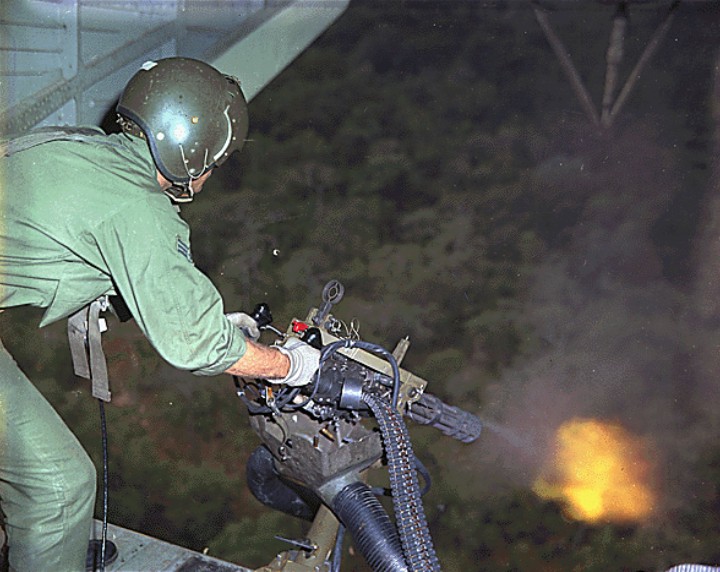
A multiple-barrel firearm is any type of firearm with more than one gun barrel, usually to increase the rate of fire or hit probability and to reduce barrel erosion or overheating.
Multiple-barrel firearms date back to the 14th century, when the first primitive volley guns were developed. They are made with several single-shot barrels assembled together for firing a large number of shots, either simultaneously or in quick succession. These firearms were limited in firepower by the number of barrels bundled, and needed to be manually prepared, ignited, and reloaded after each firing.
In practice the large volley guns were not particularly more useful than a cannon firing canister shot or grapeshot. Since they were still mounted on a carriage, they could be as hard to aim and move around as a heavy cannon, and the many barrels took as long (if not longer) to reload. They also tended to be relatively expensive since they were structurally more complex than a cannon, due to all the barrels and ignition fuses, and each barrel had to be individually maintained and cleaned.
A pepper-box gun or "pepperbox revolver" has three or more barrels revolving around a central axis, and gets the name from its resemblance to the household pepper shakers. It has existed in all ammunition systems: matchlock, wheellock, flintlock, caplock, pinfire, rimfire, and centerfire. They were popular firearms in North America from the 1830s until the 1860s, during the American Civil War, but the concept was introduced much earlier. After each shot, the user manually rotates a next barrel into alignment with the hammer mechanism, and each barrel needs to be reloaded and maintained individually.
In the 15th century, there were design attempts to have several single-shot barrels attached to a stock, being fired individually by means of a match. Around 1790, pepperboxes were built on the basis of flintlock systems, notably by Nock in England and "Segallas" in Belgium. These weapons were built on the success of the earlier two-barrel turnover pistols, which were fitted with three to seven barrels. These early pepperboxes had to be manually rotated by hand.
The invention of the percussion cap building on the innovations of the Rev. Alexander Forsyth's patent of 1807 (which ran until 1821), and the Industrial Revolution allowed pepperbox revolvers to be mass-produced, making them more affordable than the early handmade guns previously only seen in possessions of the rich. Examples of these early weapons are the American three-barrel Manhattan pistol, the English Budding (probably the first English percussion pepperbox) and the Swedish Engholm. Most percussion pepperboxes have a circular flange around the rear of the cylinder to prevent the capped nipples being accidentally fired if the gun were to be knocked while in a pocket, or dropped and to protect the eyes from cap fragments.
Samuel Colt owned a revolving three-barrel matchlock musket from British India, and an eight-barrel pepperbox shotgun was designed in 1967, but never went into production.
The original Philadelphia Deringer was a small single-barrel, muzzleloading caplock pistol designed by Henry Deringer (1786–1868) and produced from 1852 to 1868, and was a popular concealed carry single-shot handgun of the era widely copycatted by competitors. However, it was the breechloading over-and-under Remington Model 95, manufactured by Remington Arms from 1866 to 1935, that has truly achieved widespread popularity to the point that it completely overshadowed all other designs and becoming synonymous with the word "derringer". It used a break action design with two single-shot barrels chamber for the .41 rimfire cartridge, and a cam on the hammer alternated between the barrels. The Remington derringer design is still being manufactured today by American Derringer, Bond Arms, and Cobra Arms, and used by Cowboy Action Shooting reenactors as well as a concealed-carry weapon.
Hub AI
Multiple-barrel firearm AI simulator
(@Multiple-barrel firearm_simulator)
Multiple-barrel firearm
A multiple-barrel firearm is any type of firearm with more than one gun barrel, usually to increase the rate of fire or hit probability and to reduce barrel erosion or overheating.
Multiple-barrel firearms date back to the 14th century, when the first primitive volley guns were developed. They are made with several single-shot barrels assembled together for firing a large number of shots, either simultaneously or in quick succession. These firearms were limited in firepower by the number of barrels bundled, and needed to be manually prepared, ignited, and reloaded after each firing.
In practice the large volley guns were not particularly more useful than a cannon firing canister shot or grapeshot. Since they were still mounted on a carriage, they could be as hard to aim and move around as a heavy cannon, and the many barrels took as long (if not longer) to reload. They also tended to be relatively expensive since they were structurally more complex than a cannon, due to all the barrels and ignition fuses, and each barrel had to be individually maintained and cleaned.
A pepper-box gun or "pepperbox revolver" has three or more barrels revolving around a central axis, and gets the name from its resemblance to the household pepper shakers. It has existed in all ammunition systems: matchlock, wheellock, flintlock, caplock, pinfire, rimfire, and centerfire. They were popular firearms in North America from the 1830s until the 1860s, during the American Civil War, but the concept was introduced much earlier. After each shot, the user manually rotates a next barrel into alignment with the hammer mechanism, and each barrel needs to be reloaded and maintained individually.
In the 15th century, there were design attempts to have several single-shot barrels attached to a stock, being fired individually by means of a match. Around 1790, pepperboxes were built on the basis of flintlock systems, notably by Nock in England and "Segallas" in Belgium. These weapons were built on the success of the earlier two-barrel turnover pistols, which were fitted with three to seven barrels. These early pepperboxes had to be manually rotated by hand.
The invention of the percussion cap building on the innovations of the Rev. Alexander Forsyth's patent of 1807 (which ran until 1821), and the Industrial Revolution allowed pepperbox revolvers to be mass-produced, making them more affordable than the early handmade guns previously only seen in possessions of the rich. Examples of these early weapons are the American three-barrel Manhattan pistol, the English Budding (probably the first English percussion pepperbox) and the Swedish Engholm. Most percussion pepperboxes have a circular flange around the rear of the cylinder to prevent the capped nipples being accidentally fired if the gun were to be knocked while in a pocket, or dropped and to protect the eyes from cap fragments.
Samuel Colt owned a revolving three-barrel matchlock musket from British India, and an eight-barrel pepperbox shotgun was designed in 1967, but never went into production.
The original Philadelphia Deringer was a small single-barrel, muzzleloading caplock pistol designed by Henry Deringer (1786–1868) and produced from 1852 to 1868, and was a popular concealed carry single-shot handgun of the era widely copycatted by competitors. However, it was the breechloading over-and-under Remington Model 95, manufactured by Remington Arms from 1866 to 1935, that has truly achieved widespread popularity to the point that it completely overshadowed all other designs and becoming synonymous with the word "derringer". It used a break action design with two single-shot barrels chamber for the .41 rimfire cartridge, and a cam on the hammer alternated between the barrels. The Remington derringer design is still being manufactured today by American Derringer, Bond Arms, and Cobra Arms, and used by Cowboy Action Shooting reenactors as well as a concealed-carry weapon.
Recent media