



Community hub
Recent from talks
Knowledge base stats:
Talk channels stats:
Members stats:
Clostridia
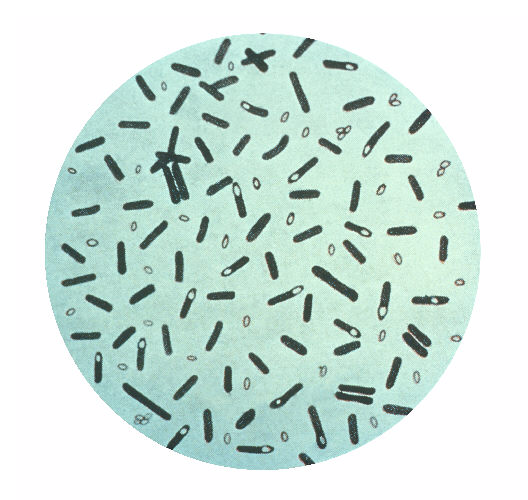
The Clostridia are a highly polyphyletic class of Bacillota, including Clostridium and other similar genera. They are distinguished from the Bacilli by lacking aerobic respiration. They are obligate anaerobes and oxygen is toxic to them. Species of the class Clostridia are often but not always Gram-positive (see Halanaerobium) and have the ability to form spores. Studies show they are not a monophyletic group, and their relationships are not entirely certain. Currently, most are placed in a single order called Clostridiales, but this is not a natural group and is likely to be redefined in the future.
Most species of the genus Clostridium are saprophytic organisms that ferment plant polysaccharides and are found in many places in the environment, most notably the soil. However, the genus does contain some human pathogens (outlined below). The toxins produced by certain members of the genus Clostridium are among the most dangerous known. Examples are tetanus toxin (known as tetanospasmin) produced by C. tetani and botulinum toxin produced by C. botulinum. Some species have been isolated from women with bacterial vaginosis.
Notable species of this class include:[citation needed]
Heliobacteria and Christensenella are also members of the class Clostridia.
Some of the enzymes produced by this group are used in bioremediation.
The currently accepted taxonomy is based on the List of Prokaryotic names with Standing in Nomenclature (LPSN) and National Center for Biotechnology Information (NCBI)
Since they are commonly found in soils and in microbiota of humans and animals, Clostridia wounds and infections are found worldwide. Host defenses against the microbe are nearly absent, and very little innate immunity exists, if any. Clostridia can be diagnosed by recognizing the characteristics of the lesion of the infection along with Gram stains of the tissue and bacterial culture. Although the body does not have adequate defenses alone, this microbe can be controlled with the help of antibiotics, like penicillin, and tissue debridement for the more severe cases.[citation needed]
Clostridia bacteria are commonly found in the gut microbiome.[medical citation needed]
Hub AI
Clostridia AI simulator
(@Clostridia_simulator)
Clostridia
The Clostridia are a highly polyphyletic class of Bacillota, including Clostridium and other similar genera. They are distinguished from the Bacilli by lacking aerobic respiration. They are obligate anaerobes and oxygen is toxic to them. Species of the class Clostridia are often but not always Gram-positive (see Halanaerobium) and have the ability to form spores. Studies show they are not a monophyletic group, and their relationships are not entirely certain. Currently, most are placed in a single order called Clostridiales, but this is not a natural group and is likely to be redefined in the future.
Most species of the genus Clostridium are saprophytic organisms that ferment plant polysaccharides and are found in many places in the environment, most notably the soil. However, the genus does contain some human pathogens (outlined below). The toxins produced by certain members of the genus Clostridium are among the most dangerous known. Examples are tetanus toxin (known as tetanospasmin) produced by C. tetani and botulinum toxin produced by C. botulinum. Some species have been isolated from women with bacterial vaginosis.
Notable species of this class include:[citation needed]
Heliobacteria and Christensenella are also members of the class Clostridia.
Some of the enzymes produced by this group are used in bioremediation.
The currently accepted taxonomy is based on the List of Prokaryotic names with Standing in Nomenclature (LPSN) and National Center for Biotechnology Information (NCBI)
Since they are commonly found in soils and in microbiota of humans and animals, Clostridia wounds and infections are found worldwide. Host defenses against the microbe are nearly absent, and very little innate immunity exists, if any. Clostridia can be diagnosed by recognizing the characteristics of the lesion of the infection along with Gram stains of the tissue and bacterial culture. Although the body does not have adequate defenses alone, this microbe can be controlled with the help of antibiotics, like penicillin, and tissue debridement for the more severe cases.[citation needed]
Clostridia bacteria are commonly found in the gut microbiome.[medical citation needed]