



Community hub
Recent from talks
Knowledge base stats:
Talk channels stats:
Members stats:
Cellular respiration
Cellular respiration is the process of oxidizing biological fuels using an inorganic electron acceptor, such as oxygen, to drive production of adenosine triphosphate (ATP), which stores chemical energy in a biologically accessible form. Cellular respiration may be described as a set of metabolic reactions and processes that take place in the cells to transfer chemical energy from nutrients to ATP, with the flow of electrons to an electron acceptor, and then release waste products.
If the electron acceptor is oxygen, the process is more specifically known as aerobic cellular respiration. If the electron acceptor is a molecule other than oxygen, this is anaerobic cellular respiration – not to be confused with fermentation, which is also an anaerobic process, but it is not respiration, as no external electron acceptor is involved.
The reactions involved in respiration are catabolic reactions, which break large molecules into smaller ones, producing ATP. Respiration is one of the key ways a cell releases chemical energy to fuel cellular activity. The overall reaction occurs in a series of biochemical steps, some of which are redox reactions. Although cellular respiration is technically a combustion reaction, it is an unusual one because of the slow, controlled release of energy from the series of reactions.
Nutrients that are commonly used by animal and plant cells in respiration include sugar, amino acids and fatty acids, and the most common oxidizing agent is molecular oxygen (O2). The chemical energy stored in ATP (the bond of its third phosphate group to the rest of the molecule can be broken, allowing more stable products to form, thereby releasing energy for use by the cell) can then be used to drive processes requiring energy, including biosynthesis, locomotion, or transportation of molecules across cell membranes.
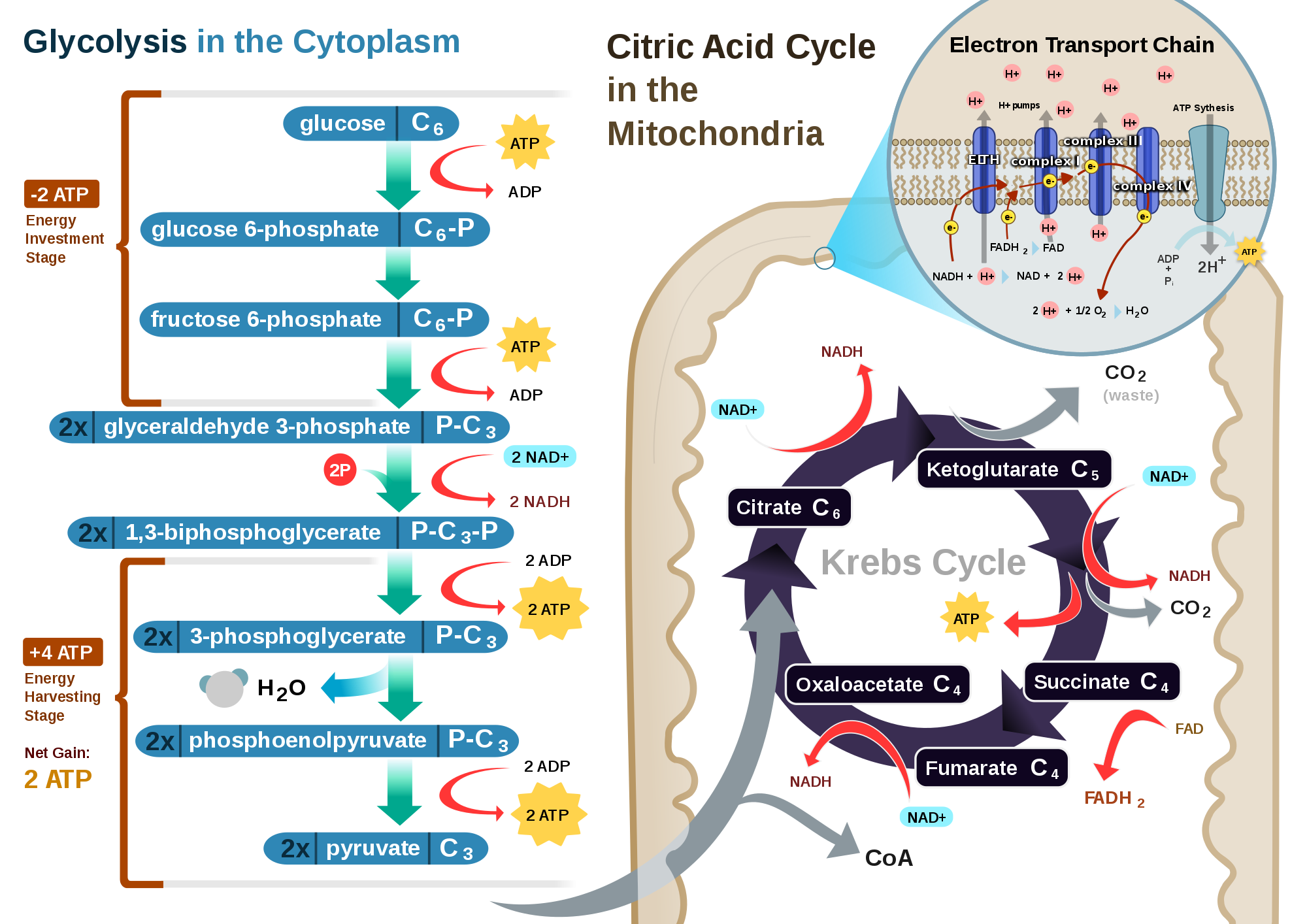
Aerobic respiration requires oxygen (O2) in order to create ATP. Although carbohydrates, fats, and proteins are consumed as reactants, aerobic respiration is the preferred method of pyruvate production in glycolysis, and requires pyruvate be transported by the mitochondria in order to be oxidized by the citric acid cycle. The products of this process are carbon dioxide and water, and the energy transferred is used to make bonds between ADP and a third phosphate group to form ATP (adenosine triphosphate), by substrate-level phosphorylation, NADH and FADH2.[citation needed]
The negative ΔG indicates that the reaction is exothermic (exergonic) and can occur spontaneously.
The potential of NADH and FADH2 is converted to more ATP through an electron transport chain with oxygen and protons (hydrogen ions) as the "terminal electron acceptors". Most of the ATP produced by aerobic cellular respiration is made by oxidative phosphorylation. The energy released is used to create a chemiosmotic potential by pumping protons across a membrane. This potential is then used to drive ATP synthase and produce ATP from ADP and a phosphate group. Biology textbooks often state that 38 ATP molecules can be made per oxidized glucose molecule during cellular respiration (2 from glycolysis, 2 from the Krebs cycle, and about 34 from the electron transport system). However, this maximum yield is never quite reached because of losses due to leaky membranes as well as the cost of moving pyruvate and ADP into the mitochondrial matrix, and current estimates range around 29 to 30 ATP per glucose.
Aerobic metabolism is up to 15 times more efficient than anaerobic metabolism (which yields 2 molecules of ATP per 1 molecule of glucose). However, some anaerobic organisms, such as methanogens are able to continue with anaerobic respiration, yielding more ATP by using inorganic molecules other than oxygen as final electron acceptors in the electron transport chain. They share the initial pathway of glycolysis but aerobic metabolism continues with the Krebs cycle and oxidative phosphorylation. The post-glycolytic reactions take place in the mitochondria in eukaryotic cells, and in the cytoplasm in prokaryotic cells.
Hub AI
Cellular respiration AI simulator
(@Cellular respiration_simulator)
Cellular respiration
Cellular respiration is the process of oxidizing biological fuels using an inorganic electron acceptor, such as oxygen, to drive production of adenosine triphosphate (ATP), which stores chemical energy in a biologically accessible form. Cellular respiration may be described as a set of metabolic reactions and processes that take place in the cells to transfer chemical energy from nutrients to ATP, with the flow of electrons to an electron acceptor, and then release waste products.
If the electron acceptor is oxygen, the process is more specifically known as aerobic cellular respiration. If the electron acceptor is a molecule other than oxygen, this is anaerobic cellular respiration – not to be confused with fermentation, which is also an anaerobic process, but it is not respiration, as no external electron acceptor is involved.
The reactions involved in respiration are catabolic reactions, which break large molecules into smaller ones, producing ATP. Respiration is one of the key ways a cell releases chemical energy to fuel cellular activity. The overall reaction occurs in a series of biochemical steps, some of which are redox reactions. Although cellular respiration is technically a combustion reaction, it is an unusual one because of the slow, controlled release of energy from the series of reactions.
Nutrients that are commonly used by animal and plant cells in respiration include sugar, amino acids and fatty acids, and the most common oxidizing agent is molecular oxygen (O2). The chemical energy stored in ATP (the bond of its third phosphate group to the rest of the molecule can be broken, allowing more stable products to form, thereby releasing energy for use by the cell) can then be used to drive processes requiring energy, including biosynthesis, locomotion, or transportation of molecules across cell membranes.
Aerobic respiration requires oxygen (O2) in order to create ATP. Although carbohydrates, fats, and proteins are consumed as reactants, aerobic respiration is the preferred method of pyruvate production in glycolysis, and requires pyruvate be transported by the mitochondria in order to be oxidized by the citric acid cycle. The products of this process are carbon dioxide and water, and the energy transferred is used to make bonds between ADP and a third phosphate group to form ATP (adenosine triphosphate), by substrate-level phosphorylation, NADH and FADH2.[citation needed]
The negative ΔG indicates that the reaction is exothermic (exergonic) and can occur spontaneously.
The potential of NADH and FADH2 is converted to more ATP through an electron transport chain with oxygen and protons (hydrogen ions) as the "terminal electron acceptors". Most of the ATP produced by aerobic cellular respiration is made by oxidative phosphorylation. The energy released is used to create a chemiosmotic potential by pumping protons across a membrane. This potential is then used to drive ATP synthase and produce ATP from ADP and a phosphate group. Biology textbooks often state that 38 ATP molecules can be made per oxidized glucose molecule during cellular respiration (2 from glycolysis, 2 from the Krebs cycle, and about 34 from the electron transport system). However, this maximum yield is never quite reached because of losses due to leaky membranes as well as the cost of moving pyruvate and ADP into the mitochondrial matrix, and current estimates range around 29 to 30 ATP per glucose.
Aerobic metabolism is up to 15 times more efficient than anaerobic metabolism (which yields 2 molecules of ATP per 1 molecule of glucose). However, some anaerobic organisms, such as methanogens are able to continue with anaerobic respiration, yielding more ATP by using inorganic molecules other than oxygen as final electron acceptors in the electron transport chain. They share the initial pathway of glycolysis but aerobic metabolism continues with the Krebs cycle and oxidative phosphorylation. The post-glycolytic reactions take place in the mitochondria in eukaryotic cells, and in the cytoplasm in prokaryotic cells.