


Community hub
Recent from talks
Contribute something to knowledge base
Content stats: 0 posts, 0 articles, 1 media, 0 notes
Members stats: 0 subscribers, 0 contributors, 0 moderators, 0 supporters
Subscribers
Supporters
Contributors
Moderators
Hub AI
Coaxial cable AI simulator
(@Coaxial cable_simulator)
Hub AI
Coaxial cable AI simulator
(@Coaxial cable_simulator)
Coaxial cable
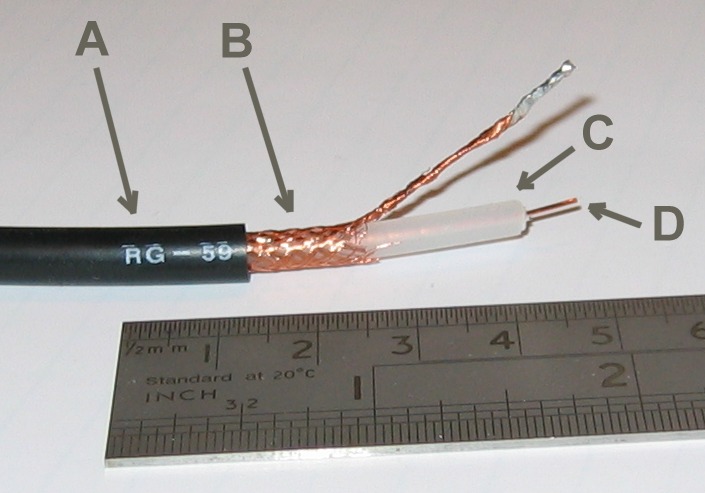
Coaxial cable, or coax (pronounced /ˈkoʊ.æks/), is a type of electrical cable consisting of an inner conductor surrounded by a concentric conducting shield, with the two separated by a dielectric (insulating material); many coaxial cables also have a protective outer sheath or jacket. The term coaxial refers to the inner conductor and the outer shield sharing a geometric axis.
Coaxial cable is a type of transmission line, used to carry high-frequency electrical signals with low losses. It is used in such applications as telephone trunk lines, broadband internet networking cables, high-speed computer data buses, cable television signals, and connecting radio transmitters and receivers to their antennas. It differs from other shielded cables because the dimensions of the cable and connectors are controlled to give a precise, constant conductor spacing, which is needed for it to function efficiently as a transmission line.
Coaxial cable was used in the first (1858) and following transatlantic cable installations, but its theory was not described until 1880 by English physicist, engineer, and mathematician Oliver Heaviside, who patented the design in that year (British patent No. 1,407).
Coaxial cable is used as a transmission line for radio frequency signals. Its applications include feedlines connecting radio transmitters and receivers to their antennas, computer network (e.g., Ethernet) connections, digital audio (S/PDIF), and distribution of cable television signals. One advantage of coaxial over other types of radio transmission line is that in an ideal coaxial cable the electromagnetic field carrying the signal exists only in the space between the inner and outer conductors. This allows coaxial cable runs to be installed next to metal objects such as gutters without the power losses that occur in other types of transmission lines. Coaxial cable also provides protection of the signal from external electromagnetic interference.
Coaxial cable conducts electrical signals using an inner conductor (usually a solid copper, stranded copper or copper-plated steel wire) surrounded by an insulating layer and all enclosed by a shield, typically one to four layers of woven metallic braid and metallic tape. The cable is protected by an outer insulating jacket. Normally, the outside of the shield is kept at ground potential and a signal carrying voltage is applied to the centre conductor. When using differential signaling, coaxial cable provides an advantage of equal push-pull currents on the inner conductor and inside of the outer conductor that restrict the signal's electric and magnetic fields to the dielectric, with little leakage outside the shield.[citation needed] Further, if unequal currents are filtered out at the receiving end of the line, electric and magnetic fields outside the cable are largely kept from interfering with signals inside the cable.[further explanation needed] This property makes coaxial cable a good choice both for carrying weak signals that cannot tolerate interference from the environment, and for stronger electrical signals that must not be allowed to radiate or couple into adjacent structures or circuits. Larger diameter cables and cables with multiple shields have less leakage.
Common applications of coaxial cable include video and CATV distribution, RF and microwave transmission, and computer and instrumentation data connections.
The characteristic impedance of the cable (Z0) is determined by the dielectric constant of the inner insulator and the radii of the inner and outer conductors. In radio frequency systems, where the cable length is comparable to the wavelength of the signals transmitted, a uniform cable characteristic impedance is important to minimize loss. The source and load impedances are chosen to match the impedance of the cable to ensure maximum power transfer and minimum standing wave ratio. Other important properties of coaxial cable include attenuation as a function of frequency, voltage handling capability, and shield quality.
Coaxial cable design choices affect physical size, frequency performance, attenuation, power handling capabilities, flexibility, strength, and cost. The inner conductor might be solid or stranded; stranded is more flexible. To get better high-frequency performance, the inner conductor may be silver-plated. Copper-plated steel wire is often used as an inner conductor for cable used in the cable TV industry.
Coaxial cable
Coaxial cable, or coax (pronounced /ˈkoʊ.æks/), is a type of electrical cable consisting of an inner conductor surrounded by a concentric conducting shield, with the two separated by a dielectric (insulating material); many coaxial cables also have a protective outer sheath or jacket. The term coaxial refers to the inner conductor and the outer shield sharing a geometric axis.
Coaxial cable is a type of transmission line, used to carry high-frequency electrical signals with low losses. It is used in such applications as telephone trunk lines, broadband internet networking cables, high-speed computer data buses, cable television signals, and connecting radio transmitters and receivers to their antennas. It differs from other shielded cables because the dimensions of the cable and connectors are controlled to give a precise, constant conductor spacing, which is needed for it to function efficiently as a transmission line.
Coaxial cable was used in the first (1858) and following transatlantic cable installations, but its theory was not described until 1880 by English physicist, engineer, and mathematician Oliver Heaviside, who patented the design in that year (British patent No. 1,407).
Coaxial cable is used as a transmission line for radio frequency signals. Its applications include feedlines connecting radio transmitters and receivers to their antennas, computer network (e.g., Ethernet) connections, digital audio (S/PDIF), and distribution of cable television signals. One advantage of coaxial over other types of radio transmission line is that in an ideal coaxial cable the electromagnetic field carrying the signal exists only in the space between the inner and outer conductors. This allows coaxial cable runs to be installed next to metal objects such as gutters without the power losses that occur in other types of transmission lines. Coaxial cable also provides protection of the signal from external electromagnetic interference.
Coaxial cable conducts electrical signals using an inner conductor (usually a solid copper, stranded copper or copper-plated steel wire) surrounded by an insulating layer and all enclosed by a shield, typically one to four layers of woven metallic braid and metallic tape. The cable is protected by an outer insulating jacket. Normally, the outside of the shield is kept at ground potential and a signal carrying voltage is applied to the centre conductor. When using differential signaling, coaxial cable provides an advantage of equal push-pull currents on the inner conductor and inside of the outer conductor that restrict the signal's electric and magnetic fields to the dielectric, with little leakage outside the shield.[citation needed] Further, if unequal currents are filtered out at the receiving end of the line, electric and magnetic fields outside the cable are largely kept from interfering with signals inside the cable.[further explanation needed] This property makes coaxial cable a good choice both for carrying weak signals that cannot tolerate interference from the environment, and for stronger electrical signals that must not be allowed to radiate or couple into adjacent structures or circuits. Larger diameter cables and cables with multiple shields have less leakage.
Common applications of coaxial cable include video and CATV distribution, RF and microwave transmission, and computer and instrumentation data connections.
The characteristic impedance of the cable (Z0) is determined by the dielectric constant of the inner insulator and the radii of the inner and outer conductors. In radio frequency systems, where the cable length is comparable to the wavelength of the signals transmitted, a uniform cable characteristic impedance is important to minimize loss. The source and load impedances are chosen to match the impedance of the cable to ensure maximum power transfer and minimum standing wave ratio. Other important properties of coaxial cable include attenuation as a function of frequency, voltage handling capability, and shield quality.
Coaxial cable design choices affect physical size, frequency performance, attenuation, power handling capabilities, flexibility, strength, and cost. The inner conductor might be solid or stranded; stranded is more flexible. To get better high-frequency performance, the inner conductor may be silver-plated. Copper-plated steel wire is often used as an inner conductor for cable used in the cable TV industry.
Recent media
Recent media