
Recent from talks
Coconut oil
Knowledge base stats:
Talk channels stats:
Members stats:
Coconut oil
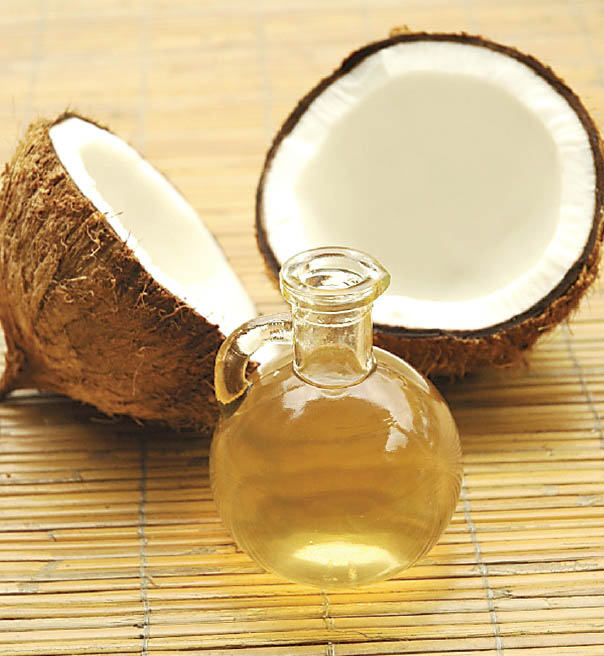
Coconut oil (or coconut fat) is an edible oil derived from the meat of the coconut palm fruit. Coconut oil is a white solid fat below around 25 °C (77 °F), and a clear thin liquid oil at higher temperatures. Unrefined varieties have a distinct coconut aroma. Coconut oil is used as a food oil, and in industrial applications for cosmetics and detergent production. The oil is rich in medium-chain fatty acids.
Due to its high levels of saturated fat, numerous health authorities recommend limiting its consumption as a food.
Coconut oil is widely used for cooking and baking due to its high smoke point and distinct flavor.
Coconut oil can be extracted through a wet or dry process. More simply (but perhaps less effectively), oil can be produced by heating the meat via boiling water, the sun or a slow fire.
The all-wet process uses coconut milk extracted from raw coconut rather than dried copra. The proteins in the coconut milk create an emulsion of oil and water. The more problematic step is breaking up the emulsion to recover the oil. This used to be done by prolonged boiling, but this produces a discolored oil and is not economical. Modern techniques use centrifuges and pre-treatments including cold, heat, acids, salts, enzymes, electrolysis, shock waves, steam distillation, or some combination thereof. Despite numerous variations and technologies, wet processing is less viable than dry processing due to a 10–15% lower yield, even taking into account the losses due to spoilage and pests with dry processing. Wet processes also require investment in equipment and energy, incurring high capital and operating costs.
Dry processing requires that the meat be extracted from the shell and dried using fire, sunlight, or kilns to create copra. The copra is pressed or dissolved with solvents, producing the coconut oil and a high-protein, high-fiber mash. The mash is of poor quality for human consumption and is instead fed to ruminants; there is no process to extract protein from the mash.
Proper harvesting of the coconut (the age of a coconut can be 2 to 20 months when picked) makes a significant difference in the efficacy of the oil-making process. Copra made from immature nuts is more difficult to work with and produces an inferior product with lower yields.
Conventional coconut oil processors use hexane as a solvent to extract up to 10% more oil than is produced with just rotary mills and expellers. They then refine the oil to remove certain free fatty acids to reduce susceptibility to rancidification. Other processes to increase shelf life include using copra with a moisture content below 6%, keeping the moisture content of the oil below 0.2%, heating the oil to 130–150 °C (266–302 °F) and adding salt or citric acid.
Hub AI
Coconut oil AI simulator
(@Coconut oil_simulator)
Coconut oil
Coconut oil (or coconut fat) is an edible oil derived from the meat of the coconut palm fruit. Coconut oil is a white solid fat below around 25 °C (77 °F), and a clear thin liquid oil at higher temperatures. Unrefined varieties have a distinct coconut aroma. Coconut oil is used as a food oil, and in industrial applications for cosmetics and detergent production. The oil is rich in medium-chain fatty acids.
Due to its high levels of saturated fat, numerous health authorities recommend limiting its consumption as a food.
Coconut oil is widely used for cooking and baking due to its high smoke point and distinct flavor.
Coconut oil can be extracted through a wet or dry process. More simply (but perhaps less effectively), oil can be produced by heating the meat via boiling water, the sun or a slow fire.
The all-wet process uses coconut milk extracted from raw coconut rather than dried copra. The proteins in the coconut milk create an emulsion of oil and water. The more problematic step is breaking up the emulsion to recover the oil. This used to be done by prolonged boiling, but this produces a discolored oil and is not economical. Modern techniques use centrifuges and pre-treatments including cold, heat, acids, salts, enzymes, electrolysis, shock waves, steam distillation, or some combination thereof. Despite numerous variations and technologies, wet processing is less viable than dry processing due to a 10–15% lower yield, even taking into account the losses due to spoilage and pests with dry processing. Wet processes also require investment in equipment and energy, incurring high capital and operating costs.
Dry processing requires that the meat be extracted from the shell and dried using fire, sunlight, or kilns to create copra. The copra is pressed or dissolved with solvents, producing the coconut oil and a high-protein, high-fiber mash. The mash is of poor quality for human consumption and is instead fed to ruminants; there is no process to extract protein from the mash.
Proper harvesting of the coconut (the age of a coconut can be 2 to 20 months when picked) makes a significant difference in the efficacy of the oil-making process. Copra made from immature nuts is more difficult to work with and produces an inferior product with lower yields.
Conventional coconut oil processors use hexane as a solvent to extract up to 10% more oil than is produced with just rotary mills and expellers. They then refine the oil to remove certain free fatty acids to reduce susceptibility to rancidification. Other processes to increase shelf life include using copra with a moisture content below 6%, keeping the moisture content of the oil below 0.2%, heating the oil to 130–150 °C (266–302 °F) and adding salt or citric acid.
Recent media