
Recent from talks
Imperata cylindrica
Knowledge base stats:
Talk channels stats:
Members stats:
Imperata cylindrica
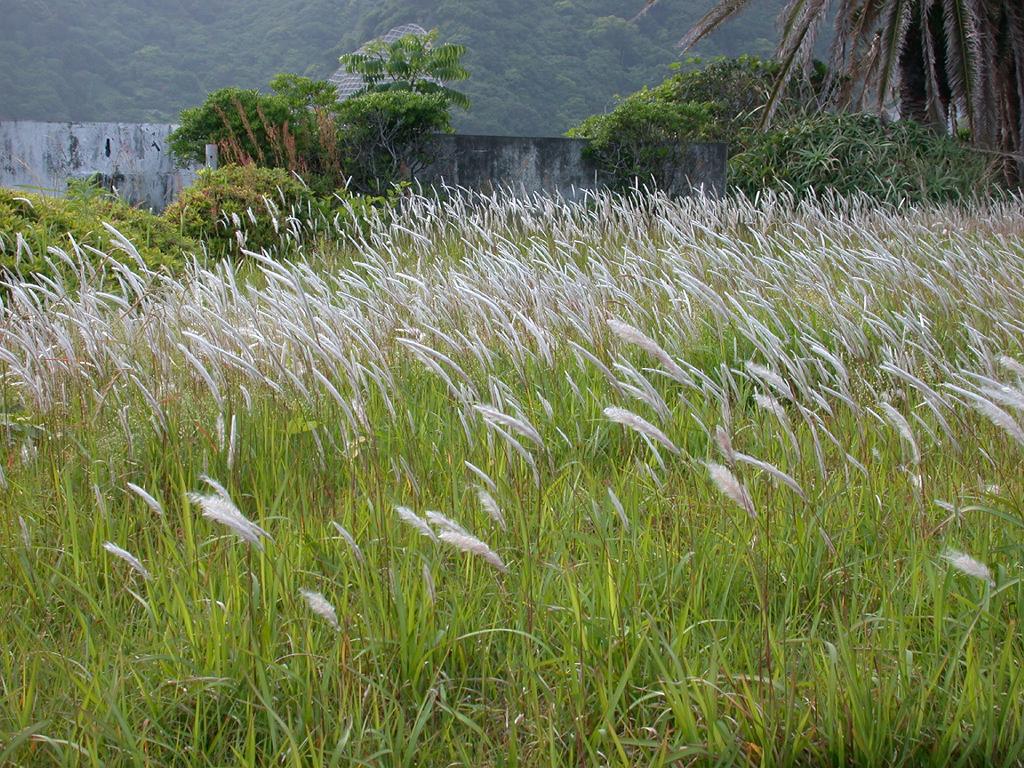
Imperata cylindrica (commonly known as cogongrass /koʊˈɡoʊn/ or kunai grass /ˈkuːnaɪ/) is a species of perennial rhizomatous grass native to tropical and subtropical Asia, Micronesia, Melanesia, Australia, Africa, and Southern Europe. It has also been introduced to Latin America, the Caribbean, and the Southeastern United States. It is a highly flammable pyrophyte, and can spread rapidly by colonizing disturbed areas and encouraging more frequent wildfires.
The species is most commonly known in English as "cogongrass" (also "cogon grass"), from Spanish cogón, from the Tagalog and Visayan kugon. Other common names in English include kunai grass, blady grass, satintail, spear grass, sword grass, thatch grass, alang-alang, lalang grass, cotton wool grass, kura-kura, and keri, among other names.
Imperata cylindrica was first described by Linnaeus in 1759 under the basionym Lagurus cylindricus. They were renamed by the French entomologist and botanist Palisot de Beauvois to the current accepted name of Imperata cylindrica.
Cogongrass grows from 0.2–3 m (1⁄2–10 ft) tall, its stalk is firm and has nodes covered with long white hairs. Each clump that grows shares an extensive rhizome network, the biomass of which accounts for 60% of the total biomass of the plant. They can penetrate up to 1.2 m (4 ft) deep, but 0.4 m (1+1⁄2 ft) is typical in sandy soil.
The leaves are about 2 cm wide in average and 12–80 centimetres (4+1⁄2–31+1⁄2 in) in length near the base of the plant and narrow to a sharp point at the top; the margins are finely toothed and are embedded with sharp silica crystals. The main vein is a lighter colour than the rest of the leaf and tends to be nearer to one side of the leaf. The upper surface is hairy near the base of the plant while the underside is usually hairless.
Its flowers small and gathered on pedicels 0.5–3 mm long from narrow panicles slightly above its stalks that grow tall as high as 28 cm.
The plant contains the triterpenoids arundoin, cylindrin and fernenol.
The plant has become naturalized in the Americas, Northern Asia, Europe and Africa in addition to many islands and is listed as an invasive weed in some areas. In the United States it survives best in the Southeast (and, according to a 2003 survey, has overtaken more acreage in that region than the notorious kudzu), but has been reported to exist as far north as West Virginia and Oregon. Worldwide it has been observed from 45°N to 45°S. It grows on wet lands, dry lands, areas of high salinity, organic soils, clay soils, and sandy soils of pH from 4.0 to 7.5. It prefers full sun but will tolerate some shade. In Florida, I. cylindrica is found in areas where the soil has been disturbed, such as roadsides, building sites, timber harvesting areas, and borrow pits. It is able to invade both moist and dry upland pine forests. Once established it often forms dense monocultures.
Hub AI
Imperata cylindrica AI simulator
(@Imperata cylindrica_simulator)
Imperata cylindrica
Imperata cylindrica (commonly known as cogongrass /koʊˈɡoʊn/ or kunai grass /ˈkuːnaɪ/) is a species of perennial rhizomatous grass native to tropical and subtropical Asia, Micronesia, Melanesia, Australia, Africa, and Southern Europe. It has also been introduced to Latin America, the Caribbean, and the Southeastern United States. It is a highly flammable pyrophyte, and can spread rapidly by colonizing disturbed areas and encouraging more frequent wildfires.
The species is most commonly known in English as "cogongrass" (also "cogon grass"), from Spanish cogón, from the Tagalog and Visayan kugon. Other common names in English include kunai grass, blady grass, satintail, spear grass, sword grass, thatch grass, alang-alang, lalang grass, cotton wool grass, kura-kura, and keri, among other names.
Imperata cylindrica was first described by Linnaeus in 1759 under the basionym Lagurus cylindricus. They were renamed by the French entomologist and botanist Palisot de Beauvois to the current accepted name of Imperata cylindrica.
Cogongrass grows from 0.2–3 m (1⁄2–10 ft) tall, its stalk is firm and has nodes covered with long white hairs. Each clump that grows shares an extensive rhizome network, the biomass of which accounts for 60% of the total biomass of the plant. They can penetrate up to 1.2 m (4 ft) deep, but 0.4 m (1+1⁄2 ft) is typical in sandy soil.
The leaves are about 2 cm wide in average and 12–80 centimetres (4+1⁄2–31+1⁄2 in) in length near the base of the plant and narrow to a sharp point at the top; the margins are finely toothed and are embedded with sharp silica crystals. The main vein is a lighter colour than the rest of the leaf and tends to be nearer to one side of the leaf. The upper surface is hairy near the base of the plant while the underside is usually hairless.
Its flowers small and gathered on pedicels 0.5–3 mm long from narrow panicles slightly above its stalks that grow tall as high as 28 cm.
The plant contains the triterpenoids arundoin, cylindrin and fernenol.
The plant has become naturalized in the Americas, Northern Asia, Europe and Africa in addition to many islands and is listed as an invasive weed in some areas. In the United States it survives best in the Southeast (and, according to a 2003 survey, has overtaken more acreage in that region than the notorious kudzu), but has been reported to exist as far north as West Virginia and Oregon. Worldwide it has been observed from 45°N to 45°S. It grows on wet lands, dry lands, areas of high salinity, organic soils, clay soils, and sandy soils of pH from 4.0 to 7.5. It prefers full sun but will tolerate some shade. In Florida, I. cylindrica is found in areas where the soil has been disturbed, such as roadsides, building sites, timber harvesting areas, and borrow pits. It is able to invade both moist and dry upland pine forests. Once established it often forms dense monocultures.
Recent media