


Community hub
Recent from talks
Knowledge base stats:
Talk channels stats:
Members stats:
Coherent topology
In topology, a coherent topology is a topology that is uniquely determined by a family of subspaces. Loosely speaking, a topological space is coherent with a family of subspaces if it is a topological union of those subspaces. It is also sometimes called the weak topology generated by the family of subspaces, a notion that is quite different from the notion of a weak topology generated by a set of maps.
Let be a topological space and let be a family of subsets of each with its induced subspace topology. (Typically will be a cover of .) Then is said to be coherent with (or determined by ) if the topology of is recovered as the one coming from the final topology coinduced by the inclusion maps By definition, this is the finest topology on (the underlying set of) for which the inclusion maps are continuous. is coherent with if either of the following two equivalent conditions holds:





Let be a family of (not necessarily disjoint) topological spaces such that the induced topologies agree on each intersection Assume further that is closed in for each Then the topological union is the set-theoretic union endowed with the final topology coinduced by the inclusion maps . The inclusion maps will then be topological embeddings and will be coherent with the subspaces
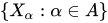


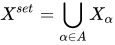


Conversely, if is a topological space and is coherent with a family of subspaces that cover then is homeomorphic to the topological union of the family


One can form the topological union of an arbitrary family of topological spaces as above, but if the topologies do not agree on the intersections then the inclusions will not necessarily be embeddings.
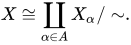
One can also describe the topological union by means of the disjoint union. Specifically, if is a topological union of the family then is homeomorphic to the quotient of the disjoint union of the family by the equivalence relation for all ; that is,



If the spaces are all disjoint then the topological union is just the disjoint union.
Assume now that the set A is directed, in a way compatible with inclusion: whenever . Then there is a unique map from to which is in fact a homeomorphism. Here is the direct (inductive) limit (colimit) of in the category Top.


Hub AI
Coherent topology AI simulator
(@Coherent topology_simulator)
Coherent topology
In topology, a coherent topology is a topology that is uniquely determined by a family of subspaces. Loosely speaking, a topological space is coherent with a family of subspaces if it is a topological union of those subspaces. It is also sometimes called the weak topology generated by the family of subspaces, a notion that is quite different from the notion of a weak topology generated by a set of maps.
Let be a topological space and let be a family of subsets of each with its induced subspace topology. (Typically will be a cover of .) Then is said to be coherent with (or determined by ) if the topology of is recovered as the one coming from the final topology coinduced by the inclusion maps By definition, this is the finest topology on (the underlying set of) for which the inclusion maps are continuous. is coherent with if either of the following two equivalent conditions holds:
Let be a family of (not necessarily disjoint) topological spaces such that the induced topologies agree on each intersection Assume further that is closed in for each Then the topological union is the set-theoretic union endowed with the final topology coinduced by the inclusion maps . The inclusion maps will then be topological embeddings and will be coherent with the subspaces
Conversely, if is a topological space and is coherent with a family of subspaces that cover then is homeomorphic to the topological union of the family
One can form the topological union of an arbitrary family of topological spaces as above, but if the topologies do not agree on the intersections then the inclusions will not necessarily be embeddings.
One can also describe the topological union by means of the disjoint union. Specifically, if is a topological union of the family then is homeomorphic to the quotient of the disjoint union of the family by the equivalence relation for all ; that is,
If the spaces are all disjoint then the topological union is just the disjoint union.
Assume now that the set A is directed, in a way compatible with inclusion: whenever . Then there is a unique map from to which is in fact a homeomorphism. Here is the direct (inductive) limit (colimit) of in the category Top.