



Community hub
Recent from talks
Knowledge base stats:
Talk channels stats:
Members stats:
Colombian conflict
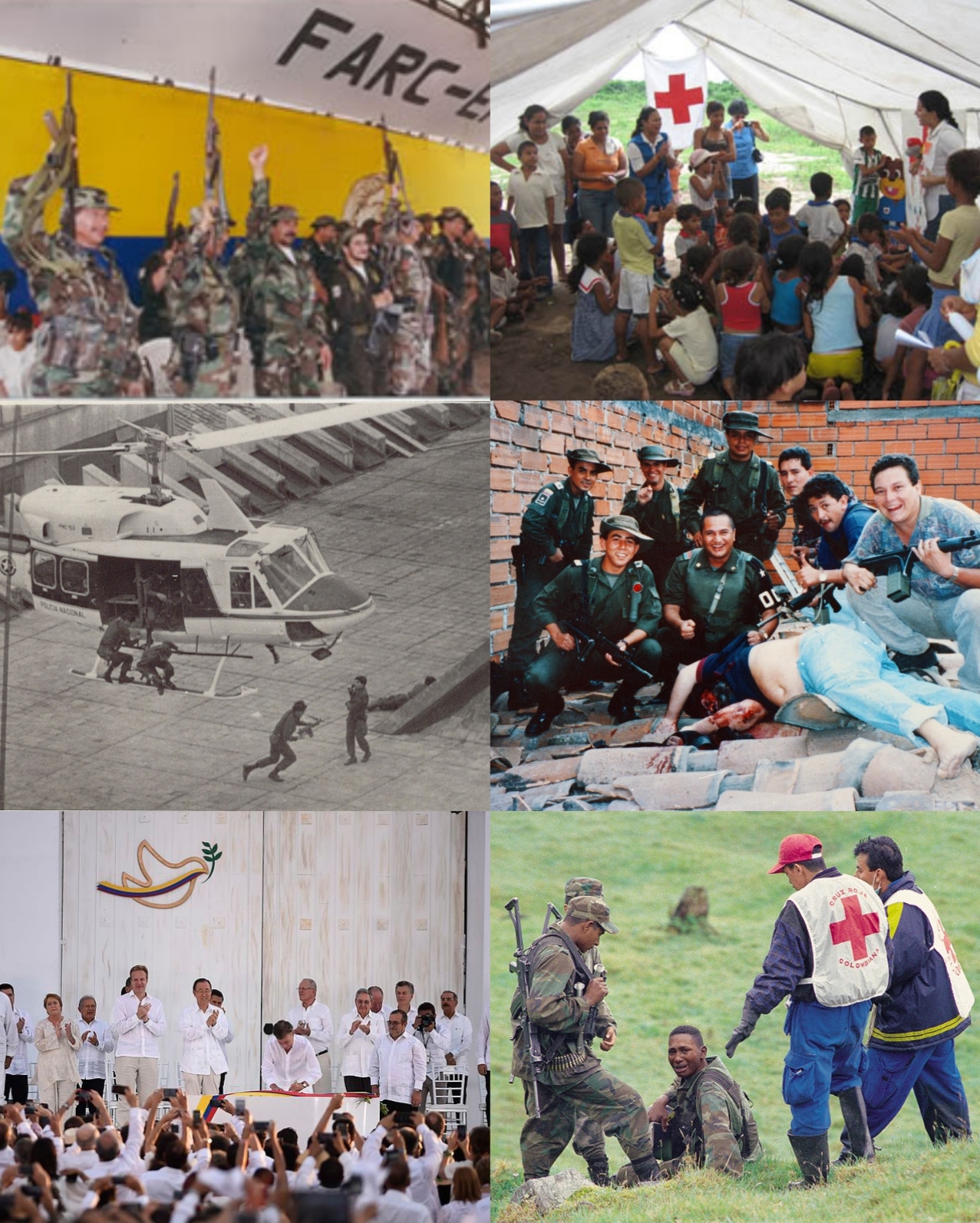
The Colombian conflict (Spanish: Conflicto armado interno de Colombia, lit. 'Colombian internal armed conflict') began on May 27, 1964, and is a low-intensity asymmetric war between the government of Colombia, far-right paramilitary groups, crime syndicates and far-left guerrilla groups fighting each other to increase their influence in Colombian territory. Some of the most important international contributors to the Colombian conflict include multinational corporations, the United States, Cuba, and the drug trafficking industry.
The conflict is historically rooted in the conflict known as La Violencia, which was triggered by the 1948 assassination of liberal political leader Jorge Eliécer Gaitán and in the aftermath of the anti-communist repression in rural Colombia in the 1960s that led Liberal and Communist militants to re-organize into the Revolutionary Armed Forces of Colombia (FARC).
The reasons for fighting vary from group to group. The FARC and other guerrilla movements claim to be fighting for the rights of the impoverished in Colombia to protect them from government violence and to provide social justice through communism. The Colombian government claims to be fighting for order and stability and to protect the rights and interests of its citizens. The paramilitary groups claim to be reacting to perceived threats by guerrilla movements.
According to a study by Colombia's National Centre for Historical Memory, 220,000 people died in the conflict between 1958 and 2013, most of them civilians (177,307 civilians and 40,787 fighters), and more than five million civilians were forced from their homes between 1985 and 2012, generating the world's second-largest population of internally displaced persons (IDPs). 16.9% of the population in Colombia has been a direct victim of the war. 2.3 million children have been displaced from their homes, and 45,000 children have been killed, according to national figures cited by UNICEF.[citation needed] In total, one in three of the 7.6 million registered victims of the conflict are children, and since 1985, 8,000 minors have disappeared. A Special Unit was created to search for persons deemed as missing within the context of and due to the armed conflict. As of April 2022, the Single Registry of Victims reported 9,263,826 victims of the Colombian conflict, with 2,048,563 of them being children.
Approximately 80% of those killed in the conflict have been civilians. In 2022, the Truth Commission of Colombia estimated that paramilitaries were responsible for 45% of civilian deaths, the guerrillas for 27%, and state forces for 12%, with the remaining 16% attributable to other groups or mixed responsibility.
On June 23, 2016, the Colombian government and the FARC rebels signed a historic ceasefire deal, bringing them closer to ending more than five decades of conflict. Although the agreement was rejected in the subsequent October plebiscite, the same month, the then Colombian president Juan Manuel Santos was awarded the Nobel Peace Prize for his efforts to bring the country's more than 50-year-long civil war to an end. A revised peace deal was signed the following month and submitted to Congress for approval. The House of Representatives unanimously approved the plan on November 30, a day after the Senate gave its backing.
The origin of the armed conflict in Colombia goes back to 1920, with agrarian disputes over the Sumapaz and Tequendama regions. Much of the background of the Colombian conflict is rooted in La Violencia, a conflict in which liberal and leftist parties united against the dictator of Colombia, Gustavo Rojas Pinilla. Colombia at the time was a banana republic dominated by foreign monopolies, specifically, the United Fruit Company.[citation needed]
The United Fruit Company existed to buy large quantities of agricultural products in Latin America at cheap prices, then resell the crops in foreign markets for inflated amounts. Local farmers were impoverished and forced to grow specific crops, creating a monoculture in which farmers depended on the company for all food, products, and wages. The United Fruit Company would usually pay their workers in coupons, worthless outside company stores, which would further charge extravagant prices compared to what workers earned. Further, the employment system was usually one in which farmers would be forced to sell their property to the United Fruit Company. They ended up having to work on the land, becoming indebted to the company and having to pay it back.
Hub AI
Colombian conflict AI simulator
(@Colombian conflict_simulator)
Colombian conflict
The Colombian conflict (Spanish: Conflicto armado interno de Colombia, lit. 'Colombian internal armed conflict') began on May 27, 1964, and is a low-intensity asymmetric war between the government of Colombia, far-right paramilitary groups, crime syndicates and far-left guerrilla groups fighting each other to increase their influence in Colombian territory. Some of the most important international contributors to the Colombian conflict include multinational corporations, the United States, Cuba, and the drug trafficking industry.
The conflict is historically rooted in the conflict known as La Violencia, which was triggered by the 1948 assassination of liberal political leader Jorge Eliécer Gaitán and in the aftermath of the anti-communist repression in rural Colombia in the 1960s that led Liberal and Communist militants to re-organize into the Revolutionary Armed Forces of Colombia (FARC).
The reasons for fighting vary from group to group. The FARC and other guerrilla movements claim to be fighting for the rights of the impoverished in Colombia to protect them from government violence and to provide social justice through communism. The Colombian government claims to be fighting for order and stability and to protect the rights and interests of its citizens. The paramilitary groups claim to be reacting to perceived threats by guerrilla movements.
According to a study by Colombia's National Centre for Historical Memory, 220,000 people died in the conflict between 1958 and 2013, most of them civilians (177,307 civilians and 40,787 fighters), and more than five million civilians were forced from their homes between 1985 and 2012, generating the world's second-largest population of internally displaced persons (IDPs). 16.9% of the population in Colombia has been a direct victim of the war. 2.3 million children have been displaced from their homes, and 45,000 children have been killed, according to national figures cited by UNICEF.[citation needed] In total, one in three of the 7.6 million registered victims of the conflict are children, and since 1985, 8,000 minors have disappeared. A Special Unit was created to search for persons deemed as missing within the context of and due to the armed conflict. As of April 2022, the Single Registry of Victims reported 9,263,826 victims of the Colombian conflict, with 2,048,563 of them being children.
Approximately 80% of those killed in the conflict have been civilians. In 2022, the Truth Commission of Colombia estimated that paramilitaries were responsible for 45% of civilian deaths, the guerrillas for 27%, and state forces for 12%, with the remaining 16% attributable to other groups or mixed responsibility.
On June 23, 2016, the Colombian government and the FARC rebels signed a historic ceasefire deal, bringing them closer to ending more than five decades of conflict. Although the agreement was rejected in the subsequent October plebiscite, the same month, the then Colombian president Juan Manuel Santos was awarded the Nobel Peace Prize for his efforts to bring the country's more than 50-year-long civil war to an end. A revised peace deal was signed the following month and submitted to Congress for approval. The House of Representatives unanimously approved the plan on November 30, a day after the Senate gave its backing.
The origin of the armed conflict in Colombia goes back to 1920, with agrarian disputes over the Sumapaz and Tequendama regions. Much of the background of the Colombian conflict is rooted in La Violencia, a conflict in which liberal and leftist parties united against the dictator of Colombia, Gustavo Rojas Pinilla. Colombia at the time was a banana republic dominated by foreign monopolies, specifically, the United Fruit Company.[citation needed]
The United Fruit Company existed to buy large quantities of agricultural products in Latin America at cheap prices, then resell the crops in foreign markets for inflated amounts. Local farmers were impoverished and forced to grow specific crops, creating a monoculture in which farmers depended on the company for all food, products, and wages. The United Fruit Company would usually pay their workers in coupons, worthless outside company stores, which would further charge extravagant prices compared to what workers earned. Further, the employment system was usually one in which farmers would be forced to sell their property to the United Fruit Company. They ended up having to work on the land, becoming indebted to the company and having to pay it back.