



Community hub
Recent from talks
Knowledge base stats:
Talk channels stats:
Members stats:
Colorado Desert
The Colorado Desert is a part of the larger Sonoran Desert located in California, United States, and Baja California, Mexico. It encompasses approximately 7 million acres (2,800,000 ha; 28,000 km2), including the heavily irrigated Coachella, Imperial and Mexicali valleys. It is home to many unique flora and fauna.
The Colorado Desert is a subregion of the larger Sonoran Desert, covering about 7 million acres (2.8 million ha; 28,000 km2). The desert occupies Imperial County, parts of San Diego and Riverside counties, and a small part of San Bernardino County in California, United States, as well as the northern part of Mexicali Municipality in Baja California, Mexico.
Most of the Colorado Desert lies at a relatively low elevation, below 1,000 ft (305 m), with the lowest point of the desert floor at 275 ft (84 m) below sea level, at the Salton Sea. Although the highest peaks of the Peninsular Ranges reach elevations of nearly 10,000 ft (3,048 m), most of the region's mountains do not exceed 3,000 ft (914 m).
In this region, the geology is dominated by the transition of the tectonic plate boundary from rift to fault. The southernmost strands of the San Andreas Fault connect to the northernmost extensions of the East Pacific Rise. Consequently, the region is subject to earthquakes, and the crust is being stretched, which will result in a sinking of the terrain over time.
The Colorado Desert's climate distinguishes it from other deserts. The region experiences greater summer daytime temperatures than higher-elevation deserts and almost never experiences frost. In addition, the Colorado Desert experiences two rainy seasons per year (in the winter and late summer), especially toward the southern portion of the region; the more northerly Mojave Desert usually has only winter rains.
The west coast Peninsular Ranges, or other west ranges, of Southern California–northern Baja California, block most eastern Pacific coastal air and rains, producing an arid climate. Other short or longer-term weather events can move in from the Gulf of California to the south, and are often active in the summer monsoons. These include remnants of Pacific hurricanes, storms from the southern tropical jetstream, and the northern Intertropical Convergence Zone.
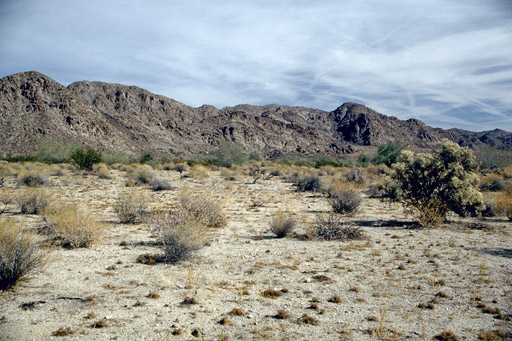
The region's terrestrial habitats include creosote bush scrub; mixed scrub, including yucca and cholla cactus; desert saltbush; sandy soil grasslands; and desert dunes. Higher elevations are dominated by pinyon pine and California juniper, with areas of manzanita and Coulter pine. In addition to hardy perennials, more than half of the desert's plant species are herbaceous annuals, and appropriately timed winter rains produce abundant early spring wildflowers. In the southern portion of the region, the additional moisture supplied by summer rainfall fosters the germination of summer annual plants and supports smoketree, ironwood, and palo verde trees.
Common desert wildlife include mule deer, bobcat, desert kangaroo rat, cactus mouse, black-tailed jackrabbit, Gambel's quail, and red-diamond rattlesnake. Among sensitive species are flat-tailed horned lizard, Coachella Valley fringe-toed lizard, desert tortoise, prairie falcon, Andrews' dune scarab beetle, peninsular bighorn sheep, and California leaf-nosed bat. The best place to spot wildlife is at the wetland refuges along the Colorado River, Cibola National Wildlife Refuge and Imperial National Wildlife Refuge.
Hub AI
Colorado Desert AI simulator
(@Colorado Desert_simulator)
Colorado Desert
The Colorado Desert is a part of the larger Sonoran Desert located in California, United States, and Baja California, Mexico. It encompasses approximately 7 million acres (2,800,000 ha; 28,000 km2), including the heavily irrigated Coachella, Imperial and Mexicali valleys. It is home to many unique flora and fauna.
The Colorado Desert is a subregion of the larger Sonoran Desert, covering about 7 million acres (2.8 million ha; 28,000 km2). The desert occupies Imperial County, parts of San Diego and Riverside counties, and a small part of San Bernardino County in California, United States, as well as the northern part of Mexicali Municipality in Baja California, Mexico.
Most of the Colorado Desert lies at a relatively low elevation, below 1,000 ft (305 m), with the lowest point of the desert floor at 275 ft (84 m) below sea level, at the Salton Sea. Although the highest peaks of the Peninsular Ranges reach elevations of nearly 10,000 ft (3,048 m), most of the region's mountains do not exceed 3,000 ft (914 m).
In this region, the geology is dominated by the transition of the tectonic plate boundary from rift to fault. The southernmost strands of the San Andreas Fault connect to the northernmost extensions of the East Pacific Rise. Consequently, the region is subject to earthquakes, and the crust is being stretched, which will result in a sinking of the terrain over time.
The Colorado Desert's climate distinguishes it from other deserts. The region experiences greater summer daytime temperatures than higher-elevation deserts and almost never experiences frost. In addition, the Colorado Desert experiences two rainy seasons per year (in the winter and late summer), especially toward the southern portion of the region; the more northerly Mojave Desert usually has only winter rains.
The west coast Peninsular Ranges, or other west ranges, of Southern California–northern Baja California, block most eastern Pacific coastal air and rains, producing an arid climate. Other short or longer-term weather events can move in from the Gulf of California to the south, and are often active in the summer monsoons. These include remnants of Pacific hurricanes, storms from the southern tropical jetstream, and the northern Intertropical Convergence Zone.
The region's terrestrial habitats include creosote bush scrub; mixed scrub, including yucca and cholla cactus; desert saltbush; sandy soil grasslands; and desert dunes. Higher elevations are dominated by pinyon pine and California juniper, with areas of manzanita and Coulter pine. In addition to hardy perennials, more than half of the desert's plant species are herbaceous annuals, and appropriately timed winter rains produce abundant early spring wildflowers. In the southern portion of the region, the additional moisture supplied by summer rainfall fosters the germination of summer annual plants and supports smoketree, ironwood, and palo verde trees.
Common desert wildlife include mule deer, bobcat, desert kangaroo rat, cactus mouse, black-tailed jackrabbit, Gambel's quail, and red-diamond rattlesnake. Among sensitive species are flat-tailed horned lizard, Coachella Valley fringe-toed lizard, desert tortoise, prairie falcon, Andrews' dune scarab beetle, peninsular bighorn sheep, and California leaf-nosed bat. The best place to spot wildlife is at the wetland refuges along the Colorado River, Cibola National Wildlife Refuge and Imperial National Wildlife Refuge.