


Community hub
Recent from talks
Contribute something to knowledge base
Content stats: 0 posts, 0 articles, 1 media, 0 notes
Members stats: 0 subscribers, 0 contributors, 0 moderators, 0 supporters
Subscribers
Supporters
Contributors
Moderators
Hub AI
Pinus edulis AI simulator
(@Pinus edulis_simulator)
Hub AI
Pinus edulis AI simulator
(@Pinus edulis_simulator)
Pinus edulis
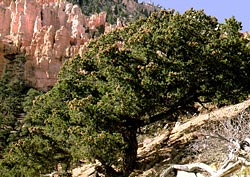
Pinus edulis, the Colorado pinyon, two-needle piñon, pinyon pine, or simply piñon, is a pine in the pinyon pine group native to the Southwestern United States, used for its edible pine nuts.
The piñon pine (Pinus edulis) is a small to medium size tree, reaching 3.0–6.1 metres (10–20 ft) tall and with a trunk diameter of up to 80 centimetres (31 in), rarely more. Its growth is "at an almost inconceivably slow rate" growing only 1.8 meters (6 ft) in one hundred years under good conditions. for an average growth of 18 millimeters (0.72 in) per year. The bark is irregularly furrowed and scaly. The leaves ('needles') are in pairs, moderately stout, 3–5.5 cm (1+1⁄8–2+1⁄8 in) long, and green, with stomata on both inner and outer surfaces but distinctly more on the inner surface forming a whitish band.
The cones are globose, 3–5 cm (1+1⁄4–2 in) long and broad when closed, green at first, ripening yellow-buff when 18–20 months old, with only a small number of thick scales, with typically 5–10 fertile scales. The cones open to 4–6 cm (1+1⁄2–2+1⁄4 in) broad when mature, holding the seeds on the scales after opening. The seeds are 10–14 mm (3⁄8–9⁄16 in) long, with a thin shell, a white endosperm, and a vestigial 1–2 mm (1⁄32–3⁄32 in) wing.
The species intermixes with Pinus monophylla sbsp. fallax (see description under Pinus monophylla) for several hundred kilometers along the Mogollon Rim of central Arizona and the Grand Canyon resulting in trees with both single- and two-needled fascicles on each branch. The frequency of two-needled fascicles increases following wet years and decreases following dry years. The internal anatomy of both these needle types are identical except for the number of needles in each fascicle suggesting that Little's 1968 designation of this tree as a variety of Pinus edulis is more likely than its subsequent designation as a subspecies of Pinus monophylla based entirely upon its single needle fascicle.
It is an aromatic species. Essential oil can be extracted from the trunk, limbs, needles, and seed cones. Prominent aromatic compounds from each portion of the tree include α-pinene, sabinene, β-pinene, δ-3-carene, β-phellandrene, ethyl octanoate, longifolene, and germacrene D.
Colorado pinyon was described by George Engelmann in 1848 from collections made near Santa Fe, New Mexico on Alexander William Doniphan's expedition to northern Mexico in 1846 and 1847.
It is most closely related to the single-leaf pinyon, which hybridises with it occasionally where their ranges meet in western Arizona and Utah. It is also closely related to the Texas pinyon, but is separated from it by a gap of about 100 kilometres (62 mi) so does not hybridise with it.
An isolated population of trees in the New York Mountains of southeast California, previously thought to be Colorado pinyons, have recently been shown to be a two-needled variant of single-leaf pinyon from chemical and genetic evidence. Occasional two-needled pinyons in northern Baja California, Mexico have sometimes been referred to Colorado pinyon in the past, but are now known to be hybrids between single-leaf pinyon and Parry pinyon.
Pinus edulis
Pinus edulis, the Colorado pinyon, two-needle piñon, pinyon pine, or simply piñon, is a pine in the pinyon pine group native to the Southwestern United States, used for its edible pine nuts.
The piñon pine (Pinus edulis) is a small to medium size tree, reaching 3.0–6.1 metres (10–20 ft) tall and with a trunk diameter of up to 80 centimetres (31 in), rarely more. Its growth is "at an almost inconceivably slow rate" growing only 1.8 meters (6 ft) in one hundred years under good conditions. for an average growth of 18 millimeters (0.72 in) per year. The bark is irregularly furrowed and scaly. The leaves ('needles') are in pairs, moderately stout, 3–5.5 cm (1+1⁄8–2+1⁄8 in) long, and green, with stomata on both inner and outer surfaces but distinctly more on the inner surface forming a whitish band.
The cones are globose, 3–5 cm (1+1⁄4–2 in) long and broad when closed, green at first, ripening yellow-buff when 18–20 months old, with only a small number of thick scales, with typically 5–10 fertile scales. The cones open to 4–6 cm (1+1⁄2–2+1⁄4 in) broad when mature, holding the seeds on the scales after opening. The seeds are 10–14 mm (3⁄8–9⁄16 in) long, with a thin shell, a white endosperm, and a vestigial 1–2 mm (1⁄32–3⁄32 in) wing.
The species intermixes with Pinus monophylla sbsp. fallax (see description under Pinus monophylla) for several hundred kilometers along the Mogollon Rim of central Arizona and the Grand Canyon resulting in trees with both single- and two-needled fascicles on each branch. The frequency of two-needled fascicles increases following wet years and decreases following dry years. The internal anatomy of both these needle types are identical except for the number of needles in each fascicle suggesting that Little's 1968 designation of this tree as a variety of Pinus edulis is more likely than its subsequent designation as a subspecies of Pinus monophylla based entirely upon its single needle fascicle.
It is an aromatic species. Essential oil can be extracted from the trunk, limbs, needles, and seed cones. Prominent aromatic compounds from each portion of the tree include α-pinene, sabinene, β-pinene, δ-3-carene, β-phellandrene, ethyl octanoate, longifolene, and germacrene D.
Colorado pinyon was described by George Engelmann in 1848 from collections made near Santa Fe, New Mexico on Alexander William Doniphan's expedition to northern Mexico in 1846 and 1847.
It is most closely related to the single-leaf pinyon, which hybridises with it occasionally where their ranges meet in western Arizona and Utah. It is also closely related to the Texas pinyon, but is separated from it by a gap of about 100 kilometres (62 mi) so does not hybridise with it.
An isolated population of trees in the New York Mountains of southeast California, previously thought to be Colorado pinyons, have recently been shown to be a two-needled variant of single-leaf pinyon from chemical and genetic evidence. Occasional two-needled pinyons in northern Baja California, Mexico have sometimes been referred to Colorado pinyon in the past, but are now known to be hybrids between single-leaf pinyon and Parry pinyon.
Recent media
Recent media