Hubbry Logo
Pinus monophyllaPinus monophyllaMain
Open search
Pinus monophylla
Community hub
Pinus monophylla
logo
8 pages, 0 posts
0 subscribers
Be the first to start a discussion here.
Pinus monophylla
Pinus monophylla
from Wikipedia

Single-leaf pinyon
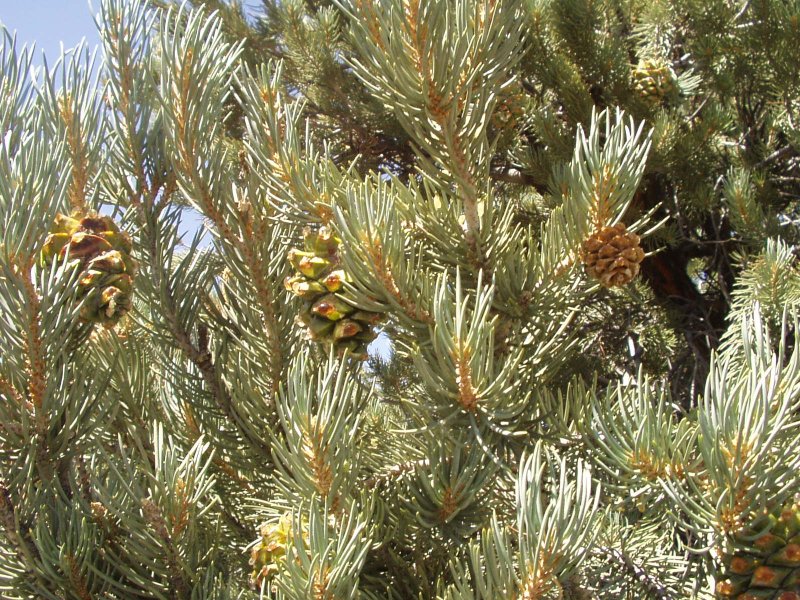
Single-leaf pinyon (Pinus monophylla subsp. monophylla) leaves and immature cones

Secure  (NatureServe)[2]
Scientific classification Edit this classification
Kingdom: Plantae
Clade: Tracheophytes
Clade: Gymnospermae
Division: Pinophyta
Class: Pinopsida
Order: Pinales
Family: Pinaceae
Genus: Pinus
Subgenus: P. subg. Strobus
Section: P. sect. Parrya
Subsection: P. subsect. Cembroides
Species:
P. monophylla
Binomial name
Pinus monophylla
Natural range:
green – Pinus monophylla subsp. monophylla
blue – Pinus monophylla subsp. californiarum
red – Pinus monophylla subsp. fallax
Synonyms[3]
List
    • Caryopitys monophylla (Torr. & Frém.) Rydb.
    • Pinus cembroides var. monophylla (Torr. & Frém.) Voss
    • Pinus cembroides subsp. monophylla (Torr. & Frém.) A.E.Murray
    • Pinus edulis var. monophylla (Torr. & Frém.) Torr.
    • Pinus fremontiana Endl.

Pinus monophylla, the single-leaf pinyon, (alternatively spelled piñon) is a pine in the pinyon pine group, native to North America. The range is in southernmost Idaho, western Utah, Arizona, southwest New Mexico, Nevada, eastern and southern California and northern Baja California.

It occurs at moderate altitudes from 1,200 to 2,300 m (3,900 to 7,500 ft), rarely as low as 950 m (3,120 ft) and as high as 2,900 m (9,500 ft). It is widespread and often abundant in this region, forming extensive open woodlands, often mixed with junipers in the Pinyon-juniper woodland plant community. Single-leaf pinyon is the world's only one-needled pine.[4]

Description

[edit]

Pinus monophylla is a small to medium size tree, reaching 10–20 m (33–66 ft) tall and with a trunk diameter of up to 80 cm (31+12 in) rarely more. The bark is irregularly furrowed and scaly. The leaves ('needles') are, uniquely for a pine, usually single (not two or more in a fascicle, though trees with needles in pairs are found occasionally), stout, 4–6 cm (1+122+14 in) long, and grey-green to strongly glaucous blue-green, with stomata over the whole needle surface (and on both inner and outer surfaces of paired needles). The cones are acute-globose, the largest of the true pinyons, 4.5–8 cm (1+343+18 in) long and broad when closed, green at first, ripening yellow-buff when 18–20 months old, with only a small number of very thick scales, typically 8–20 fertile scales. The cones thus grow over a two-year (26-month) cycle, so that newer green and older, seed-bearing or open brown cones are on the tree at the same time.

Open cone with empty pine nuts

The seed cones open to 6–9 cm (2+143+12 in) broad when mature, holding the seeds on the scales after opening. The seeds are 11–16 mm (71658 in) long, with a thin shell, a white endosperm, and a vestigial 1–2 mm (132332 in) wing. Empty pine nuts with undeveloped seeds (self-pollinated) are a light tan color, while the "good" ones are dark brown.[5] The pine nuts are dispersed by the pinyon jay, which plucks the seeds out of the open cones, choosing only the dark ones and leaving the light ones (as in image at right). The jay, which uses the seeds as a food resource, stores many of the seeds for later use by burying them. Some of these stored seeds are not used and are able to grow into new trees. Indeed, Pinyon seeds will rarely germinate in the wild unless they are cached by jays or other animals.

Taxonomy

[edit]

There are three subspecies:

  • Pinus monophylla subsp. monophylla. Most of the range, except for the areas below. Needles more stout, bright blue-green, with 2–7 resin canals and 8–16 stomatal lines. Cones are 5.5–8 cm (2+183+18 in) long, often longer than broad.
  • Pinus monophylla subsp. californiarum (D. K. Bailey) Zavarin. Southernmost Nevada, southwest through southeastern California (northwest only as far as the San Jacinto Mountains) to 29°N in northern Baja California. Needles less stout, gray-green, with 8–16 resin canals and 13–18 stomatal lines. Cones are 4.5–6 cm (1+342+38 in) long, broader than long.
  • Pinus monophylla subsp. fallax (E. L. Little) D.K. Bailey. Slopes of the lower Colorado River valley and adjacent tributaries from St. George, Utah to the Hualapai Mountains, and along the lower flank of the Mogollon Rim to Silver City, New Mexico. Needles less stout, gray-green, with 2–3 resin canals and 8–16 stomatal lines. Cones are 4.5–6 cm (1+342+38 in) long, broader than long.

It is most closely related to the Colorado pinyon, which hybridises with it (both subsps. monophylla and fallax) occasionally where their ranges meet in western Arizona and Utah. It also (subsp. californiarum) hybridises extensively with Parry pinyon. This classification of pinyon species based only upon the presence of single-needle fascicles is brought into doubt by the reporting of trees from both the Pinus monophylla/Pinus edulis and the Pinus monophylla subsp. fallax/Pinus edulis zones as growing more single needle fascicles after dry years and more two-needled fascicles after wet years.[6]

Hybrid individual showing the single-needles of P. monophylla and the two-needles of P. edulis. Logan-Dry canyon ridge, Bear River Range, N. Utah

Mojave National Preserve

[edit]

An isolated population of single-leaf pinyon trees in the Mojave Desert's New York Mountains, within the Mojave National Preserve of southeast California, has needles mostly in pairs and was previously thought to be Colorado pinyons. They have recently been shown to be a two-needled variant of single-leaf pinyon from chemical and genetic evidence[citation needed].

Occasional two-needled pinyons in northern Baja California are hybrids between single-leaf pinyon and Parry pinyon.

Prehistoric occurrence

[edit]

Pinus monophylla has been studied with regard to prehistoric occurrence based upon fossil needles found in packrat middens and fossil pollen records.[7] All three of these sub-types of single-needled pinyon have maintained distinctive ranges over the last 40,000 years, although the northerly species (Pinus monophylla) expanded greatly throughout Utah and Nevada since the end of the Pleistocene, 11,700 years ago. The southern California variety has been found to occur within Joshua Tree National Park throughout the last 47,000 years.[8]

Uses

[edit]
Tree on Spruce Mountain, Nevada, in June

The edible seeds, pine nuts, are collected throughout its range; Native American of the Great Basin region commonly ate them. Various birds and mammals eat the seeds as well.[9] The roasted cones are also edible.[10]

Individuals may harvest the seed for personal use on BLM and Forest Service land.[11]

Single-leaf pinyon is also cultivated as an ornamental tree for native plant, drought tolerant, and wildlife gardens, and for natural landscaping. It is used regionally as a Christmas tree. It is rarely seen in nurseries, because it is difficult to germinate.

Deforestation

[edit]

During the mid-nineteenth century, many pinyon groves were cut down to make charcoal for ore-processing, threatening the traditional lifestyle of the Native Americans who depended on them for food. When the railroads penetrated these areas, imported coal supplanted locally produced charcoal.

Following the resulting re-establishment of pinyon woodlands after the charcoal era, many cattle ranchers became concerned that these woodlands provided decreased livestock forage in grazing rangeland. Efforts to clear these woodlands, often using a surplus battleship chain dragged between two bulldozers, peaked in the 1950s, but were subsequently abandoned when no long term forage increase resulted. The habitat destruction of large areas of Pinyon woodlands in the interests of mining and cattle ranching is seen by some as an act of ecological and cultural vandalism.[5]

In culture

[edit]

In 1959, it was designated Nevada's state tree, later to be joined by the Great Basin Bristlecone Pine.[12] Its description is attributed to American politician and explorer John C. Frémont.

See also

[edit]

References

[edit]

Further reading

[edit]
[edit]
Revisions and contributorsEdit on WikipediaRead on Wikipedia
from Grokipedia

Pinus monophylla Torr. & Frém., commonly known as singleleaf pinyon or nut pine, is a slow-growing coniferous in the family , native to the dry mountain ranges of the and northern . It typically reaches heights of 6–12 meters (20–40 feet) with a rounded to flat-topped crown, multiple upswept branches, and a short trunk, thriving in arid, soils on slopes and plateaus at elevations of 1,200–2,300 meters. The species is distinguished by its stout, sharp-tipped needles borne singly (rarely in twos) per fascicle, measuring 2–5 cm long, bluish-green with prominent stomatal lines, and persisting for several years.
This pine dominates pinyon-juniper woodlands across isolated ranges in , , western , southern , northwestern , and , where it associates with species like in well-drained, calcareous soils under semi-arid conditions with limited precipitation. Its monoecious flowers develop into woody, egg-shaped cones 4–6 cm long, bearing large, wingless edible s (piñon nuts) that have served as a vital source for and , though commercial harvesting is limited due to smaller seed crops compared to related species. The tree's and longevity—often exceeding 500 years—make it a key component of ecosystems, supporting amid harsh climates, while its remains secure globally.

Morphology and Physical Characteristics

Foliage and Growth Form

Pinus monophylla exhibits solitary , a distinctive trait among pines, with each fascicle containing a single rigid leaf rather than clusters. These measure 2.5-3.5 cm in length and feature sheaths at their base. The are stout, with dried diameters of 1.3-1.7 mm and two to seven ducts, contributing to structural resilience in arid conditions. The species forms small, bushy or shrub-like individuals, typically reaching heights of 5-9 m, occasionally up to 14 m, with diameters up to 50 cm and a strongly tapering trunk. The crown is rounded and dense, resulting from extensive branching that promotes a spreading adapted to low-water environments. Growth is slow; a dominant requires approximately 60 years to attain 2 m in height and 150 years for 8.5 m. The root system includes a deep capable of penetrating bedrock fractures to access subsurface moisture, enhancing in contrast to the shallower, more fibrous roots of pines in mesic habitats. This extensive rooting strategy supports persistence in semi-arid regions with limited precipitation.

Reproductive Structures

The female cones of Pinus monophylla are ovoid to subglobose, measuring 3.7–8.3 cm in length with an average of 5.5 cm, and feature thick, woody scales. They emerge green and ripen to brown over two growing seasons, with occurring in the first year and maturation by early September to early November of the second year. Male cones are small, cylindrical, and pale yellow, occurring in clusters of 20 to 40 on lower branches, emerging in or and shedding by mid-June. Seeds are wingless, oblong, and 10–17 mm long, weighing approximately 400 mg each, with a moderately thin shell enclosing an kernel known as the pinyon nut. Each cone contains an average of 20 , ranging from 2 to 60. The pinyon nut kernel has a high content of about 61 g per 100 g dry weight and provides roughly 629 kcal per 100 g. Cone production begins around 35 years of age, with substantial crops from 75–100 years and peak yields at 160–200 years, though output varies widely due to climatic influences. Mast years occur irregularly every 2–3 years, as evidenced by long-term monitoring showing per-acre yields fluctuating from 0 cones in poor years to over 2,500 in abundant ones, such as 765 cones in 1975 and 2,560 in 1977.

Taxonomy and Phylogeny

Classification and Etymology

Pinus monophylla & Frém. (1850) belongs to the family and the genus , where it is placed in subgenus Strobus (soft pines, characterized by a single per needle), section Parrya (pinyon and foxtail pines with 1–5 needles per fascicle), and subsection Cembroides (true pinyons with , wingless seeds). This taxonomic assignment reflects its morphological alignment with other nut-producing pines adapted to arid environments. The monophylla originates from terms monos (single or alone) and phyllon (), denoting the ' distinctive fascicles typically bearing one needle, unlike the multi-needled arrangements in most pines. Molecular phylogenetic studies, including restriction fragment analyses of chloroplast DNA, position P. monophylla in close kinship with P. edulis within subsection Cembroides, supported by shared traits like serotinous, indehiscent cones and genetic markers indicating a derived among soft pines. Early botanical accounts frequently merged P. monophylla with P. edulis owing to variable needle counts (occasional two-needled fascicles in P. monophylla), but systematic revisions in the mid-20th century, such as Elbert L. Little's 1968 USDA assessments, delineated it as a separate entity through emphasis on predominant monofoliate needles, resin duct positioning, and morphology.

Subspecies and Genetic Variation

displays intraspecific morphological variation chiefly in needle fascicles, with the nominate P. m. subsp. monophylla characterized by consistently single needles (1 per fascicle), while subsp. fallax exhibits variable 1–2 needles, often in transitional populations. predominates in the central ranges of , , and at elevations of 1,000–2,300 m, whereas subsp. fallax is confined to peripheral overlap zones in , southern , and , where it shows intermediate traits like foliage and resin canal counts of 2–7 per needle. These distinctions reflect clinal adaptations to and gradients, with single-needled forms favoring higher winter rainfall areas. Genetic investigations, including and chloroplast DNA analyses, reveal moderate intraspecific diversity structured clinally across isolated mountain ranges, correlating with environmental heterogeneity rather than strict boundaries. studies indicate regional gradients, while chloroplast markers highlight maternal lineage sorting incomplete due to historical expansions. This variation supports local adaptations, such as , despite overall low from long generation times. Pinus monophylla participates in a monophyletic pinyon syngameon with P. edulis and P. californiarum, where hybridization generates forms like subsp. fallax through sequential , enabling adaptive into novel niches. A 2023 genomic analysis documents reduced but persistent hybrid production in mixed stands, maintaining cohesion via ecological barriers while allowing beneficial alleles—such as enhanced seed viability—to spread, as evidenced by and SNP data across hybrid zones. This dynamic underpins resilience, with hybrids documented via packrat middens dating to 48,000 years ago, though contemporary rates emphasize P. monophylla's role as a genetic recipient in interfaces.

Fossil Record and Evolutionary History

Fossil records of Pinus monophylla are predominantly in age, derived from well-preserved macrofossils such as needles in packrat middens and associated pollen sequences across the . These deposits, particularly abundant in and the , reveal that the species maintained a more extensive distribution during cooler, moister periods linked to glacial cycles, extending into presently unsuitable low-elevation and northern habitats. Packrat middens dated between approximately 10,000 and 40,000 years (BP) document this expanded range, with P. monophylla needles indicating colonization facilitated by increased effective precipitation from orbital-driven climate oscillations, followed by contractions during warmer, drier interpluvials. Pollen records corroborate macrofossil evidence, showing elevated P. monophylla-type pollen (often grouped with other white pines) during full-glacial and pluvial phases of the late Pleistocene, reflecting habitat suitability under cooler conditions with higher winter precipitation. Early Holocene macrofossils, including a pine nut hull directly dated to 7410 ± 120 years BP from Danger Cave in the northeastern Great Basin, indicate presence at least 2000 years earlier than prior extrapolations from southern records suggested, implying faster northward migration or relic populations amid post-glacial warming. These patterns underscore repeated range dynamics tied to Milankovitch-scale forcings and precipitation regime shifts, independent of modern anthropogenic drivers. The evolutionary lineage of P. monophylla belongs to Pinus subsection Cembroides (pinyon pines), a monophyletic group that arose within the diversification of Pinus—originating in the around 130 million years ago—amid of western . Subsection Cembroides species, including P. monophylla, exhibit morphological adaptations to xeric conditions, such as reduced leaf surface and resinous defenses, that predate Pleistocene glacial cycles and align with uplift and drying trends in the region's paleoenvironments. Phylogenetic analyses confirm niche conservatism in tolerance across the group, with fossil-proxy data supporting long-term persistence and biogeographic adjustments primarily through natural climatic variability rather than novel selective pressures.

Distribution and Habitat

Native Geographic Range

, commonly known as singleleaf piñon, is native to isolated mountain ranges, often termed , across the and regions. Its core distribution spans , , western Utah, , and , extending southward into northern , . This species predominates in pinyon-juniper woodlands, forming open to moderately dense canopies on dry slopes and plateaus. The elevational range typically falls between 1,000 and 2,800 meters, varying by locality with lower limits in warmer margins and higher extents in cooler intermountain sites. Distribution patterns are patchy, reflecting to fragmented habitats where it achieves densities of 300 to 600 s per in optimal stands. Pinyon-juniper woodlands dominated by P. monophylla contribute to extensive coverage in the , though precise occupied area estimates for this species alone remain approximate within broader woodland extents exceeding 22 million s regionally. Fossil evidence from packrat middens, containing preserved needles as dated macrofossils, documents historical shifts in range. During the , P. monophylla occupied lower intermountain valleys and extended across the to northwestern , but post-glacial warming prompted upslope retraction to current higher-elevation refugia, limiting its presence in former lowland distributions. This migration pattern, evident from middens dated to the last 50,000 years, underscores climatic control over its .

Soil and Climatic Preferences

Pinus monophylla prefers well-drained, shallow soils of low to moderate fertility, typically rocky or coarse-textured substrates such as Mollisols derived from , , or other parent materials. These edaphic conditions often include soils, supporting its occurrence on sites with limited water retention and high drainage to prevent or fungal issues. The species exhibits intolerance to waterlogging, heavy clays, or poorly aerated valley floor soils, where establishment and growth are markedly reduced. Climatically, P. monophylla is adapted to arid to semiarid environments where annual ranges from approximately 150 to 500 mm, with the majority falling as winter snow or rain, rendering summer moisture deficits a primary growth constraint. Empirical observations indicate growth cessation or absence in locales with winter below 18 mm or spring totals under 17 mm, underscoring its sensitivity to prolonged dry periods despite overall once mature. Temperature regimes encompass extremes from -20°C in winter to 40°C in summer, with the species demonstrating resistance and endurance suited to continental desert-steppe climates. Under severe stress, individuals may shed needles as an adaptive response, though full drought deciduousness is not characteristic. On limestone-derived soils, P. monophylla often outperforms co-occurring junipers in establishment and vigor, attributable to its enhanced tolerance for alkaline, nutrient-poor conditions.

Ecology

Biotic Interactions

Pinus monophylla forms ectomycorrhizal associations with fungi such as those in the genera and , which enhance and uptake in the nutrient-poor, arid soils typical of its . These mutualistic relationships colonize 80-90% of fine , significantly improving survival and establishment by extending the root system's absorptive capacity beyond the depleted . Rodents, including pinyon mice (Peromyscus truei) and kangaroo rats, serve as key seed predators and dispersers of P. monophylla, caching seeds in shallow burrows near shrubs, which promotes away from parent trees while risking predation if caches are retrieved. Avian dispersers, such as pinyon jays (Gymnorhinus cyanocephalus) and scrub jays ( californica), transport seeds over longer distances, often burying them in mineral soil, though they recover only a portion, leaving others for potential recruitment. Field enclosure studies demonstrate varying effectiveness among rodent species, with heteromyids like kangaroo rats showing higher dispersal rates than murids due to deeper caching behaviors. The species is vulnerable to herbivory by , including tip moths and needle miners, which can reduce foliage and cone production, particularly in hybrid zones where resistance varies. Pathogens and pests like the pinyon ips beetle (Ips confusus) exploit drought-stressed , with outbreaks documented following prolonged dry periods that impair flow defenses; empirical data link such events to tree mortality rates exceeding 50% in affected stands. Mechanistic models forecast increased beetle generations and outbreak frequency under projected warming scenarios, as shorter generation times align with extended favorable temperatures.

Role in Pinyon-Juniper Woodlands

Pinus monophylla functions as a foundational species in pinyon-juniper s, contributing to structure by forming dense canopies that provide shelter and microhabitats for vegetation and . These woodlands create ecotonal mosaics with adjacent shrublands and grasslands, enhancing connectivity and supporting diverse faunal assemblages through thermal cover and nesting sites. The tree's production of nutrient-rich seeds serves as a primary mast resource, sustaining seed-dependent species like the piñon jay (Gymnorhinus cyanocephalus), which relies on piñon nuts for a substantial portion of its diet and caches them for dispersal, thereby promoting woodland regeneration. This mast also supports browsing by ungulates such as (Odocoileus hemionus), which utilize foliage and seeds opportunistically in woodland edges. Deep taproots extending up to several meters enable P. monophylla to stabilize soils on arid slopes, mitigating by binding substrates and enhancing water infiltration in rocky or shallow soils typical of these ecosystems. Pinyon-juniper stands, including those dominated by P. monophylla, accumulate carbon in aboveground , woody debris, and soils, contributing to regional sequestration despite lower densities compared to mesic forests. In succession dynamics, P. monophylla participates in expansion into open habitats via episodic pulses, with recent demographic models attributing increased cover to sustained natural rather than exclusively disturbance suppression or shifts. This process facilitates development by shading pioneer grasses and improving moisture retention, advancing sites toward later seral communities.

Response to Disturbance and Fire

Pinus monophylla woodlands historically experienced infrequent fires, with return intervals estimated at 15 to 90 years in mesic sites such as north-facing slopes and canyon bottoms, though longer cycles of several centuries characterized drier, upland areas. These regimes featured predominantly small, patchy, high-severity crown fires rather than widespread low-severity surface burns, influenced by sparse fine fuels and discontinuous canopies that limited fire spread. The exhibits low tolerance to due to its thin bark and poor self-pruning, rendering even moderate-intensity burns lethal to saplings and mature alike. As an obligate-seeding , P. monophylla lacks resprouting capacity post-, relying instead on serotinous or semi-serotinous cones for release and subsequent regeneration, which succeeds primarily in sites with intact seed banks and reduced from herbaceous fuels. suppression since the early has promoted denser stands, elevating fuel loads and shifting toward higher-severity events in expanded woodlands, though empirical reconstructions indicate no inherent dependence on frequent burning for persistence. Compounded disturbances, such as the 2000s–2010s in the , have driven widespread die-offs exceeding 50% in some stands, where water deficits exacerbated outbreaks (e.g., Ips confusus), amplifying mortality beyond isolated effects. These synergies increased susceptibility to subsequent fires by creating dead fuel ladders, yet paleoecological records reveal recurrent fluctuations in woodland extent tied to multidecadal climate cycles, with mast-like variable seed production enabling recolonization during wetter phases rather than indicating novel . Recent analyses (2023–2025) attribute pinyon-juniper expansions less to anthropogenic climate forcing and more to historical release from herbivory, fire exclusion, and biotic facilitation, challenging models overemphasizing CO2-driven drivers in favor of density-dependent feedbacks and edaphic opportunities.

Reproduction and Life Cycle

Pollination and Seed Dispersal

Pinus monophylla is monoecious, producing separate cones on the same individual, with reproduction occurring exclusively via . cones release substantial quantities of lightweight, winged grains during spring, enabling anemophilous dispersal primarily over short to moderate distances within stands, though effective pollen flow can extend farther under favorable conditions as observed in related . This mechanism ensures cross-fertilization despite the ' often sparse, patchy distribution in arid environments. Seed dispersal in P. monophylla relies mainly on gravity for initial release from serotinous cones, which open slowly under dry, sunny conditions, but effective long-range movement is limited without biotic agents. Rodents, including species such as chipmunks (Neotamias spp.) and deer mice (Peromyscus maniculatus), play a critical role as dispersers through scatter-hoarding behavior, caching seeds at distances typically ranging from 10 to 50 meters from parent trees. This caching often results in partial seed predation but promotes establishment where uneaten caches are forgotten, though the overall dispersal kernel remains narrow, constraining gene flow and fostering fine-scale genetic differentiation across populations. Cone and seed production exhibits high variability, characterized by mast seeding cycles with intermittent crop failures in suboptimal years, where individual trees may yield fewer than one viable cone. Such failures correlate with climatic factors, including reduced prior-summer precipitation, which empirical studies link to diminished floral induction and ovule development over the multi-year cone maturation period. This intermittency enhances predator satiation during mast years while limiting recruitment in drought-prone sequences.

Germination and Establishment

Germination of Pinus monophylla seeds primarily occurs in the spring following dispersal, necessitating 28 to 90 days of cold stratification to overcome and initiate emergence. This process aligns with natural overwintering conditions in its arid habitats, where experience moist, cold periods that enhance viability. In controlled settings with proper stratification and moist substrate, can achieve rates of 50-70%, but field success remains low, typically under 10%, due to intense post-dispersal pressures including granivory by and in exposed microsites. Seedling establishment faces profound barriers, with mortality often surpassing 90% within the first few years post-germination, driven by stress, herbivory, and exposure in open environments. Initial growth is protracted, with first-year height increments of only 1-2 cm, rendering young seedlings highly vulnerable and dependent on protective nurse structures such as shrubs or logs for shade and reduced . Ectomycorrhizal fungi play a pivotal role in overcoming nutrient limitations in phosphorus-poor soils characteristic of pinyon habitats, forming symbiotic networks that extend and improve relations; without these associations, seedling declines markedly, with dependency persisting for 2-5 years until autotrophy fully supports independent . Long-term viability of established individuals underpins population persistence, as mature P. monophylla trees attain lifespans of 350 to over 600 years on disturbance-free sites, monopolizing resources and contributing to stable dynamics in mesic microsites where recent matrix population models project growth rates (λ > 1). Empirical survivorship data from woodlands confirm low adult mortality (<10% even amid droughts), enabling episodic pulses to sustain cohorts over centuries.

Human Uses and Economic Value

Nutritional and Culinary Applications

The edible seeds of Pinus monophylla, commonly known as singleleaf nuts, exhibit a nutritional profile characterized by high content—predominantly unsaturated fats comprising 60-70% of dry weight—and protein levels ranging from 14% to 20%. These nuts also contain notable amounts of carbohydrates, contributing to their caloric density of approximately 6,700 kJ per kg, which historically supported sustenance in nutrient-scarce environments like the . Micronutrients such as magnesium, iron, , and further enhance their value as a whole-food source, with empirical analyses confirming antioxidant properties that may mitigate . In traditional indigenous practices, particularly among Paiute and other tribes, P. monophylla nuts were harvested, roasted over fire, and processed into meal, mush, or cakes, forming a dietary staple that provided up to 50% of annual caloric intake during mast years. Historical records indicate or family-level collections of 10-20 kg annually in productive seasons, underscoring their role in amid variable yields. These nuts were often consumed raw, boiled in water with hot stones, or mixed with other foraged items, reflecting adaptive strategies for nutrient extraction without advanced processing. Contemporary culinary uses extend to incorporation in pestos, salads, breads, and desserts, leveraging the nuts' buttery texture and mild flavor, though availability is constrained by the species' biennial or triennial cone production cycles. Market values for shelled P. monophylla nuts typically range from $20 to $40 per kg wholesale, with retail prices higher due to labor-intensive harvesting and limited supply compared to imported . Empirical studies on pine nut consumption, including pinyon varieties, demonstrate enhanced from lipid profiles rich in s and potential improvements in serum markers, such as reduced LDL , attributed to bioactive fatty acids like pinolenic present in select Pinus species. These effects, observed in and limited human trials, align with the nuts' high monounsaturated and content rather than isolated hype, though long-term human data specific to P. monophylla remains sparse.

Timber, Fuel, and Material Uses

The wood of Pinus monophylla is light, soft, weak, and brittle, rendering it unsuitable for commercial production due to the ' small stature, irregular growth form, and slow maturation to heights of typically 10-15 meters with diameters rarely exceeding 50 cm. utilitarian applications have included fenceposts, which benefit from the wood's relative durability in arid, low-decay environments of the , though quantitative longevity data remains limited. Historically, P. monophylla served as a primary source in the region, powering for operations and providing for settlements from the mid-19th century onward, with extensive harvesting documented in areas like where pinyon-juniper woodlands supplied up to substantial portions of regional energy needs prior to widespread adoption. production from the wood supported silver ore , utilizing earth-covered pits or ovens—such as those constructed near Ward, , between 1876 and 1879—to yield with favorable burning characteristics for industrial , though yields varied with stand density and extraction efficiency. The wood's resinous nature contributes to high heat output and relatively low smoke emission when burned, making it preferable for local heating and cooking over less dense alternatives in sparse ecosystems. Resin extracted from the tree has been employed as a natural adhesive for mending pottery and other crafts, valued for its sticky, waterproof properties in pre-industrial applications. Bark strips, though fibrous and coarse, found occasional use as roofing material in rudimentary structures, leveraging the tree's abundance in remote areas for low-cost, site-sourced building. These material uses underscore the species' role in sustaining small-scale economies, with limited modern scalability due to slower regeneration rates compared to faster-growing commercial pines.

Harvesting Methods and Sustainability

Harvesting of Pinus monophylla pine nuts primarily occurs in the fall when cones mature, employing methods that range from traditional hand collection to more intensive green picking. Traditional and indigenous practices, as utilized by tribes such as the Washoe, involve using hooked sticks to pull down limbs and hand-twisting or snapping off green, immature cones before they open, or waiting for cones to dry and open naturally before whipping branches with poles to dislodge onto the ground for collection. These techniques minimize physical damage to trees, with some groups incorporating of dead branches during harvest to promote future cone production. In areas like , regulations prohibit breaking branches, cutting, shaking, or climbing trees to protect tree health and leave nuts for such as Clark's nutcrackers and pinyon , limiting personal gathering to 25 pounds per household annually or three gunnysacks of cones. Commercial harvesting often employs ladders up to 28 feet or poles with hooks to access green cones from tree tops, collecting them in sacks that yield approximately five pounds of nuts each, followed by drying and processing to extract seeds. Alternative dry picking methods include gathering opened brown cones, placing them on screens, and striking them to release nuts at the tree base, a practice that avoids direct branch manipulation. While mechanical shaking has been noted in some pinyon contexts, careful application is emphasized to prevent limb breakage, as improper techniques can lead to localized tree stress, though empirical evidence links such decline more to natural factors than harvesting intensity. Sustainability of P. monophylla nut harvesting is supported by the ' mast fruiting cycles, with produced every three to seven years starting around age 35 and peaking after 100 years, allowing rotation among groves to permit recovery periods. No widespread population depletion from nut collection has been documented; instead, annual yield variability—driven by weather fluctuations and cone like moths that substantially reduce production—dominates observed fluctuations, countering claims of harvest-induced crises. Regulations and traditional practices ensure that only a portion of the is taken, preserving for regeneration and , while enhances long-term tree vigor without evidence of overharvest causing 20-30% decline in unmanaged stands.

Conservation Status and Threats

Pinus monophylla is classified as Least Concern (LC) on the , a status reflecting its extensive range across the and [Mojave Desert](/page/Mojave Desert) regions and absence of evidence for substantial population reduction. This assessment underscores a stable global population, with the species' adaptability to arid conditions contributing to its persistence despite episodic environmental stresses. NatureServe ranks the species as G5 (globally secure), based on its widespread occurrence in the , though the ranking last reviewed in requires updating to incorporate recent demographic data. Long-term monitoring from fixed plots in mixed-conifer ecosystems reveals low adult mortality, typically under 10% even after prolonged droughts such as those in the early 2000s, indicating demographic stability. models estimate finite rates of increase (λ) averaging 1.0 to 1.1 across core distributions, with many Forest Inventory and Analysis (FIA) plots documenting stable or expanding densities through episodic pulses rather than consistent invasion of new areas. Local contractions, including 10-20% mortality in peripheral or marginal sites during the , contrast with overall resilience in primary habitats per these analyses.

Natural and Anthropogenic Threats

Pinus monophylla faces natural threats primarily from drought-induced stress and associated insect infestations. Prolonged droughts, such as the phases spanning 2000–2020 in the , reduce tree vigor and defensive resin production, heightening vulnerability to bark beetles including the piñon ips (Ips confusus). These outbreaks target weakened individuals, often resulting in high mortality rates within affected stands, with historical episodes documented in regions like and . Fire represents a recurrent natural disturbance, with pre-settlement regimes characterized by frequent, low-severity surface that scorched saplings and thinned understories but spared many mature due to their thick bark. Suppression efforts since the early 1900s have modified these dynamics, allowing denser fuel accumulation in some woodlands, though inherent low fuel continuity in sparse stands limits spread on drier sites. Herbivory by , such as deer mice and rats, and further constrains regeneration, with chronic damage linked to reduced cone and seed production in heavily browsed populations. Competition from co-occurring shrubs like can impede establishment by limiting soil moisture and nutrients, although facilitative effects from shade and moisture retention occasionally mitigate this in harsh microsites. Anthropogenic influences include extensive mechanical removal of pinyon-juniper woodlands for conversion, encompassing millions of hectares cleared via and bulldozing from the 1950s through the 1990s across the . Such interventions fragmented habitats and promoted grass dominance but have declined in scale since the late . Recent demographic analyses, including 2025 studies of long-term tree ring data, attribute observed woodland expansions to intrinsic demographic processes and historical variability rather than invasion driven by human alteration of regimes alone.

Management Practices and Policy Debates

Management of Pinus monophylla woodlands often involves mechanical and mastication to reduce fuel loads and mitigate severity in dense stands, particularly near wildland-urban interfaces. These practices aim to break canopy continuity and promote recovery, with post-treatment monitoring indicating sustained reductions in tree cover—such as P. monophylla density remaining low 32 years after clear-cutting in some sites—alongside increases in perennial grasses. However, outcomes vary by treatment intensity and site conditions; selective enhances native in favorable cases, while aggressive removal can elevate exotic grass abundance, potentially exacerbating risks over time. Empirical data emphasize prioritizing variability as a causal driver of stand dynamics, as wetter periods historically enable recruitment booms that thinning alone may not durably suppress without addressing climatic fluctuations. Policy debates center on the characterization of expansion as problematic "encroachment" warranting intervention versus recognition of natural demographic processes. A 2025 University of , Reno-led study, published in PNAS, models woody encroachment primarily as a product of steady, long-term rates rather than solely anthropogenic factors like suppression or , predicting patterns via null demographic models and challenging uniform removal strategies as overly human-centric. Critics of broad eradication argue it ignores such variability, advocating site-specific assessments over precautionary policies that risk degradation without guaranteed resilience gains. Contention also arises over harvest regulations for pine nuts, balancing sustainability with indigenous access rights on federal lands managed by the (BLM) and U.S. Forest Service. Federal rules cap personal use at 22.5 pounds per individual annually and prohibit unpermitted commercial collection to prevent overharvesting, yet Native American tribes, who have gathered P. monophylla nuts for millennia, contend these limits infringe on treaty-based harvesting privileges and cultural practices. BLM policies permit recreational gathering on most public lands but require commercial leases, prompting debates on equitable allocation amid fluctuating nut yields influenced by mast cycles and . Data-driven reforms, informed by monitoring harvest impacts on cone production, are proposed to reconcile conservation with traditional utilization without blanket restrictions.

Cultural and Historical Significance

Indigenous Knowledge and Utilization

Indigenous peoples of the Great Basin, particularly the Shoshone, Paiute, and Washoe tribes, traditionally harvested the edible nuts of Pinus monophylla as a staple food resource, especially during mast years when cone production was abundant. These nuts offered high nutritional value, with approximately 3,000 calories per pound, enabling storage for winter sustenance and contributing substantially to seasonal caloric needs in foraging economies. Anthropologist Julian Steward documented the singleleaf pinyon as the most critical long-term vegetal food for Great Basin forager-horticulturalists, underpinning settlement patterns and subsistence strategies adapted to the tree's irregular fruiting cycles. Harvesting techniques involved using hooked poles or sticks to bend flexible branches and dislodge ripe cones, which were collected, dried, and roasted over fires to crack shells more easily before extracting the kernels. Processed nuts were often ground into meal using stone mortars and pestles for making , cakes, or mixed with meat or berries, while excess yields were cached in underground pits or rock shelters lined with grass to prevent spoilage and deter , ensuring across seasons. Such methods reflected empirical knowledge of the pine's , including its mast-seeding pattern, which prompted communal gatherings and migration to groves for intensive collection periods. Archaeological middens containing pine nut shells and cone fragments provide evidence of sustained use spanning at least 7,500 years in the northeastern , confirming the antiquity of these practices among prehistoric foragers. Oral traditions among Southern Paiute (Nuwuvi) incorporate environmental taboos and stewardship norms, such as avoiding complete stripping of trees to allow regeneration, which supported long-term by aligning harvest intensity with natural variability in cone crops rather than exhaustive exploitation. This , grounded in observed ecological cycles, mitigated risks of and preserved stands for future generations.

Modern Cultural References

The singleleaf pinyon (Pinus monophylla) serves as one of Nevada's official state trees, designated by the on March 26, 1959, alongside the , to represent adaptation and endurance in the Great Basin's dry, rocky terrains. This designation underscores its cultural emblem as a hardy survivor amid sparse precipitation and nutrient-poor soils, evoking themes of perseverance in regional identity. In 2020s environmental media, Pinus monophylla appears in coverage of Western U.S. woodland dynamics, such as a December 2022 Audubon article detailing reduced cone and seed yields from , insect outbreaks, and , which strain symbiotic relationships with species like the (Gymnorhinus cyanocephalus). Such reporting frames the tree within factual accounts of climatic variability affecting nut production cycles, rather than unsubstantiated claims of widespread depletion, with historical data showing inherent boom-bust patterns tied to rather than harvest pressure alone. These depictions highlight market-driven responses, including price volatility for pine nuts—reaching premiums in low-yield years like 2021–2023—while emphasizing landowner incentives for sustaining stands through selective gathering over clear-cutting.

References

Add your contribution
Related Hubs
User Avatar
No comments yet.