


Community hub
Recent from talks
Contribute something to knowledge base
Content stats: 0 posts, 0 articles, 1 media, 0 notes
Members stats: 0 subscribers, 0 contributors, 0 moderators, 0 supporters
Subscribers
Supporters
Contributors
Moderators
Hub AI
Columbia, Missouri AI simulator
(@Columbia, Missouri_simulator)
Hub AI
Columbia, Missouri AI simulator
(@Columbia, Missouri_simulator)
Columbia, Missouri
Columbia is a city in Boone County, Missouri, United States, and its county seat. It was founded in 1821 and had a population of 126,254 as recorded in the 2020 United States census, making it the fourth-most populous city in Missouri. Columbia is a Midwestern college town, home to the University of Missouri, a major research institution also known as MU or Mizzou. In addition to the university and surrounding Downtown Columbia are Stephens College and Columbia College, giving the city its educational focus and nearly 40,000 college students. It is the principal city of the Columbia metropolitan area, population 215,811, and the central city of the nine-county Columbia–Jefferson City–Moberly combined statistical area with 415,747 residents. The city is the fastest-growing municipality in Missouri, with a growth of almost 40% since 2000, and a population estimated at 130,900 in 2024. Columbia is among the most-educated cities in the United States with about half of citizens being college graduates and about a quarter holding advance degrees.
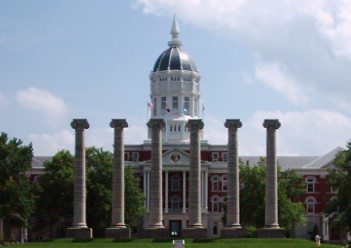
The city is built on the oak-forested hills and rolling prairies of Mid-Missouri, near the Missouri River, where the Ozark Mountains transition into plains and savanna. At the city's center is the Avenue of the Columns (8th Street), connecting Francis Quadrangle and Jesse Hall to the Boone County Courthouse and City Hall. Surrounding Columbia is a greenbelt including Rock Bridge Memorial State Park, Eagle Bluffs Conservation Area, the Mark Twain National Forest, Katy Trail State Park, Finger Lakes State Park, and the Big Muddy National Fish and Wildlife Refuge. Limestone bedrock forms bluffs and glades while rain dissolves the bedrock, creating karst (caves and springs) which water the Hinkson, Roche Perche, Flat Branch, and Bonne Femme creeks. Within city limits, there is an extensive city parks and trails system with a focus on non-motorized transportation, including the MKT Trail. The Columbia Agriculture Park is home to the nationally-regarded Columbia Farmers Market.
Originally an agricultural town, education and healthcare are now Columbia's primary economic concern, with secondary interests in the insurance, finance, and technology sectors. Companies founded in Columbia include: Paytient, Carfax, Shelter Insurance, Veterans United Home Loans, MFA Incorporated, MFA Oil, Slackers CDs and Games, MidwayUSA, EquipmentShare, and Scripps News. The University of Missouri Health Care system operates six hospitals in Columbia, several clinics, and the Thompson Center for Autism and Neurodevelopment. There is also the county-owned Boone Hospital Center, several smaller private hospitals, and the Harry S. Truman Memorial Veterans' Hospital, adjacent to University Hospital and MU School of Medicine. The University of Missouri nuclear reactor is the most-powerful research reactor in the United States and the sole supplier of important radioisotopes used in nuclear medicine.
Cultural institutions include the State Historical Society of Missouri, the Museum of Art and Archaeology, the Missouri Symphony, the North Village Arts District, The Blue Note, the Missouri Theatre, The Conservatory of the Performing Arts at Stephens College, the Boone County Historical Society, Columbia Public Library, Ragtag Cinema and the annual True/False Film Festival, an internationally-known documentary festival. The Missouri Tigers, the state's only major college athletic program, play football at Faurot Field and basketball at Mizzou Arena as members of the Southeastern Conference (SEC). The city has been known as the "Athens of Missouri" for its educational emphasis and classic beauty, but is more commonly called "CoMo".
Columbia's origins begin with the settlement of American pioneers from Kentucky and Virginia in an early 1800s region known as the Boonslick. Before 1815 settlement in the region was confined to small log forts due to the threat of Native American attack during the War of 1812. When the war ended settlers came on foot, horseback, and wagon, often moving entire households along the Boone's Lick Road and often bringing enslaved African Americans. By 1818 it was clear that the increased population would necessitate a new county be created from territorial Howard County. The Moniteau Creek on the west and Cedar Creek on the east were obvious natural boundaries.
Believing it was only a matter of time before a county seat was chosen, the Smithton Land Company was formed to purchase over 2,000 acres (8.1 km2) to establish the village of Smithton (near the present-day intersection of Walnut and Garth). In 1819 Smithton was a small cluster of log cabins in an ancient forest of oak and hickory; chief among them was the cabin of Richard Gentry, a trustee of the Smithton Company who would become first mayor of Columbia. In 1820, Boone County was formed and named after the recently deceased explorer Daniel Boone. The Missouri Legislature appointed John Gray, Jefferson Fulcher, Absalom Hicks, Lawrence Bass, and David Jackson as commissioners to select and establish a permanent county seat. Smithton never had more than twenty people, and it was quickly realized that well digging was difficult because of the bedrock.
Springs were discovered across the Flat Branch Creek, so in the spring of 1821 Columbia was laid out, and the inhabitants of Smithton moved their cabins to the new town. The first house in Columbia was built by Thomas Duly in 1820 at what became Fifth and Broadway. Columbia's permanence was ensured when it was chosen as county seat in 1821 and the Boone's Lick Road was rerouted down Broadway.
The roots of Columbia's three economic foundations—education, medicine, and insurance— can be traced to the city's incorporation in 1821. Original plans for the town set aside land for a state university. In 1833, Columbia Baptist Female College opened, which later became Stephens College. Columbia College, distinct from today's and later to become the University of Missouri, was founded in 1839. When the state legislature decided to establish a state university, Columbia raised three times as much money as any competing city, and James S. Rollins donated the land that is today the Francis Quadrangle. Soon other educational institutions were founded in Columbia, such as Christian Female College, the first college for women west of the Mississippi, which later became Columbia College.
Columbia, Missouri
Columbia is a city in Boone County, Missouri, United States, and its county seat. It was founded in 1821 and had a population of 126,254 as recorded in the 2020 United States census, making it the fourth-most populous city in Missouri. Columbia is a Midwestern college town, home to the University of Missouri, a major research institution also known as MU or Mizzou. In addition to the university and surrounding Downtown Columbia are Stephens College and Columbia College, giving the city its educational focus and nearly 40,000 college students. It is the principal city of the Columbia metropolitan area, population 215,811, and the central city of the nine-county Columbia–Jefferson City–Moberly combined statistical area with 415,747 residents. The city is the fastest-growing municipality in Missouri, with a growth of almost 40% since 2000, and a population estimated at 130,900 in 2024. Columbia is among the most-educated cities in the United States with about half of citizens being college graduates and about a quarter holding advance degrees.
The city is built on the oak-forested hills and rolling prairies of Mid-Missouri, near the Missouri River, where the Ozark Mountains transition into plains and savanna. At the city's center is the Avenue of the Columns (8th Street), connecting Francis Quadrangle and Jesse Hall to the Boone County Courthouse and City Hall. Surrounding Columbia is a greenbelt including Rock Bridge Memorial State Park, Eagle Bluffs Conservation Area, the Mark Twain National Forest, Katy Trail State Park, Finger Lakes State Park, and the Big Muddy National Fish and Wildlife Refuge. Limestone bedrock forms bluffs and glades while rain dissolves the bedrock, creating karst (caves and springs) which water the Hinkson, Roche Perche, Flat Branch, and Bonne Femme creeks. Within city limits, there is an extensive city parks and trails system with a focus on non-motorized transportation, including the MKT Trail. The Columbia Agriculture Park is home to the nationally-regarded Columbia Farmers Market.
Originally an agricultural town, education and healthcare are now Columbia's primary economic concern, with secondary interests in the insurance, finance, and technology sectors. Companies founded in Columbia include: Paytient, Carfax, Shelter Insurance, Veterans United Home Loans, MFA Incorporated, MFA Oil, Slackers CDs and Games, MidwayUSA, EquipmentShare, and Scripps News. The University of Missouri Health Care system operates six hospitals in Columbia, several clinics, and the Thompson Center for Autism and Neurodevelopment. There is also the county-owned Boone Hospital Center, several smaller private hospitals, and the Harry S. Truman Memorial Veterans' Hospital, adjacent to University Hospital and MU School of Medicine. The University of Missouri nuclear reactor is the most-powerful research reactor in the United States and the sole supplier of important radioisotopes used in nuclear medicine.
Cultural institutions include the State Historical Society of Missouri, the Museum of Art and Archaeology, the Missouri Symphony, the North Village Arts District, The Blue Note, the Missouri Theatre, The Conservatory of the Performing Arts at Stephens College, the Boone County Historical Society, Columbia Public Library, Ragtag Cinema and the annual True/False Film Festival, an internationally-known documentary festival. The Missouri Tigers, the state's only major college athletic program, play football at Faurot Field and basketball at Mizzou Arena as members of the Southeastern Conference (SEC). The city has been known as the "Athens of Missouri" for its educational emphasis and classic beauty, but is more commonly called "CoMo".
Columbia's origins begin with the settlement of American pioneers from Kentucky and Virginia in an early 1800s region known as the Boonslick. Before 1815 settlement in the region was confined to small log forts due to the threat of Native American attack during the War of 1812. When the war ended settlers came on foot, horseback, and wagon, often moving entire households along the Boone's Lick Road and often bringing enslaved African Americans. By 1818 it was clear that the increased population would necessitate a new county be created from territorial Howard County. The Moniteau Creek on the west and Cedar Creek on the east were obvious natural boundaries.
Believing it was only a matter of time before a county seat was chosen, the Smithton Land Company was formed to purchase over 2,000 acres (8.1 km2) to establish the village of Smithton (near the present-day intersection of Walnut and Garth). In 1819 Smithton was a small cluster of log cabins in an ancient forest of oak and hickory; chief among them was the cabin of Richard Gentry, a trustee of the Smithton Company who would become first mayor of Columbia. In 1820, Boone County was formed and named after the recently deceased explorer Daniel Boone. The Missouri Legislature appointed John Gray, Jefferson Fulcher, Absalom Hicks, Lawrence Bass, and David Jackson as commissioners to select and establish a permanent county seat. Smithton never had more than twenty people, and it was quickly realized that well digging was difficult because of the bedrock.
Springs were discovered across the Flat Branch Creek, so in the spring of 1821 Columbia was laid out, and the inhabitants of Smithton moved their cabins to the new town. The first house in Columbia was built by Thomas Duly in 1820 at what became Fifth and Broadway. Columbia's permanence was ensured when it was chosen as county seat in 1821 and the Boone's Lick Road was rerouted down Broadway.
The roots of Columbia's three economic foundations—education, medicine, and insurance— can be traced to the city's incorporation in 1821. Original plans for the town set aside land for a state university. In 1833, Columbia Baptist Female College opened, which later became Stephens College. Columbia College, distinct from today's and later to become the University of Missouri, was founded in 1839. When the state legislature decided to establish a state university, Columbia raised three times as much money as any competing city, and James S. Rollins donated the land that is today the Francis Quadrangle. Soon other educational institutions were founded in Columbia, such as Christian Female College, the first college for women west of the Mississippi, which later became Columbia College.
Recent media
Recent media