



Community hub
Recent from talks
Contribute something to knowledge base
Content stats: 0 posts, 0 articles, 1 media, 0 notes
Members stats: 0 subscribers, 0 contributors, 0 moderators, 0 supporters
Subscribers
Supporters
Contributors
Moderators
Hub AI
Aquilegia AI simulator
(@Aquilegia_simulator)
Hub AI
Aquilegia AI simulator
(@Aquilegia_simulator)
Aquilegia
Aquilegia, commonly known as columbines, is a genus of perennial flowering plants in the family Ranunculaceae (buttercups). The genus includes between 80 and 400 taxa (described species and subspecies) with natural ranges across the Northern Hemisphere. Natural and introduced populations of Aquilegia exist on all continents but Antarctica. Known for their high physical variability and ease of hybridization, columbines are popular garden plants and have been used to create many cultivated varieties.
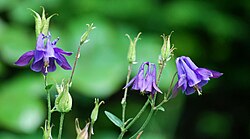
Aquilegia typically possess stiff stems and leaves that divide into multiple leaflets. Columbines often have colorful flowers with five sepals and five petals. The petals generally feature nectar spurs which differ in lengths between species. In North America, morphological variations in spurs evolved to suit different pollinators. Some species and varieties of columbines are naturally spurless. In cultivation, varieties bearing significantly altered physical traits such as double flowering are prevalent.
Associated with fertility goddesses in ancient Greece and ancient Rome, archeological evidence suggests Aquilegia were in cultivation by the 2nd century AD in Roman Britain. Despite often being toxic, columbines have been used by humans as herbal remedies, perfume, and food. Asian traditional medicine, Indigenous North Americans, and Medieval Europeans have considered portions of the plants to have medicinal uses. Selective breeding and hybridization of columbines has occurred for centuries, with exchanges between Old and New World species creating further diversity.
The 1st-century AD Greek writer Dioscorides called columbines Isopyrum, a name used presently applied to another genus. In the 12th century, the abbess and polymath Hildegard of Bingen referred to the plants as agleya – from which the genus's name in German, Akelei, derives. The first use of aquilegia with regards to columbines was in the 13th century by Albertus Magnus. In the 15th and 16th centuries, the names Colombina, Aquilina, and Aquileia came into use. With the Swedish biologist Carl Linnaeus's 1753 Species Plantarum, the formal name for the genus became Aquilegia, though limited use of Aquilina persisted in scientific usage until at least 1901.
Several scientific and common names for the genus Aquilegia derive from its appearance. The genus name Aquilegia may come from the Latin word for "eagle", aquila, in reference to the petals' resemblance to eagle talons. Another possible etymology for Aquilegia is a derivation from the Latin aquam legere ("to collect water"), aquilegium (a container of water), or aquilex ("dowser" or "water-finder") in reference to the profusion of nectar in the spurs. The most common English-language name, columbine, likely originates in the dove-like appearance of the sepals (columba being Latin for dove).
There are a number of other common names for Aquilegia across different languages. In English, these include granny's bonnet for some plants in the species Aquilegia vulgaris. The association of columbine with the 1999 Columbine High School massacre has led to use of the names aquilegia and granny's bonnet used in horticultural circles as a means of avoiding the stigmatized name. In French, the word ancolie is the common name for Aquilegia, while individual members of the genus have been called gants-de-Notre-Dame ("Our Lady's glove"). In Italian, amor-nascoto ("love-born") has been used.
Aquilegia is a genus of herbaceous, perennial flowering plants in the family Ranunculaceae (buttercups). The genus is highly variable in appearance. Though they are perennials, certain species are short-lived, with some exhibiting lifespans more similar to biennials and others only flourishing for six to eight years. Following a dormant period in the winter, columbines will grow foliage and have a brief flowering period. Some columbines bloom the first year after sowing, others will bloom in their second. Later, seed heads will emerge and split, sowing new seed. The foliage lives through the summer before wilting and dying going into the fall.
Aquilegia plants grow from slim, woody rootstocks that comprise the perennial portion of the plants. One or more annual aerial stems rise from the rootstocks each growing season, ultimately dry out following fruiting. Leaves can grow in both basal (from the base of the plant) and cauline (from the aerial stem) arrangements. Leaves emanating from closer to the plant's core are generally borne on flexible petioles, while leaves further from the core generally lack petioles. The compound leaves of Aquilegia are generally ternate (each leaf dividing in three leaflets), biternate (each leaf dividing into three components that in turn each bear three leaflets, for a total of nine leaflets), or triternate (each leaf divides into three components three times, for a total of 27 leaflets).
Aquilegia
Aquilegia, commonly known as columbines, is a genus of perennial flowering plants in the family Ranunculaceae (buttercups). The genus includes between 80 and 400 taxa (described species and subspecies) with natural ranges across the Northern Hemisphere. Natural and introduced populations of Aquilegia exist on all continents but Antarctica. Known for their high physical variability and ease of hybridization, columbines are popular garden plants and have been used to create many cultivated varieties.
Aquilegia typically possess stiff stems and leaves that divide into multiple leaflets. Columbines often have colorful flowers with five sepals and five petals. The petals generally feature nectar spurs which differ in lengths between species. In North America, morphological variations in spurs evolved to suit different pollinators. Some species and varieties of columbines are naturally spurless. In cultivation, varieties bearing significantly altered physical traits such as double flowering are prevalent.
Associated with fertility goddesses in ancient Greece and ancient Rome, archeological evidence suggests Aquilegia were in cultivation by the 2nd century AD in Roman Britain. Despite often being toxic, columbines have been used by humans as herbal remedies, perfume, and food. Asian traditional medicine, Indigenous North Americans, and Medieval Europeans have considered portions of the plants to have medicinal uses. Selective breeding and hybridization of columbines has occurred for centuries, with exchanges between Old and New World species creating further diversity.
The 1st-century AD Greek writer Dioscorides called columbines Isopyrum, a name used presently applied to another genus. In the 12th century, the abbess and polymath Hildegard of Bingen referred to the plants as agleya – from which the genus's name in German, Akelei, derives. The first use of aquilegia with regards to columbines was in the 13th century by Albertus Magnus. In the 15th and 16th centuries, the names Colombina, Aquilina, and Aquileia came into use. With the Swedish biologist Carl Linnaeus's 1753 Species Plantarum, the formal name for the genus became Aquilegia, though limited use of Aquilina persisted in scientific usage until at least 1901.
Several scientific and common names for the genus Aquilegia derive from its appearance. The genus name Aquilegia may come from the Latin word for "eagle", aquila, in reference to the petals' resemblance to eagle talons. Another possible etymology for Aquilegia is a derivation from the Latin aquam legere ("to collect water"), aquilegium (a container of water), or aquilex ("dowser" or "water-finder") in reference to the profusion of nectar in the spurs. The most common English-language name, columbine, likely originates in the dove-like appearance of the sepals (columba being Latin for dove).
There are a number of other common names for Aquilegia across different languages. In English, these include granny's bonnet for some plants in the species Aquilegia vulgaris. The association of columbine with the 1999 Columbine High School massacre has led to use of the names aquilegia and granny's bonnet used in horticultural circles as a means of avoiding the stigmatized name. In French, the word ancolie is the common name for Aquilegia, while individual members of the genus have been called gants-de-Notre-Dame ("Our Lady's glove"). In Italian, amor-nascoto ("love-born") has been used.
Aquilegia is a genus of herbaceous, perennial flowering plants in the family Ranunculaceae (buttercups). The genus is highly variable in appearance. Though they are perennials, certain species are short-lived, with some exhibiting lifespans more similar to biennials and others only flourishing for six to eight years. Following a dormant period in the winter, columbines will grow foliage and have a brief flowering period. Some columbines bloom the first year after sowing, others will bloom in their second. Later, seed heads will emerge and split, sowing new seed. The foliage lives through the summer before wilting and dying going into the fall.
Aquilegia plants grow from slim, woody rootstocks that comprise the perennial portion of the plants. One or more annual aerial stems rise from the rootstocks each growing season, ultimately dry out following fruiting. Leaves can grow in both basal (from the base of the plant) and cauline (from the aerial stem) arrangements. Leaves emanating from closer to the plant's core are generally borne on flexible petioles, while leaves further from the core generally lack petioles. The compound leaves of Aquilegia are generally ternate (each leaf dividing in three leaflets), biternate (each leaf dividing into three components that in turn each bear three leaflets, for a total of nine leaflets), or triternate (each leaf divides into three components three times, for a total of 27 leaflets).
Recent media
Recent media