Hubbry Logo
logo
Column chromatography
Community hub

Column chromatography

logo
0 subscribers
Read side by side
from Wikipedia
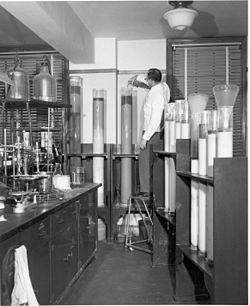
A chemist in the 1950s using column chromatography. The Erlenmeyer receptacles are on the floor.

Column chromatography in chemistry is a chromatography method used to isolate a single chemical compound from a mixture. Chromatography is able to separate substances based on differential absorption of compounds to the adsorbent; compounds move through the column at different rates, allowing them to be separated into fractions. The technique is widely applicable, as many different adsorbents (normal phase, reversed phase, or otherwise) can be used with a wide range of solvents. The technique can be used on scales from micrograms up to kilograms. The main advantage of column chromatography is the relatively low cost and disposability of the stationary phase used in the process. The latter prevents cross-contamination and stationary phase degradation due to recycling. Column chromatography can be done using gravity to move the solvent, or using compressed gas to push the solvent through the column.

A thin-layer chromatography can show how a mixture of compounds will behave when purified by column chromatography. The separation is first optimised using thin-layer chromatography before performing column chromatography.

Column preparation

[edit]

A column is prepared by packing a solid adsorbent into a cylindrical glass or plastic tube. The size will depend on the amount of compound being isolated. The base of the tube contains a filter, either a cotton or glass wool plug, or glass frit to hold the solid phase in place. A solvent reservoir may be attached at the top of the column.

Two methods are generally used to prepare a column: the dry method and the wet method. For the dry method, the column is first filled with dry stationary phase powder, followed by the addition of mobile phase, which is flushed through the column until it is completely wet, and from this point is never allowed to run dry.[1] For the wet method, a slurry is prepared of the eluent with the stationary phase powder and then carefully poured into the column. The top of the silica should be flat, and the top of the silica can be protected by a layer of sand. Eluent is slowly passed through the column to advance the organic material.

The individual components are retained by the stationary phase differently and separate from each other while they are running at different speeds through the column with the eluent. At the end of the column they elute one at a time. During the entire chromatography process the eluent is collected in a series of fractions. Fractions can be collected automatically by means of fraction collectors. The productivity of chromatography can be increased by running several columns at a time. In this case multi stream collectors are used. The composition of the eluent flow can be monitored and each fraction is analyzed for dissolved compounds, e.g. by analytical chromatography, UV absorption spectra, or fluorescence. Colored compounds (or fluorescent compounds with the aid of a UV lamp) can be seen through the glass wall as moving bands.

Stationary phase

[edit]
Automated fraction collector and sampler for chromatography techniques

The stationary phase or adsorbent in column chromatography is a solid. The most common stationary phase for column chromatography is silica gel, the next most common being alumina. Cellulose powder has often been used in the past. A wide range of stationary phases are available in order to perform ion exchange chromatography, reversed-phase chromatography (RP), affinity chromatography or expanded bed adsorption (EBA). The stationary phases are usually finely ground powders or gels and/or are microporous for an increased surface, though in EBA a fluidized bed is used. There is an important ratio between the stationary phase weight and the dry weight of the analyte mixture that can be applied onto the column. For silica column chromatography, this ratio lies within 20:1 to 100:1, depending on how close to each other the analyte components are being eluted.[2]

Mobile phase (eluent)

[edit]
Column chromatography proceeds by a series of steps.

The mobile phase or eluent is a solvent or a mixture of solvents used to move the compounds through the column. It is chosen so that the retention factor value of the compound of interest is roughly around 0.2 - 0.3 in order to minimize the time and the amount of eluent to run the chromatography. The eluent has also been chosen so that the different compounds can be separated effectively. The eluent is optimized in small scale pretests, often using thin layer chromatography (TLC) with the same stationary phase, using solvents of different polarity until a suitable solvent system is found. Common mobile phase solvents, in order of increasing polarity, include hexane, dichloromethane, ethyl acetate, acetone, and methanol.[3] A common solvent system is a mixture of hexane and ethyl acetate, with proportions adjusted until the target compound has a retention factor of 0.2 - 0.3. Contrary to common misconception, methanol alone can be used as an eluent for highly polar compounds, and does not dissolve silica gel.

There is an optimum flow rate for each particular separation. A faster flow rate of the eluent minimizes the time required to run a column and thereby minimizes diffusion, resulting in a better separation. However, the maximum flow rate is limited because a finite time is required for the analyte to equilibrate between the stationary phase and mobile phase, see Van Deemter's equation. A simple laboratory column runs by gravity flow. The flow rate of such a column can be increased by extending the fresh eluent filled column above the top of the stationary phase or decreased by the tap controls. Faster flow rates can be achieved by using a pump or by using compressed gas (e.g. air, nitrogen, or argon) to push the solvent through the column (flash column chromatography).[4][5]

Photographic sequence of a column chromatography

The particle size of the stationary phase is generally finer in flash column chromatography than in gravity column chromatography. For example, one of the most widely used silica gel grades in the former technique is mesh 230 – 400 (40 – 63 μm), while the latter technique typically requires mesh 70 – 230 (63 – 200 μm) silica gel.[6]

A spreadsheet that assists in the successful development of flash columns has been developed. The spreadsheet estimates the retention volume and band volume of analytes, the fraction numbers expected to contain each analyte, and the resolution between adjacent peaks. This information allows users to select optimal parameters for preparative-scale separations before the flash column itself is attempted.[7]

Automated systems

[edit]
An automated ion chromatography system.

Column chromatography is an extremely time-consuming stage in any lab and can quickly become the bottleneck for any process lab. Many manufacturers like Biotage, Buchi, Interchim and Teledyne Isco have developed automated flash chromatography systems (typically referred to as LPLC, low pressure liquid chromatography, around 350–525 kPa or 50.8–76.1 psi) that minimize human involvement in the purification process. Automated systems will include components normally found on more expensive high performance liquid chromatography (HPLC) systems such as a gradient pump, sample injection ports, a UV detector and a fraction collector to collect the eluent. Typically these automated systems can separate samples from a few milligrams up to an industrial many kilogram scale and offer a much cheaper and quicker solution to doing multiple injections on prep-HPLC systems.

The resolution (or the ability to separate a mixture) on an LPLC system will always be lower compared to HPLC, as the packing material in an HPLC column can be much smaller, typically only 5 micrometre thus increasing stationary phase surface area, increasing surface interactions and giving better separation. However, the use of this small packing media causes the high back pressure and is why it is termed high pressure liquid chromatography. The LPLC columns are typically packed with silica of around 50 micrometres, thus reducing back pressure and resolution, but it also removes the need for expensive high pressure pumps. Manufacturers are now starting to move into higher pressure flash chromatography systems and have termed these as medium pressure liquid chromatography (MPLC) systems which operate above 1 MPa (150 psi).

Column chromatogram resolution calculation

[edit]
Powdery silica gel for column chromatography

Typically, column chromatography is set up with peristaltic pumps, flowing buffers and the solution sample through the top of the column. The solutions and buffers pass through the column where a fraction collector at the end of the column setup collects the eluted samples. Prior to the fraction collection, the samples that are eluted from the column pass through a detector such as a spectrophotometer or mass spectrometer so that the concentration of the separated samples in the sample solution mixture can be determined.

For example, if you were to separate two different proteins with different binding capacities to the column from a solution sample, a good type of detector would be a spectrophotometer using a wavelength of 280 nm. The higher the concentration of protein that passes through the eluted solution through the column, the higher the absorbance of that wavelength.

Because the column chromatography has a constant flow of eluted solution passing through the detector at varying concentrations, the detector must plot the concentration of the eluted sample over a course of time. This plot of sample concentration versus time is called a chromatogram.

The ultimate goal of chromatography is to separate different components from a solution mixture. The resolution expresses the extent of separation between the components from the mixture. The higher the resolution of the chromatogram, the better the extent of separation of the samples the column gives. This data is a good way of determining the column's separation properties of that particular sample. The resolution can be calculated from the chromatogram.

The separate curves in the diagram represent different sample elution concentration profiles over time based on their affinity to the column resin. To calculate resolution, the retention time and curve width are required.

Retention time is the time from the start of signal detection by the detector to the peak height of the elution concentration profile of each different sample.

Curve width is the width of the concentration profile curve of the different samples in the chromatogram in units of time.

A simplified method of calculating chromatogram resolution is to use the plate model.[8] The plate model assumes that the column can be divided into a certain number of sections, or plates and the mass balance can be calculated for each individual plate. This approach approximates a typical chromatogram curve as a Gaussian distribution curve. By doing this, the curve width is estimated as 4 times the standard deviation of the curve, 4σ. The retention time is the time from the start of signal detection to the time of the peak height of the Gaussian curve.

From the variables in the figure above, the resolution, plate number, and plate height of the column plate model can be calculated using the equations:

Resolution (Rs):

Rs = 2(tRB – tRA)/(wB + wA),

where:

tRB = retention time of solute B
tRA = retention time of solute A
wB = Gaussian curve width of solute B
wA = Gaussian curve width of solute A

Plate Number (N):

N = (tR)2/(w/4)2

Plate Height (H):

H = L/N

where L is the length of the column.[8]

Column adsorption equilibrium

[edit]

For an adsorption column, the column resin (the stationary phase) is composed of microbeads. Even smaller particles such as proteins, carbohydrates, metal ions, or other chemical compounds are conjugated onto the microbeads. Each binding particle that is attached to the microbead can be assumed to bind in a 1:1 ratio with the solute sample sent through the column that needs to be purified or separated.

Binding between the target molecule to be separated and the binding molecule on the column beads can be modeled using a simple equilibrium reaction Keq = [CS]/([C][S]) where Keq is the equilibrium constant, [C] and [S] are the concentrations of the target molecule and the binding molecule on the column resin, respectively. [CS] is the concentration of the complex of the target molecule bound to the column resin.[8]

Using this as a basis, three different isotherms can be used to describe the binding dynamics of a column chromatography: linear, Langmuir, and Freundlich.

The linear isotherm occurs when the solute concentration needed to be purified is very small relative to the binding molecule. Thus, the equilibrium can be defined as:

[CS] = Keq[C].

For industrial scale uses, the total binding molecules on the column resin beads must be factored in because unoccupied sites must be taken into account. The Langmuir isotherm and Freundlich isotherm are useful in describing this equilibrium. The Langmuir isotherm is given by:

[CS] = (KeqStot[C])/(1 + Keq[C]), where Stot is the total binding molecules on the beads.

The Freundlich isotherm is given by:

[CS] = Keq[C]1/n

The Freundlich isotherm is used when the column can bind to many different samples in the solution that needs to be purified. Because the many different samples have different binding constants to the beads, there are many different Keqs. Therefore, the Langmuir isotherm is not a good model for binding in this case.[8]

See also

[edit]

References

[edit]
[edit]
Revisions and contributorsEdit on WikipediaRead on Wikipedia
from Grokipedia
Column chromatography is a fundamental separation technique in analytical chemistry used to isolate and purify components of a complex mixture by passing a mobile phase (typically a liquid or gas) through a stationary phase packed into a vertical column, where components separate based on their differing affinities for the two phases.[1] Invented by Russian botanist Mikhail Tswett in 1903 during his studies on plant pigments, the method involves adsorbing the mixture onto a column of powdered adsorbent material, such as calcium carbonate, and eluting with a nonpolar solvent like petroleum ether to produce colored bands representing separated chlorophyll derivatives.[2] This technique, originally termed "chromatography" from the Greek words for "color" and "writing" due to the visible pigment bands, laid the foundation for modern chromatographic methods and remains widely employed for both preparative and analytical purposes.[2] The core principle of column chromatography relies on the differential partitioning or adsorption of mixture components between the stationary phase—often silica gel, alumina, or resin beads immobilized in the column—and the mobile phase, which carries the sample through the column under gravity, pressure, or centrifugation.[1] Separation efficiency depends on factors such as the column's length and diameter, particle size of the stationary phase (typically 40–200 μm for classical columns), flow rate of the mobile phase, and the chemical properties of the analytes, including polarity, charge, size, and hydrophobicity.[1] As the mixture travels down the column, components with stronger interactions with the stationary phase elute more slowly, resulting in distinct fractions that can be collected and analyzed.[3] Column chromatography encompasses several variants tailored to specific separation needs, including normal-phase chromatography, where a polar stationary phase (e.g., silica) retains polar analytes longer in a nonpolar mobile phase; reversed-phase chromatography, utilizing a nonpolar stationary phase (e.g., C18-modified silica) with a polar mobile phase like water-methanol mixtures for hydrophobic separations; ion-exchange chromatography, which separates based on charge interactions with charged resins; size-exclusion chromatography, relying on molecular size to navigate porous beads; and affinity chromatography, exploiting specific biological binding for targeted purification.[1] Each type optimizes selectivity and resolution, with modern high-performance variants (e.g., HPLC columns) using smaller particles (under 10 μm) and pressurized systems for faster, higher-resolution separations.[2] Applications of column chromatography span organic synthesis, biochemistry, pharmaceuticals, and environmental analysis, including the purification of reaction products in drug development, isolation of proteins and nucleic acids for research, quantification of metabolites in clinical diagnostics, and detection of pollutants like polycyclic aromatic hydrocarbons in soil samples.[3] In preparative scales, it enables gram-to-kilogram isolation of natural products, while analytical scales support quality control in industries by ensuring compound purity and potency.[1] Ongoing advancements, such as automated systems and novel stationary phases, continue to enhance its versatility and efficiency in laboratory settings.[2]

Principles and History

Basic Principles

Column chromatography is a fundamental separation technique used to purify and isolate components from complex mixtures by passing a liquid mobile phase through a vertical column packed with a solid or liquid-coated stationary phase. The sample, containing the mixture of analytes, is introduced at the top of the column, where it interacts differentially with the stationary phase based on physical and chemical properties such as polarity, size, charge, or affinity. This differential interaction leads to the separation of analytes as they travel through the column at varying speeds, with those having stronger affinities for the stationary phase moving more slowly.[1] The core principle of separation relies on the partitioning of analytes between the stationary phase and the mobile phase, governed by mechanisms such as adsorption, where molecules adhere to the surface of the stationary phase via forces like van der Waals interactions or hydrogen bonding; partition, based on solubility differences between the two phases; or ion-exchange, involving electrostatic attractions between charged analytes and oppositely charged sites on the stationary phase. Retention time, defined as the duration an analyte spends in the column before eluting, is unique to each component and determined by its relative affinity for the stationary phase versus its solubility in the mobile phase, resulting in an elution order where less retained compounds exit first. The mobile phase is driven through the column primarily by gravity in classical setups, though pressure may be applied in modern variants to accelerate flow.[1][3] In a typical setup, the column consists of a glass or metal tube fitted with a porous frit at the bottom to retain the stationary phase, into which the sample is injected as a concentrated solution or adsorbed onto the column top; fractions of the eluate are then collected sequentially at the outlet for further analysis or use. This process enables the isolation of pure compounds from mixtures, with applications spanning the purification of natural products, such as plant extracts for bioactive compounds, and pharmaceuticals, where it ensures drug substance homogeneity by removing impurities.[1][3]

Historical Development

Column chromatography originated with the work of Russian-Italian botanist Mikhail Tswett, who in 1903 developed the technique of adsorption chromatography using a glass column packed with calcium carbonate to separate plant pigments into colored bands, coining the term "chromatography" from the Greek words for "color" and "to write."[4] Tswett first publicly described his method in a 1903 lecture in Warsaw, demonstrating its application to isolate chlorophyll and other leaf pigments, though it received limited attention initially due to prevailing chemical paradigms favoring crystallization over such physical separations.[5] This foundational invention laid the groundwork for column-based separations, distinguishing it from earlier dye migration experiments by enabling controlled, reproducible fractionations. The technique experienced a revival in the 1930s through contributions from Russian and German scientists, who expanded its applications beyond botany into organic chemistry. In Germany, Richard Kuhn and his collaborators employed adsorption columns to isolate carotenoids, demonstrating chromatography's utility for purifying complex natural products. Meanwhile, Paul Karrer used adsorption chromatography on alumina to purify vitamin A extracts from fish liver oils.[6] Russian researchers, building on Tswett's legacy, refined column designs for broader analyte separations, while German groups like that of László Zechmeister advanced theoretical understanding through systematic studies of adsorbent selectivity.[6] These efforts marked chromatography's transition from a niche botanical tool to a versatile analytical method. Mid-20th-century advancements came with the 1941 invention of partition chromatography by Archer J.P. Martin and Richard L.M. Synge, who utilized silica gel impregnated with water as the stationary phase and an organic solvent as the mobile phase to separate amino acids based on partitioning rather than adsorption alone.[7] Their innovation, detailed in foundational papers, dramatically improved resolution and efficiency, earning them the 1952 Nobel Prize in Chemistry.[8] Post-World War II expansions included the 1940s development of ion-exchange chromatography, pioneered by Robert Kunin through synthetic resins that enabled selective separations of ions, as outlined in his seminal 1950 monograph on ion-exchange materials.[9] In 1959, Jerker Porath and Per Flodin introduced gel filtration, a size-exclusion variant using cross-linked dextran gels to separate biomolecules by molecular size without chemical interactions.[10] By the 1960s, column chromatography evolved from gravity-fed systems to pressure-driven formats, precursors to high-performance liquid chromatography (HPLC), with early instrumental pumps and detectors enhancing speed and sensitivity for industrial applications like polymer analysis.[11] The 1970s saw standardization of normal-phase (polar stationary phase, nonpolar mobile phase) and reversed-phase (nonpolar stationary phase, polar mobile phase) methods, driven by chemically bonded silica phases that improved stability and reproducibility, making reversed-phase the dominant mode for diverse analytes by decade's end.[12]

Components and Setup

Stationary Phase

The stationary phase in column chromatography is the fixed component within the column that selectively retains analytes through mechanisms such as adsorption, partition, or ion exchange, enabling their separation based on differential interactions.[13] It typically consists of a solid support, often coated with a liquid or chemically modified, and serves as the medium where analytes pause or slow down relative to the mobile phase flow.[14] Common types of stationary phases are selected based on the desired separation mode. In normal-phase chromatography, polar materials like silica gel and alumina are widely used; silica gel, with its silanol groups, provides strong adsorption for polar analytes, while alumina, being slightly basic, favors retention of acidic compounds.[13] [14] For reverse-phase separations, non-polar phases such as C18-modified silica are employed, where hydrophobic alkyl chains on a silica support interact with non-polar analytes.[13] Ion-exchange resins, including strong acid cation exchangers (e.g., sulfonic acid-functionalized polystyrene) and strong base anion exchangers (e.g., quaternary ammonium groups), facilitate separation of charged species based on electrostatic interactions.[15] Size-exclusion gels, such as Sephadex (cross-linked dextran), separate molecules by hydrodynamic volume without specific chemical interactions, ideal for biomolecules like proteins.[16] Chiral stationary phases, exemplified by cellulose derivatives immobilized on silica, enable enantiomer separations through stereoselective binding.[13] Key properties influencing stationary phase selection include particle size, surface area, chemical stability, and selectivity. Particle sizes typically range from 40–250 μm in classical columns, with smaller sizes (e.g., 1.5–5 μm in high-performance variants) enhancing resolution by increasing the number of theoretical plates, though they elevate column pressure inversely proportional to the square of the particle diameter.[13] [17] High surface areas, such as 200–500 m²/g for silica, promote greater analyte interaction sites for improved selectivity toward specific classes like polar or ionic compounds.[13] Chemical stability varies by type—silica withstands pH 2–8, while polymer-based phases like poly(styrene-divinylbenzene) offer broader pH tolerance and mechanical robustness.[13] Preparation of the stationary phase involves activation to optimize adsorptive properties and slurry packing into the column. For silica gel, activation often entails acid or base treatment followed by drying at elevated temperatures (e.g., 150°C) to remove adsorbed water and expose active sites.[13] Alumina is activated by heating to grades like neutral, basic, or acidic, enhancing its selectivity for particular analytes.[18] Ion-exchange and chiral phases require functionalization of supports (e.g., grafting ionic or selector groups onto silica) before slurry suspension in a solvent for packing under pressure to ensure uniform bed density.[13] Common supports include silica particles or cross-linked polymers, with glass beads occasionally used for low-interaction applications. Representative examples illustrate practical applications: activated charcoal serves as a stationary phase for decolorization in purification columns due to its high adsorptive capacity for impurities, while Sephadex gels are routinely used for desalting proteins via size exclusion.[19] Chiral phases like those coated with polysaccharide derivatives have been pivotal in resolving enantiomers in pharmaceutical analysis.[13] These choices ensure compatibility with analyte-mobile phase interactions for effective separations.[13]

Mobile Phase

In column chromatography, the mobile phase is a liquid solvent or solvent mixture that flows through the stationary phase, dissolving the sample components and transporting them along the column based on their relative solubilities and interactions. This movement enables the differential elution of analytes, where more soluble components travel faster and emerge earlier.[20] The primary function of the mobile phase is to act as the carrier that facilitates separation by continuously renewing the equilibrium between the dissolved and adsorbed states of the analytes, without directly altering the stationary phase itself.[21] Selection of the mobile phase depends on the polarity and chemical nature of the analytes, ensuring compatibility with the intended separation mode. For non-polar compounds, non-polar organic solvents such as hexane or petroleum ether are commonly used, as they effectively dissolve and elute hydrophobic molecules like lipids.[22] In contrast, polar or ionic analytes, such as proteins, require aqueous buffers like sodium acetate (e.g., 10-50 mM at pH 4-6) to maintain solubility and prevent denaturation while promoting selective elution.[23] Gradient elution involves progressively changing the composition, such as increasing the proportion of methanol in water from 5% to 95% over time, to handle samples with a wide range of polarities and improve resolution for complex mixtures.[20] Key properties of the mobile phase influence its performance and practicality. Polarity is critical, with non-polar solvents (e.g., polarity index P' ≈ 0.1 for hexane) suited for normal-phase separations and polar ones (e.g., P' ≈ 10.2 for water) for reversed-phase, directly affecting analyte solubility and migration speed.[20] Viscosity impacts flow resistance, where lower-viscosity solvents like acetonitrile (0.38 cP at 15°C) allow higher flow rates compared to more viscous options like ethanol (1.2 cP), reducing separation time without excessive pressure buildup.[20] Volatility and toxicity must also be considered; highly volatile solvents (e.g., boiling point 81.6°C for acetonitrile) aid in post-elution handling but require ventilation due to flammability risks, while toxic options like chloroform are minimized in favor of safer alternatives.[20] Optimization of the mobile phase focuses on elution efficiency and reproducibility. Isocratic elution uses a fixed composition for simpler separations, maintaining consistent conditions, whereas gradient modes enhance desorption by gradually increasing solvent strength to desorb tightly bound analytes.[20] Flow rates are typically controlled between 0.1 and 5 mL/min via gravity or pumps, balancing speed with resolution—lower rates (e.g., 0.5 mL/min) for analytical precision and higher for preparative scale.[20] These adjustments ensure optimal partitioning, where the mobile phase's solvating power promotes analyte release from the stationary phase surface.

Column Preparation

Column preparation involves assembling the chromatography column with the stationary phase to create a uniform packed bed that ensures efficient separation. This process is critical for achieving reproducible results, as irregularities in the packing can lead to poor resolution or uneven flow. Columns are typically constructed from glass, stainless steel, or plastic materials, with lengths ranging from 1 to 100 cm and inner diameters of 0.5 to 5 cm, depending on the scale of the separation—analytical runs often use shorter beds of 10-20 cm height. To retain the packing, the column bottom is fitted with frits, porous disks, or plugs such as cotton wool or glass wool, while sand layers may be added for additional support in gravity-fed systems. Two primary packing methods are employed: dry packing and wet slurry packing. In dry packing, the stationary phase is added directly to the empty column and settled using vibration or tapping before introducing the mobile phase, which is suitable for low-pressure applications. Wet slurry packing, more common for high-performance setups, involves suspending the stationary phase in the mobile phase at a concentration of 50-60% to form a pourable mixture, which is then introduced under gentle pressure to form a dense, uniform bed. The choice depends on the particle size of the stationary phase and the desired efficiency, with slurry methods preferred for finer particles to minimize voids. The step-by-step process begins with thorough cleaning of the column: rinse it with water followed by acetone or another solvent, then dry it in a fume hood to remove contaminants. Next, weigh the required amount of stationary phase—typically calculated based on the sample load and desired bed height—and insert the bottom plug or frit securely using a rod, ensuring it does not impede flow. Add a thin layer of sand (1-2 cm) above the plug to create an even base. For slurry packing, partially fill the column (about one-third) with mobile phase, prepare the slurry by gradually adding the stationary phase to 1.5 times its volume of solvent in a beaker while swirling, then pour the mixture into the column through a funnel to avoid disturbing the base layer. Tap the column sides gently with a mallet or use vibration to settle the particles evenly, repeating pours as needed until the desired bed height is reached. Rinse the column walls with additional mobile phase to dislodge any clinging particles, then add a thin top layer of sand (2-3 mm) to protect the bed surface. Finally, equilibrate the column by flowing 5-6 column volumes of mobile phase through it at the operating flow rate, closing the stopcock just above the bed level to prevent drying. To achieve a uniform bed and avoid troubleshooting issues, monitor for voids or channeling—regions of uneven packing that cause irregular flow—by observing the solvent front during initial equilibration; if cracks appear, repack the column. Gentle tapping during packing helps consolidate the bed without compressing it excessively, and bed height should be adjusted to 10-20 cm for most analytical separations to balance resolution and time. Pressure should not exceed the column's limits, typically 1-5 bar for glass columns in low-pressure systems. Safety considerations are paramount during preparation, as volatile solvents can release harmful vapors; all steps involving solvents must be performed in a fume hood with appropriate personal protective equipment. For pressurized packing in stainless steel or HPLC columns, adhere to manufacturer-specified pressure limits (often up to 400 bar) to prevent rupture, and handle fine stationary phase particles carefully to avoid inhalation, as they can be irritants.

Operation and Techniques

Manual Operation

Manual column chromatography relies on gravity or low-pressure flow to separate compounds based on their differential affinities for the stationary and mobile phases, typically performed without automated equipment. The process begins after the column has been prepared with a stationary phase such as silica gel or alumina, and a suitable mobile phase solvent system has been selected, often guided by thin-layer chromatography (TLC) to ensure appropriate separation.[24][14] The procedure starts with sample preparation and loading. The sample, typically a mixture of compounds, is dissolved in a minimal volume of solvent compatible with the mobile phase, aiming for a sample mass that is 1-5% of the stationary phase mass to avoid overloading and band broadening.[25] This solution is carefully layered onto the top of the stationary phase using a pipette, allowing the solvent to drain just below the surface without disturbing the packed bed; for drier loading, the sample can be pre-adsorbed onto a small amount of silica and added as a powder.[24] The stopcock at the column base is then opened to initiate gravity-driven elution, with the mobile phase added gradually to maintain a consistent flow rate of about 1-2 drops per second, adjustable by partially closing the stopcock if needed.[26][14] Progress is monitored visually for colored bands or by collecting small aliquots for TLC analysis every few fractions to track compound migration.[24] Fraction collection follows as the eluent exits the column. Fractions are gathered in test tubes or vials, typically 5-10 mL each, depending on the column size and expected resolution, with the volume chosen to capture distinct bands without excessive dilution.[26][24] Collectors label tubes sequentially and may mark the appearance of colored bands or changes in eluent properties; TLC is used to identify pure fractions, which are then combined and concentrated via rotary evaporation.[14] Solvent polarity is increased stepwise (e.g., from hexane to ethyl acetate/hexane mixtures) as needed to elute more polar components.[26] Optimization enhances efficiency and yield. The sample must be layered evenly to prevent channeling, and excess eluent can be recycled if uncontaminated; for larger preparative runs, columns up to kilogram scales are feasible by increasing diameter and bed height while maintaining linear flow rates.[24][14] A silica-to-sample mass ratio of 20:1 to 100:1 is recommended, with taller columns (e.g., 6-7 inches of stationary phase) for better resolution of closely related compounds.[24] This method offers advantages such as low cost—requiring only basic glassware and solvents—and simplicity, making it ideal for teaching laboratories or small-scale purifications under 1 gram.[24][26] However, limitations include slow flow rates, often taking hours to days for completion, and reliance on manual monitoring, which can lead to inconsistencies without experience.[14][24] An example workflow involves separating pigments from spinach extracts for bioassay. The crude extract is dissolved in hexane, loaded onto an alumina column, and eluted first with hexane to collect yellow carotene fractions (5-10 mL each), followed by acetone for green chlorophyll bands, with TLC confirming purity before combining for further analysis.[27][14]

Automated Systems

Automated systems in column chromatography represent an evolution from manual methods, enabling precise control over separation parameters for complex mixtures in research and industrial applications. These systems integrate mechanical and electronic components to automate fluid handling, sample introduction, and detection, allowing for consistent performance across multiple runs. High-performance liquid chromatography (HPLC) serves as a foundational example, where pressurized flow accelerates separations compared to gravity-based techniques.[28] Core components include pumps that deliver the mobile phase at constant pressure or flow rates, typically ranging from 1 to 400 bar to overcome column resistance and ensure uniform elution.[29] Injectors facilitate sample introduction, with options for manual loading or autosamplers that enable unattended processing of multiple samples via precise volume metering and valve switching.[30] Detectors positioned at the column exit monitor eluting compounds in real time, commonly using UV-Vis for absorbance at specific wavelengths or refractive index for universal detection of non-chromophoric analytes.[31] Automated systems encompass various configurations, such as flash chromatography operating at medium pressures of 10-50 bar for rapid preparative separations of organic compounds.[32] Semi-preparative HPLC interfaces scale up analytical methods for isolating milligrams to grams of material, often incorporating modular setups for method transfer.[33] Integrated software supports gradient programming to vary mobile phase composition dynamically and logs data for post-run analysis, enhancing method optimization and compliance with regulatory standards.[34] In operation, these systems generate automated elution profiles by programming flow rates, gradients, and timing to match analyte properties, reducing manual intervention.[35] Real-time monitoring via detectors provides immediate feedback on separation progress, allowing adjustments or halting if anomalies occur. Fraction collectors automate product isolation, triggered by threshold-based signals from detectors to deposit discrete volumes into tubes or plates.[36] Advancements include seamless integration with mass spectrometry in LC-MS setups, where the chromatographic effluent flows directly into the ion source for structural identification and quantification, boosting sensitivity for trace analysis.[37] Robotic handling further enables high-throughput workflows, with automated sample preparation, injection, and collection modules processing hundreds of samples sequentially in pharmaceutical screening.[38] The primary benefits of automated systems are significantly faster run times, often completing separations in minutes rather than hours, and superior reproducibility through standardized conditions that minimize operator variability.[39] In drug discovery, these advantages facilitate rapid screening of compound libraries, accelerating lead identification and optimization while conserving resources.[40]

Theory and Analysis

Adsorption Equilibrium

In adsorption-based column chromatography, analyte retention is governed by a dynamic equilibrium between adsorption onto the stationary phase surface and desorption into the mobile phase, where the rates of these processes balance at constant temperature and pressure. This equilibrium establishes the partition coefficient that dictates how much time an analyte spends in each phase, directly influencing its migration speed through the column.[41] The relationship between the amount adsorbed and the equilibrium concentration in the mobile phase is described by an adsorption isotherm. The Langmuir isotherm model is widely applied for this purpose in adsorption chromatography, assuming monolayer coverage on a homogeneous surface with no lateral interactions between adsorbed molecules. The fractional surface coverage θ\theta is given by
θ=KC1+KC, \theta = \frac{K C}{1 + K C},
where CC is the equilibrium concentration of the analyte in the mobile phase, and KK is the adsorption equilibrium constant reflecting the affinity of the analyte for the surface.[42] This equation derives from the law of mass action applied to the reversible adsorption process: analyte in mobile phase + vacant surface site \rightleftharpoons adsorbed analyte. The equilibrium constant KK equals the ratio of the forward rate constant to the reverse rate constant, yielding K=[adsorbed analyte]C[vacant sites]K = \frac{[\text{adsorbed analyte}]}{C \cdot [\text{vacant sites}]}. Since total surface sites equal vacant sites plus occupied sites, substituting θ=[adsorbed analyte]total sites\theta = \frac{[\text{adsorbed analyte}]}{\text{total sites}} leads directly to the isotherm form.[42] The equilibrium constant KK depends on environmental factors such as temperature and pH. Temperature dependence follows the van't Hoff equation,
lnK=ΔHRT+ΔSR, \ln K = -\frac{\Delta H}{RT} + \frac{\Delta S}{R},
where ΔH\Delta H is the enthalpy change of adsorption (typically negative for exothermic processes), ΔS\Delta S is the entropy change, RR is the gas constant, and TT is the absolute temperature; higher temperatures generally reduce KK and thus retention.[43] In silica-based systems, pH influences KK by altering the ionization of surface silanol groups (pKa ≈ 6–7), which affects electrostatic interactions and hydrogen bonding with analytes; acidic conditions protonate silanols, enhancing adsorption of polar neutrals, while basic pH deprotonates them, repelling anionic analytes.[44] Adsorption in column chromatography typically involves monolayer coverage, as in the Langmuir model, but multilayer adsorption can occur at high analyte concentrations or on highly porous surfaces, following models like Brunauer-Emmett-Teller (BET) that allow stacking beyond the first layer. Multilayer formation leads to nonlinear isotherms, where retention varies with concentration, contributing to band broadening through uneven analyte distribution and increased dispersion during migration.[45] In the adsorption mode, retention stems from specific surface interactions, such as hydrogen bonding between polar analyte functional groups and silanol (Si-OH) sites on silica stationary phases, which provide active sites for reversible binding without partitioning into the bulk phase.[46]

Resolution Calculation

Resolution in column chromatography quantifies the effectiveness of separation between two adjacent solute peaks and serves as a key metric for assessing chromatographic performance. It is defined mathematically as
R=t2t1w1+w22 R = \frac{t_2 - t_1}{\frac{w_1 + w_2}{2}}
where t1t_1 and t2t_2 (t2>t1t_2 > t_1) are the retention times of the two peaks, and w1w_1 and w2w_2 are their baseline widths at the base.[47] This formula measures how distinctly the peaks are separated relative to their widths; values of R>1.5R > 1.5 generally ensure baseline resolution, allowing complete separation without overlap.[48] The concept of resolution derives from the plate theory of chromatography, which conceptualizes the column as consisting of a series of equilibrium stages or theoretical plates. Within this framework, RR depends on three primary factors: column efficiency (NN), selectivity (α\alpha), and the average retention factor (kˉ\bar{k}). Column efficiency, representing the sharpness of peaks, is calculated as N=16(tRwb)2N = 16 \left( \frac{t_R}{w_b} \right)^2, where tRt_R is the retention time and wbw_b is the baseline peak width for a single solute.[49] Selectivity, which reflects the differential interaction of solutes with the stationary phase, is given by α=k2/k1\alpha = k_2 / k_1, the ratio of retention factors for the later-eluting (k2k_2) to the earlier-eluting (k1k_1) solute. The retention factor itself is defined as k=(tRt0)/t0k = (t_R - t_0)/t_0, where t0t_0 is the dead time or void volume time./Instrumentation_and_Analysis/Chromatography/Chromatographic_Separations/Resolution_in_Chromatography) These factors interrelate such that enhancements in NN, α\alpha, or appropriate adjustments to kk directly improve RR, enabling prediction of separation quality prior to experimentation. Column efficiency (NN) is fundamentally limited by band broadening mechanisms, as described by the Van Deemter equation, which relates the height equivalent to a theoretical plate (H=L/NH = L/N, with LL as column length) to mobile phase linear velocity (uu):
H=A+Bu+Cu H = A + \frac{B}{u} + C u
The AA term arises from eddy diffusion due to uneven flow paths around stationary phase particles, the B/uB/u term from longitudinal molecular diffusion in the mobile phase, and the CuC u term from finite mass transfer rates between phases. This equation reveals an optimal uu where HH is minimized, maximizing NN and thus RR; deviations from this velocity increase broadening and degrade separation. To apply these concepts, resolution can be calculated from experimental chromatograms or predicted using the plate theory factors. For example, consider two solutes with t1=8t_1 = 8 min, t2=10t_2 = 10 min, w1=0.8w_1 = 0.8 min, and w2=1.0w_2 = 1.0 min; substituting yields R=(108)/((0.8+1.0)/2)=2/0.92.22R = (10 - 8) / ((0.8 + 1.0)/2) = 2 / 0.9 \approx 2.22, indicating excellent baseline separation since R>1.5R > 1.5.[48] In practice, if measured N=5000N = 5000, α=1.2\alpha = 1.2, and kˉ=3\bar{k} = 3, one can estimate R1.8R \approx 1.8 using derived relationships, confirming suitability for analysis; values below 1.5 prompt method adjustments. Software tools such as DryLab facilitate such predictions by simulating chromatograms and computing RR under varied conditions like flow rate or phase composition.[50] Optimization of resolution involves targeted modifications informed by the governing equations. Adjusting the mobile phase flow rate to the Van Deemter optimum minimizes HH and boosts NN by up to 20-50% in typical columns, directly enhancing RR. Alternatively, selecting a stationary phase that increases α\alpha (e.g., via altered polarity) or fine-tuning mobile phase strength to optimize kk around 2-10 can yield multiplicative improvements in separation quality. The retention factor kk is determined by adsorption equilibrium constants, which govern solute partitioning.

Chromatogram Interpretation

In column chromatography, the chromatogram is a graphical representation of the detector signal intensity plotted against elution time or volume, illustrating the separation of sample components as they emerge from the column. The void volume, denoted as $ t_0 $ or the dead time, corresponds to the elution volume of an unretained compound that passes through the column without interacting with the stationary phase, providing a reference for the system's dead space. Retained peaks appear after $ t_0 $, with their positions determined by the degree of interaction between analytes and the stationary phase.[51][52] Peak characteristics are essential for evaluating separation quality and quantifying analytes. Ideal peaks exhibit Gaussian symmetry, but deviations such as tailing or fronting indicate interactions like secondary adsorption or overloading. The tailing factor, a measure of peak asymmetry, is calculated at 5% of the peak height as $ T = \frac{w_{0.05}}{2 w_{0.05/2}} $, where $ w_{0.05} $ is the total width at 5% height and $ w_{0.05/2} $ is the front half-width; values close to 1 indicate symmetry, while greater than 2 suggest excessive tailing that can compromise resolution. Peak area, proportional to analyte concentration, enables quantification, such as determining percentage composition via $ % = \left( \frac{\text{area}_i}{\sum \text{areas}} \right) \times 100 $, assuming similar response factors for components.[53][52] Interpreting a chromatogram involves systematic analysis to extract meaningful data. Peaks are identified by comparing their retention times to those of known standards under identical conditions, confirming analyte identity. Purity is assessed by the presence of a single dominant peak versus multiple overlapping ones, which may indicate impurities or incomplete separation. Overloading the column can cause peak fronting, where the leading edge sharpens asymmetrically due to sample concentration exceeding capacity, necessitating dilution or reduced loading.[54][52] Common artifacts can distort interpretation and require troubleshooting. Ghost peaks, appearing as extraneous signals, often arise from system contamination, such as residual solvents or impurities in reagents, and are verified by running blank injections. Baseline drift, particularly in gradient elution, results from changes in mobile phase composition or detector instability, potentially masking low-level peaks and requiring stabilization or subtraction methods.[54][54] Following the run, chromatogram analysis guides practical outcomes like fraction collection. Fractions are pooled based on peak elution profiles to isolate pure components, monitored via UV absorbance or refractive index detectors. Integration for quantification can be manual, using geometric approximation like the trapezoidal rule for irregular peaks, or automated via software algorithms that apply baseline correction and peak detection thresholds for higher precision and reproducibility.[54][52]

References

User Avatar
No comments yet.