Hubbry Logo
search
logo
1200989

Combination K

logo
Community Hub0 Subscribers
Read side by side
from Wikipedia
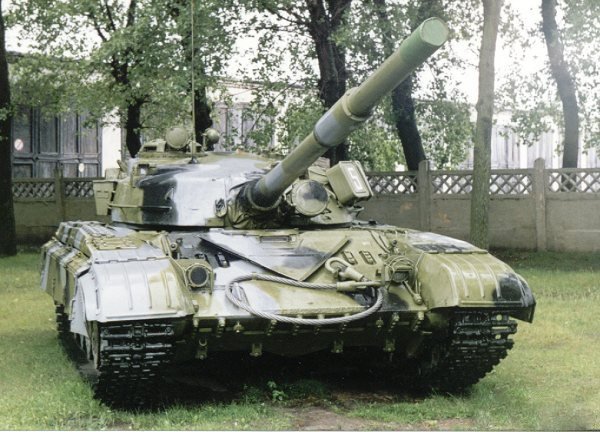
A T-64, the first tank to use Combination K

Combination K is a type of composite armor. It is fitted onto the Soviet Union tank T-64.

Description

[edit]

Combination K is a three-layer composite armor consisting of an outer and inner layer of steel and a middle layer of fiberglass glass-reinforced plastic ("steklotekstolit") and a pack of ceramic (allegedly corundum) plates.

Some T-72 tanks have their gun turret frontal armour composed of three layers: outer and inner layers of steel and a middle layer of sand or quartz ("kvartz", probably the origin of the "K" in the name; also implies some relationship between the T-64A and the kvartz composite). The gun turrets are cast with internal cavities on each side of the main tank gun, which are later filled with the desired composite material. Some Russian sources describe the material as "peschannye sterzhni" ("sand rods"), likely made of a form of silica similar to fused silica developed in the US for the T95 Medium Tank prototype in the 1952 program for equipping tanks with protection against shaped charges and high-explosive anti-tank (HEAT) rounds without sacrificing protection against kinetic energy penetrators. The same design of cast-steel turret with cavities for composite insets is reportedly used also in some earlier variants of T-80 and T-90 tanks with cast turrets.[1] The more modern T-90A and T-90M, use an Object 187-derived slab-sided welded turret, which offers an easier and more optimal way to mount inserts of various forms, including non-explosive reactive armour (NERA). More effective inserts can lead to radically increased protection. Reportedly, during the Second Chechen War no T-90A suffered a penetrating hit, with some allegedly surviving up to seven RPG-7 hits that failed to penetrate the armor.

References

[edit]
Revisions and contributorsEdit on WikipediaRead on Wikipedia
from Grokipedia
Combination K is a pioneering form of composite armor developed by the Soviet Union in the mid-1960s, first implemented on the T-64 main battle tank to provide enhanced protection against shaped-charge warheads while maintaining a low-profile design.[1] This armor system integrates ceramic inserts within steel structures, marking one of the earliest applications of multi-layered composite technology in operational main battle tanks.[2] Introduced in 1966, it represented a significant advancement over homogeneous steel armor, offering superior resistance to high-explosive anti-tank (HEAT) rounds by disrupting penetrator jets through material disruption and energy absorption.[1] The development of Combination K stemmed from Soviet efforts during the Cold War to counter evolving Western anti-tank threats, with initial prototypes appearing on early T-64 models produced at the Kharkov Malyshev Factory.[3] Its composition typically involves an outer layer of cast steel, a central filler of ceramic elements—such as corundum (aluminum oxide) plates or spheres suspended in a matrix, sometimes combined with glass-fiber reinforced materials like steklotekstolit—and an inner steel backing.[4] Early variants on the T-64A turret featured cast cavities filled with this composite during manufacturing, achieving effective thicknesses of up to 25 cm on the turret face and 20 cm on the glacis plate.[3] Later iterations, including those on the T-64B, refined the formula by incorporating boron carbide ceramics in place of earlier plastic-embedded glass fibers, further improving performance against both HEAT and kinetic energy penetrators while reducing overall weight compared to equivalent steel armor.[1] Combination K's effectiveness lies in its multi-layered design, where hard ceramics fracture incoming projectiles, and ductile steel layers capture fragments and absorb residual energy, providing protection several times greater than rolled homogeneous armor of similar thickness—particularly against HEAT rounds common in the 1960s and 1970s.[2] However, it was less resilient to repeated impacts, as ceramic components could shatter upon penetration attempts, necessitating careful production to ensure uniform distribution.[1] The armor contributed to the T-64's reputation for survivability, influencing subsequent Soviet designs like the T-72 and T-80, though its exact specifications remained classified, leading Western analysts to infer details from battlefield examinations and intelligence reports.[4] Production of T-64 variants equipped with Combination K continued until the early 1980s, with over 14,000 units built, many of which saw service in Soviet and post-Soviet forces.[3]

Overview

Description

Combination K is a pioneering composite armor system developed by the Soviet Union, defined as a three-layer configuration featuring outer and inner steel plates that sandwich a middle layer of non-metallic materials.[5] This design represented an early advancement in tank protection technology, integrating disparate materials to achieve superior defensive properties compared to traditional homogeneous steel armor.[2] The primary purpose of Combination K was to bolster a tank's resistance to anti-tank threats, particularly shaped-charge warheads, by disrupting and dissipating the penetrating energy of projectiles while adhering to strict limits on vehicle weight and mobility.[5] This balance allowed for enhanced survivability without compromising the operational agility essential for main battle tanks on dynamic battlefields.[2] Combination K was first deployed on the Soviet T-64 main battle tank in the mid-1960s, specifically entering service in 1967, which marked the debut of composite armor in an operational main battle tank.[6] This introduction on the T-64 platform set a precedent for future armored vehicle designs worldwide.[7]

Historical Significance

During the Cold War, the escalating arms race between NATO and the Warsaw Pact drove innovations in armored vehicle protection, particularly in response to the growing threat of shaped charge warheads employed by Western anti-tank guided missiles (ATGMs), which rendered traditional homogeneous steel armor increasingly inadequate.[5] Soviet designers recognized that these high-explosive anti-tank (HEAT) munitions could penetrate conventional armor with ease, prompting a shift toward multi-layered composites to disrupt the penetrating jet formed by shaped charges.[5] Combination K marked a pivotal milestone as the earliest production composite armor fitted to a main battle tank, debuting on the T-64 in the mid-1960s and entering serial production by 1966, nearly a decade before Western counterparts like Britain's Chobham armor achieved operational deployment in the 1970s.[5] This advancement allowed the Soviet Union to leapfrog NATO in tank survivability against HEAT threats, integrating non-metallic fillers into cast steel structures to enhance protection without excessive weight penalties.[5] Its deployment on the T-64 underscored the strategic importance of such innovations in maintaining armored superiority amid mutual deterrence.[5] The introduction of Combination K also epitomized the intense secrecy surrounding Soviet tank design, with technical details remaining classified throughout the Cold War to preserve tactical advantages over Western intelligence.[5] It was only after the dissolution of the Soviet Union in 1991 that declassifications and publications in the 1990s—such as analyses by Russian experts—began to reveal its composition and effectiveness, providing Western analysts with long-sought insights into Soviet armor evolution.[5]

Development

Origins in Soviet Tank Design

Combination K's origins trace back to the Soviet Union's ambitious tank modernization programs in the early 1960s, particularly the Object 432 project, which served as the direct prototype for the T-64 main battle tank.[6] This initiative was spearheaded by Alexander Morozov, a prominent tank designer, at the Kharkiv Morozov Design Bureau (KMDB), formerly known as KB-60M, where the first technical project documentation for Object 432 was completed in 1961.[8] The design bureau collaborated with institutions like VNII-100 to pioneer composite armor solutions, marking a shift toward integrated protection systems in Soviet armored vehicles.[8] The primary motivation for developing Combination K stemmed from the recognized shortcomings of preceding Soviet tanks, such as the T-55 and T-62, which proved vulnerable to Western high-explosive anti-tank (HEAT) warheads and armor-piercing rounds during the Cold War arms race.[6] Intelligence assessments, including analyses of captured NATO equipment like the M60 tank, highlighted the need for enhanced defenses against emerging threats from guns such as the British L7.[9] In response, Soviet engineers under Morozov began exploring layered armor concepts around 1962-1963, aiming to combine steel plates with non-metallic inserts to disrupt penetrator jets without significantly increasing vehicle weight.[8] These early efforts aligned with the broader Soviet push for low-profile, lightweight tanks capable of matching Western technological advances, with initial prototypes of Object 432 incorporating preliminary composite elements by late 1962.[9] The project's focus on advanced materials integration laid the conceptual groundwork for Combination K, transitioning from traditional homogeneous armor to multifaceted designs that prioritized survivability in high-intensity conflicts.[6]

Research and Implementation

The development of Combination K originated from the Object 432 project, the T-64 prototype initiated in the early 1960s.[5] Extensive testing occurred at Soviet proving grounds, including Kubinka, where prototypes underwent ballistic trials simulating threats from 115mm smoothbore gun rounds and early anti-tank guided missiles such as the AT-3 Sagger.[10] These trials, conducted by the Technical Institute for Armored Technology at Kubinka, validated the composite's effectiveness against shaped-charge warheads and kinetic penetrators, contributing to its approval for operational use.[10] Implementation began with integration into T-64 production at the Kharkov tank plant starting in 1963, with refinements for the T-64A variant from 1967, coinciding with upgrades to the 125mm smoothbore gun and refinements in turret casting to accommodate the embedded composites.[10][6] The process involved casting internal cavities in the turret front, which were then filled with the layered materials under controlled conditions to maintain structural integrity.[2] Manufacturing presented significant challenges, particularly in achieving uniform distribution of filler materials during the high-temperature casting of the turret, which risked voids or inconsistencies that could compromise protection.[10] These issues were addressed through iterative prototypes and field trials in 1967, including operational evaluations with the 100th Guards Tank Training Regiment, leading to reliable production methods by the early 1970s.[10]

Composition and Design

Layered Structure

Combination K employs a three-layer sandwich configuration, consisting of an outer steel faceplate, a middle non-metallic filler layer, and an inner steel backing plate.[5] This arrangement provides a structured composite that enhances overall armor integrity by distributing loads across the layers. The outer steel faceplate typically measures 40-80 mm in thickness, serving as the primary impact surface, while the inner backing ensures structural support. The layers are integrated by casting the armor into voids within the turret structure during manufacturing, where the composite filler occupies pre-formed cavities in the cast steel.[5] This method allows the non-metallic filler to be securely embedded without requiring post-casting assembly, maintaining the monolithic appearance of the turret. On the T-64 tank, this integration is applied to the turret, forming a cohesive unit.[2] The design incorporates non-planar geometry, particularly in the turret cheeks, to optimize deflection angles against incoming threats.[5] This approach leverages the cast steel's inherent shape for enhanced ballistic efficiency without compromising manufacturability.

Materials Used

Combination K armor employs high-hardness homogeneous armor steel for its outer and inner layers, which provide structural support and spall protection by containing fragments from impacts.[5] These steel layers, typically around 80 mm thick on the outer side and 20 mm on the inner for the hull, offer baseline ballistic resistance while integrating with the composite core.[8] The middle layer consists of Steklotekstolit, a glass-fiber reinforced epoxy resin, combined with ceramic elements such as corundum (aluminum oxide) plates or spheres, which disrupt and erode incoming penetrators by fracturing and absorbing energy.[5] This composite filler, varying from 105-140 mm in thickness, enhances protection against shaped charges through its non-metallic properties that promote jet instability.[8] In the T-64 turret front, the overall physical thickness reaches approximately 400-500 mm.[8]

Applications

Primary Use on T-64

Combination K was first implemented on the T-64 main battle tank in 1966, with early variants appearing on the T-64A introduced in 1969, marking the first operational implementation of composite armor in Soviet tank design. The turret's frontal armor, incorporating this early variant, provided approximately 450 mm of rolled homogeneous armor (RHA) equivalent protection against high-explosive anti-tank (HEAT) rounds, significantly enhancing the tank's defensive capabilities compared to prior homogeneous steel designs. This integration involved a layered structure with inner and outer steel plates sandwiching a central filler of steklotekstolit (glass-reinforced plastic) combined with ceramic elements, primarily corundum plates, which disrupted penetrating jets from shaped charges.[8][5] Subsequent upgrades in the T-64B variant, introduced in 1976, refined Combination K through improved fillers and manufacturing processes, resulting in a less bulky yet more effective armor array on both hull and turret. These enhancements included the incorporation of silica-based ultraporcelain inserts and high-hardness steel layers, replacing earlier aluminum fillers in some components to boost disruption against HEAT threats while maintaining comparable kinetic energy resistance. The T-64B's turret achieved similar 450-460 mm RHA equivalent versus HEAT, but with greater overall efficiency due to optimized ceramic aggregates like silica and quartz, which improved energy dissipation without increasing weight significantly.[8][11] Due to the T-64's technical complexity and advanced features, including Combination K, it was exclusively produced for Soviet forces and never exported prior to the USSR's dissolution, unlike the simpler T-72. This restriction ensured that elite Soviet units, particularly those deployed in forward positions, benefited from the armor's superior protection in potential high-intensity conflicts.[12]

Adoption in Other Tanks

While the original Combination K armor was primarily associated with the T-64, principles of layered composite protection were partially adopted in early T-72 prototypes, such as Object 172, which initially featured a simplified hull armor layout using glass textolite fillers between steel plates rather than the full ceramic-based structure. This evolved in post-1977 variants like the T-72 Ural-1 and T-72A, incorporating "Kvartz" armor—a cost-effective simplification using sintered quartz ceramic inserts embedded in cast steel turrets, providing comparable but less complex protection against shaped charges compared to the original design.[13] The T-80 series extended these concepts more directly, with the T-80B (introduced in 1978) employing Kvartz composite armor in its cast turret, akin to contemporary T-72A designs, to enhance frontal protection without the manufacturing challenges of true Combination K. Early T-90 models, derived from T-72B prototypes like Object 188, incorporated limited composite inserts in their turrets, building on these layered approaches. By the T-90A (1992), this evolved into modular welded turret designs with integrated armor slabs, allowing easier updates while retaining core multi-layer principles from Combination K lineage.[14][15] By the 1980s, variants of Combination K or its simplified forms equipped over 8,000 T-64 and T-80 units across Soviet forces, though the authentic ceramic-intensive Combination K remained exclusive to T-64 production, with later successors like T-72B and T-80BV relying on explosive reactive armor overlays such as Kontakt-1 for additional enhancement.[16]

Performance

Protection Against Shaped Charges

Combination K's effectiveness against shaped charges stems from its multi-layered design, where the fiberglass (steklotekstolit) and ceramic components play a critical role in disrupting the hypervelocity metallic jet formed by high-explosive anti-tank (HEAT) warheads. Upon impact, the ceramic plates fracture and erode the jet's tip, while the fiberglass layers absorb and redistribute the kinetic energy, causing the jet to destabilize and fragment before fully penetrating the armor. This mechanism significantly reduces penetration depth compared to homogeneous steel armor of equivalent weight, providing approximately 2-3 times greater protection against shaped charges.[5] Testing demonstrated that Combination K-equipped T-64 turrets could withstand impacts from 125 mm HEAT rounds, such as the 3BK29, at close range without catastrophic breach, owing to the armor's ability to limit jet coherence. Similarly, simulations of T-64B variants showed survival against multiple RPG-7 hits on the frontal arc, with the composite layers effectively dissipating the shaped charge effects across the impacted area. These results highlight the armor's robustness against both tank-fired and infantry-portable anti-tank weapons prevalent during the Cold War era.[8] Declassified Soviet trials from the 1970s quantified the turret front's protection as equivalent to 500-575 mm of rolled homogeneous armor (RHA) versus shaped charges for T-64A and T-64B variants, with the glacis providing around 450 mm RHA; this far exceeded the baseline steel thickness and established Combination K as a pioneering composite solution for HEAT threats. This equivalence was achieved through the synergistic interaction of the armor's materials, where the ceramics provided high hardness for jet erosion and the fiberglass offered lightweight energy absorption without compromising structural integrity.[8][17]

Resistance to Kinetic Penetrators

Combination K offers moderate improvement in resistance to kinetic energy penetrators, such as APFSDS rounds, providing an equivalent protection of approximately 370-440 mm RHA for the turret and 300-340 mm RHA for the glacis on T-64A/B variants due to its reliance on steel layers and ceramic disruption of long-rod projectiles.[18][8] The composite's ceramic components, while effective against shaped charges, contribute to defeating solid kinetic threats through spalling and yawing, though less optimally than in later armors.[18] This level of protection rendered Combination K effective against contemporary 115 mm AP rounds, like the 3BM3 used on T-62 tanks, which had penetration capabilities around 300 mm RHA at typical combat ranges. However, it proved vulnerable to subsequent generations of 120 mm and 125 mm depleted uranium penetrators, such as the M829 series introduced in the 1980s, which could exceed 540 mm RHA penetration and typically defeated the armor without additional ERA overlays.[18] Post-1980s evaluations highlighted these shortcomings against advanced NATO rounds like the M829 in simulated engagements, emphasizing the necessity for enhanced designs like those implemented on the T-72B.[18]

Legacy

Influence on Successor Armors

Combination K's innovative multi-layer composite design, featuring ceramic inserts suspended in steel, served as a foundational technology for subsequent Soviet and Russian armor systems, particularly in the passive armor components of the T-80 and T-90 tanks.[10] These later designs retained core principles of layered materials to disrupt shaped charge jets and kinetic penetrators, while integrating advancements like improved ceramics for greater efficiency.[5] The technology's influence extended to explosive reactive armor (ERA) developments, where Combination K's base protection was complemented by add-on systems such as Kontakt-5, deployed on upgraded T-72 and T-80 models in the 1980s to defeat tandem warheads.[19] This evolution continued with Relikt ERA, which enhanced disruption capabilities against both chemical energy and kinetic threats, representing a hybrid approach building on early composite foundations.[19] In the T-14 Armata, multi-layer composites further refined these concepts, incorporating advanced materials for superior all-aspect protection, with indications of optimized performance against depleted uranium penetrators.[20] The appearance of Combination K prompted a rapid Western response, accelerating NATO's composite armor programs in the 1970s and directly inspiring the creation of Burlington and Chobham armors to counter the T-64's enhanced defenses against contemporary anti-tank weapons.[10] By 1991, derived composite protections appeared in a substantial share of the Soviet tank inventory, extending to export variants like the T-72M1, which adopted simplified multi-layer glacis arrays for broader proliferation.[21]

Modern Interpretations

The full composition of Combination K, a three-layer composite armor consisting of steel plates sandwiching glass-reinforced plastic and ceramic elements, was disclosed in the early 1990s following the dissolution of the Soviet Union. This revelation came through Russian technical publications and Western analyses of captured Iraqi T-72 variants during the 1991 Gulf War, which shared conceptual similarities with T-64 armor designs.[5] These disclosures allowed for detailed post-Cold War studies and simulations of the armor's properties. Preserved examples of T-64 tanks equipped with Combination K are displayed in Russian military museums, serving as educational replicas for historical analysis and public exhibits on Soviet armored development. The Kubinka Tank Museum, for instance, houses multiple variants including the T-64A (Object 446) from 1969, showcasing the original implementation of this composite armor in operational contexts.[22] Such displays highlight the armor's role in early third-generation main battle tanks without modern modifications. In the 2022 Russian invasion of Ukraine, legacy T-64 tanks featuring Combination K have shown mixed effectiveness against advanced threats, with Ukraine losing over 400 T-64s as of mid-2025, many attributed to anti-tank guided missiles (ATGMs) including top-attack systems like the FGM-148 Javelin and FPV drones exploiting vulnerabilities in the armor's design.[23] This has prompted Ukrainian forces to retrofit these vehicles with explosive reactive armor (ERA) packages, such as Kontakt-1 or indigenous Nozh blocks integrated over the composite layers, to improve protection against contemporary ATGMs and other threats.[24]
User Avatar
No comments yet.