


Community hub
Recent from talks
Contribute something
Nothing was collected or created yet.
Spall
View on Wikipedia
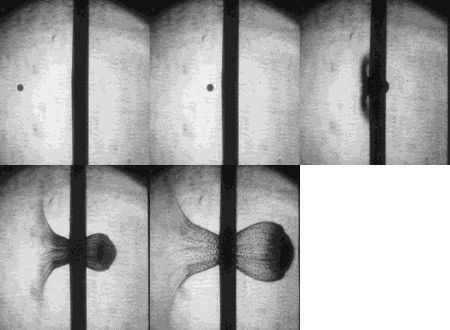
Spall are fragments of a material that are broken off a larger solid body. It can be produced by a variety of mechanisms, including as a result of projectile impact, corrosion, weathering, cavitation, or excessive rolling pressure (as in a ball bearing). Spalling and spallation both describe the process of surface failure in which spall is shed.

The terms spall, spalling, and spallation have been adopted by particle physicists; in neutron scattering instruments, neutrons are generated by bombarding a uranium (or other) target with a stream of atoms. The neutrons that are ejected from the target are known as "spall".
Mechanical spalling
[edit]Mechanical spalling occurs at high-stress contact points, for example, in a ball bearing. Spalling occurs in preference to brinelling, where the maximal shear stress occurs not at the surface, but just below, shearing the spall off.
One of the simplest forms of mechanical spalling is plate impact, in which two waves of compression are reflected on the free-surfaces of the plates and then interact to generate a region of high tensile stress inside one of the plates.
Spalling can also occur as an effect of cavitation, where fluids are subjected to localized low pressures that cause vapour bubbles to form, typically in pumps, water turbines, vessel propellers, and even piping under some conditions. When such bubbles collapse, a localized high pressure can cause spalling on adjacent surfaces.
Anti-tank warfare
[edit]
In anti-tank warfare, spalling through mechanical stress is an intended effect of high-explosive squash head (HESH) anti-tank shells and many other munitions, which may not be powerful enough to pierce the armour of a target. The relatively soft warhead, containing or made of plastic explosive, flattens against the armour plating on tanks and other armoured fighting vehicles (AFVs) and explodes, creating a shock wave that travels through the armour as a compression wave and is reflected at the free surface as a tensile wave breaking (tensile stress/strain fracture) the metal on the inside. The resulting spall is dangerous to crew and equipment, and may result in a partial or complete disablement of a vehicle and/or its crew. Many AFVs are equipped with spall liners inside their armour for protection.
A kinetic energy penetrator, if it can defeat the armour, generally causes spalling within the target as well, which helps to destroy or disable the vehicle and its crew.[1]
An early example of anti-tank weapon intentionally designed to cause spallation instead of penetration is the wz. 35 anti-tank rifle.
Spalling in mechanical weathering
[edit]
Spalling is a common mechanism of rock weathering, and occurs at the surface of a rock when there are large shear stresses under the surface. This form of mechanical weathering can be caused by freezing and thawing, unloading, thermal expansion and contraction, or salt deposition.
Unloading
[edit]Unloading is the release of pressure due to the removal of an overburden. When the pressure is reduced rapidly, the rapid expansion of the rock causes high surface stress and spalling.
Freeze–thaw weathering
[edit]Freeze–thaw weathering is caused by moisture freezing inside cracks in rock. Upon freezing its volume expands, causing large forces which cracks spall off the outer surface. As this cycle repeats the outer surface repeatedly undergoes spalling, resulting in weathering.
Some stone and masonry surfaces used as building surfaces will absorb moisture at their surface. If exposed to severe freezing conditions, the surface may flake off due to the expansion of the water. This effect can also be seen in terracotta surfaces (even if glazed) if there is an entrance for water at the edges.
Exfoliation
[edit]
Exfoliation (or onion skin weathering) is the gradual removing of spall due to the cyclic increase and decrease in the temperature of the surface layers of the rock. Rocks do not conduct heat well, so when they are exposed to extreme heat, the outermost layer becomes much hotter than the rock underneath causing differential thermal expansion. This differential expansion causes sub-surface shear stress, in turn causing spalling. Extreme temperature change, such as forest fires, can also cause spalling of rock. This mechanism of weathering causes the outer surface of the rock to fall off in thin fragments, sheets or flakes, hence the name exfoliation or onion skin weathering.
Salt spalling
[edit]Salt spalling is a specific type of weathering which occurs in porous building materials, such as brick, natural stone, tiles and concrete. Dissolved salt is carried through the material in water and crystallizes inside the material near the surface as the water evaporates. As the salt crystals expand this builds up shear stresses which break away spall from the surface.
Corrosion
[edit]In corrosion, spalling occurs when a substance (metal or concrete) sheds tiny particles of corrosion products as the corrosion reaction progresses. Although they are not soluble or permeable, these corrosion products do not adhere to the parent material's surface to form a barrier to further corrosion, as happens in passivation. Spallation happens as the result of a large volume change during the reaction.
In the case of actinide metals (most notably the depleted uranium used in some types of ammunition), the material expands so strongly upon exposure to air that a fine layer of oxide is forcibly expelled from the surface. A slowly oxidised plug of metallic uranium can sometimes resemble an onion subjected to desquamation. The main hazard however arises from the pyrophoric character of actinide metals which can spontaneously ignite when their specific area is high. This property, along with the inherent toxicity and (for some to a lesser extent) radioactivity of these elements, make them dangerous to handle in metallic form under air. Therefore, they are often handled under an inert atmosphere (nitrogen or argon) inside an anaerobic glovebox.
Spalling in refractory concrete
[edit]There are two drivers for spalling of concrete: thermal strain caused by rapid heating and internal pressures due to the removal of water. Being able to predict the outcome of different heating rates on thermal stresses and internal pressure during water removal is particularly important to industry and other concrete structures.
Explosive spalling events of refractory concrete can result in serious problems. If an explosive spalling occurs, projectiles of reasonable mass (1–10 kg) can be thrust violently over many metres, which will have safety implications and render the refractory structure unfit for service. Repairs will then be required resulting in significant costs to industry.[2][failed verification]
Anatomical spalling in blast injuries
[edit]Blast-wave overpressure from explosions can cause spalling in the human body where the wave travels across the interface between denser to less-dense areas of anatomy. This is notable at the boundary between liquid and air, for example from the bowel wall to a gas-filled bowel, or from lung tissue to cavity. Spallation, implosion, and shearing are the three primary mechanisms known to cause blast injuries.[3][4]
See also
[edit]References
[edit]- ^ "How M1 Tanks Work: Sabot". 7 May 2002.
- ^ The Accelerated Drying of Refractory Concrete – Parts I and II, Volume 6, Issues 2 and 4 /The Refractory Worldforum
- ^ Sasser SM, Sattin RW, Hunt RC, Krohmer J (2006). "Blast lung injury". Prehosp Emerg Care. 10 (2): 165–72. doi:10.1080/10903120500540912. PMID 16531371. S2CID 2912045.
- ^ Bukowski, Josh; Nowadly, Craig D.; Schauer, Steven G.; Koyfman, Alex; Long, Brit (2023-08-01). "High risk and low prevalence diseases: Blast injuries". The American Journal of Emergency Medicine. 70: 46–56. doi:10.1016/j.ajem.2023.05.003. ISSN 0735-6757. PMID 37207597.
External links
[edit]Spall
View on GrokipediaFundamentals
Definition
Spalls are fragments of material that break off from a larger solid body due to stresses exceeding the material's tensile strength, often resulting in chipping, fracturing, or fragmentation accompanied by upward and outward heaving.[14] This phenomenon is characterized by the production of typically small, sharp-edged pieces, which distinguishes it from broader forms of material degradation.[7] Unlike general fracture or fragmentation, which may occur under static loading and involve simple cracking without ejection, spalling specifically entails dynamic separation or ejection driven by internal tensile stresses, frequently induced by shock waves or rapid pressure application.[15] It predominantly affects brittle or semi-brittle materials, including rock, ceramics, concrete, and metals under high-impact conditions, where the material's limited ductility leads to localized failure rather than ductile deformation.[16] The term "spall" has historical roots in lithic technology, particularly in knapping—the prehistoric process of shaping stone tools—where spalls refer to the detached flakes removed from materials like obsidian to form sharp edges and implements.[17] For instance, in producing obsidian tools, controlled percussion creates these spalls as waste products, enabling the refinement of blades and points essential to early human technologies.[18] Spalling in this context highlights the intentional exploitation of material brittleness for tool-making, a practice dating back over 2.5 million years in human history.[19]Etymology
The term "spall" originates from Middle English "spalle" or "spalles," first attested around 1440, denoting a chip or splinter of stone or similar material.[4][1] This noun form likely derives from the Middle English verb "spald" or "spallen," meaning to split, chip, or break off fragments, which itself relates to processes of fracturing hard materials like stone during quarrying or hewing.[4][20] The deeper roots trace to Proto-West Germanic **spaluz or similar forms, akin to Old English **spald and Low German "spalden," all connoting the act of splitting or splintering, particularly in the context of stonework.[4][21] By the mid-18th century, "spall" had evolved into a verb form, with its earliest recorded use in 1758 by antiquary William Borlase to describe the chipping of stone or ore. The term gained prominence in the 19th century within geology and engineering, applied to fragmentation in rock formations and material failures, reflecting its origins in practical stone-splitting trades.[4][20] A related term is "spallation," formed by adding the suffix "-ation" to "spall," first appearing in 1948 to describe the ejection of atomic fragments in nuclear reactions, drawing an analogy to the chipping process but in a high-energy particle context.[22] Separately, a rare and obsolete usage of "spall" as a noun for the shoulder dates to 1590 in Edmund Spenser's works, derived from Italian "spalla" meaning shoulder, unrelated to the modern sense of fragmentation.[23] In contemporary materials science, the term continues to denote ejected fragments from stressed surfaces, as explored in later sections.[4]Mechanisms of Spalling
Mechanical Spalling
Mechanical spalling occurs when a compressive stress wave propagates through a solid material and reflects off a free surface, inverting into a tensile wave that, upon overlapping with the tail of the incident wave, generates localized tension exceeding the material's tensile strength, resulting in fracture planes parallel to the surface.[24] This dynamic process is prevalent in brittle and semi-brittle materials such as rocks and metals under high-strain-rate loading, where the rapid wave interaction leads to delamination and ejection of material layers.[25] The mechanism relies on one-dimensional wave propagation theory, assuming the material behaves as an elastic continuum initially, with fracture initiating once the tensile stress surpasses the dynamic tensile strength.[26] The thickness of the spalled layer, , can be estimated from the pulse duration using the relation , where is the longitudinal wave speed in the material and is the duration of the compressive pulse.[27] This formula derives from the wave propagation characteristics: the reflected tensile wave travels back toward the interior at speed , and the location of peak tension (spall plane) forms at a distance where the rarefaction from the free surface interacts with the pulse tail after a time ; the round-trip distance for this interaction is , yielding .[28] Factors influencing spall severity include material brittleness, which determines the ease of void nucleation and growth under tension; impact velocity, which scales the peak compressive stress and thus the resulting tensile magnitude; and confinement, which modifies the stress state to suppress or enhance tensile wave development.[24] These effects are pronounced in materials like granite or steel, where higher brittleness correlates with thinner, more numerous spall layers.[29] Two prominent types of mechanical spalling arise from distinct loading regimes. Fatigue spalling in rolling element bearings stems from cyclic Hertzian contact stresses that induce subsurface shear, leading to microcrack initiation and propagation under repeated loading, ultimately forming surface pits parallel to the contact plane.[30] In contrast, tensile failure spalling in rock under high deviatoric stress occurs when axial compression generates radial tensile strains near boundaries, causing axial splitting and slab-like ejection in confined environments such as tunnels.[31] Experimental observations of mechanical spalling are commonly achieved through high-speed plate impact tests, where a flyer plate generates a controlled shock wave in a target sample, producing measurable ejecta velocities and spall thicknesses via velocity interferometry or post-mortem sectioning.[32] These tests reveal ejecta clouds with velocities up to several km/s, confirming the tensile wave-driven fracture and providing validation for predictive models in materials like metals and ceramics.[26]Thermal and Chemical Spalling
Thermal spalling arises from differential thermal expansion in heterogeneous materials, where components with varying coefficients of thermal expansion, such as aggregates in concrete, generate internal stresses under temperature gradients.[33] These stresses can lead to cracking and material detachment when the induced tensile forces exceed the material's strength.[34] In fire-exposed concrete, explosive spalling occurs due to pore pressure buildup from the rapid vaporization of moisture into steam during heating, which creates explosive forces that eject surface layers.[35] A specific example involves hydrocarbon fires, such as burning petrol (gasoline), which can subject the concrete surface to rapid, intense heating exceeding 1000°C. This causes violent explosive spalling through internal moisture vaporization, building pore pressure that leads to cracking, flaking, chipping, or sudden ejection of concrete fragments. The surface develops craters, exposes aggregates, loses material (reducing cover over reinforcement), and may exhibit color changes (pink/red at 300–600°C, then gray/white at higher temperatures).[36][37] Small-scale petrol burns may cause mainly superficial damage, whereas prolonged exposure results in more severe structural weakening.[38] Moisture content is a critical factor, as higher levels increase steam pressure and exacerbate spalling risk, while rapid heating rates intensify the effect.[39] Thermal shock in refractories, caused by sudden temperature changes, similarly induces spalling through comparable gradient-induced stresses.[40] The thermal stress responsible for initiating spalling can be quantified by the equation: where is the thermal stress, is the modulus of elasticity, is the coefficient of thermal expansion, and is the temperature change; spalling initiates when surpasses the material's tensile strength.[41] Chemical spalling involves degradation from corrosive agents that exert expansive forces on the surrounding matrix. In corrosion-induced spalling, rust formation on steel reinforcements expands to approximately 2-6 times the volume of the original iron, generating radial pressures that crack and delaminate the concrete cover.[42] Salt crystallization contributes similarly by forming crystals in pores during evaporation or freeze-thaw cycles, where supersaturated solutions produce crystallization pressures up to several megapascals, leading to surface flaking and material loss.[43] These pressures arise from the mismatch between crystal growth and pore confinement, driving progressive damage.[44] Spalling types include progressive spalling, characterized by gradual flaking or sloughing due to sustained low-level stresses, and explosive spalling, which involves sudden, violent ejection of fragments from high internal pressures.[45] In fire-exposed concrete, aggregate spalling specifically occurs when siliceous aggregates expand more than the cement paste, causing localized shear failures and surface detachment.[46]Spalling in Natural Processes
Geological Unloading and Exfoliation
Geological unloading refers to the process where erosion removes overlying rock layers or sediments, reducing the overburden pressure on underlying rocks and allowing them to expand vertically. This expansion generates tangential tensile stresses in the near-surface rock mass, leading to the formation of curved fracture sheets parallel to the topographic surface, a phenomenon known as exfoliation or sheeting.[47] In brittle igneous rocks like granite, these tensile stresses arise because the lateral confinement remains relatively high compared to the relieved vertical stress, promoting radial cracking that detaches concentric slabs from the rock exterior.[48] The exfoliation process manifests as unloading joints that develop incrementally through subcritical fracture propagation, often forming fan-shaped cracks which merge into larger composite sheets oriented normal to the minimum compressive stress direction. These joints typically occur in massive, sparsely jointed granitic formations, where the sheets can range from a few meters to hundreds of meters in thickness and follow the local topography, such as horizontal on flat surfaces or curving over domes. A prominent example is the exfoliation dome of Half Dome in Yosemite National Park, California, where unloading joints separate curved granite sheets, contributing to the feature's rounded profile after glacial exposure.[48][47] Several factors influence the development of unloading-induced spalling, including rock type, with brittle igneous rocks such as granite being most susceptible due to their low tensile strength and elastic properties that facilitate expansion. The original depth of burial determines the magnitude of stress relief, as deeper rocks experience greater initial confinement and thus more pronounced tensile stresses upon unloading. Additionally, the rate of erosion controls the fracturing pace, with rapid unloading promoting brittle tensile failure over slower, more ductile responses.[47][49] This form of spalling holds significant geological importance, as it drives landscape evolution by progressively rounding domes and cliffs, exposing fresh rock interiors, and facilitating further erosion in upland regions like the Sierra Nevada. In analogous settings, such as tunnel boring through granitic rock, rapid stress release mimics natural unloading and induces spallation along similar tensile fractures. Field evidence from the Sierra Nevada, including detailed mapping at Yosemite, reveals widespread exfoliation sheets in granodiorite, while laboratory triaxial tests under simulated unloading conditions demonstrate tensile failure at low confinement levels, confirming the dominance of radial stresses in fracture initiation.[47][48][50]Weathering-Induced Spalling
Weathering-induced spalling refers to the mechanical breakdown of rock surfaces and soils through repeated environmental cycles that generate internal stresses, leading to the detachment of thin layers or fragments without involving deep pressure relief. This process primarily occurs in porous rocks where fluids infiltrate pores, and subsequent phase changes or crystallization exert expansive forces that exceed the material's tensile strength, resulting in progressive fragmentation. Unlike thermal or chemical spalling driven by high temperatures or reactions, weathering-induced forms are tied to climatic fluctuations in moisture and salinity, accelerating surface deterioration in exposed natural settings.[51] Freeze-thaw cycles are a dominant mechanism in cold climates, where water saturates rock pores and expands by approximately 9% upon freezing, generating hydrostatic pressures often exceeding 10 MPa that propagate microcracks and cause spalling. This volumetric expansion acts like a wedge, prying apart mineral grains and leading to the detachment of flakes or slabs from the rock surface, particularly in materials with interconnected porosity greater than 1-2%. In laboratory simulations of top-down freezing, ice pressures of 1.96-9.1 MPa have been measured, sufficient to initiate fractures in granites and sandstones, while theoretical models predict up to 207 MPa under confined conditions. Repeated cycles—typically dozens to hundreds annually—amplify damage through cumulative stress, transitioning from microfracturing to granular disintegration as pore saturation fluctuates with seasonal thawing. In Arctic regions, such as exposed bedrocks in Alaska's Donnelly Dome area, freeze-thaw spalling contributes significantly to slope instability and sediment production, with rates enhanced by permafrost thaw exposing fresh surfaces to cycles.[52][53][54] Salt spalling, prevalent in arid environments, involves the crystallization of dissolved salts within pores as water evaporates, creating wedging forces that can reach 70-100 MPa and induce tensile failure akin to hydraulic fracturing. For instance, sodium chloride (NaCl) solutions infiltrating rocks form halite crystals that grow against pore walls, exerting localized pressures up to 73.87 MPa in cyclic wetting-drying tests on porous stones, far surpassing the 1-5 MPa tensile strength of most siliceous rocks. The process begins with pore saturation via capillary rise or aerosol deposition, followed by evaporation-driven supersaturation and nucleation; repeated cycles enlarge voids, promoting delamination and eventual granular breakup. In arid deserts like the central Namib, salt weathering rapidly disintegrates Jurassic limestones, with blocks showing 20-50% mass loss over months due to NaCl and sulfate crystallization from coastal fog and groundwater. This mechanism is especially evident in regolith development, where spalled fragments accumulate as loose debris layers.[55][56][57] Overall, these processes accelerate mechanical weathering by increasing surface area for further breakdown, contributing to regolith formation at rates of 10-100 mm per millennium in affected zones, and shaping landscapes through enhanced erosion and soil genesis. In polar and desert settings, they dominate rock-to-soil transformation, with freeze-thaw favoring coarse debris in periglacial zones and salt spalling yielding finer grus in hyperarid areas.[58][59]Spalling in Engineering Applications
Corrosion and Concrete Degradation
In reinforced concrete structures, spalling occurs primarily through the corrosion of embedded steel reinforcement bars (rebars), where the formation of expansive rust products generates internal tensile stresses that crack and delaminate the surrounding concrete cover.[60] The corrosion process begins with the depassivation of the protective oxide layer on the rebar, often triggered by chloride ions penetrating the concrete pores, leading to localized pitting or uniform corrosion.[60] As rust expands to 2.2–6.4 times the original steel volume, it exerts radial pressure, resulting in typical spall depths of 10–50 mm, often corresponding to the concrete cover thickness over the rebar.[61] This degradation compromises structural integrity, exposing further rebar to environmental attack and accelerating deterioration.[62] De-icing salts, such as sodium and calcium chlorides, exacerbate spalling by facilitating chloride ingress into the concrete, particularly in road and bridge applications where salts are applied during winter maintenance.[63] Chloride ions migrate through moisture-filled pores, reaching the rebar and initiating corrosion once a critical threshold concentration (typically 0.4–1.0% by cement weight) is exceeded.[64] In cold climates, this chemical attack combines with freeze-thaw cycles, where water-saturated concrete expands upon freezing, amplifying cracks and promoting salt crystallization that further disrupts the matrix.[65] Marine environments pose similar risks, classified under exposure classes like XS (tidal/splash zones) in standards such as Eurocode 2, where airborne or splash-borne chlorides from seawater accelerate ingress.[66] Key factors influencing spalling include concrete mix design, with low water-to-cement (w/c) ratios (ideally below 0.45) reducing permeability and limiting chloride diffusion.[67] Higher w/c ratios increase porosity, hastening ion transport, while inadequate cover depth (minimum 40–50 mm in aggressive exposures) shortens the time to corrosion initiation.[61] To prevent spalling, epoxy coatings on rebars provide a barrier against moisture and chlorides, extending service life by up to 75 years in chloride-laden environments.[61] Cathodic protection systems, using impressed current or sacrificial anodes, suppress corrosion by making the rebar the cathode in an electrochemical cell, effectively halting rust expansion.[68] For repair, patching involves removing spalled concrete to sound substrate (typically 50–75 mm deep), cleaning exposed rebar, applying inhibitors, and overlaying with polymer-modified mortar to restore cover and prevent recurrence.[69] Notable case studies highlight the impacts: In the 1970s United States, widespread bridge deck spalling emerged in "snow belt" states due to de-icing salts, affecting structures as young as 5–10 years old and contributing to over 100,000 structurally deficient bridges by the 1990s, with overall corrosion-related bridge maintenance costs estimated at $5.9–9.7 billion annually.[63][70] Similarly, historic buildings like the 1913 Kilauea Point Light Station in Hawaii and the 1919 63rd Street Beach House in Chicago have suffered spalling from rebar corrosion, often compounded by coastal exposure or early-use calcium chloride admixtures, necessitating specialized preservation to maintain architectural integrity.[62]Refractory Materials Failure
Spalling in refractory materials represents a critical failure mode in high-temperature industrial applications, where rapid temperature changes induce explosive disintegration of the lining, compromising furnace integrity and operational safety. This phenomenon primarily affects dense refractory castables used in environments like steelmaking and cement production, leading to material loss and downtime if not managed.[40] The primary mechanism of explosive spalling in refractories involves the buildup of vapor pressure within pores during rapid heating, which can reach 5-10 MPa and exceed the material's tensile strength, causing internal fractures and ejection of fragments. In low-cement castables, the dense matrix formed by calcium aluminate cement hydration limits vapor escape, exacerbating pressure accumulation and promoting spalling. This process aligns with thermal spalling mechanisms, where thermo-mechanical stresses amplify the vapor-induced damage.[71][72][40] Key types of spalling in refractories include thermal shock spalling in furnace linings, where sudden heat fluxes generate steep temperature gradients and surface cracking, and first-heat-up spalling during initial drying of castables bonded with calcium aluminate cements, when residual moisture vaporizes explosively. These failures are prevalent in steel ladles and rotary kilns, where cyclic thermal loads intensify the risks.[40][73] Influencing factors encompass heating rate, with rates exceeding 50°C/min significantly elevating pore pressure and spalling likelihood by accelerating moisture vaporization; larger aggregate sizes that reduce permeability; and overall low gas permeability in the castable matrix, which traps vapors. Material composition, such as cement content and porosity, further modulates these effects, with denser formulations showing heightened vulnerability.[74][75][73] Prevention strategies focus on enhancing permeability and controlled drying, including the addition of permeable additives like polypropylene fibers, which vaporize at around 160-170°C to form escape channels for steam, thereby reducing peak pore pressures by up to 50%. Optimized drying schedules, involving gradual heating ramps below 10°C/h up to 300°C, minimize vapor buildup during initial heat-up. Recent 2020s studies have advanced anti-spalling castables by incorporating polyolefin fibers into low-cement formulations for steel ladle linings, demonstrating improved explosion resistance without compromising mechanical properties. These approaches have been validated in kiln applications, extending service life by mitigating first-heat-up failures.[75][40][76][77]Armor and Anti-Tank Contexts
In armored vehicles, spalling represents a critical vulnerability where high-velocity projectiles penetrate or partially penetrate the armor, generating shock waves that propagate through the material and induce tensile stresses on the inner surface. These stresses cause fragments of the armor—known as spall—to detach and eject rearward at velocities typically ranging from 500 to 1000 m/s, posing lethal threats to crew members and internal components by creating secondary projectiles within the vehicle compartment.[78][79] This phenomenon, often termed back-spall, occurs primarily from the internal face of the armor following impact, while partial penetration effects can exacerbate fragmentation even without full breach, leading to widespread debris dispersion. The mechanical wave effects, involving compressive and reflective tensile waves, amplify the damage potential in homogeneous steel armors commonly used in vehicles.[78][80] Historically, spalling became a deliberate target in anti-tank warfare during World War II, with the development of high-explosive squash head (HESH) rounds designed to squash against the armor exterior upon impact, transmitting a shock wave that maximizes internal spall without requiring penetration. These munitions, initially conceived for anti-fortification roles in the 1940s, evolved post-war to exploit spall against tank crews in vehicles like British Centurions. By the 1970s, countermeasures emerged with the introduction of spall liners—such as Kevlar fabrics or rubber composites—affixed to interior surfaces in main battle tanks like the German Leopard 2 and American M1 Abrams, significantly reducing fragment velocity and coverage.[81][82] In modern contexts, composite armors incorporating ceramic tiles, metals, and polymers have substantially mitigated spall by disrupting and attenuating shock waves through layered interfaces, preventing coherent fragment ejection and limiting behind-armor debris to lower energies.[83] Anti-tank guided missiles continue to exploit penetration-induced spall, contributing to crew incapacitation.[84] Mitigation strategies emphasize multi-layered designs that absorb and dissipate impact energy, combined with spall liners engineered from aramid fibers or elastomers to capture and decelerate fragments, often reducing spall cone diameters by over 50% in tests. Ballistic impact testing, conducted per standards like STANAG 4569, evaluates these systems by simulating projectile strikes and measuring fragment distribution, ensuring enhanced occupant survivability against kinetic and shaped-charge threats.[85][86]Spalling in Medicine
Blast Injury Pathophysiology
Blast injury pathophysiology in the context of spalling refers to the damage inflicted on human tissues by the reflection and interaction of explosive shock waves at interfaces of differing densities, such as bone-air or tissue-gas boundaries. The primary mechanism involves the shock wave propagating through denser tissues like muscle or bone and reflecting off less dense media, such as air in the lungs or sinuses, generating tensile stresses that exceed the material strength of biological structures. This leads to molecular disruption, cavitation, and fragmentation of cells and tissues, often termed anatomical spalling, where fragments of denser tissue are driven into adjacent less dense areas.[87][88] Primary effects of this spalling are most pronounced in gas-filled organs due to their acoustic impedance mismatch with surrounding tissues. In the lungs, known as blast lung injury, the shock wave causes alveolar wall rupture, hemorrhage, and contusion, resulting in pulmonary edema, pneumothorax, and potential air embolism into the pulmonary vasculature. Gastrointestinal involvement manifests as tears, perforations, and hemorrhage, particularly in the small intestine and colon, where gas interfaces amplify the tensile forces leading to mucosal disruption and delayed perforation. These injuries arise from spalling at the bowel wall-gas lumen interface, contributing to what is sometimes described as "blast abdomen."[89][87][90] Injury severity depends on blast overpressure exceeding approximately 100 kPa (about 15 psi), which marks the threshold for significant lung damage, though higher levels above approximately 240 kPa (35 psi) can cause fatalities, with lethality increasing significantly above 380 kPa (55 psi); factors such as proximity to the explosion epicenter, body orientation relative to the blast (e.g., prone position offering partial shielding), and confinement in enclosed spaces exacerbate the effects by reflecting waves back toward the victim. Clinically, symptoms include hemoptysis, dyspnea, abdominal pain, and signs of shock from internal bleeding or pneumothorax, often presenting delayed by hours to days due to evolving edema. Diagnosis relies on history of exposure, physical examination, and imaging such as chest X-rays or CT scans revealing contusions or free air; treatment focuses on supportive measures like mechanical ventilation with lung-protective strategies (low tidal volumes and positive end-expiratory pressure), surgical intervention for perforations, and monitoring for secondary complications like infection.[91][92][89] Blast injuries, including those later understood as spalling, were observed during World War I and contributed to "shell shock" cases with physical trauma such as pulmonary and neurological damage from artillery blasts. Systematic studies, including autopsies, advanced understanding during and after World War II, revealing characteristic alveolar and gastrointestinal disruptions in explosion victims. The incidence has surged in modern conflicts, particularly with improvised explosive devices (IEDs) in Iraq and Afghanistan, where lower-yield blasts at close range have increased primary blast injuries, including spalling-related organ damage, among exposed personnel.[93][94][87][95]References
- https://en.wiktionary.org/wiki/spall