


Community hub
Recent from talks
Contribute something to knowledge base
Content stats: 0 posts, 0 articles, 1 media, 0 notes
Members stats: 0 subscribers, 0 contributors, 0 moderators, 0 supporters
Subscribers
Supporters
Contributors
Moderators
Hub AI
Common barbel AI simulator
(@Common barbel_simulator)
Hub AI
Common barbel AI simulator
(@Common barbel_simulator)
Common barbel
The common barbel (Barbus barbus) is a species of freshwater fish belonging to the family Cyprinidae. It shares the common name 'barbel' with its many relatives in the genus Barbus, of which it is the type species. In Great Britain it is usually referred to simply as the barbel; similar names are used elsewhere in Europe, such as barbeau in France and flodbarb in Sweden. The name derives from the four whiskerlike structures located at the corners of the fish's mouth, which it uses to locate food.
B. barbus is native throughout northern and eastern Europe, ranging north and east from the Pyrénées and Alps to Lithuania, Russia and the northern Black Sea basin. It is an adaptable fish which transplants well between waterways, and has become established as an introduced species in several countries including Scotland, Morocco and Italy. Although barbel are native to eastern flowing rivers in England, they have historically been translocated to western flowing rivers, such as the River Severn. Its favoured habitats are the so-called barbel zones in fast-flowing rivers with gravel or stone bottoms, although it regularly occurs in slower rivers and has been successfully stocked in still waters.
Barbel are very abundant in some rivers, often seen in large shoals on rivers such as the Wye. Izaak Walton reported that there were once so many barbel in the Danube that they could be caught by hand, 'eight or ten load at a time' .
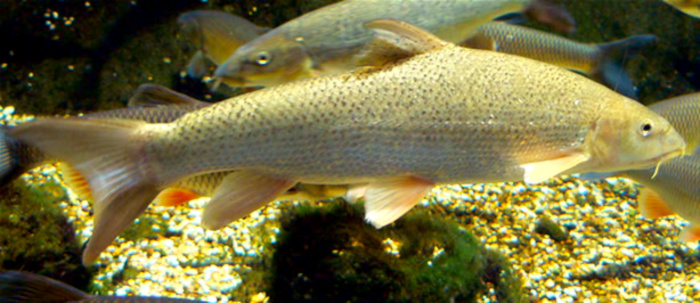
Adult B. barbus specimens can reach 1.2 m (4 ft) in length and 12 kg (26 lb) in weight, although it is typically found at smaller sizes (50–100 cm length, weight 1–3 kg). Adult barbel can live to over 20 years of age. Their sloping foreheads, flattened undersides, slender bodies and horizontally oriented pectoral fins are all adaptations for their life in swift, deep rivers, helping to keep them close to the riverbed in very strong flows. Juvenile fish are usually grey and mottled in appearance; adults are typically dark brown, bronze or grey in colour with a pale underside, with distinctively reddish or orange-tinged fins. The lobes of the tail are asymmetrical, the lower lobe being rounded and slightly shorter than the pointed upper lobe.
Barbel are active fish and often travel long distances in quite short time periods. Individuals can move between 16 and 68 km in a year, with mean (average) daily movement between 26 and 139 m. Adults commonly feed at night, although they may feed during the daytime in the safety of deeper water or near bankside cover and underwater obstructions. Their underslung mouths make them especially well adapted for feeding on benthic organisms, including crustaceans, insect larvae and mollusks, which they root out from the gravel and stones of the riverbed. Barbel diets change as the fish develop from fry to juveniles and then to adults. Diatoms that cover rocks and the larvae of non-biting midges (Chironomidae) are particularly important foods for young fish.
Males become mature after three to four years, females after five to eight years. Spawning occurs between May and late June on most rivers, when groups of males assemble in shallow water in pursuit of mates. Upstream migration to reach spawning grounds typically occurs between March and May, depending on water temperature. Females produce between 8,000 and 12,000 eggs per kilogram of body weight, which are fertilised by males as they are released and deposited in shallow excavations in the gravel of the riverbed. Barbel bury their eggs below the gravel, creating redd-like pit and tailspill structures. High amounts of fine sediment can be detrimental to the eggs and larvae of barbel, with emergence being delayed when sand content was above 30%. Barbel can spawn multiple times in captivity and there is also evidence for multiple spawning either of individuals or across the population, in wild rivers.
Parasites of B. barbus include Aspidogaster limacoides, a trematode flatworm; Eustrongylides sp., a nematode; and Pomphorhynchus laevis, an acanthocephalan worm.
The Barbel is a swete fysshe, but it is a quasy meete and perilous for mannys body
Common barbel
The common barbel (Barbus barbus) is a species of freshwater fish belonging to the family Cyprinidae. It shares the common name 'barbel' with its many relatives in the genus Barbus, of which it is the type species. In Great Britain it is usually referred to simply as the barbel; similar names are used elsewhere in Europe, such as barbeau in France and flodbarb in Sweden. The name derives from the four whiskerlike structures located at the corners of the fish's mouth, which it uses to locate food.
B. barbus is native throughout northern and eastern Europe, ranging north and east from the Pyrénées and Alps to Lithuania, Russia and the northern Black Sea basin. It is an adaptable fish which transplants well between waterways, and has become established as an introduced species in several countries including Scotland, Morocco and Italy. Although barbel are native to eastern flowing rivers in England, they have historically been translocated to western flowing rivers, such as the River Severn. Its favoured habitats are the so-called barbel zones in fast-flowing rivers with gravel or stone bottoms, although it regularly occurs in slower rivers and has been successfully stocked in still waters.
Barbel are very abundant in some rivers, often seen in large shoals on rivers such as the Wye. Izaak Walton reported that there were once so many barbel in the Danube that they could be caught by hand, 'eight or ten load at a time' .
Adult B. barbus specimens can reach 1.2 m (4 ft) in length and 12 kg (26 lb) in weight, although it is typically found at smaller sizes (50–100 cm length, weight 1–3 kg). Adult barbel can live to over 20 years of age. Their sloping foreheads, flattened undersides, slender bodies and horizontally oriented pectoral fins are all adaptations for their life in swift, deep rivers, helping to keep them close to the riverbed in very strong flows. Juvenile fish are usually grey and mottled in appearance; adults are typically dark brown, bronze or grey in colour with a pale underside, with distinctively reddish or orange-tinged fins. The lobes of the tail are asymmetrical, the lower lobe being rounded and slightly shorter than the pointed upper lobe.
Barbel are active fish and often travel long distances in quite short time periods. Individuals can move between 16 and 68 km in a year, with mean (average) daily movement between 26 and 139 m. Adults commonly feed at night, although they may feed during the daytime in the safety of deeper water or near bankside cover and underwater obstructions. Their underslung mouths make them especially well adapted for feeding on benthic organisms, including crustaceans, insect larvae and mollusks, which they root out from the gravel and stones of the riverbed. Barbel diets change as the fish develop from fry to juveniles and then to adults. Diatoms that cover rocks and the larvae of non-biting midges (Chironomidae) are particularly important foods for young fish.
Males become mature after three to four years, females after five to eight years. Spawning occurs between May and late June on most rivers, when groups of males assemble in shallow water in pursuit of mates. Upstream migration to reach spawning grounds typically occurs between March and May, depending on water temperature. Females produce between 8,000 and 12,000 eggs per kilogram of body weight, which are fertilised by males as they are released and deposited in shallow excavations in the gravel of the riverbed. Barbel bury their eggs below the gravel, creating redd-like pit and tailspill structures. High amounts of fine sediment can be detrimental to the eggs and larvae of barbel, with emergence being delayed when sand content was above 30%. Barbel can spawn multiple times in captivity and there is also evidence for multiple spawning either of individuals or across the population, in wild rivers.
Parasites of B. barbus include Aspidogaster limacoides, a trematode flatworm; Eustrongylides sp., a nematode; and Pomphorhynchus laevis, an acanthocephalan worm.
The Barbel is a swete fysshe, but it is a quasy meete and perilous for mannys body
Recent media
Recent media